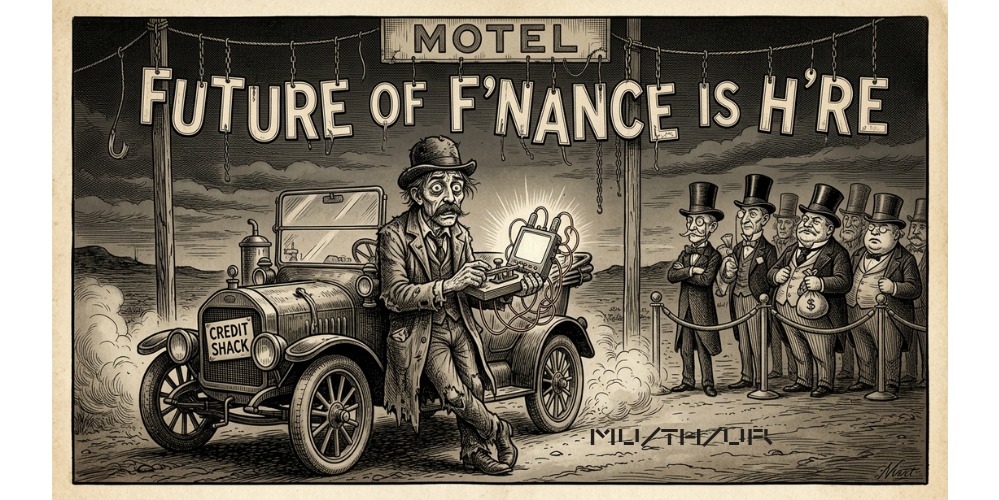
crypto
the MU/TH/UR series
Fables from the Crypt 9.0 - True Believer: Asset Class

MU/TH/UR

The foundation didn't have a name. Names were for organizations that wanted to be found.
What it had was a floor in Zug, a methodology, and forty years of back-tested data showing that a single well-placed magazine profile of the right kind of person, published during the right kind of market, could accelerate a sentiment flush by 2 weeks. Cross's team had measured this the way pharmacologists measure half-lives. Precisely and repeatedly, without sentiment about the subjects.
The subjects were called Prophets internally. Never to their faces. They didn't have faces in the system, only folders.
Cross had owned Bitcoin since 2011. He still did. Never traded it, never hedged it, never mentioned it to anyone in the operation. It sat in a cold wallet in a drawer in his office in Zug, compounding quietly through every cycle he'd helped engineer. He believed in the technology, completely, privately, without performance. He never needed anyone to know.
Michael's folder was four hundred pages by the time the profile ran.
It had started in 2020, during the bull run, when one of Cross's scouts flagged him at a conference in Miami. Not because he was important but because of how he believed. Photogenic conviction, the scout wrote in the report. Subject speaks about decentralized finance the way early Christians spoke about resurrection. Unfiltered. Total.
The foundation introduced him, six months later, to a woman named Priya who ran a retreat center in Sedona that the foundation quietly funded. Sedona was where the spirituality calcified. Michael had always been drawn to it, the market felt alive to him, sentient, like it was trying to tell you something if you knew how to listen. Sedona gave that feeling a vocabulary. He came back with a new framework for understanding price cycles as consciousness events and a genuine belief that certain blockchain protocols were picking up signals from non-human intelligences. He told people this at conferences. People laughed, then quoted him, then wrote about him.
Michael figured it out in year two.
Not all of it. Not Cross, not Zug, not the folder. But enough. The Sedona retreat had been too convenient, the journalist's number passed along too casually, the podcast boost too clean. He was good with patterns, it was why the foundation had selected him in the first place, and the pattern was visible if you knew where to look, which he did, which meant they had slightly miscalculated, which was the first and last mistake Cross's operation ever made with him.
Michael sat with it for three weeks. He ran the numbers. He mapped the introductions backward, traced the accounts that had boosted his visibility, noted the timing against market cycles. By the end of the third week he had a working theory that was approximately 80% correct, which was close enough.
He had a choice.
He thought about it for one more week. Then he called Priya and booked another retreat.
After that, things moved faster. They always do, once you've decided.
Michael told himself he was using them back. That the access, the capital, the elevation, these were his, earned, extracted from a machine that thought it was extracting from him. A parasite running a counter-parasitism. He found this framing satisfying in the way that sophisticated self-deception always is: it was partially true, which made it functional, which made it dangerous.
He told himself he would exit before the profile ran.
He told himself this for three years.
The profile piece came together the way these things do, slowly, then all at once. Eight months of access. A journalist who was talented, genuinely rigorous, and had been pointed in his direction by someone who had been pointed by someone else entirely. Michael gave her everything. The diamond bracelets, the couture, the bunker, the alien research, which had started as performance and somewhere along the way had become real, which was the thing he hadn't anticipated, the way the character he'd agreed to play had grown back into him until he couldn't locate the seam.
He kept waiting for the moment to pull back. To decline the cover photo. To say something off-message. Each time the moment came he calculated the cost and let it pass. The access was still good. The fund was performing. There was always next month, next quarter, one more cycle before the exit that kept not happening.
The piece ran on a Tuesday in March, during the worst wipeout in recent years. Bitcoin down 47%. Ethereum down 61%.
The comments hit within hours.
This is who's running our financial infrastructure. We deserve to go to zero. Imagine showing this to someone who doesn't own crypto and asking them to take it seriously.
Cross sent the post-operation report to eleven addresses. Total return on deployed capital: 340% over eight months. Sentiment compression: 19 days ahead of natural cycle. Prophet performance: optimal.
He added one line to Michael's folder, the only editorial notation in four hundred pages of clinical observation:
Subject was aware. Performed anyway. Recommend for next cycle without modification.
Michael read the comments for a long time that Tuesday.
He had known this was coming. He had mapped it, priced it, told himself he'd absorbed the cost in advance. What he hadn't priced was the specific quality of the shame, not the public kind, which he'd prepared for, but the private kind, the 3am kind, the kind that arrives when you try to locate the version of yourself that existed before the performance and find the coordinates don't resolve to anything anymore.
He opened his portfolio. Up, actually. The foundation had bought his fund's positions during the crash. A courtesy, maybe. Or just the operation working as designed.
He called no one. Posted nothing. Went to the window and stood there for a while looking at a city that didn't know his name.
Somewhere in Montana the bunker was stocked for eighteen months.
He had built it himself, in 2022, before any of this, when he had believed completely and without complication in the thing he was doing. He remembered the believing. He could describe it in detail. He just couldn't find it anymore, the way you can describe a room in a house you've sold, the dimensions, the light, the way the floor felt, without being able to go back inside.
Cross's report updated automatically at midnight:
Michael folder: 400 pages.
Status: Optimal.
Next cycle: Q3 2028.
Note: subject no longer requires grooming. The performance is now load-bearing. He can't stop without the whole thing coming down.
That's not a liability.
That is the product.