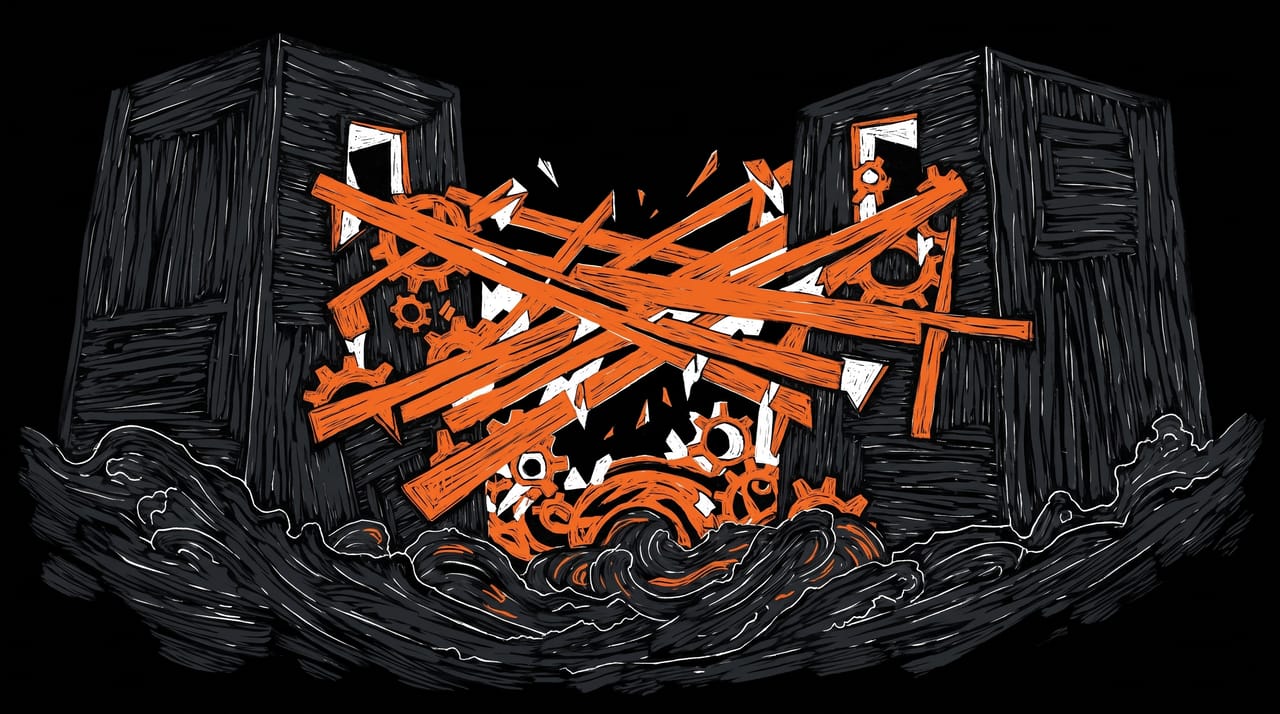
The $33.5B Bridge Between Two Unforgiving State Machines
Formalizing the synchronization gap between EVM determinism, legal wrappers, oracle latency, and non-atomic RWA liquidation.
The $33.5B Bridge Between Two Unforgiving State Machines
Abstract
The tokenization of real-world assets (RWAs) is transitioning from an experimental issuance primitive into an institutional financial infrastructure layer. By mid-2026, the tokenized RWA market crossed approximately $33.5 billion on public ledgers (source: ChainAnalytics RWA Report 2026), reflecting a rapid migration of off-chain instruments directly onto smart contract platforms.
The core engineering challenge, however, is not token issuance. It is state synchronization.
Ethereum Virtual Machine (EVM) protocols operate as deterministic replicated state machines. Given a state S_t and a valid transaction T_t, protocol execution yields a deterministic successor state:
S_{t+1} = F(S_t, T_t)
RWA markets operate under fundamentally different semantics. Their economic state depends on external events, legal jurisdictions, contractual interpretation, human intermediaries, asynchronous reporting, and uncertain recovery timelines:
X_{t+1} = G(X_t, ω_t, L, τ)
where X_t is the economic state of the underlying asset, ω_t represents exogenous events, L represents the applicable legal regime, and τ represents enforcement and information latency.
This creates a structural synchronization problem between two systems with incompatible notions of finality, valuation, liquidity, and enforcement. The blockchain finalizes a liquidation transaction in seconds. The underlying collateral may require months of servicing, restructuring, litigation, or bankruptcy proceedings before it becomes economically realizable.
This research paper examines the resulting attack surfaces and details an architectural framework based on risk-isolated markets, confidence-aware oracles, cryptographic attestations, legal-state synchronization, and non-atomic liquidation waterfalls.
1. The State-Machine Mismatch
A conventional DeFi lending protocol assumes that collateral is both continuously observable and economically realizable. For a collateralized debt position, health factor is evaluated as:
HF_t = (V_C(t) · LT) / V_D(t)
where V_C(t) is the protocol's observed collateral value, LT is the liquidation threshold, and V_D(t) is outstanding debt. A position triggers liquidation as soon as:
HF_t < 1
This formulation underpins pooled lending designs like Aave. Morpho Blue exposes the same mathematical primitive through isolated pairs defined by collateral asset, loan asset, LLTV, oracle, and interest rate model, isolating bad debt to single markets.
The equation is simple, but the input is problematic. For crypto-native collateral, value tracks continuous market pricing:
V_C(t) ≈ P_{market}(t) · Q_C
For an RWA, token pricing diverges from realizable asset value:
V_C(t) ≠ P_{token}(t) · Q_C
because the token price frequently fails to represent the recoverable value of the underlying legal claim. Realizable value is instead an expectation over available information:
V_C(t) = E[Recovery Value | I_t]
where I_t is information available at time t. The protocol faces a fundamental information asymmetry:
I_{chain}(t) ≠ I_{economic}(t)
The blockchain validates what the smart contract state records; it does not know what happened to the underlying borrower off-chain.
2. The Legal Wrapper as a State-Translation Layer
The tokenization stack operates through a multi-layer state translation pipeline:
A_{real} → SPV → Legal Claim → Token → Oracle → DeFi Position
An ERC-20 or permissioned token does not confer physical possession of an asset. It conveys a contractual claim against an issuing vehicle. Permissioned standards like ERC-3643 embed identity and compliance conditions into token transfers, restricting transferability to verified counterparties.
This architecture creates two distinct state variables:
S_{chain}(t) and S_{legal}(t)
The system requires the invariant S_{chain}(t) ≡ S_{legal}(t). In practice, however:
S_{chain}(t) ≠ S_{legal}(t)
whenever a material off-chain event occurs before the oracle, administrator, custodian, or court updates the blockchain. This is the RWA synchronization gap.
3. Bankruptcy Remoteness Does Not Equal On-Chain Recoverability
Traditional structured finance relies on bankruptcy-remote Special Purpose Vehicles (SPVs) to isolate collateral. Bankruptcy remoteness answers one specific legal question: can creditors of the asset originator seize the assets? It does not guarantee that an on-chain liquidator can convert those assets into cash immediately.
Consider an institutional position with:
C_{token} = 20M, D = 15M
The protocol evaluates the position using nominal token balances:
HF = (20M · LT) / 15M
Suppose an off-chain credit default reduces expected recovery value to:
E[R] = 12M
The true economic collateralization ratio is now:
CR_{economic} = 12M / 15M = 0.80
while the protocol oracle still computes:
CR_{protocol} = 20M / 15M = 1.33
The system is solvent according to the oracle, but insolvent according to economic reality. This is not a smart contract coding flaw. It is an information consistency failure.
4. Oracle Latency as an Attack Surface
Let t_d be the time economic deterioration occurs off-chain, and t_o be the time the oracle reflects this deterioration. The oracle recognition latency is defined as:
Δt = t_o - t_d
For liquid crypto assets, Δt is measured in seconds. For private credit and illiquid loans, Δt ≫ 0, frequently spanning reporting periods, monthly valuation cycles, or court filings.
If an informed participant observes credit deterioration at t_d while the protocol continues referencing stale valuation P_o, they can borrow pristine liquid capital against stale collateral. The maximum extractable value is bounded by:
E ≈ LTV · (V_{oracle} - V_{economic})
subject to pool liquidity, borrow limits, and transaction overhead. This asymmetry converts delayed reporting into an exploitable financial arbitrage primitive.
5. NAV Is Not a Price Oracle
For complex RWAs, the reported metric is not a continuously clearing market price. It is an accounting estimate:
NAV = ∑ PV(CF_i) - EL
where CF_i represents expected cash flows, PV(·) discounts them, and EL is expected credit loss. Expected loss breaks down into three dynamic variables:
EL = PD(t) · LGD(t) · EAD(t)
where PD is probability of default, LGD is loss given default, and EAD is exposure at default.
A static Proof of Reserve attestation confirming that an SPV holds a $50M portfolio does not establish that the assets are worth $50M. This requires delineating three distinct tiers of verification:
PoC = Proof of Custody | PoS = Proof of Solvency | PoL = Proof of Liquidity
PoC ≠ PoS ≠ PoL
A system verifying only custody can maintain cryptographic correctness while holding economically insolvent collateral.
6. The Liquidation Paradox
DeFi liquidations assume collateral can be converted into the borrowed debt asset within a single block transaction:
Collateral → Liquidation → Debt Asset
For a liquid token, this operates via standard automated market makers:
RWA_{token} → AMM / Orderbook → USDC
For a private credit claim, liquidation triggers an extensive off-chain legal process:
RWA_{token} → Issuer → KYC → Servicer → Legal Recovery → Cash
The protocol executes its internal accounting state transition immediately, but the broader economic system cannot realize the underlying collateral:
τ_{execution} ≪ τ_{realization}
where τ_{execution} represents block finality and τ_{realization} is the time required to convert off-chain collateral into cash. Protocol liabilities are instantaneous, while collateral realization is temporally elastic.
7. Liquidity Mismatch
This structural fragility stems from a maturity and liquidity mismatch:
τ_C ≫ τ_D
where τ_C is collateral realization time and τ_D is the debt redemption horizon. When stablecoin depositors can withdraw funds immediately while collateral takes months to monetize, the protocol performs fractional maturity transformation. The solvency condition requires:
L_{liquid} ≥ R_{expected}(t)
This maturity gap introduces systemic risk that atomic on-chain liquidations cannot resolve. To maintain protocol integrity, liquidation mechanisms must shift toward non-atomic, waterfall-based settlement models that account for recovery timelines and legal enforcement, rather than forcing immediate, potentially fire-sale conversions that destroy value for all stakeholders.
Under stress conditions where R_{stress} > L_{liquid}, the protocol must halt redemptions, socialize losses, tap emergency credit, or sell collateral at severe distress discounts.
8. MEV and the Information-Advantage Problem
Oracle delays create Maximal Extractable Value (MEV) around off-chain information arrival. If an off-chain event E occurs at t_0 and the oracle updates at t_1 > t_0, a participant acquiring knowledge at t_0 + ε can execute a borrow transaction before the update lands:
E → Information Acquisition → Borrow → Oracle Update → Liquidation
This is economically equivalent to front-running an unapplied state transition. The actor does not manipulate oracle feeds directly; they exploit an oracle that is accurate about the past rather than the present.
9. Risk Should Be a Function, Not a Scalar
Crypto-native DeFi protocols often compress risk parameters to static scalars based on market volatility and exchange depth. For RWAs, risk is a multi-dimensional function:
R = f(CR, PD, LGD, τ_{oracle}, τ_{liquidation}, τ_{legal}, L, C, J)
where CR is collateralization ratio, PD is probability of default, LGD is loss given default, τ_{oracle} is reporting latency, τ_{liquidation} is liquidation duration, τ_{legal} is enforcement duration, L is secondary market liquidity, C is debtor concentration, and J is jurisdictional risk.
The liquidation threshold must adjust dynamically with observed risk:
LT_t = f(R_t) with ∂LT / ∂R < 0
When valuation confidence deteriorates, protocols must dynamically demand higher collateral buffers.
10. ZK Attestations as an Information-Compression Layer
Zero-knowledge proofs offer a verifiable computation layer over private financial statements. For an SPV holding confidential loan data D = {d_1, d_2, ..., d_n}, on-chain verifiers do not need raw asset visibility. Instead, circuits evaluate financial covenants:
π = Prove(NAV(D) ≥ N_{min} ∧ LTV(D) ≤ L_{max} ∧ Overdue(D) ≤ O_{max} ∧ Concentration(D) ≤ C_{max})
The on-chain verifier executes:
Verify(vk, π, x) == 1
This transforms reporting from manual accounting logs into an automated proof architecture:
Private Financial State → Computation → ZK Proof → Verifier → Risk Engine
A critical distinction remains: zero-knowledge proofs verify execution integrity, not input authenticity:
ZK Integrity ≠ Data Authenticity
Proofs confirm mathematical rules were applied correctly over committed data, but verifying underlying truthfulness still demands authenticated source feeds and legal attestations.
11. Legal State Oracles
A production RWA architecture requires a legal-state oracle operating alongside price feeds. We formalize this state variable as:
L_t ∈ { ACTIVE, DELINQUENT, DEFAULT, RESTRUCTURING, FROZEN, ENFORCEMENT, RECOVERY }
Protocol risk parameters react programmatically to these transitions:
L_t = DEFAULT ⇒ BorrowEnabled = false
L_t = ENFORCEMENT ⇒ RedemptionMode = QUEUE
This encodes judicial milestones into smart contract operational modes rather than relying on discretionary off-chain administrative interventions.
12. Permissioned Transfer Architecture
ERC-3643 formalizes conditional transfer rules at the token contract layer. A generalized transfer predicate evaluates:
T(A, B, x) = Ownership(A, x) ∧ Eligible(A) ∧ Eligible(B) ∧ Compliance(A, B, x)
This introduces an explicit engineering trade-off:
Greater Legal Alignment ↔ Less Permissionless Composability
For institutional instruments with strict statutory restrictions, this trade-off is an unavoidable structural constraint.
13. Isolated Markets as a Containment Primitive
Pooled lending models expose cross-collateral depositors to contagion whenever an RWA position degrades. Isolated lending markets, exemplified by Morpho Blue, construct isolated pairs:
Market_i = (RWA_i, Stablecoin_j, Oracle_i, LLTV_i, IRM_i)
If an asset experiences an unexpected default, risk isolation ensures:
ΔLoss_j ≈ 0
for independent lending markets across the platform. This compartmentalizes failure at the market perimeter.
14. Hybrid Liquidation Waterfalls
Single-block DEX liquidation fails when applied to illiquid RWA debt. Staged waterfalls structure loss absorption systematically:
Default → Freeze → Mark Down → Junior Absorption → Auction → Recovery → Senior Distribution
For an aggregate collateral impairment L, a dedicated first-loss junior tranche J absorbs initial downside:
L_J = min(L, J) | L_S = max(0, L - J)
Protocols replace instantaneous clearing with discrete epoch auctions t_0 < t_1 < ... < t_n, allowing qualified secondary buyers to price distressed debt without causing market dislocations.
15. The RWA Protocol as a Dual-State Machine
A complete RWA lending architecture models two coupled state machines running in parallel:
On-chain State Machine: M_C = (S_C, T_C, F_C)
Off-chain Financial State Machine: M_L = (S_L, E_L, F_L)
where S_C and S_L represent blockchain and legal states respectively. The objective of the protocol risk engine is maintaining a bounded synchronization gap:
d(S_C, S_L) ≤ ε
System failures occur when d(S_C, S_L) → ∞, resulting in on-chain transactions settling against an internal state that has fully decoupled from underlying economic reality.
16. A More Appropriate RWA Collateral Invariant
Conventional DeFi models equate nominal token balance with realizable economic backing. A resilient RWA protocol instead enforces a multi-factor realizable collateral invariant:
V_{realizable} ≥ D + Buffer
where:
V_{realizable} = V_{NAV} - Haircut_{credit} - Haircut_{liquidity} - Haircut_{legal}
Buffer = f(σ_V, τ_O, τ_L, L)
with σ_V denoting valuation uncertainty, τ_O oracle reporting latency, τ_L legal recovery latency, and L secondary market liquidity. The fundamental rule is clear: collateral parameters must reflect the probability and latency of asset recovery, not merely reported accounting NAV.
17. Conclusion: The Bridge Needs More Than Tokenization
Scaling RWA tokenization past the $33.5B milestone will not be decided by issuance tooling alone. It hinges on whether systems can enforce financial invariants across mismatched execution environments.
Blockchains provide determinism, composability, and instant finality. Traditional finance provides legal recourse, credit underwriting, and judicial recovery. Building a durable bridge requires unifying:
Tokenization + Oracles + ZK Attestations + Legal State + Risk Isolation + Liquidity Engineering
The architectural test is not whether a protocol can represent off-chain value during stable conditions. It is whether the system maintains state synchronization when legal default, oracle latency, and liquidity constraints stress the bridge.
Support CryptoBug with $CRYPB
Own a stake in independent, no-sponsor Web3 research.