
AI Is Turning Experimentation into a New Form of Productivity
For most of modern economic history, success was built around certainty.
Companies conducted market research before launching products.
Entrepreneurs raised capital before testing ideas.
Traders spent years developing expertise before building strategies.
Professionals accumulated knowledge before entering specialized fields.
Because in the past, experimentation was expensive.
Every experiment required time, capital, talent, knowledge, and opportunity.
AI is changing this fundamental condition.
As the cost of analysis, research, content creation, data processing, strategy simulation, and knowledge acquisition continues to fall, a deeper economic transformation is emerging:
The future of productivity may depend less on knowing the right answer and more on how many meaningful possibilities we can afford to test.
One of the defining capabilities of the industrial economy was the ability to increase certainty in production.
Factories required standardization.
Companies required processes.
Financial institutions required risk controls.
Organizations required hierarchy and structure.
Because every mistake could create significant costs.
Traditional business logic therefore often followed:
Plan → Execute → Wait for Results
Companies spent substantial resources trying to predict markets before committing resources.
But reality rarely follows the plan perfectly.
Consumers change.
Markets evolve.
Technology shifts.
Competitors emerge.
The more complex the environment becomes, the harder it is to solve the future through a single correct plan.
One of AI's deeper impacts is not simply making existing work faster.
It is making more things that were previously too expensive to try worth experimenting with.
In the past, someone might abandon a product idea because they could not code.
Today, AI can help create an initial prototype.
A team might previously spend weeks reviewing and structuring market information.
Today, AI can accelerate research, comparison, and analysis.
A trader once needed substantial time to study data, strategies, and market structures.
Today, AI-powered tools can help users enter the analysis and experimentation stage much faster.
JLM AI reflects this broader direction by combining AI analysis, trading tools, strategies, data, and education into an ecosystem designed to lower the barriers to learning and practical participation.
The deeper shift is therefore:
AI is lowering the cost of starting.
Imagine an idea that once required:
RM10,000 to validate
30 days to execute
3 people to operate
Most people would never try it.
Now imagine the same experiment requiring:
RM500
3 days
1 person + AI
The economic equation changes completely.
People can begin testing more possibilities.
The economy gradually moves from:
“Find the correct answer.”
Toward:
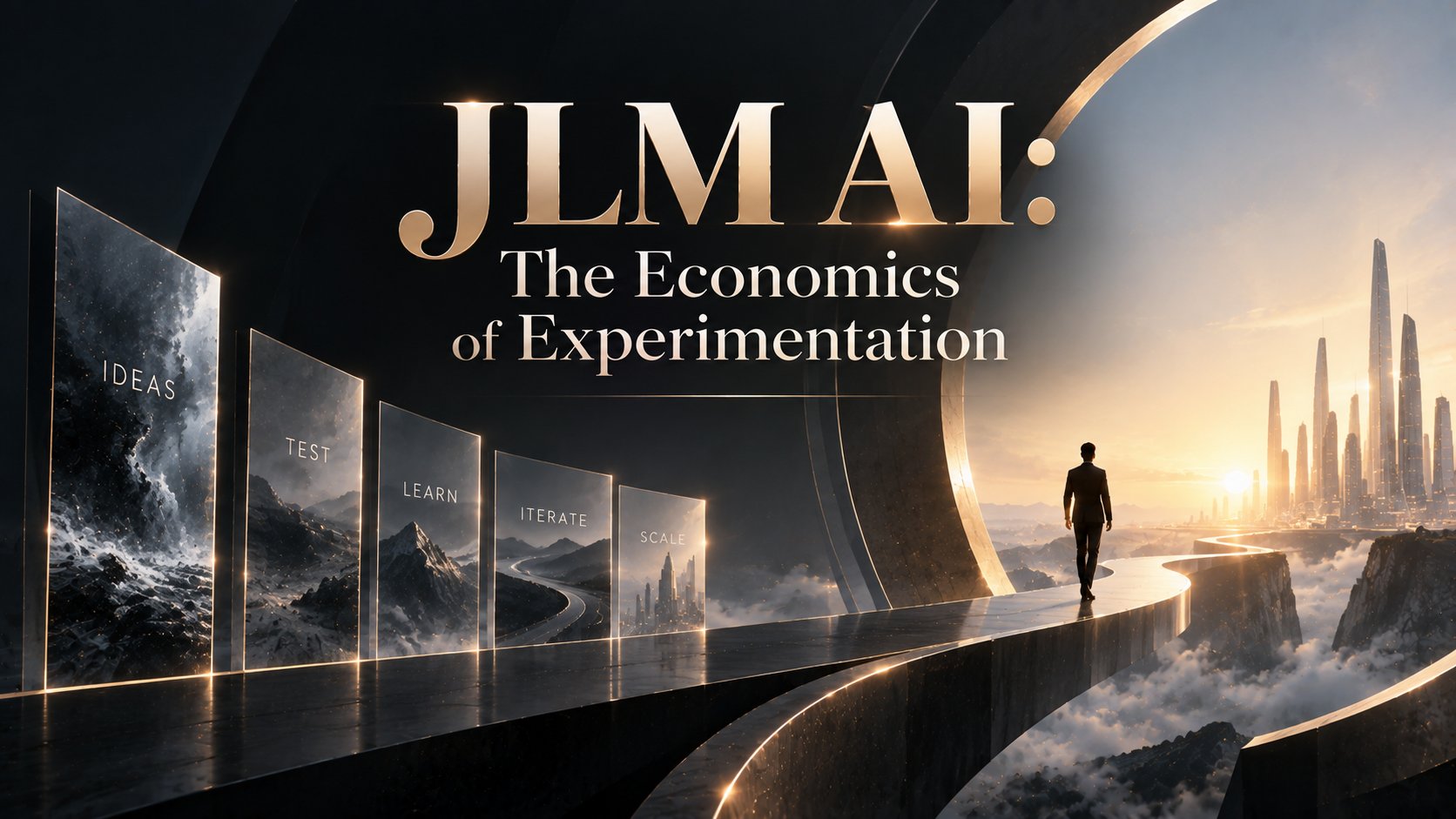
“Generate → Test → Learn → Iterate.”
This is a fundamental change in how production can work.
Future competitiveness may not belong to organizations that are best at predicting the future.
It may belong to organizations that are best at experimenting with the future.
This does not mean planning disappears.
It means the internal operating logic of organizations changes.
The traditional model is:
Strategy → Execution → Result
An increasingly important model is:
Hypothesis → Experiment → Feedback → Adaptation
Form a hypothesis.
Run an experiment.
Collect feedback.
Adjust.
Experiment again.
This changes what organizations value.
The traditional economy emphasized:
Scale, processes, and resources.
The emerging economy increasingly emphasizes:
Experimentation speed, feedback speed, and iteration speed.
The scarce resource may no longer be capital alone.
It may be:
How many meaningful experiments an organization can run within a given period.
One important principle behind JLM AI is that AI can reduce the barriers to professional capabilities, allowing more people to access analytical, knowledge-based, and decision-support capabilities that previously required years of experience.
This creates a deeper transformation.
In the past:
Professional expertise → determined who could participate.
Increasingly:
AI capability → determines who can begin experimenting.
A person does not necessarily need to become an expert before taking the first step.
They can:
Learn → Experiment → Receive Feedback → Adjust → Learn Again.
Education therefore moves beyond simply:
“Giving people knowledge.”
It increasingly becomes:
“Giving people the ability to continuously experiment.”
This is also reflected in JLM AI's combination of AI tools, structured education, practical trading environments, and community participation.
Consider two companies.
Company A
Launches one initiative every quarter.
Company B
Tests ten initiatives every week.
Even with similar talent and capital, the amount of market feedback accumulated by the two organizations can become dramatically different over time.
This can be understood as:
The higher the experiment density:
→ The faster feedback arrives
→ The faster learning occurs
→ The faster mistakes are exposed
→ The faster iteration happens
→ The higher the probability of discovering effective models
The competition of the AI era may therefore shift from:
“Who has more resources?”
Toward:
“Who can convert resources into more meaningful experiments?”
Every major technological revolution has reduced the cost of something.
The Industrial Revolution reduced the cost of large-scale production.
The Internet reduced the cost of information distribution.
Cloud computing reduced the cost of computing and infrastructure.
AI is increasingly reducing the cost of:
Cognition, analysis, creation, and experimentation.
When experimentation becomes cheaper, the number of possibilities society can explore expands.
More individuals can build businesses.
More small teams can create products.
More educational models can be tested.
More business models can be experimented with.
More financial strategies can be studied.
More cross-domain collaborations can emerge.
AI therefore represents more than an efficiency improvement.
It represents:
Future organizations should not ask only:
“What is our plan?”
They should also ask:
“How many new possibilities can we validate every month?”
Individuals should not ask only:
“What do I already know?”
They should increasingly ask:
“What can I try now?”
Because as AI continues to reduce the cost of experimentation,
experimentation itself becomes a form of productivity.
The individuals and organizations capable of continuously experimenting, learning, and adapting will increasingly possess a higher rate of evolution.
JLM AI is not simply positioned around a single AI tool.
Its ecosystem incorporates AI strategies, data analysis, trading tools, education, strategy developers, and open ecosystem integration.
From a broader perspective, this represents a potential new model:
Enable more people to enter real-world environments, access intelligent tools, experiment, accumulate feedback, and continuously evolve through human-AI collaboration.
The next stage of AI is not simply about helping people complete tasks.
It is about helping humanity:
And when a civilization can explore more possibilities at a lower cost,
the boundaries of its future expand with it.