
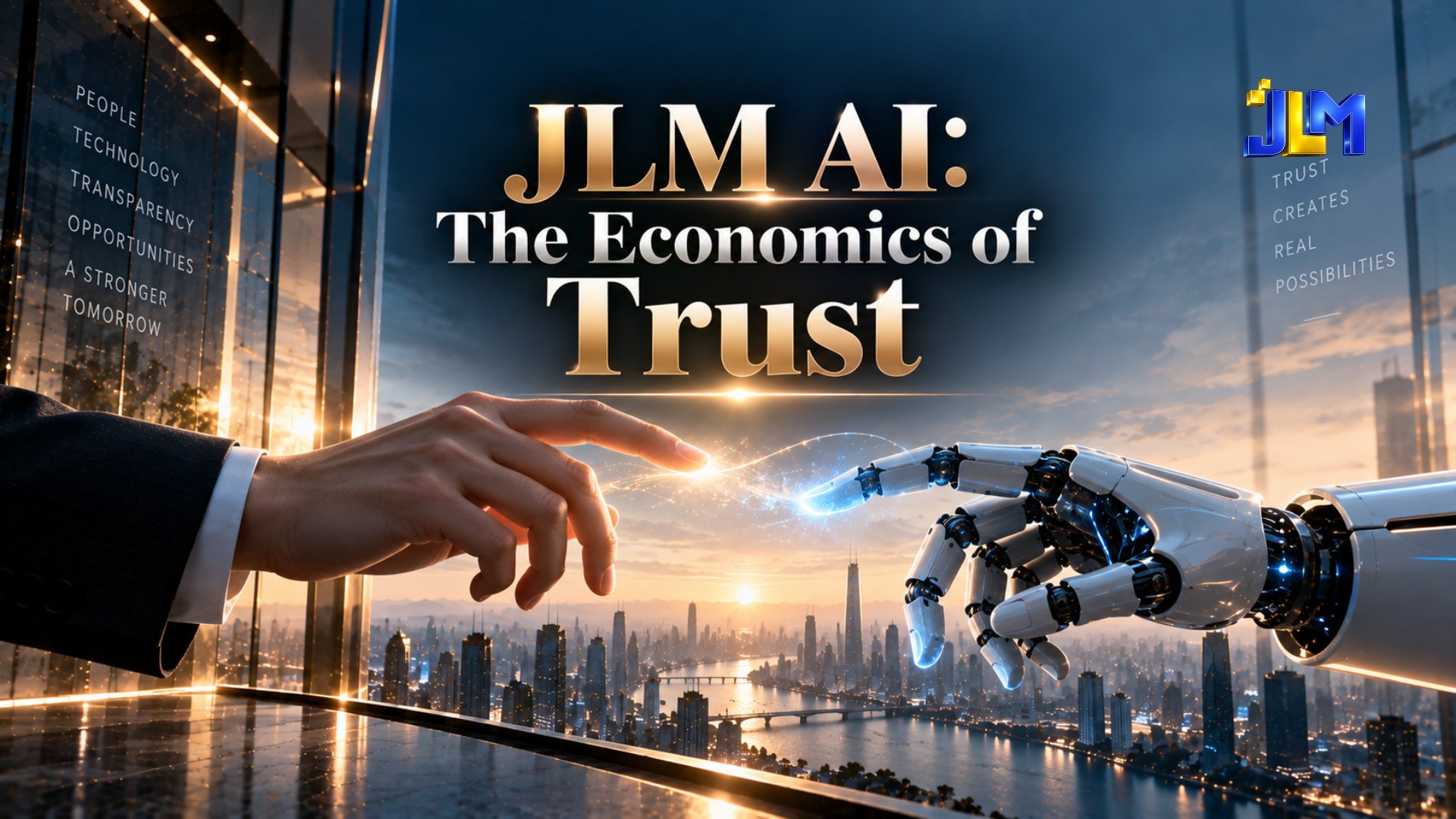
The first wave of AI competition has focused on capability.
Who has the better model?
Who can generate faster?
Who can analyze more data?
Who can automate more tasks?
But as AI-generated information becomes abundant, another question becomes increasingly important:
Can users trust what the system gives them?
In finance, trading, education, and decision-support environments, intelligence alone is not enough.
Users also need to understand the limits of the system, maintain independent judgment, and remain responsible for their own decisions.
This creates another important layer of the AI economy:
Before AI, producing professional-looking analysis required significant effort.
Research required time.
Reports required specialists.
Data interpretation required expertise.
Content required creators.
AI dramatically reduces these costs.
As a result, the digital economy is entering an environment where:
Answers become abundant.
Analysis becomes abundant.
Content becomes abundant.
Recommendations become abundant.
But abundance creates another problem.
When everyone can generate convincing information,
The Internet solved an information-access problem.
Search engines made knowledge easier to find.
Social platforms made information easier to distribute.
AI makes information easier to generate and interpret.
But each transition creates a new scarcity.
When information was scarce:
Access had value.
When information became abundant:
Attention gained value.
When AI-generated intelligence becomes abundant:
Because users increasingly need to determine:
What is reliable?
What is relevant?
What are the limitations?
What assumptions are being made?
Where does human judgment remain necessary?
The importance of trust becomes even clearer in financial environments.
Markets contain uncertainty.
Strategies contain risk.
Historical performance does not guarantee future outcomes.
Models can be wrong.
Data can be incomplete.
Market conditions can change.
Therefore, the role of AI should not be presented as:
“AI knows what will happen.”
A more sustainable model is:
This distinction is consistent with JLM AI's own PPT framing, which explicitly states that the platform provides AI trading tools and data analysis rather than investment advice, and that users remain responsible for their own decisions and risks.
Trust is not created by promising certainty.
It is created by being clear about uncertainty.
A trustworthy intelligent system should increasingly help users understand:
What does the system know?
What does it not know?
What information is being considered?
What assumptions are involved?
Where are the risks?
What requires human judgment?
This changes the relationship between AI and users.
Instead of:
AI → Answer → User follows
the healthier architecture becomes:
Data → AI Analysis → Explanation → Human Judgment → Decision
AI becomes a support layer rather than an unquestionable authority.
This is where education becomes strategically important.
If users do not understand the tools they use,
they may either:
Trust them too much.
Or distrust them completely.
Neither extreme is ideal.
JLM AI's PPT places education alongside AI tools, including structured learning pathways, trading mentors, online courses, offline training, and certification.
This creates a stronger model:
Tool + Education
rather than:
Tool only.
Because education helps users understand:
What the tool does.
How to interpret information.
Where risks exist.
When independent judgment is necessary.
In this sense:
JLM AI is designed around more than a direct relationship between platform and user.
Its PPT describes collaboration across trading platforms, wallets, public chains, education institutions, KOLs, trading communities, strategy developers, and project teams.
In an ecosystem like this,
trust becomes networked.
Users need confidence in tools.
Partners need confidence in infrastructure.
Developers need confidence in integration.
Communities need confidence in information.
Institutions need confidence in collaboration.
Therefore:
Without trust,
connections remain weak.
With trust,
participation can deepen.
AI marketing can easily become a competition of claims.
Smarter.
Faster.
More accurate.
More powerful.
More profitable.
But long-term intelligent infrastructure may require a different approach.
A strong AI platform should be able to communicate:
What it can do.
What it cannot do.
Where it adds value.
Where uncertainty remains.
Where users remain responsible.
That may appear less dramatic.
But it creates something much harder to build:
And credibility compounds over time.
Trust is not only an emotional concept.
It has economic consequences.
When trust is low:
Users hesitate.
Partners require more verification.
Transactions become slower.
Adoption becomes harder.
Compliance becomes more important.
Collaboration becomes more expensive.
When appropriate trust exists:
Coordination becomes easier.
Relationships become stronger.
Adoption friction can decrease.
Long-term participation becomes more sustainable.
This is why trust can function as:
The digital economy has evolved through different forms of scarcity:
Information Scarcity
↓
Attention Scarcity
↓
Intelligence Abundance
↓
As AI makes sophisticated outputs increasingly accessible,
the value of simply producing another answer may decline.
The value of producing intelligence that users can:
understand, evaluate, contextualize, and responsibly use
may increase.
That creates a different competitive equation: