


In Traditional Finance (TradFi), liquidity is a privilege. In DeFi, it is a product, If you understand how this "product" works, you stop being a gambler and start being a bank. If you don't, you are just exit liquidity.
Today, we are breaking down the engine that powers trillions of dollars in decentralized trading: The Liquidity Pool.
Part 1: The Problem (Chinedu, Tony, and the "Coincidence of Wants")
To understand why DeFi is revolutionary, we first have to look at the flaw in the old system.
Imagine Chinedu wants to sell his used iPhone for $500, he goes to the market. He stands there waiting
For a trade to happen, Chinedu needs a miracle. He needs to find Tony.
But not just any Tony. he needs a specific version of Tony who:
-
Want to buy an iPhone right now.
-
Has exactly $500.
-
Trusts Chinedu enough to hand over the cash.
This is called the Coincidence of Wants.
If Tony doesn't show up, Chinedu is stuck. The market is " illiquid."
In TradFi (Wall Street), they solve this by hiring massive institutions called Market Makers. These middlemen sit in the middle, buying from Chinedu and selling to Tony, taking a fee every time. They control the flow.
DeFi asked a different question:
"What if we fired Tony and replaced him with a Robot?
Part 2: Meet The Robot (The AMM)
An Automated Market Maker (AMM) is a smart contract—a robot—that is always willing to trade with you, 24/7
It doesn't care who you are. It doesn't need to sleep. It doesn't need to find a buyer.
Imagine a giant glass vault sitting in the middle of a digital city.
inside the vault, there are two piles of money:
-
Pile A: Ethereum (ETH)
-
Pile B: USDC (USDC)
When Chinedu wants to sell his ETH now, he doesn't look for Tony, he walks up to the Vault , he throws his ETH in the Robot instantly throws USDC back out.
Trade Complete, No human, No waiting, Permissionless.
Part 3: The Math (How The Robot Decides Price)
How does the Robot know that 1 ETH equals $2,000?
It uses a beautifully simple formula:
x * y = k-
x = The amount of ETH in the pool.
-
y = The amount of USDC in the pool.
-
k = A constant number that must stay the same.

The Robot is programmed to keep the "balance" (k) perfect.
The See-Saw Effect:
If you buy ETH from the pool, you are removing ETH (supply goes down).
To keep the balance, the Robot demands more USDC from you (price goes up).
It is Supply and Demand, not controlled by a central bank, but enforced by pure code.
Part 4: Who Funds The Robot? (You.)
The Robot has no money of its own. It needs "Liquidity."
This is where You come in, you can become a Liquidity Provider (LP).

You take your spare ETH and USDC, and you deposit them into the Vault
Why would you do this?
Because the Robot pays you, every time a trader swaps tokens, they pay a small fee (usually 0.3%). That fee doesn't go to a CEO or a bank branch, it goes to you.
You essentially become the "House." You are owning a piece of the exchange.
Part 5: The Risk (Impermanent Loss Explained)
Is this free money? No.
The biggest risk in Liquidity Providing is called Impermanent Loss (IL).
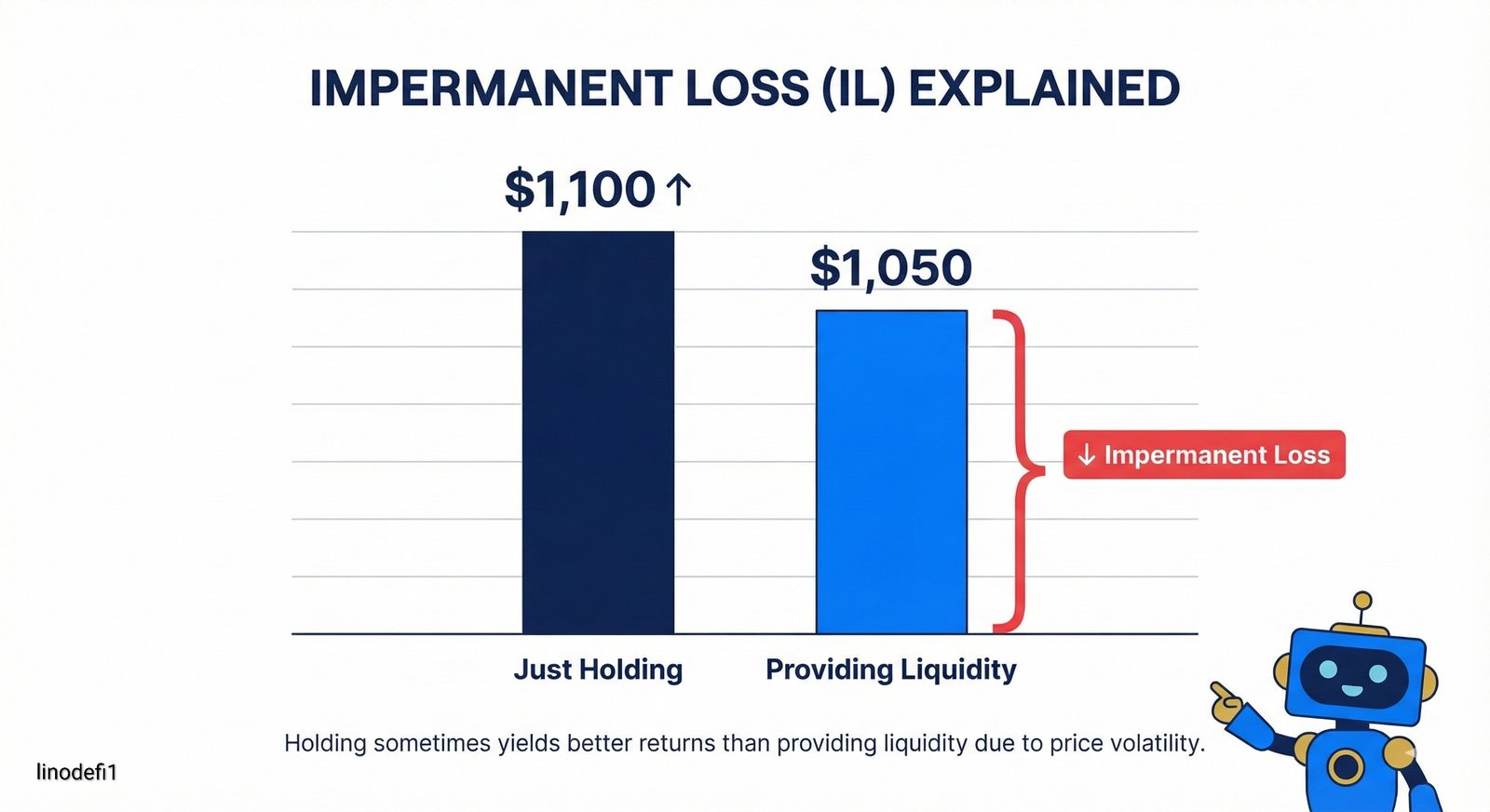
Let’s go back to the Vault, if the price of ETH skyrockets on the outside market (Binance/Coinbase) to $5,000:
-
Arbitrage traders will rush to your Vault.
-
They see your Robot is still selling ETH cheap.
-
They buy all the cheap ETH from your pool until the price matches the outside world.
The Result:
When you go to withdraw your money, you will find:
-
You have A LOT of USDC (because everyone bought your ETH).
-
You have VERY LITTLE ETH (because the Robot sold it all).
If you had just held the ETH in your wallet, you would be richer. By putting it in the pool, you sold too early.
That difference is your "Loss." you miss the pump in price .
Part 6: The Strategic "Why" For Founders & Investors
For Founders:
In 2017, listing a token cost $1M+ and required begging a centralized exchange.
Today, a founder can seed a Uniswap pool with $10k and have a global, liquid market in 5 minutes, AMMs democratized IPOs.
For Investors:
It changes your portfolio strategy. Are you holding a token because you think it will moon? (Hold in Wallet)
Or are you holding a token because you want to earn yield on a sideways market? (Provide Liquidity)
>Understanding the difference is how you protect your capital.
Conclusion: The Clarity Gap
The technology behind Web3 is complex, but the value proposition is simple:
We are replacing "Trust in Humans" with "Trust in Code."
We replaced the Middleman Market Maker with a piece of software that can never lie, never cheat, and never closes.
Whether you are a user swapping tokens or a VC deploying capital, understanding the AMM is the first step to financial sovereignty.
If you enjoyed this breakdown, follow @Linodefi1 on X-twitter and don't forget to Subscribe to get notified Whenever I publish more visual Narratives breakdown on DeFi, RWA, and Tokenomics.
Thank you