

The European Data Governance Act (DGA) came into force on June 23, 2022, and will be applicable from September 23, 2023.
What is it about? And which Web3 projects can benefit from it?
The DGA is part of the European Data Strategy that positions the EU as a model, presents exemplary legal frameworks and articulates economic development opportunities for the European infrastructure.
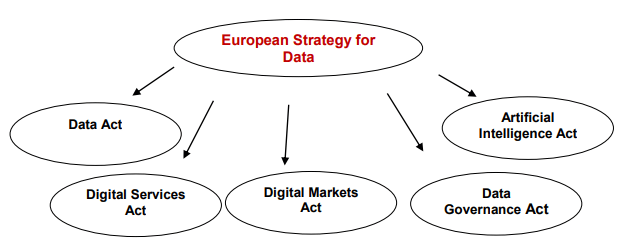
In short, the objective of the DGA is to frame data management from the perspective of a more transparent, decompartmentalized and accessible data economy. In this sense, Web 3 offers data infrastructures that are more adapted than those of Web 2 (and its Data Lakes), which are too centralized, less secure, limit our sovereignty over our data and do not "always" meet the General Data Protection Regulation (GDPR).
The DGA primarily addresses the following:
Terms of use of public sector data
Status and function of data sharing service providers (aka. data intermediaries)
Management of personal data spaces
Terms of use of public sector data:
The DGA will allow the reuse of public sector data for purposes other than those for which the data has already been collected in accordance with the GDPR. This includes sensitive and valuable data from health services and other public sector sources that have geolocation data. It can be used for commercial or non-commercial activities and will primarily serve the common good by improving our mobility infrastructure, energy consumption (smart city) and medical services (individualized/genomic medicine...).
The European Commission estimates that the use of public data can generate over 11 billion euros by 2028!
Status and function of data sharing service providers (aka. data intermediaries)
The DGA defines data intermediaries as any provider of data sharing services (clouds, social networks, search engines, web apps...) and regulates them to better manage data sharing on behalf of their owners (RGPD compliant). Considering the importance of data for research, marketing, artificial intelligence... And considering that the Big Data market is expected to reach $450 billion by 2026, it is foreseeable that these data-sharing services represent a real revenue opportunity for Internet users and digital companies.
Management of personal data spaces
Individuals will be able to donate their personal data in the public interest. This data will only be used for the purposes for which the donor has given his consent (medical research, energy consumption, surveys...). The actors facilitating these "donations" must be non-profit organizations.
Which Web3 players are best positioned to take advantage of the DGA?
Much of this data could be stored in crypto projects such as Arweave, built on the HTTP protocol (you can get a free 0.02 AR on their Faucet to surf the "permaweb" by following this link), as well as Filecoin, built on the IPFS protocol. These data could also be processed (treated and transferred) by "data unions" or more complex applications like Oceanprotocol which allows data monetization and access to data processing services while preserving privacy rights (Machine Learning, Curation...). We can also think of Pool or Data Union which present solutions to manage the data of several individuals/organizations.
It is not easy to understand and anticipate the digital transformation of our societies, but we find here an opportunity for decentralized Web3 applications attached to the principles of digital sovereignty, transparency, accessibility and data portability.
What about you? Do you think the DGA brings good solutions to develop the European digital economy?
Share if you liked it and follow me for more articles on Web3!
Thank you for your feedback!
Sources:
https://data.europa.eu/en/datastories/data-governance-act-open-data-directive
https://eur-lex.europa.eu/legal-content/EN/TXT/?uri=CELEX%3A52020PC0767
https://www.expertmarketresearch.com/reports/big-data-market