

Executive Proem: The Illusion of Institutional Readiness
The tokenization of Real-World Assets (RWA) represents the most profound infrastructural paradigm shift in global capital markets since the dematerialization of physical stock certificates. At the absolute vanguard of this transition stands Ondo Finance. By aggregating a Total Value Locked (TVL) exceeding $3.57 billion across 12 blockchain networks and orchestrating 165 strategic protocol integrations, Ondo has undeniably won the first phase of the RWA war: the technological proof-of-concept.
However, technology is merely the plumbing of the global financial system; trust, legal abstraction, and lexicon constitute the water that flows through it.
Despite securing pivotal custodial and accounting relationships with heritage institutions such as BNY, Coinbase, and StoneX, a rigorous forensic audit of Ondo’s current market positioning reveals a critical architectural fissure. Ondo is attempting to bridge the epistemological chasm between decentralized permissionless networks and the highly regulated corridors of Traditional Finance (TradFi). Yet, it continues to communicate, market, and structure its outward-facing narrative using the vernacular of Web3 retail speculation.
For Tier-1 asset managers, global banking syndicates, corporate treasuries, and sovereign wealth funds, smart contract execution is only fifty percent of the mandate. The remaining fifty percent is an impregnable risk translation framework. Currently, Ondo’s narrative is fractured. Until this strategic dissonance is resolved through severe corporate realignment, true institutional adoption at the mega-fund level will remain paralyzed by compliance friction.
This manifesto serves as a foundational teardown of Ondo’s current strategic paradoxes and provides the quantitative and qualitative blueprint required to transition from a highly successful Web3 protocol into a trillion-dollar foundational layer for the global Open Economy.

Section I: The Quantitative Triumph and the Qualitative Ceiling
To diagnose the strategic bottleneck, we must first acknowledge the scale of the execution. The metrics are formidable. Ondo has successfully deployed institutional-grade underlying assets onto distributed ledgers, creating a robust secondary market for US sovereign debt derivatives.
v USDY (US Dollar Yield): Commanding a TVL of $2.16 billion, generating a baseline APY of 3.55% derived from a portfolio of short-term US Treasury Bills and bank demand deposits.
v OUSG (Ondo Short-Term US Government Treasuries): specifically engineered for institutional investors, securing $405.43 million in TVL, providing 24/7 instant mints and redemptions.
v Ondo Stocks: Bringing traditional public securities on-chain, amassing $1.00 billion in TVL with an impressive distribution of ~80,300 unique holders.
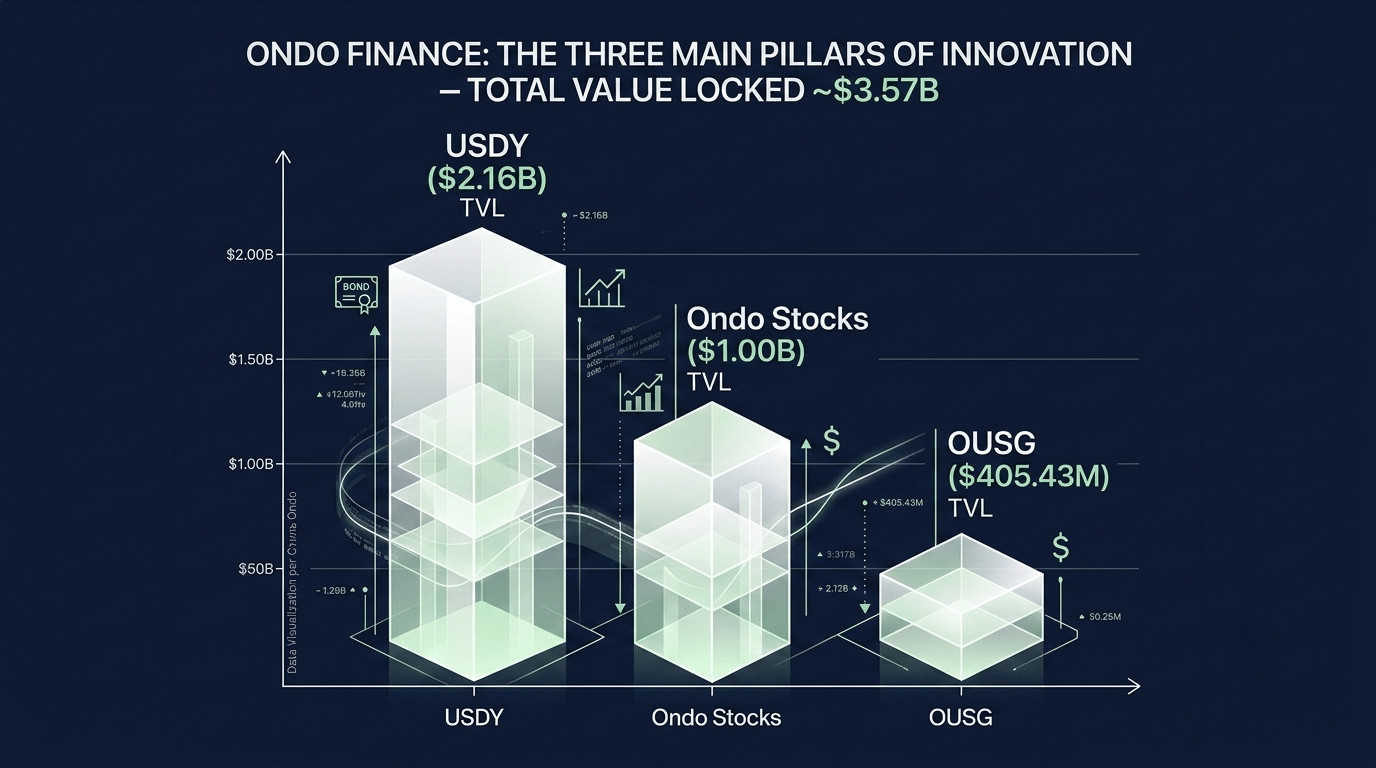
These numbers represent an extraordinary triumph of product-market fit within the crypto-native ecosystem. However, a deeper analysis reveals that this capital represents the "low-hanging fruit" of the Web3 economy: stablecoin treasuries of other DAOs, crypto-native high-net-worth individuals, and decentralized hedge funds seeking a safe harbor from crypto volatility while remaining on-chain.
This is not institutional capital.
True institutional capital—managed by entities governed by fiduciary duties, Basel III capital requirements, and strict compliance mandates—remains on the sidelines. The current TVL, while impressive in a Web3 context, is a statistical rounding error compared to the $130+ trillion global fixed-income market. Ondo has hit a qualitative ceiling; breaking through requires a fundamental shift in how the asset is legally and linguistically packaged.
Section II: The Lexical Disconnect – "Yieldcoins" in the Boardroom
Language is the operating system of corporate finance. The terminology utilized to describe an asset directly dictates the risk bucket into which a compliance officer will categorize it. Herein lies Ondo’s most glaring self-inflicted wound.
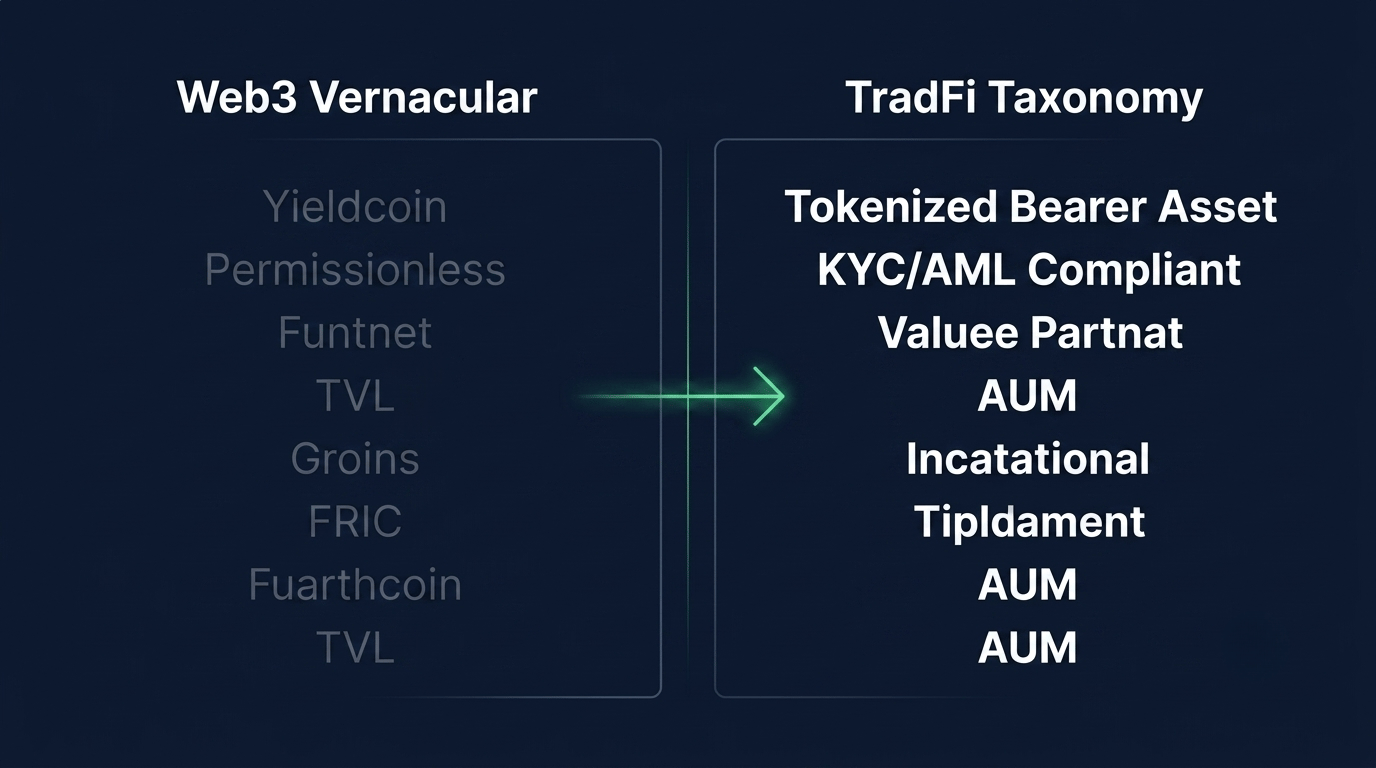
Ondo markets USDY prominently as "The world's leading permissionless yieldcoin."
From the perspective of a Chief Risk Officer at a multinational bank, or a partner at a Big-4 advisory firm, this phrasing is profoundly toxic.
"Yieldcoin": This term immediately evokes the catastrophic algorithmic stablecoin collapses of the previous macroeconomic cycle. It sounds speculative, retail-focused, and fundamentally unstable. Institutions do not invest in "yieldcoins." They invest in Tokenized Repurchase Agreements, Blockchain-Settled Money Market Funds (MMFs), or Digital Bearer Instruments.
"Permissionless": While a holy grail for Cypherpunks, "permissionless" is the antithesis of institutional compliance. TradFi operates in a strictly permissioned reality governed by draconian Know Your Customer (KYC), Anti-Money Laundering (AML), and Office of Foreign Assets Control (OFAC) regulations. While USDY incorporates specific onboarding controls, leading the marketing pitch with "permissionless" creates an immediate psychological and compliance barrier.
Section III: The Regulatory Arbitrage Paradox and the US Market Fencing
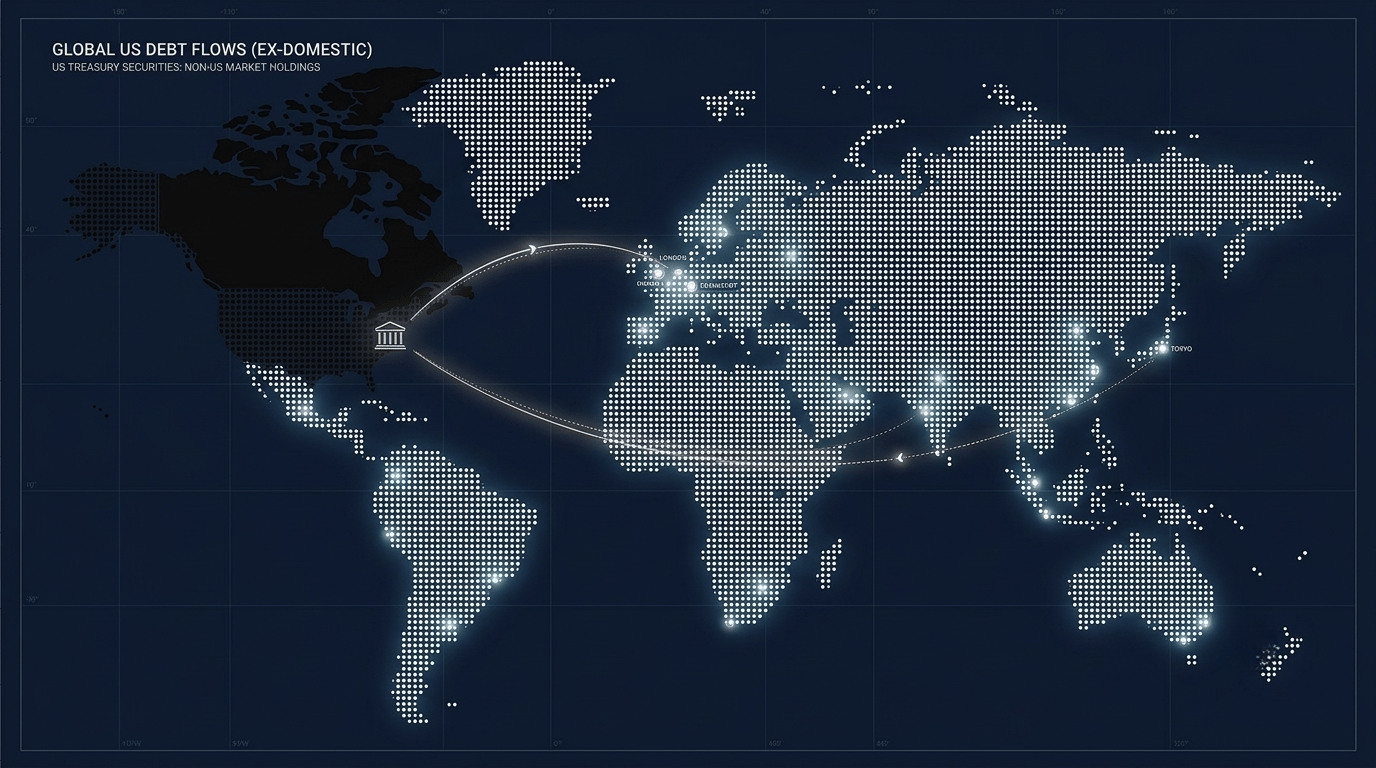
The most complex structural contradiction within Ondo’s current operational framework is its geographic fencing. A cursory glance at the primary dashboards for both USDY and Ondo Stocks reveals a prominent, legally mandated badge: "Not Available in US".
This creates a fascinating, yet ultimately unsustainable, macroeconomic paradox. The protocol's foundational yield-generating assets are US sovereign debt instruments (Treasuries). Yet, it actively blocks US persons and entities to circumvent the jurisdictional purview of the Securities and Exchange Commission (SEC).
From a strategic advisory perspective, this regulatory arbitrage fundamentally limits the Total Addressable Market (TAM) and creates cascading secondary risks:
The Fiduciary Discount: If an asset is deemed too legally perilous to be offered in the jurisdiction of its underlying collateral (the US), conservative European (MiCA-regulated) or Asian institutional allocators will inherently apply a steep risk-premium discount to the asset. It signals that the legal wrapper may not withstand a Tier-1 sovereign stress test.
Bifurcation of Liquidity: By isolating the deepest capital market on earth, Ondo relies on offshore liquidity. While substantial, offshore capital is often more transient and less structurally sticky than domestic institutional allocations.
The Solution: The evolution of RWA requires moving beyond geographical exclusions. Ondo must rapidly develop dual-structured legal entities utilizing Reg D (Rule 506c) and Reg S exemptions simultaneously. This allows for a permissioned, whitelisted pool for US Qualified Purchasers and Accredited Investors that interacts seamlessly with the offshore pool, bridging the liquidity gap without violating securities laws.
Section IV: Deconstructing the Institutional Risk Premium
When traditional capital evaluates a tokenized asset, they are not simply looking at the nominal yield. They are calculating the Institutional Risk Premium (IRP) of the Web3 wrapper.

Currently, for Tier-1 institutions, the sum of the Risk Premiums (RP) vastly outweighs the benefits of the Liquidity Premium (LP). Therefore, the nominal 3.55% APY is insufficient to justify the perceived systemic risk of the Web3 wrapper.
Ondo's entire corporate strategy must be reoriented toward systematically driving RP_SmartContract, RP_Regulatory, and RP_Oracle to absolute zero in the eyes of a traditional compliance officer.
Section V: Architectural Vulnerabilities and SPV Opacity
Ondo boldly claims "Institutional Grade In All We Do," highlighting that products hold assets at "third-party qualified custodians" like BNY and StoneX. While integrating heritage custodians is a massive step forward, the opacity of the legal linkage remains a hurdle.
Institutions do not trust marketing copy; they trust bankruptcy-remote Special Purpose Vehicles (SPVs) and exhaustive legal memorandums.
The Commingling Fear: If Ondo Finance (the operating company) faces insolvency, how mathematically and legally isolated are the assets backing OUSG and USDY?
On-Chain Proof of Off-Chain Reality: While Ondo provides transparency, the ultimate institutional standard is a real-time, zero-knowledge cryptographic proof linking the on-chain token supply directly to off-chain CUSIP numbers held at BNY, verified by an independent Big-4 auditor on an hourly basis.

Section VI: Forecasting the Collision – Macroeconomic Scenarios
The window of opportunity for Ondo to solidify its monopoly as the RWA foundational layer is finite. We must project the macroeconomic and competitive environment over the next 24 to 36 months.
Scenario A: The TradFi Awakening (The Threat) As the US Federal Reserve eventually normalizes the yield curve, the intrinsic appeal of 4-5% risk-free rates will compress. Simultaneously, massive TradFi incumbents (BlackRock's BUIDL is just the prologue, J.P. Morgan's Onyx is scaling) will launch their own tokenized treasuries. These entities do not suffer from the "Yieldcoin" stigma. They have pre-existing, multi-decade relationships with sovereign wealth funds. If Ondo does not elevate its corporate positioning to match these giants, it will be relegated to a niche liquidity provider for DeFi protocols, entirely missing the $100T+ TradFi migration.

Scenario B: The Synthesis Monopoly (The Ondo Opportunity) If Ondo executes the strategic realignment proposed in this manifesto, it becomes the ultimate bridging infrastructure. By adopting Big-4 consulting standards of risk communication, wrapping its superior tech stack in unassailable legal SPVs, and restructuring its compliance for global (including US) institutional participation, Ondo becomes the M&A target or the primary infrastructural partner for every major bank that is too slow to build their own on-chain architecture.
Section VII: The Strategic Realignment Blueprint (Actionable Mandates)
To secure the sovereign capital tranches and solidify market dominance, Ondo Finance must immediately implement the following strategic overhauls:
1. The Lexical Purge: Conduct a comprehensive audit of all enterprise-facing materials. Eliminate all retail Web3 terminology. "Yield" becomes "Coupon" or "Dividend." "Permissionless" is replaced with "Programmatically Compliant." "TVL" is supplemented with "AUM (Assets Under Management)." The website must bifurcate: one interface for DeFi integrations, and a deeply gated, highly sterile portal for institutional allocators requiring an NDA to access data rooms.

2. The Legal Transparency Initiative: Publish a "Trust & Transparency" compendium that goes beyond logos of auditors. Provide flowcharts of the exact legal path of a fiat dollar converting to a tokenized treasury, explicitly mapping the counterparty risk at every millisecond of the transaction. Produce a 50-page open-source Risk Memorandum detailing the failure states of the protocol and the legal recourse for token holders.

3. The DePIN / Web3 Infrastructure Integration: While pivoting the narrative to TradFi, Ondo must quietly solidify its backend by integrating Decentralized Physical Infrastructure Networks (DePIN) for oracle pricing and verification, ensuring that the transition to an institutional narrative does not compromise the fundamental decentralization of the settlement layer.
4. Dual-Track Regulatory Structure: Immediately prioritize the legal engineering required to compliantly onboard US institutions. The cost of legal structuring is negligible compared to the opportunity cost of ignoring the deepest capital market globally.
Section VIII: Strategic Partnership Proposal - The Asynchronous Advantage
Executing this structural pivot requires an architectural perspective that bridges the rigid frameworks of traditional corporate banking and the hyper-agile execution of Web3.
My background, spanning rigorous financial advisory at Deloitte and institutional relationship management at ING Bank Śląski, synthesized with deep academic grounding in AI & Blockchain Strategy (Caltech) and Executive Management (MIT Sloan), uniquely positions me to orchestrate this transition.
I do not operate as a traditional consultant burning hours on synchronous Zoom calls. I operate as a highly specialized, 100% remote, fully asynchronous Strategic Capital Advisor. This methodology guarantees that engagement yields dense, actionable, and rigorously researched output-much like this manifesto-delivered strictly through comprehensive written frameworks, architectural diagrams, and strategic directives.

Ondo Finance possesses the technological supremacy to dictate the future of global finance. However, without a fundamental realignment of your institutional communication and legal abstraction strategy, you remain vulnerable to legacy incumbents.
The infrastructure is built. It is time to upgrade the narrative.
Let us build the trillion-dollar rails.
Senior Strategic Capital Advisor Expertise: Corporate Finance Integration | Web3 Infrastructure | RWA Tokenization
Direct Engagement: hromecmaria@gmail.com
💼 Professional Matrix: linkedin.com/in/maria-hromec
🐦 Market Insights (X): x.com/Maria_Hromec