
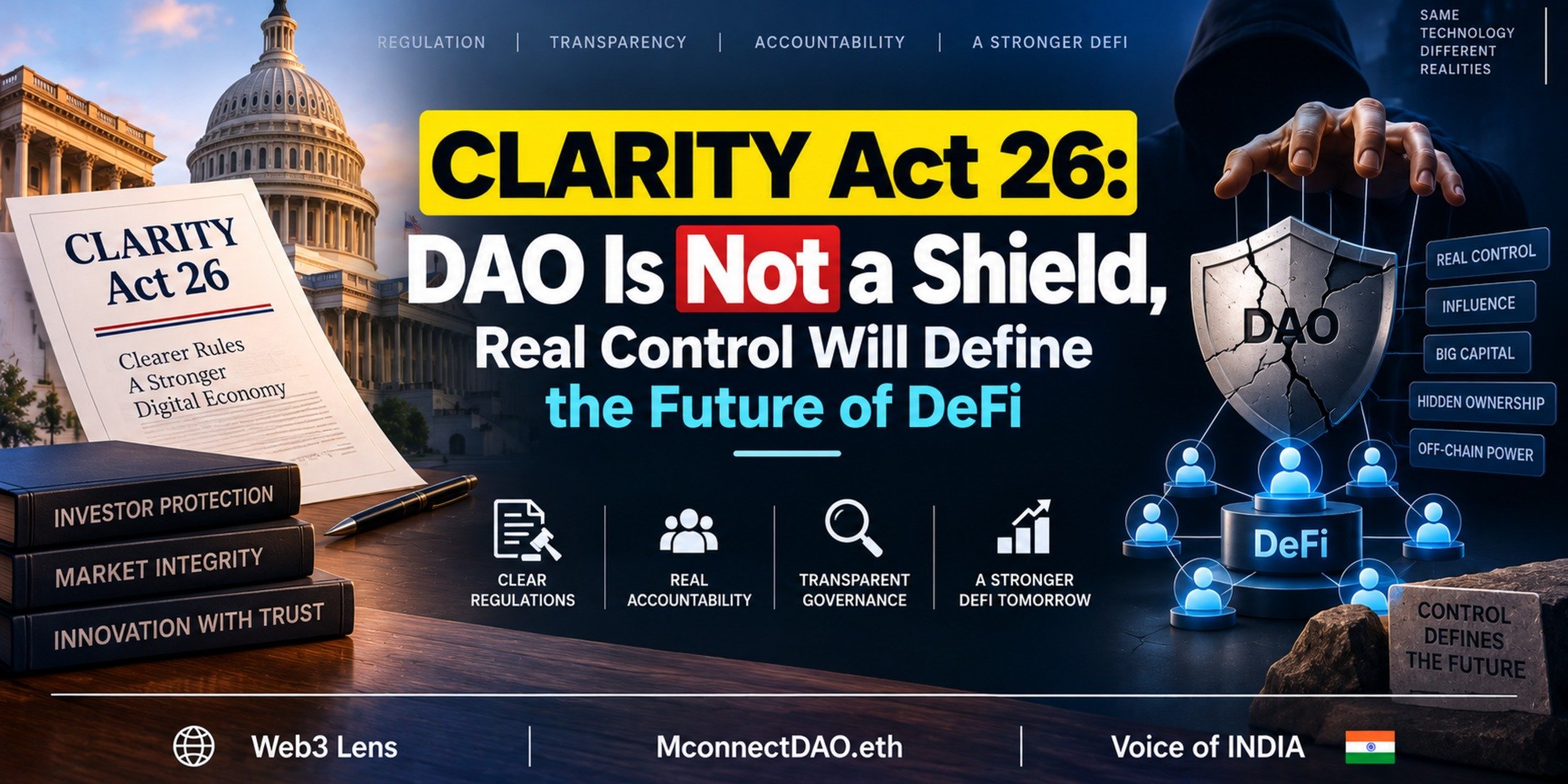
he biggest question facing Web3 is no longer only this:
Is the protocol on a blockchain?
The more important question is now this:
Who actually controls it?
A project can have a governance token. It can use Snapshot. It can call itself a DAO. It can have an offshore foundation. It can publish open source smart contracts. It can say that no company controls the system.
But if a small group can upgrade contracts, pause the protocol, move the treasury, block users, change core parameters, or decide which governance votes execute, then the project may not be decentralized in practice.
This is the central issue raised by the revised United States CLARITY Act draft released in September 2026.
The draft does not say that every DAO is illegal. It does not say that all DeFi must register. It does not say that open source software itself is a financial intermediary.
Its core message is simpler and more important.
A DAO label is not enough.
Real control matters.
If the revised language becomes law after the Senate process, the future of DeFi may depend less on marketing claims and more on evidence. Regulators, institutions, token holders, researchers, and users may all start asking the same question.
Who can actually change the system?
This article explains what that could mean for DAOs, DeFi protocols, offshore foundations, hybrid governance models, community members, and the wider Web3 market.
First, the current status matters.
A revised 630 page version of the CLARITY Act was released by Senate Republicans on September 10, 2026. The Senate was expected to hold a procedural cloture vote on September 15.
A cloture vote is not final passage of a bill. It is a vote about whether the Senate can move forward with debate. The measure would need enough support to clear that stage, and then it would still need to move through further legislative steps before becoming law.
The text may also change during negotiations. Agency rulemaking would be needed to explain many technical details after any final law is passed.
So every discussion today should be careful.
The revised draft is a policy direction, not final legal certainty.
But policy direction matters. It tells projects what regulators may look at in the future.
For years, many Web3 projects have used the word decentralized in a broad way.
A project may say it is decentralized because users hold tokens.
It may say it is decentralized because voting happens on Snapshot.
It may say it is decentralized because contracts are deployed on Ethereum or another public blockchain.
It may say it is decentralized because it has an offshore foundation instead of a traditional company.
These things can be useful. But they do not automatically prove decentralization.
A more serious test looks at actual authority.
Who can upgrade a smart contract?
Who can pause deposits, borrowing, swaps, or withdrawals?
Who can change interest rates, collateral factors, borrow caps, oracle settings, or liquidation thresholds?
Who can move the treasury?
Who controls the official front end?
Who can block users or restrict access?
Who appoints multisig signers?
Who can decide whether a passed proposal will execute?
Who has the practical ability to coordinate a majority vote?
These questions reveal the real governance structure.
The revised CLARITY Act draft reportedly adds a category for non decentralized finance trading protocols. The purpose is to identify protocols that are presented as DeFi but remain under material control of an identifiable person or coordinated group.
This is a major conceptual shift.
The question is not only whether there is a DAO.
The question is whether the DAO has real power.
Real decentralization does not mean that no one has any responsibility.
It does not mean a protocol cannot respond to exploits.
It does not mean all contributors must be anonymous.
It means that no single founder, company, foundation, or coordinated group has ongoing unilateral power to materially control the system.
A stronger decentralized design may include:
Public, verifiable smart contracts
Transparent governance rules
On chain execution for important decisions
Timelocks before high risk changes execute
Independent and rotating multisig signers
Limited, time bound emergency powers
Public treasury reporting
Clear separation between treasury control and security response
Open proposal process
Distributed voting and delegation
Public records of upgrades, parameters, and emergency actions
No protocol will become perfectly decentralized overnight. Many early stage projects need a core team, a foundation, a security council, and fast incident response.
The problem is not that these structures exist.
The problem is when a project calls itself fully decentralized while these structures have broad, opaque, and permanent control.
Multisigs are common in Web3. They are often necessary.
A multisig can protect a treasury from a single private key compromise. It can require several independent signers before funds move. It can provide a fast response during an exploit.
This is a good use of multisig technology.
But the same tool can create hidden centralization.
If five people control upgrades, treasury withdrawals, emergency pauses, and protocol parameters, then those five people may be more powerful than thousands of token holders.
The key issue is not whether a multisig exists.
The issue is its scope, transparency, and accountability.
A healthy multisig structure should have:
Public signer identities or credible public accountability framework
Independent signers, not only employees or close friends of founders
Clear signer selection and removal process
Fixed terms and rotation rules
Public conflict of interest disclosures
Separate multisigs for treasury and emergency security actions
Defined transaction categories and approval thresholds
On chain transaction history
Timelocks for non emergency upgrades
A public incident response process
A dangerous multisig structure has:
Unknown signers
One founder controlling most signers
Unlimited upgrade authority
Direct and unrestricted treasury access
No timelock
No expiry for emergency powers
No public explanation after actions
No way for token holders to remove signers
This difference will become increasingly important. A project cannot claim that control belongs to the community if a small multisig can override the community at any time.
Many DeFi protocols use upgradeable smart contracts. This can be useful because it allows teams to fix bugs, add features, improve efficiency, and respond to security issues.
But upgradeability is also control.
A contract upgrade can change core logic. It can change fee rules. It can alter collateral requirements. It can add transfer restrictions. It can change liquidation systems. In the worst case, a malicious or compromised upgrade key can endanger user funds.
That is why every DAO should publish a simple upgrade map.
The map should show:
Which contracts are upgradeable
Who holds upgrade authority
Whether authority is a Safe multisig, timelock, DAO executor, or foundation
The exact upgrade delay
The audit requirements before deployment
The emergency upgrade process
The rollback plan
The last time an upgrade was executed
If a small group can upgrade the protocol instantly and without a public delay, the protocol may be decentralized in branding but centralized in practice.
A better model is progressive decentralization.
At first, the core team may hold limited upgrade rights with a clear public roadmap.
Later, upgrades move to a multisig with independent signers.
Then high risk upgrades require DAO approval, audit reports, and timelock execution.
Finally, the DAO may limit upgradeability for core contracts or place strict constitutional limits on future changes.
The important point is honesty. A protocol should say where it is today, not claim it has already reached the final stage.
DAO treasuries are community capital.
They may hold governance tokens, stablecoins, ETH, BTC, LP positions, protocol revenue, grants, and reserve funds.
A treasury can support public goods, development, audits, liquidity incentives, security research, community events, and long term protocol growth.
But it can also become a target for poor governance, insider deals, rushed proposals, and grant misuse.
Arbitrum Watchdog discussions in September 2026 made this issue clear. The program reviewed allegations involving Good Entry, Limitless, and APX Finance, with roughly 457,553 ARB discussed across high severity grant misuse cases. The proposed response was future program exclusion, not an on chain seizure of wallets or a direct shutdown of protocols.
The case showed two important facts.
First, grant reporting and monitoring are essential.
Second, social accountability is useful but may be weaker than direct treasury protection when funds have already moved.
A strong DAO treasury design should include:
Public treasury addresses
Regular treasury reports
Clear budget categories
Recipient wallet disclosure
Milestone based grant payments
Defined performance metrics
Independent grant review
Public conflict disclosure
Return of unused funds
Clawback conditions where legally and technically possible
Long timelocks for large transfers
Higher voting thresholds for exceptional spending
Clear consequences for grant misuse
The community should be able to follow treasury money from proposal to final use.
If voters cannot see where money goes, governance becomes trust based instead of evidence based.
DeFi protocols operate in fast moving markets.
A stablecoin can depeg.
An oracle can fail.
A bridge can be exploited.
A price feed can be manipulated.
A governance attack can begin.
A smart contract bug can put deposits at risk.
In such situations, waiting for a normal seven day governance vote may be too slow.
This is why emergency pause powers and security councils exist.
They can be legitimate tools.
But they are also evidence of control if they are broad, permanent, or unaccountable.
A well designed emergency system should follow five principles.
First, narrow scope.
Emergency actors should be able to pause a risky function, reduce a borrow cap, disable a problematic market, or delay a suspicious transaction. They should not have unlimited power to rewrite protocol rules or move treasury funds.
Second, limited time.
A pause should expire after a fixed period, such as 24, 48, or 72 hours. Continuing the pause should require another defined process.
Third, multisig threshold.
No single person should control emergency action. A group threshold should be required.
Fourth, public disclosure.
The emergency group should publish an explanation, action log, affected contracts, and next steps as soon as doing so does not increase security risk.
Fifth, DAO review.
The DAO should be able to review the emergency action, confirm it, reverse it where possible, or replace the emergency council.
This model protects users without creating a permanent shadow government.
DAO voters often assume that if a proposal reaches quorum and passes, it must be legitimate.
This is not always true.
A proposal can follow the technical rules and still be dangerous.
It may have hidden conflicts.
It may include recipient wallets linked to insiders.
It may be rushed through by a late whale vote.
It may move too much money without milestones.
It may give broad authority to a small group.
It may change a protocol parameter without enough stress testing.
Recent discussion around Compound Proposal 289 highlighted the risk of late vote concentration around a large COMP transfer. The key governance lesson is not that every late vote is illegitimate. The lesson is that high risk decisions need more protection than a simple vote count.
This is why a strong governance design uses three layers.
Layer one is normal governance.
Community discussion, formal proposals, voting, and transparent results.
Layer two is a timelock.
After a proposal passes, execution waits for a fixed period. This gives researchers, delegates, and users time to identify hidden risk.
Layer three is a limited emergency brake.
If evidence of fraud, exploit, or serious governance manipulation appears during the timelock, an independent security group can pause execution temporarily.
The DAO then makes the final decision with better information.
This is not anti democracy.
It is governance with safety.
Many Web3 projects use foundations or companies outside the United States.
A foundation may be incorporated in Switzerland, Cayman Islands, British Virgin Islands, Singapore, Panama, United Arab Emirates, or another jurisdiction. Developers may live in many countries. Signers may be global. Users may be worldwide.
There are real business reasons for this structure.
Foundations can help manage intellectual property, grants, legal contracts, ecosystem funding, taxes, and operations. Different jurisdictions offer different legal frameworks and costs.
But moving a legal entity offshore does not automatically remove US regulatory relevance.
A regulator may still ask:
Are US residents using the product?
Is the official interface open to US users?
Are founders, employees, developers, or key signers in the United States?
Does a US based group control upgrade rights or treasury decisions?
Is the protocol marketed to US users?
Does it use US banking, US investors, US service providers, or US infrastructure?
Are tokens offered, traded, or promoted in US markets?
The final legal answer depends on facts, the final law, agency rules, and enforcement policy. No general article can decide jurisdiction for a specific project.
But the governance lesson is clear.
An offshore address does not prove decentralization.
A Cayman foundation does not erase a founder controlled multisig.
A global team does not erase coordinated control.
A project must show where practical authority sits.
If US rules become clearer and stricter, some projects may choose to establish or move their legal headquarters outside the United States.
They may seek lower compliance costs, more predictable token rules, better foundation law, easier banking, or a more supportive environment for open protocols.
Some may restrict US users through geo blocking or terms of service.
Some may use a split structure:
Offshore foundation for governance and grants
Separate development company
Independent front end operator
Global token holder base
Distributed multisig signers
Permissionless smart contracts on public chains
This may be a valid business structure in some cases. But it should not be used as a false claim that no one controls the protocol.
If the same small group holds the upgrade keys, manages the treasury, controls the front end, and directs governance outcomes, offshore incorporation changes the address, not the control reality.
Hybrid governance is becoming common.
In a hybrid model, token holders vote on major proposals, while a foundation, company, core team, multisig, or security council handles operational execution.
This can be practical.
A protocol needs developers to write code. It needs experts to respond to security incidents. It may need a legal entity to sign contracts. It may need a treasury committee to manage assets. It may need a front end team to keep the user interface working.
The issue is not whether hybrid governance exists.
The issue is whether it is transparent.
A project should not say that the community has full control if the community cannot replace signers, cannot stop upgrades, cannot audit treasury actions, and cannot challenge emergency decisions.
An honest hybrid project should disclose:
Which decisions belong to token holders
Which decisions belong to the foundation
Which decisions belong to core contributors
Which decisions belong to the security council
Which actions can happen without a token holder vote
How the community can replace or constrain operators
What roadmap exists for reducing centralized control
This type of honesty can improve trust.
A project may say:
“We are currently in a hybrid governance phase. Our core team holds limited emergency upgrade authority. This power expires in 12 months. Any use requires four of seven independent signer approvals, a public incident report, and DAO review. High risk upgrades use a seven day timelock. Treasury movement above a defined limit requires DAO approval.”
This is far better than saying “fully decentralized” while keeping all meaningful power with a few people.
If the CLARITY Act or a similar framework becomes law, the market may start separating projects into three broad groups.
First, genuinely decentralized protocols.
These projects may have limited upgrade rights, broad distribution of governance power, transparent timelocks, public treasury control, and narrow emergency mechanisms. They may find it easier to make a credible case that they are not operated by a controlling intermediary.
Second, transparent hybrid protocols.
These projects may admit that they have operators and accept compliance obligations for parts of their business. They may build regulated front ends, institutional products, KYC based services, or controlled access while keeping some on chain components open.
Third, opaque projects.
These projects may claim decentralization but fail to disclose signer control, upgrade rights, treasury authority, and founder influence. They may face the highest trust and regulatory risk.
This could lead to more governance transparency as a competitive advantage.
Investors may ask for public control maps.
Institutions may prefer protocols with clear emergency processes and auditable governance.
Token holders may demand signer disclosure and treasury reporting.
DAO researchers may focus more on practical control instead of token distribution alone.
The possible benefit of this approach is not only regulatory clarity. It may improve DAO governance itself.
First, it can reduce fake decentralization.
Projects may have to prove control distribution instead of relying on branding.
Second, it can make multisigs more accountable.
Public signer information, rotation, conflict disclosure, and narrow mandates can improve community confidence.
Third, it can protect treasuries.
More attention to timelocks, milestones, wallet tracking, and grant reporting can reduce misuse.
Fourth, it can improve security design.
Emergency powers can become documented, temporary, and reviewable instead of informal and hidden.
Fifth, it can make token holder voting more meaningful.
If proposal execution and treasury control truly move toward the community, token holders gain real power instead of symbolic voting rights.
Arbitrum Watchdog activity shows why monitoring matters. Curve risk provider debates show why disclosures matter. Compound emergency control discussions show why safety design matters. These are not separate issues. They are all questions of who controls money, code, and risk.
There are also real concerns.
The first concern is compliance cost.
Legal review, registrations, recordkeeping, audits, cybersecurity controls, and reporting can be expensive. Large platforms may manage these costs more easily than small teams and community DAOs.
The second concern is innovation flight.
Some builders may avoid the United States, block US users, or move development activity to other jurisdictions. This can reduce US participation in open innovation.
The third concern is regulatory uncertainty.
A legal definition of control can sound clear, but difficult questions remain. How much multisig authority is too much? When does security response become operational control? What level of delegation concentration matters? How should a global protocol treat local users?
The fourth concern is over correction.
Projects may remove useful security controls only to appear more decentralized. This could make users less safe.
The goal should not be no emergency powers. The goal should be narrow, transparent, and accountable emergency powers.
The fifth concern is centralization through compliance.
If only large and well funded projects can comply, Web3 may become dominated by major exchanges, venture backed companies, and regulated financial firms. This would weaken the open and permissionless culture that made DeFi important.
Policy should therefore distinguish between code publication, passive infrastructure, independent community participation, and ongoing practical control of a protocol.
DAOs do not need to wait for final legislation before improving their governance.
Every DAO should conduct a Control Structure Audit.
This audit should answer:
Who can upgrade contracts?
Which contracts are upgradeable?
What is the upgrade delay?
Who can pause protocol functions?
Can emergency actors move treasury funds?
Who holds treasury signing authority?
Are signer identities, terms, and conflicts public?
Can token holders remove signers?
What actions need on chain votes?
What actions can be executed without a vote?
Who controls the official front end?
Can users be blocked or restricted?
How concentrated is voting and delegation?
What is the incident response plan?
What is the roadmap to reduce centralized control?
The audit should not be a hidden internal document. It should be public, easy to read, and updated regularly.
DAOs should also separate powers.
Treasury control should not be identical to emergency security control.
Protocol upgrades should not be instant.
Emergency pauses should not be permanent.
Grant payments should not be fully upfront.
Risk providers should not be chosen without conflict checks.
These are basic governance protections.
A strong DAO could use this structure.
Community governance controls major protocol decisions, treasury budgets, large payments, signer elections, and policy changes.
A treasury multisig executes approved budgets, with published signers, public transactions, and higher thresholds for large transfers.
A security council can only pause defined functions, reduce defined risk limits, or delay suspicious execution. It cannot transfer treasury assets.
A timelock applies to upgrades, large treasury transfers, new collateral listings, and major parameter changes.
An independent risk provider publishes methodology, conflicts, scenarios, and review dates.
A public dashboard shows treasury balances, delegate concentration, signer roles, active proposals, emergency actions, and grant milestones.
This does not eliminate all risk. Nothing can.
But it creates evidence that the protocol is governed by a system, not by a hidden group.
The CLARITY Act debate is not only about the United States.
It is a test of what Web3 means when it says decentralized.
For years, the industry has repeated a simple phrase.
“No one controls the protocol.”
Now DAOs may have to demonstrate it.
This is not necessarily bad for Web3.
It can push projects to build stronger governance, better treasury protection, more transparent multisigs, limited emergency powers, and real community execution rights.
Yes, some projects may move offshore. Some may block US users. Some may choose regulated hybrid models. Some may face higher costs.
But an offshore office is not proof of decentralization.
A DAO label is not proof of community control.
A token vote is not proof that token holders hold real power.
The proof is in the architecture.
Who holds the upgrade keys?
Who controls the treasury?
Who can pause the protocol?
Who can block users?
Who can override the vote?
Who can be removed by the community?
If the answer is a small, permanent, and opaque group, then the protocol is not fully decentralized, no matter what its website says.
If the answer is a transparent system with distributed authority, on chain execution, clear limits, independent checks, public reporting, and real community control, then Web3 can defend its core promise with evidence.
The future of DeFi will not be decided by slogans.
It will be decided by who actually controls the code, the money, and the rules.
Revised CLARITY Act draft released by United States Senate Republicans, September 10, 2026
US Senate CLARITY Act procedural vote reporting, September 2026
CLARITY Act reporting on non decentralized DeFi protocols and CFTC oversight, September 2026
Arbitrum Watchdog Committee reporting on grant misuse cases and future program eligibility proposals, September 2026
DAO governance research covering timelocks, multisigs, upgrade authority, emergency controls, treasury protection, and voting concentration