
The scream cut through the street raw like something torn loose. Low, but urgent. It didn’t persist. It snapped, like something rending under pressure. I was already moving before I’d finished deciding not to. The street was narrow, half-lit by a flickering sodium lamp that made everything look guilty by association. Storefronts shuttered. A car parked too close to the curb. A fire escape rattling faintly above. The kind of place where sound died quickly—and help even faster. The scream came again. Closer this time. Shorter. Strangled at the edges, pulled inward like someone was learning how much noise they were allowed to make before it cost them something.
Running in blind was how people died fast and confused. I let my pace settle and listened instead, leaning into the shadow of a doorway. Shoes scraping pavement. A voice. Male. Annoyed more than angry. Drunk courage and slurred cruelty. Another sound underneath. Someone trying not to cry. There was a side street up ahead, black and narrow, swallowing light. Cul-de-sac. I stayed to the wall and approached from the edge, letting the overlapping gloaming do their job and hide me.
Two men. One pressed her back against the wall, forearm across the collarbone. Not choking—yet. Another gripped a wrist hard enough to bruise tomorrow, pinning her coat where it had ragged at the shoulder. He was laughing. High and brittle. The other stood close, hands working with an impatient hunger. “Don’t make this harder,” he said, like that was a reasonable request.
She wasn’t screaming anymore. She was shaking. Eyes wide. Mouth open, pulling in air that didn’t seem to help. Seventeen, maybe. Younger was possible. Old enough to know exactly what was happening. Young enough to still hope it might stop if she stayed quiet. The knife at the low of the back felt heavier than it should have. The gun in my jacket didn’t. Inert weight. Useless for a shot, but weighted perfectly for an impact. A count of three breaths followed. The fourth one signaled the transition. “Gentlemen.” I simply occupied the space they thought was empty. “This night’s already louder than it should be.”
They turned fast. Too fast. One reached for something in his pocket. The other tightened his grip. Bad instincts. I moved before the situation could finish forming. The man closest to her went down first. A short step in as my lead hand flashed out a swift jab to the throat followed by a palm-strike to the nose. Bone gave under the impact. His head jerked back, balance gone before the pain could register. My side gave me a sharp reminder that every extension had a price. He collapsed as I was already turning for the second. The other swung wild. Drunk, angry and confident. All the wrong tools. I redirected the momentum and introduced his face to the brick wall—once. Twice. Thrice. Repetition teaches faster. He slumped and stayed there, leaving a dark, messy trail behind. The space went quiet again, the sudden violence absorbed in the nightfall as if it had never happened.
My attention pulled toward the shadow still pinned against the wall. She began to sink, legs giving way, clutching her jacket like it could keep the world out. Her breathing was fast and uneven. Eyes darting between me and the men, like she couldn’t decide which was worse. Then her knees buckled. I caught her before she hit the ground. There was almost no weight to meet the effort. That was the problem. I eased her down against the wall and checked her quickly. The pulse was fading. Her skin cold. Consciousness gone. Not from injury; pure and uncomplicated shock. Behind me, one of the men groaned. I turned and put enough conviction into a single strike to end the conversation, bracing myself as the heat of the wound in my side flared again. He stopped whimpering a short second later. Good.
The girl hadn’t moved. She was a collection of absences—no phone, no bag, no jewelry. Just a cheap, secondhand coat. Seams failing from where hands had grabbed it too often, shoes worn thin with mismatched laces tied twice to hold. She wasn't dressed for a destination. She was dressed to exist in between places. The missing person who never actually makes it onto a poster. People who were expected didn't look like this. I lingered just long enough for my better judgment to lose the argument. This was the moment. She was alive. Still cycling air. The threat was gone. I could leave her here. Someone else would find her. Or they wouldn’t. Either way, the night would keep moving. No one would blame me. That’s what made it a choice. A single, slow exhale followed. “This stretch of time, already spent.”
She was lifted with a calculated shift of weight. I kept the head supported and her center close to mine to save my side the extra work. She was light in my arms and didn't stir. The car was three blocks away, a choice I’d made before even turning into the alley. It was parked where the streetlights didn't reach. Old model with a worn lock, owned by someone who trusted the neighborhood’s reputation more than maintenance. Stealing it took less time than expected. The car was likely registered and would be reported sooner or later. But not tonight. Not in this district. By the time anyone noticed, I’d be somewhere the plate didn’t matter.
The slide into the passenger seat was guided and controlled. The belt adjusted so it wouldn’t choke her if she came around. Her head slumped against the glass, leaving a faint fog with every exhale. I sat behind the wheel. Hands on the dash. Engine off. This was still optional. The exit was right there—a clean walk away into the dawn, leaving the city to reclaim what it almost finished. I sighed and leaned my head against the rest, listening. The city didn’t change its tone. No sirens accelerating. No doors opening and voices calling her name in the dark like they thought it might answer back. Someone might look for her. Eventually.
Eventually was a wide window. Wide enough to move through. If I left her here, she’d wake up alone in the same vise that had almost finished her. Same block. Same habits. Same men or others like them. If I stayed, she became a variable. One more thing the city could use to locate me. Distance solved both problems. A pulse check confirmed her standing. Fast. Present. A sign that she was still there. Just gone somewhere small and quiet inside herself where the night couldn't follow.
I straightened, letting my hands rest on the wheel while the math finished settling. She was a temporary load. Contained and mobile. I didn't want the burden, but leaving her behind would create an echo that might eventually find its way back to me. The cabin air tasted of dust and old neglect, the driver’s seat shifting under my frame while the street waited for a move. The exit was still there. A return to the void.
But I’d already altered her trajectory. A spark bit behind the dash, and the engine coughed into life. As we pulled into traffic, she stirred faintly. A breath caught; fingers twitched against the worn passenger seat. “Don’t wake up yet. It hasn't improved since you left.” The city accepted the car without comment. Behind us, the alley closed ranks. Ahead, the streets swallowed us whole. Lights flickered past in pulsating bursts. The car rattled with a persistent fatigue that felt like my own, but it held the road. I worked the mirrors, scanning every blind corner for a flash that stayed in the frame too long. The night had bent around a decision it never needed and I could feel the weight of it already. Whatever came next was going to cost more than the price I’d just paid. Time slipped past without announcing itself. The city faded away as the lights grew sparse and the road became long and quiet. At some point her breathing evened out—deeper now, heavier. Sleep that settles in when you’ve been borrowing energy from tomorrow.
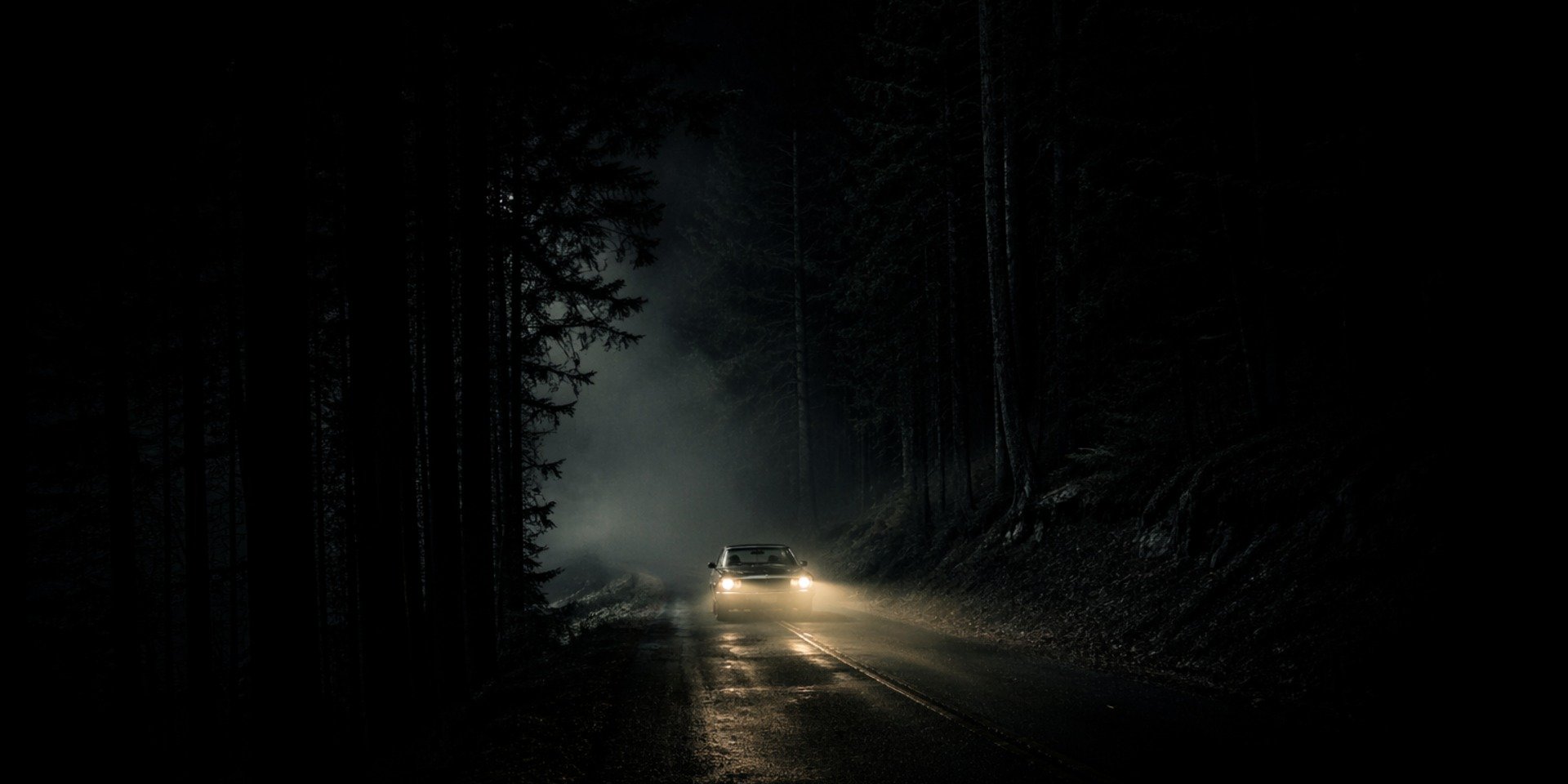
The engine held together until it didn’t. The rattling ebbed into a tired cough, then simply faded. The car shuddered once and went quiet on a straight stretch of road hemmed in by pines. I rode the last of the momentum, eased the wheels off the asphalt, and let the silence take over. No lights or cars but the dark pressing in from both sides. It felt like it had been waiting for us. My thumbs tapped once against the plastic of the steering wheel. “Figures.”
The car was old and temperamental. Not that it had stopped before. Not that it would matter if it did now. A quick glance at the passenger seat confirmed she was still slumped, breathing slow and even. I opened the door, letting the damp night air wash over me. A mile back, the faint hum of distant traffic lingered, failing to reach where the forest leaned in close and pooled its shadows under the moonless sky. The hood popped with a metallic protest. I leaned over the engine bay, frowning at the tangle of wires and corroded connectors. Age and neglect had finally caught up. The same things that kept it cheap and unnoticed back in the city.
The passenger door clicked—too soft, too careful. My hand paused on the engine frame as a faint shuffle followed, a sound far too deliberate for sleep. Then a rustle. She bolted. There was no hesitation. Just motion, fast and direct, her shoes tearing through wet needles as the trees swallowed her in seconds. I didn't chase, simply staying where I was, watching the forest close behind her the way forests do. Without comment. Branches shifted and something small fled in the underbrush. Then stillness layered itself back into place. I leaned against the hood and listened. The road was empty. No headlights cresting the bend. No distant engine turning curious.
Running into a forest at night is a decision. Whether it’s the right one depends on what you’re running from. I walked around the car and pushed the passenger door shut. The latch caught with a hollow click that seemed to echo against the trees. One variable less. My attention turned back to the engine. The work was mechanical, almost meditative. A loose connection. A tired line. After a few careful adjustments and a sharp twist, a reluctant cough ran through the carburetor. The engine settled into a low, uneven idle. Tired, but willing.
The canopy whispered, branches brushing against each other like fingers against a windowpane. She didn't stay gone long. The forest has a way of teaching you about exposure. Five minutes in the dark among the pines is enough to remind anyone that a man is a manageable threat, but the woods are indifferent. A branch cracked somewhere off to my right. Not far. Closer than it should’ve been if she meant to disappear. The heat rose in waves against my face, hands resting on warm metal. “Engine’s not subtle,” I said, not raising my voice. “If you’re trying to avoid attention.”
Silence. Or what passed for it. Then, from the dark between the trees. A voice. Thin, but steady. "You didn't follow me."
I still didn’t look up. "Running takes time. And energy. I'm short on both." The engine’s uneven pulse seemed to expand in the dark, a rhythmic intrusion that the forest didn't know how to absorb.
“You think they hear that?”
“Hear what?”
“The noise.” A pause. “The car. Us.”
I dropped the hood shut with a muffled snap, before my eyes finally turned toward the sound. She stood half-shadowed behind a trunk. She wasn't hiding, but she wasn't close. A look for the idling car, then one for me. Measuring the fact that I hadn’t moved. “Depends what’s listening.”
That answer didn't sit well. It showed in the way the light caught her eyes as they flicked to the tree line, then back to me. “They call them something,” she said carefully. “I heard people talk about it.” I didn’t answer. I just watched how shadows seemed to pool around her, sharpening her silhouette against the woods. “Back in the city. In the Gaps,” she added. “There are people who stay constantly on edge. Like something in them never switches off.”
“That describes half the city.”
“Not like that.” Her voice dropped. “They say if it builds for too long, something changes in them.” She stared toward the trees. Her breath came in white plumes. The forest had rearranged her. Hair loose and rumpled from sleep. She held my gaze now. Braver than before. “Those restless people,” she said. “Sometimes they disappear. Then something bad happens where they went.”
“How do they know it was them?”
“Because they found one with blood all over at a forest edge. And someone else in pieces.”
“And that's what brought you back?”
She took a moment before answering. “It helped.”
The engine stuttered once, then corrected. “Nothing improves the credibility of old stories like being alone in the right place.”
“You don't make it sound like those are stories.”
I repositioned against the side of the car and lit a cigarette. Smoke curled into the night, sharp and bitter, masking the scent of my own presence in the dark. She moved from behind the trunk and shifted her vision past me toward the road. Then back into the trees behind her. Spanning distance. “Cities… they like stories. They like whispers. Makes them safer. Easier to hide.”
Her breath caught, a sudden break in the white plumes. “They’re real?”
A slow, hot exhale vented through my nose. “People are good at inventing explanations. Usually less so at inventing what needed explaining.”
She absorbed the forest shadows as if they might explain it. “How much of it is true then?”
“Less than people say. More than you'd want.”
She edged a fraction closer to the spill of the headlights. “And they’ll… hurt you?”
I let out a dry sound, less a laugh and more a click in my throat. “Depends. You think anyone here likes being cornered?”
“Do you think… they’ll come?”
I tapped ash into the wet soil. “Maybe. Or maybe they’re as tired of the night as we are.”
“So they're not monsters.”
“People usually get there on their own.”
“I experienced that tonight.” She glanced down at the car. “Why didn’t you just leave me? Back in the alley?” There it was. The question that didn't have a clean answer. “You had chances,” she said.
“So did you.” I didn’t continue immediately. The cigarette tip glowed orange in the dark, a tiny, defiant spark against the wall of pines. The hum of the engine thrummed like a pulse. Finally, I said, “Because walking away is harder than it looks.”
She searched my face. “For you?”
“I’m not talking about feelings. Turning your back doesn’t end things.”
She stepped forward from the treeline. Not all the way, but enough to reduce the distance between us by a third. Still outside arm’s reach. She studied my face now, looking for a reason to run again. She didn't find one. Her gaze dropped briefly to my side. The stiffness. The guarded posture. “You’re hurt.”
“I’m functional.”
That almost earned a smile. She glanced back into the trees. “I didn’t go far. You can’t see the road from ten meters in.”
“I know.”
“And it gets darker faster in the forest.”
“Yes.”
She stood there, shoes grinding wet needles into the ground. The distance between us suddenly felt like a choice she’d already made. “I don’t want to be alone out here.” It was a simple statement of fact. Honest in a way the city never was. I inhaled deep, holding the warmth of the smoke against the cold.
I gestured toward the idling car. “I'm not an improvement. But at least the night doesn't get a vote.”
Another stretch of quiet followed. This one shared. I could feel the faint heat of the block radiating against my legs. “So,” she said. “Are we loud?”
That word lingered between us. I crushed the cherry of the cigarette between my thumb and forefinger, pocketing the filter and leaving nothing for the dirt to hold. The engine idled still, solid enough to move. Tires appeared steady. The road stayed silent up ahead. No visible surprises. “Not yet.” I reached for the driver’s door. “Stillness never lasts.”
She hesitated only a fraction before moving toward the passenger side. As the door opened, the wind shifted against the branches. It sounded like something stepping back. Or making room. We got in the car and for the first time since the scream, I allowed a small measure of stillness to settle around us. She didn't look back at the woods as the car eased into gear and rolled back onto the asphalt.
Chapter V — June 14
The Geometry of Choice: Book I of The Equilibrium Strain.
©️ 2026 Bob Roland. All rights reserved.