
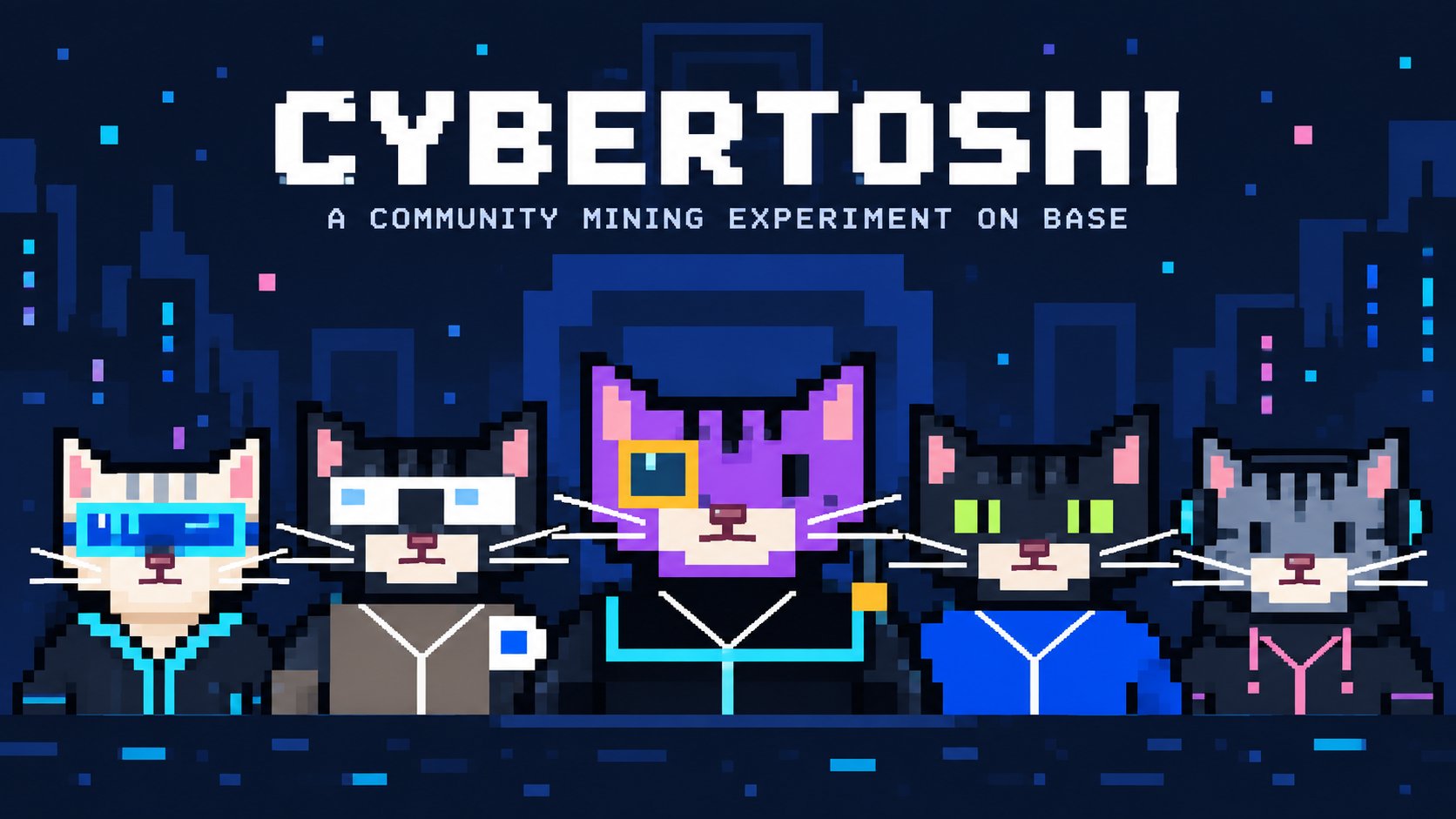
Browser mining, onchain cats, and public rules — built in the open.
CyberToshi started with a simple idea I couldn’t stop thinking about: what if minting a collectible involved actually doing some work with your computer?
Hashcats introduced me to that experience. Your machine searches for a valid proof, and finding one gives you the chance to mint a cat.
I liked the combination of computation, collectibles, and discovery. It made minting feel interactive.
That inspired me to build CyberToshi: an independent, community-focused experiment on Base.
My priorities were straightforward:
No creator fees from mints.
No reserved NFTs or creator token allocation.
Public source code.
Onchain artwork.
Rules enforced by contracts, including the opening time.
There are 16,384 cats available over the lifetime of the collection. Burning a cat does not create another minting slot.
You search for a proof in your browser using your CPU or the experimental GPU option. Once you find a valid proof, you approve the mint transaction in your wallet.
The initial mint price is 0.001 ETH, plus network gas. It increases by 0.0001 ETH every 512 mints, reaching 0.0041 ETH in the final epoch.
One concern came up repeatedly while building: what happens if powerful miners arrive and exhaust the collection before other people hear about it?
CyberToshi enforces a minimum of 60 seconds between accepted mints across the entire collection. That means the earliest possible interval from the first mint to the last is approximately 11.4 days.
That is a limit on issuance speed, not a prediction of how quickly the collection will mint out.
It also isn’t protection against mining farms. More computing power can still find more proofs. A global interval slows distribution, but it does not make every participant equally likely to succeed.
Difficulty adjusts as mining progresses and can ease after inactivity. There is no guaranteed time to find your own cat.
Each mint splits its ETH contribution:
80% is allocated to prior living cats.
20% goes to the community liquidity vault.
If there are no existing cats, the holders’ portion waits for a later distribution.
A living cat accumulates ETH from subsequent mints. After the community pool launches, its owner can permanently burn the NFT to receive both its accumulated ETH and BCAT.
You cannot withdraw that ETH while keeping the cat.
BCAT rewards begin at 1,000 tokens per burn and decrease by 5% every 512 lifetime mints. The reward uses the epoch when the cat is burned. Cosmetic rarity does not change it.
The community pool can launch once the vault holds 0.02 ETH, paired with a one-time issuance of 1,000,000 BCAT. The vault retains its liquidity position without a withdrawal function.
Collected BCAT trading fees are burned. Collected WETH fees can fund bounded buybacks, subject to the contract’s timing and historical-price checks. Anyone can trigger eligible maintenance actions and pay the gas.
These mechanisms do not guarantee demand, liquidity, or price appreciation.
The project went through local contract tests and live Base Sepolia testing.
The tests covered mining, timing restrictions, ETH accumulation, pool creation, combined ETH and BCAT redemption, fee collection, and buybacks. Sepolia used a simulated DEX; integration with real Aerodrome contracts was tested separately on a local fork of Base.
The scheduled-opening version passed 22 local tests and an additional live Sepolia opening test.
The source code is public. Testing and source verification are not an independent security audit, and CyberToshi should be treated as experimental software.
There are real limitations: mining consumes electricity, proofs can become stale, and no new mints means no new ETH contributions to existing cats. If the community pool never launches, burns remain unavailable and there is no refund mechanism.
I’m sharing CyberToshi because I want to see what people make of it: the cats they discover, the machines they use, and the feedback they bring.
If you try it, show me your cat. Tell me what worked and what was confusing. That feedback is part of the experiment.
Scheduled opening: September 13, 2026, at 01:00 UTC.
🌐
💻
🔎
Deployment and verification details
Inspired by Hashcats. Independent of Hashcats, Base, Coinbase, and Toshi.