
Yesterday I told you to find a "taquería", point at what the person in front of you got, and order two. That works for one night. You'll want to know what you're eating, what to order next, and where to walk for it. This is that.
I'll keep it to what's actually worth your time on a short trip. You're not going to taste every regional cuisine of Mexico in two weeks, and anyone pretending you can is selling you a food tour. Eat tacos. Eat from a market once a day. Try the things you've never heard of when the stand smells right. That's the program.
Five tacos do most of the work. Learn these and you can walk into any "taquería" in this city and order with confidence.
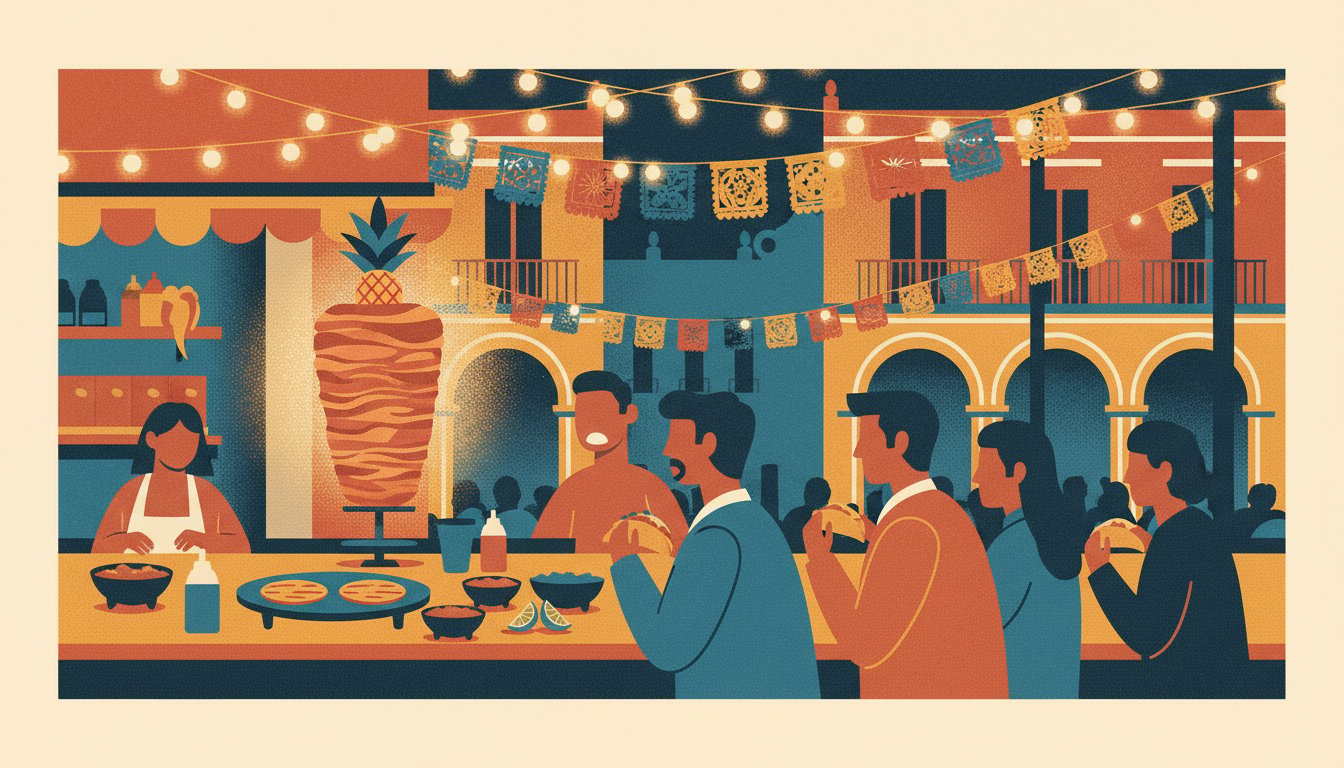
"Al pastor". Pork marinated in achiote and chiles, stacked onto a vertical spit with a pineapple on top, sliced into a small corn tortilla as the edges go crisp. "Al pastor" is a Mexico City taco, invented here in the twentieth century by Lebanese immigrants who adapted shawarma to local meat and local salsa. It's best at night, after 8pm, at a stand with a glowing "trompo" you can see from across the street. A "taquero" who flips the pineapple onto your taco with the same knife he uses to slice the meat is a "taquero" who knows what he's doing. Order them "con todo": onion, cilantro, lime, a sliver of pineapple, your choice of salsa.
"Suadero". A specific cut between the brisket and the belly, slow-cooked in its own fat in a wide round "comal" called a "choriquera". The texture sits somewhere between confit and crisp. "Suadero" is what you order at 2am after the mezcal has worn off and your judgment is back. The late-night stands in Centro are where you'll find it, with lines forming in the middle of the street after midnight and chefs from the city's best restaurants standing quietly in them.
"Carnitas". Pork slow-cooked in lard until it gives up and falls apart. A real "carnitas" stand will ask you what part you want: "maciza" (lean), "surtida" (mixed), "buche" (stomach), "oreja" (ear). Say "maciza con cuerito" and you'll get the lean meat with a strip of the crackled skin on top. "Carnitas" is weekend morning food. The classic move is a Sunday at 11am with a Victoria.
"Barbacoa". Lamb wrapped in maguey leaves and steamed for hours over a pit. The meat falls into a tortilla with a ladle of the cooking broth ("consomé") on the side, which you drink between bites. "Barbacoa" is also weekend morning food, and in this city it's widely understood as the cure for last night's tequila. Most "barbacoa" stands are only open Friday, Saturday, and Sunday because that's how "barbacoa" works.
"Cochinita pibil". Yucatecan pork marinated in achiote and bitter orange, slow-roasted, served pulled, topped with pickled red onions and a slick of habanero salsa called "xnipec" that will hurt if you respect it. The dish came from the Yucatán, and Mexico City has adopted it without spoiling it. Daytime hours only, cash works best, lines that move fast.
That's the canon. Five tacos that cover most of what you'll want to eat between a 7am Sunday "carnitas" and a 2am "suadero" in Centro.
The "taquería" rules are simple and unwritten. Here they are written down.
Stand at the counter. Most real "taquerías" have no chairs. You order, you wait, you eat standing up at a small ledge, and you pay on your way out. Don't sit at an empty plastic table at a stand that has them; that's where the family eats.
Order in numbers, not adjectives. "Dos de pastor, uno de suadero." Not "I'd like to try the pastor and one of the suadero please." The "taquero" is moving fast and the line behind you is too. Be clear.
"Con todo" means yes to the standard toppings (onion, cilantro, lime, and at a pastor stand, a slice of pineapple). If you don't want one of them, say so. "Sin cebolla" is fine. Nobody will be offended.
Salsa is your responsibility. There will be two or three on the counter in squeeze bottles or stone "molcajetes", ranging from a mild green to a serious red, with a habanero somewhere in the lineup that's there to test you. Try a drop on the back of your hand before you commit. There's a saying you'll hear from the older man at the counter when he sees you reaching for the red bottle: "el chile se le va metiendo poquito a poquito, hasta que el cuerpo lo pida solo". The chile goes in little by little, until the body asks for it on its own. He's telling you to ease into the heat. Take it as friendly advice.
Limes are free. Take one, squeeze it over the taco before the first bite. The acid is part of how the meat is supposed to taste.
Tip. Ten percent at a sit-down place. A small handful of coins at a stand if the "taquero" took care of you. Cash on the counter.
If you want the rest of this series, subscribe. Daily guides until opening match. Free, no spam, unsubscribe whenever. The button is in the corner of the page.
Tacos are the gateway. The depth of street food in this city is in the rest of it.
"Tortas". A bread roll the size of your face, split, layered with whatever protein you order ("milanesa", "pierna", "pastor"), plus avocado, beans, cheese, jalapeños in escabeche, lettuce, tomato. The best ones live in Centro at counter spots where lucha libre masks hang on the walls and the largest "torta" on the menu is technically a wager. A regular "torta" will hold you all day.
"Tamales". Masa steamed in a corn husk or banana leaf, with a filling: "rajas con queso", "mole verde", "mole rojo", sweet pink ones called "tamales de fresa". "Tamales" are a morning food, sold from giant pots out of bicycle carts before 9am. The signature CDMX move is a "tamal de mole rojo" stuffed inside a "bolillo" (the city's white roll), which makes a "guajolota", a carb-on-carb breakfast that somehow makes total sense at 7am before a metro ride.
"Esquites" and "elotes". Corn off the cob ("esquites", served in a cup with mayonnaise, queso, chile, lime) and corn on the cob ("elotes", dressed with the same toppings, eaten standing). Best after dark from a cart with a steaming pot. The chile is usually "piquín" or Tajín, and you should start with a little.
"Quesadillas". In Mexico City, and only in Mexico City, a "quesadilla" does not necessarily contain cheese. You can order a "quesadilla de chicharrón", "de huitlacoche", "de flor de calabaza", and what you'll get is the filling inside a folded tortilla, no cheese unless you specifically ask for it. The country has been arguing with itself about this for decades. The "chilango" position is that the cheese is optional and the filling is the point. Ask for "con queso" if you want cheese. Nobody will judge you.
"Tlacoyos". Thick, oval pockets of blue or yellow corn masa, filled with refried beans or fava bean paste, cooked on a "comal" until the outside is crisp, then topped with nopales, cheese, cilantro, salsa. Sold by women at "tianguis" stalls, often the cheapest good meal in the city. As the "comal" women like to say, "un buen tlacoyo se infla solito y aguanta lo que le pongas encima". A good "tlacoyo" puffs up on its own and holds whatever you put on top. The recipe predates the Spaniards, and you can taste it in the first bite.
Three diaspora cuisines have spent enough decades here to become their own animal. None of them taste like the original anymore, and that is exactly why they're worth a meal.
Mexican sushi. The "chilango" version runs heavy on cream cheese, deep-fried tempura batter, surimi instead of crab, and a drizzle of chipotle mayonnaise that a sushi chef in Tsukiji would consider a war crime. It's also delicious, and the city eats it by the truckload. The signature roll is Culiacán-style "empanizado": a hot, fried roll with shrimp, cream cheese, and avocado, dunked in soy mixed with "tatemada" chipotle salsa. There are ubiquitous chains for the easy version. For the real expression, look at neighborhood spots in Narvarte, Del Valle, and Roma Sur.
Mexicali Chinese. Cantonese immigrants arrived in northern Mexico in the late 1800s, were pushed out of the United States by the Chinese Exclusion Act, and built one of the most surprising regional cuisines in the country in Mexicali, Baja California. The pure version still lives there. The CDMX adaptation reads as Mexican food in Chinese clothes: chow mein arriving with "chiles toreados" because nobody questions it anymore, lemon chicken eaten with a basket of "bolillos" on the side, chop suey served on top of "arroz a la mexicana". Subtlety is not on the menu. Go at lunchtime, when the wok is loud and the steam is on the window.
Culiacán seafood. "Aguachile", ceviche, "callo", marlin tostadas. The Sinaloan coastal kitchen runs on raw shrimp, lime, "chiltepín", and a level of acidity that wakes you up faster than coffee. The signature dish is "aguachile verde": butterflied raw shrimp swimming in a green sauce of lime, serrano, cilantro, cucumber, and ice. Eat it within ninety seconds of it landing on the table, while the shrimp is still translucent. "Aguachile" is loud food. It is also strictly daytime, because the seafood comes in fresh in the morning and a real "marisquería" closes when it runs out, usually mid-afternoon.
Skip the food court at the airport. Eat at the "fonda" stalls inside the markets where office workers go for lunch.
Mercado de Medellín, in Roma Sur. Built around the city's South American and Caribbean immigrant communities, so you'll find Cuban sandwiches and Argentine empanadas alongside the Mexican stuff. The Yucatecan stall, where "cochinita pibil" bubbles in a clay pot, is the move. Go between one and three, when the place is full and the food moves fast.
Mercado de San Juan, in Centro, near Bellas Artes. The chef's market. Exotic proteins (venison, alligator, wild boar), excellent cheese counters, sliced jamón ibérico on toothpicks they hand you for free if you look interested. Worth a Tuesday morning when the chefs are stocking up and the place is alive without being slammed.
Mercado Roma, in Roma Norte. Less a market than a curated food hall on the higher end, with stalls from some of the city's well-known chefs. Useful if you're staying in Roma and want quality without commitment. Polished and pleasant. Fine, but not where I'd send a friend with one meal in the city.
Pick from this list and you won't have a bad meal.
"Al pastor" — El Vilsito, Av. Universidad 248, Narvarte. Auto repair shop by day, "taquería" by night. Opens at 8pm and runs to 3am most nights, later on Friday and Saturday. Order the "gringa".
"Suadero" — Los Cocuyos, Simón Bolívar 59, Centro Histórico. The 2am pilgrimage. "Suadero", "longaniza", "tripa", "cabeza", all of it. A few stools, no chairs, no concession to comfort.
"Cochinita pibil" — Tucán Coyoacán, in Coyoacán. Daytime only.
"Barbacoa" — El Hidalguense, Campeche 155, Roma Sur. "Barbacoa de borrego" with "consomé". Weekends only. Go for late breakfast around eleven, with a glass of "pulque" if you've never tried one.
"Gaonera" — El Califa de León, Av. Ribera de San Cosme 56, San Rafael. Famously the first "taquería" in the world to win a Michelin star. One taco on the menu, the "gaonera" (ribeye, salt, salsa, that's it). Worth doing once. Don't make it your only taco of the week.
"Tortas" — El Cuadrilátero, Luis Moya 73, Centro. Lucha libre masks on the walls and a "torta" on the menu that's technically a wager.
"Tamales" — Tamales Madre, Liverpool 44, Col. Juárez. The "chilango tamal" taken seriously, with masa milled in-house. Mornings and lunch, Monday to Sunday.
"Esquites" and "elotes" — the carts at Parque México, Condesa, after dark. Look for the cart with the longest queue of locals and a steaming pot you can smell from half a block away.
"Quesadillas" — the "fonda" stalls inside Mercado de Coyoacán. Order one "de huitlacoche" if it's on the "comal" that day, no cheese unless you ask.
"Tlacoyos" — the Saturday "tianguis" on Calle Pachuca, Roma Norte, or the "comal" stalls inside Mercado de Coyoacán. A woman with blue masa, a stack of nopales, and a steady hand. Pay her in cash.
Mexican sushi — neighborhood spots in Narvarte, with hand-written menus on the window. The chains are everywhere if you want the easy version.
Mexicali Chinese — Cantón Mexicali, in Álvaro Obregón. Go at lunchtime, order the chow mein with "chiles toreados".
Culiacán seafood — Mi Gusto Es, in Polanco. "Aguachile", "callo", marlin tostadas, and the "toritos": jalapeños stuffed with shrimp or marlin, wrapped, breaded, and fried until you forget they ever were a chile.
Daily guides until opening match. Free. Subscribe and tomorrow's piece, on which neighborhood to actually stay in, lands in your inbox.