
Quick Summary
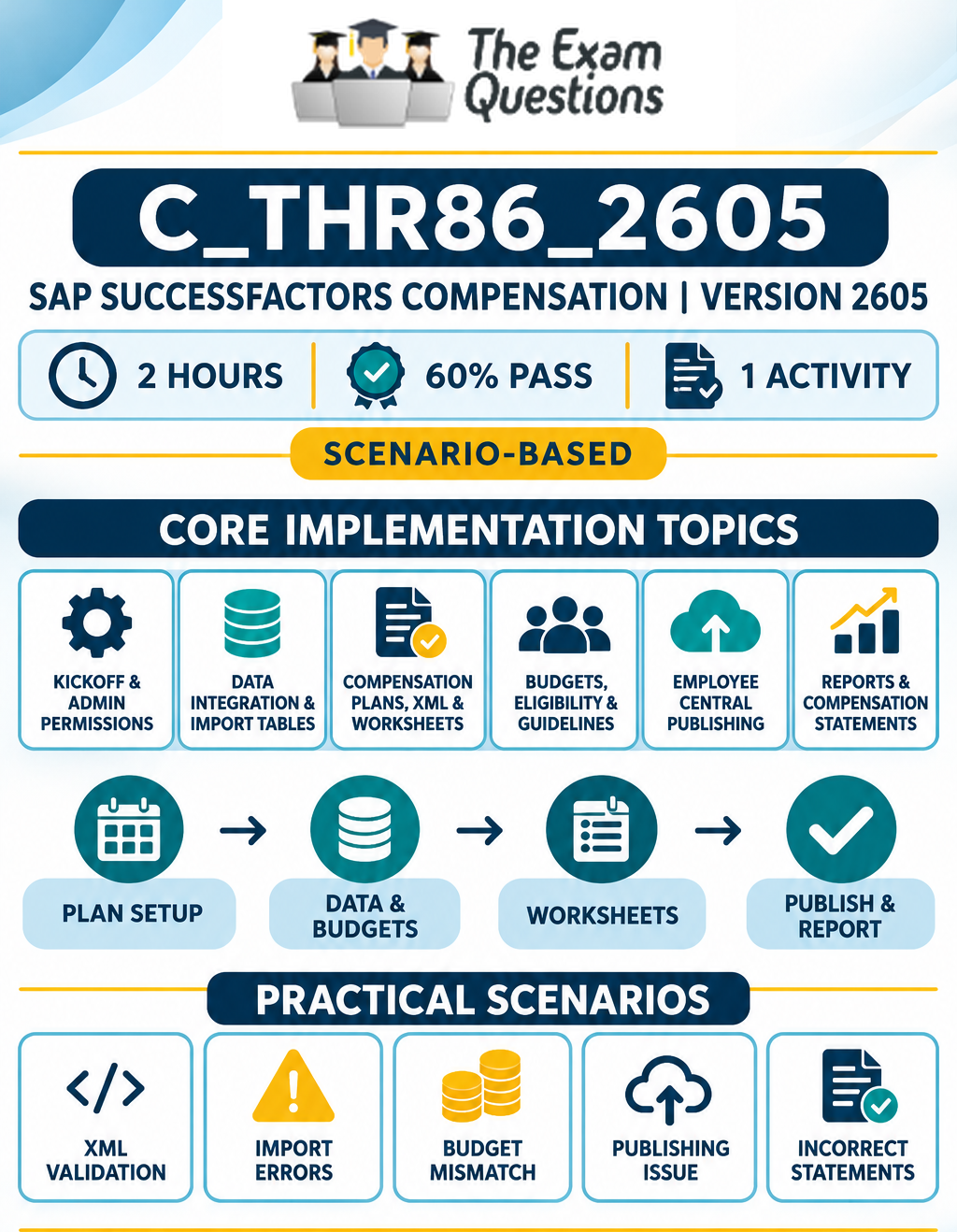
C_THR86_2605 is the version-specific label used for SAP SuccessFactors Compensation certification preparation. A structured plan that follows the implementation process builds practical knowledge across data, configuration, budgets, publishing, and reporting. This guide includes a six-session schedule with tasks, deliverables, and self-checks.
Introduction
A study plan works best when it mirrors the work. A compensation consultant studies the organization's policy, configures plans, checks employee data, sets budgets, and helps managers finish planning. Each stage affects the next. An employee data issue can change eligibility, worksheet populations, and final reports.
That connection shapes how to prepare for C_THR86_2605. Study the full compensation process, and use each configuration term as a step inside it.
Scope of C_THR86_2605
C_THR86 is the certification code for SAP SuccessFactors Compensation. The 2605 suffix appears in version-specific preparation material to point to one release of the exam, while SAP's own pages show the base code C_THR86. The certification validates fundamental knowledge for SAP partner consultants who implement the solution under the guidance of an experienced consultant.
Version scope matters because SAP updates certifications over time, and SAP indicates that a new exam version is expected in mid-December 2026. Match your study material to the version you plan to sit, and confirm it on SAP's certification page before booking.
The in-scope skill areas come from SAP's published competency information:
-
Plan settings and compensation plan guidelines
-
Compensation worksheets and route maps
-
Employee-specific data and import tables
-
Permissions, reports, and workflows
-
Compensation statements
-
Implementation testing
-
Employee Central publishing of approved results
Build your preparation around the implementation process
Start with business requirements. Ask what a consultant would ask before configuring anything: which employee groups join the review, whether promotions share the cycle, and who approves what.
Next, review employee data. Practise reading identifiers, employment status, effective dates, and compensation fields, and separate source-data errors from import-structure errors.
Then study plans and worksheets. Follow one manager through a worksheet: which fields appear, which are editable, and how a recommendation moves through approval.
Budgets, eligibility, and guidelines come after that. Budgets control spending, eligibility decides who participates, and guidelines frame manager recommendations. When a budget differs from expectations, identify the requirement and review the data before touching a setting.
Publishing follows approval. Approved results may flow to Employee Central, so understand data mapping, effective dates, and validation. Reports and statements close the loop: trace any unexpected figure to the approved worksheet result, employee data, and statement configuration.
A six-session preparation plan
Each session below fits in roughly 90 minutes. Finish every session with the same three-line note: what the configuration does, why the business needs it, and how you would confirm it works.
Session 1: Implementation requirements
-
Write a one-page project checklist covering employee groups, compensation components, budget rules, and approval owners.
-
List ten questions you would ask an HR stakeholder before configuring.
-
Deliverable: the checklist plus the question list.
-
Self-check: can you explain each question's purpose in one sentence?
Session 2: Employee data and imports
-
Build a small sample file with valid and invalid records.
-
Mark missing values, wrong identifiers, and formatting issues.
-
Write how you would read each validation message.
-
Deliverable: an annotated error log with a probable cause for every rejected record.
-
Self-check: can you sort each error into source data, mapping, or structure?
Session 3: Plans and worksheets
-
Review a sample compensation XML plan and name the purpose of each major section.
-
Study how the DTD supports structural validation and why an invalid structure needs correction before use.
-
Sketch a manager's worksheet journey from first view to submission.
-
Deliverable: an annotated plan outline and a worksheet flow diagram.
-
Self-check: can you point to where editable fields and approval steps are defined?
Session 4: Budgets, eligibility, and guidelines
-
Create two situations: a budget total that differs from the approved figure, and an employee missing from a planning population.
-
For each, list the data and settings you would review, in order.
-
Define a test that would confirm your correction.
-
Deliverable: two investigation sheets with ordered checks and a validation test.
-
Self-check: does your order start with the requirement and finish with validation?
Session 5: Employee Central publishing
-
Take one approved compensation change and trace its expected path to the employee record.
-
Record the mapping, effective date, and processing status you would verify.
-
Compare an approved result against the destination record in a sample.
-
Deliverable: a trace sheet showing each handoff and its evidence.
-
Self-check: what proof would show the update finished correctly?
Session 6: Reports, statements, and spoken review
-
Choose a statement with an unexpected figure and trace it back through worksheet results, employee data, and statement configuration.
-
Record yourself explaining the fix in two minutes: requirement, investigation, solution, validation.
-
Replay it and mark any vague sentence.
-
Deliverable: a two-minute recording and a list of three phrases to sharpen.
-
Self-check: does each sentence add a fact or a decision?
Preparing for the scenario-based assessment
SAP lists the assessment as scenario-based, with a two-hour duration, a 60% pass score, and one assessment activity. Candidates choose an AI-guided roleplay or a recorded video reviewed by an SAP evaluator. The AI evaluation looks at the meaning of responses against expert-defined criteria.
Lead each answer with the business requirement, name the configuration area, describe the investigation, and finish with validation. When asked why employees are missing from worksheets, walk through employee records, employment status, effective dates, and plan conditions in that order.
The SAP official certification page carries current assessment details and practice options.
Mistakes that weaken preparation
Studying features in isolation hides how a change in one area reaches others. Data quality deserves attention too, since a correct plan still produces odd results from incomplete employee records. Material from older exam versions may describe different content, so check the version first. Memorized answers fade under a changed scenario, while reasoning in your own words adapts.
Frequently asked questions
What does the version suffix mean?
It is a label used in preparation material to identify one release of the exam. SAP's pages display the base certification code.
Which subjects deserve priority?
Start with implementation requirements, employee data, plans, worksheets, budgets, eligibility, guidelines, Employee Central publishing, reports, and statements.
Is the assessment scenario-based?
Yes. SAP lists it as a scenario-based activity.
How long is the assessment, and what is the pass score?
SAP publishes two hours and a 60% pass score.
Does hands-on practice help?
Yes. Practical exercises show how configuration decisions reach employee data, manager planning, budgets, approvals, and results.
Should candidates memorize full answers?
Understanding the requirement and explaining a suitable solution works better. Practise communicating the reasoning behind each decision.
Conclusion
Preparation succeeds when each configuration concept connects to a business purpose and a validation step. Work through the six sessions in order, keep your deliverables, and revisit the sessions where your self-check felt weakest.
For more SAP SuccessFactors Compensation practice, visit The Exam Questions and browse the preparation material.