


How programmable liquidity is creating the next generation of stablecoin market infrastructure
Everyone is focused on launching stablecoins:
-
PayPal launched PYUSD.
-
Ripple launched RLUSD.
-
Revolut, Deel and Robinhood are all exploring stablecoin initiatives or related infrastructure.
-
In Europe, a consortium of major banks including ING, BBVA and BNP Paribas is working towards a regulated euro stablecoin.
-
In Japan, MUFG, Mizuho and SMBC are exploring stablecoin initiatives of their own.
-
Visa, Mastercard and Stripe are investing heavily in stablecoin infrastructure.
The market is preparing for more issuers. The next wave of stablecoin adoption will not be driven by a single issuer, it will be driven by an ecosystem of issuers of banks, fintechs, payment networks, exchanges and protocols. The question is no longer whether more stablecoins will exist.
The question is: What happens when there are hundreds of them?
Because the challenge facing stablecoins is no longer issuance. The challenge is building the liquidity and exchange infrastructure required for a multi-issuer stablecoin economy.
Stablecoins have quietly become one of the fastest-growing settlement layers in the digital economy. According to Chainalysis, stablecoins processed more than $28 trillion in economic transaction volume during 2025. They are no longer simply a crypto product, they are becoming critical financial infrastructure.
The growth of global value transfer is not slowing down, it’s actually accelerating. J.P. Morgan projects global cross-border payment flows will grow from approximately $194.6 trillion in 2025 to more than $320 trillion by 2032. SWIFT recently recorded the highest traffic volumes in its history, processing a record 68 million messages in a single day. At the same time, Bloomberg Intelligence projects annual stablecoin payment flows could reach $56.6 trillion by 2030. Banks are exploring digital currencies, and fintechs are building payment infrastructure around them.
The common theme is not competition, it’s scale. Money is moving faster, further and more frequently than ever before. The infrastructure supporting that movement must evolve to overcome the limitations of today's financial system. Spark, Uniswap and Sky have done just that.
This is not the launch of another liquidity pool. It is the first step towards building the exchange infrastructure a multi-issuer stablecoin economy will require. The stablecoin industry has spent years solving issuance. The next challenge is liquidity and exchange.
The next evolution is building the FX Layer for stablecoins.
Why Today's Liquidity Infrastructure Doesn't Scale
The stablecoin industry has spent years solving issuance. Today, the challenge is no longer creating digital dollars, it’s creating the infrastructure that allows them to operate efficiently at scale. As the number of issuers grows, so do the demands placed on liquidity infrastructure, for example, A payments company may settle using PYUSD. A trading firm may hold RLUSD. A bank may issue its own regulated stablecoin. An exchange may integrate multiple stablecoins issued by different providers. Every new stablecoin creates another isolated liquidity ecosystem. Each brings new liquidity requirements, inventory management challenges and trading relationships. As the market scales, capital becomes increasingly fragmented across venues, making execution more difficult and expensive.
The issue is not a lack of liquidity. It is a lack of coordination. Capital exists, but it is distributed across isolated pools, venues and ecosystems where it cannot be utilised efficiently. As the number of issuers grows, the challenge shifts from attracting liquidity to coordinating it.
The problem is no longer attracting capital, it’s deploying that capital efficiently. Solving that problem requires rethinking how liquidity itself works, not as a passive asset that sits waiting for trades, but as programmable infrastructure capable of adapting to the needs of a rapidly expanding stablecoin economy.
What Changed? Liquidity Becomes Programmable
For most of DeFi's history, liquidity has been passive. Capital enters a pool, it waits, trades occur and the pool responds. That model helped create some of the most important financial infrastructure in crypto, but it was designed for a world where liquidity pools primarily acted as trading venues.
The future stablecoin economy requires something different. As issuers, assets and liquidity requirements multiply, liquidity itself increasingly becomes infrastructure. This is where Uniswap v4 changes the equation with the introduction of hooks. Built on one of DeFi's most battle-tested liquidity infrastructures, processing more than $4.4 trillion in cumulative trading volume, Uniswap provides the foundation for the next generation of programmable liquidity. Hooks allow custom logic to be embedded directly into the behaviour of a pool. The DualPool hook is one execution component within Spark's wider Shared Liquidity Layer (SLL), with Spark's governance-defined allocation frameworks determining how liquidity is coordinated across approved venues and products, while the hook provides the programmable execution path. At first glance, that sounds like a technical upgrade, but in reality, it represents a fundamental shift in how liquidity infrastructure can be designed.
For the first time, not only liquidity, but the rules governing liquidity and inventory management become programmable. Pools can operate according to predefined objectives rather than static (isolated) parameters alone. This means inventory can be managed more intelligently, with economic policies embedded directly into infrastructure. Liquidity can adapt as market conditions evolve. For example, consider a traditional stablecoin pool holding $100 million of liquidity. Whether that pool processes $1 million or $100 million of trading volume, much of the underlying inventory remains idle between transactions despite being required to support liquidity.
Programmable liquidity introduces a different model. Rather than treating liquidity as static / idle inventory, hooks create the potential for that capital to remain productive whilst continuing to support liquidity and execution. In practice, this means liquidity no longer sits idle waiting for trades. When capital isn't actively required for market execution, Spark can coordinate it across governance-approved products, liquidity venues and deployment strategies within the wider Spark ecosystem, with the DualPool hook making liquidity available to the market the moment it is required for execution.
At this point, pools stop being passive venues, they become systems themselves. The significance is not any individual feature, the significance is that liquidity itself becomes programmable. And once liquidity becomes programmable, a new question emerges:
How should programmable liquidity behave?
The Missing Piece: Coordination
Programmable liquidity creates a new possibility, but it also creates a new challenge. Uniswap v4 solved one of the hardest problems in DeFi by making liquidity programmable. The next challenge is determining how that programmable liquidity should behave. What objectives should it optimise for? How should inventory be allocated? What happens during periods of market stress? What safeguards protect liquidity providers and users?
The difficult challenge is governing programmable liquidity. This is where Spark enters the picture. This is precisely the problem Spark has spent years solving, coordinating billions of dollars of liquidity across savings products, lending markets and liquidity infrastructure while balancing capital efficiency, liquidity and risk.
Today, that expertise is applied through governance-defined allocation frameworks, risk parameters and one of the most extensive five-layer loss absorption frameworks in DeFi. Backed by the scale and resilience of the broader Sky ecosystem, Spark provides the coordination layer that allows programmable liquidity to operate efficiently at scale.
This is not a theoretical exercise. Managing capital allocation, liquidity and risk across multiple products is already Spark's core competency. Programmable liquidity simply extends those same principles into market infrastructure itself. For institutions, treasuries and large allocators, the objective is simple: improve capital efficiency without compromising liquidity, execution or risk management. The opportunity is not to increase risk. It is to reduce inefficiency through better coordination of liquidity and inventory.
For example, imagine a future where Robinhood launches a stablecoin for brokerage customers, Revolut launches a stablecoin for global payments, and PayPal continues expanding PYUSD.
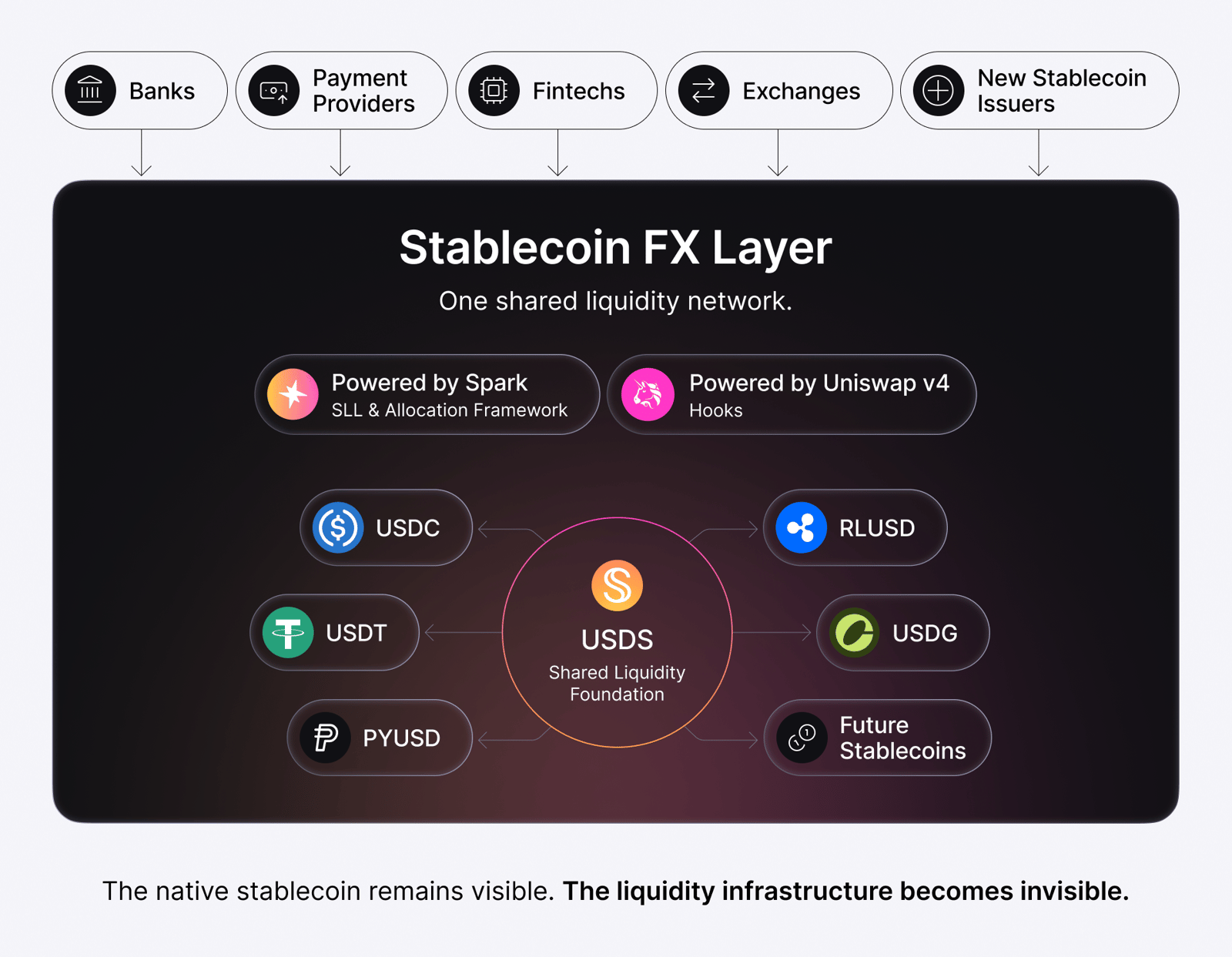
Each issuer wants users, distribution and settlement capabilities. Few want to spend years coordinating liquidity infrastructure, managing inventory across venues or bootstrapping market depth. Instead, they connect into shared liquidity infrastructure coordinated by Spark and powered by Uniswap.
The user continues interacting with the issuer's native stablecoin. The liquidity infrastructure operates beneath the surface. Capital can be allocated according to predefined objectives. Liquidity can be directed where demand is highest. Capital can remain productive while continuing to support market depth and execution.
The stablecoins remain visible. The infrastructure becomes invisible. The significance is not that liquidity can follow code. It is that liquidity can operate according to predefined objectives, risk parameters and inventory policies that respond to changing market conditions. That transforms liquidity from a passive asset into coordinated infrastructure.
The First Deployment
Every new piece of financial infrastructure starts with a first market. For the Stablecoin FX Layer, the initial deployment brings together USDS, USDT and PYUSD liquidity, with USDS providing the initial liquidity foundation across the network. Sky operates one of the largest stablecoin ecosystems in DeFi. With billions of dollars across USDS, DAI and associated savings infrastructure, it provides the scale and liquidity required to serve as the foundation for the deployment of the Stablecoin FX Layer.
This scale matters. The future stablecoin economy will require deep, reliable liquidity capable of supporting growing numbers of users, institutions, payment providers and stablecoin issuers. Any shared liquidity framework requires a strong foundation, and USDS provides that foundation as the initial quoting asset within the network.
The first step is the migration of approximately $150 million of liquidity to Uniswap v4 across the USDS/USDT and USDS/PYUSD pools, representing one of the largest AMM liquidity migrations in DeFi. The immediate benefits are straightforward:
-
Deeper liquidity.
-
Lower execution costs.
-
Reduced slippage.
-
Improved market depth.
This makes USDS one of the easiest stablecoins to acquire, trade and integrate at scale. But the significance extends beyond a single pool. The migration establishes the first large-scale implementation of programmable liquidity coordinated through Spark and powered by Uniswap v4 for multiple pools.
It demonstrates how liquidity can be managed according to predefined objectives, inventory policies and risk frameworks rather than remaining entirely passive. Most importantly, it establishes the foundation for what comes next. A future where additional stablecoin ecosystems can connect into shared liquidity infrastructure rather than independently rebuilding liquidity from scratch.
Building the Stablecoin FX Layer
The long-term opportunity extends far beyond a single pool, a single stablecoin or a single issuer. The stablecoin industry is moving towards a future where banks, fintechs, payment providers, exchanges and protocols all operate their own digital currencies and stablecoin ecosystems. PayPal has already launched PYUSD. Ripple has launched RLUSD. Robinhood, Revolut, Deel and major banking consortiums across Europe and Asia are actively exploring stablecoin initiatives of their own.
The Stablecoin FX Layer introduces a different model.
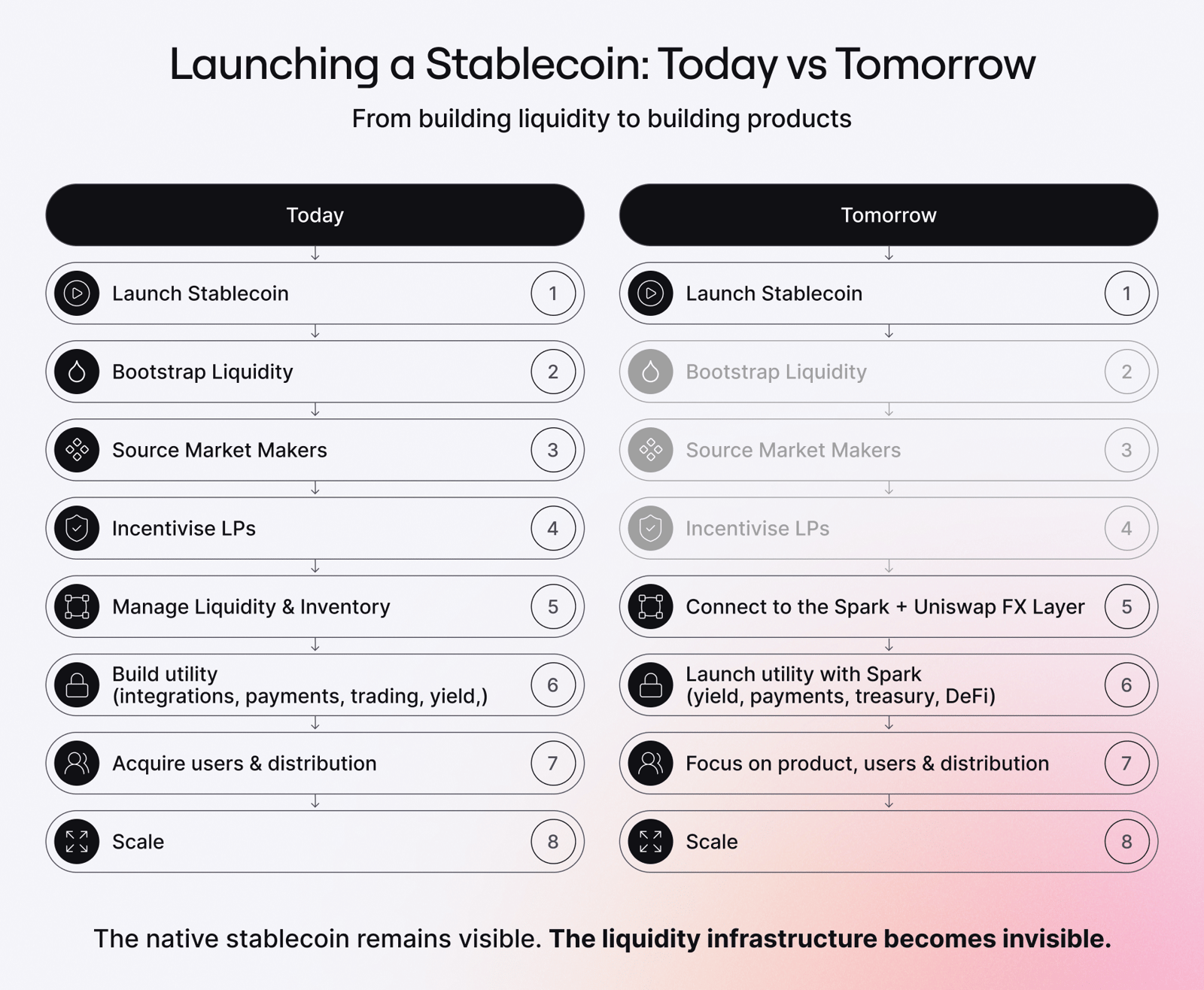
Rather than every ecosystem independently rebuilding liquidity from scratch, issuers can connect into shared liquidity infrastructure built on programmable liquidity, coordinated inventory management and predefined risk frameworks. Removing the need to bootstrap independent liquidity networks allows issuers to focus on what differentiates them; products, distribution and users. They will be able to directly connect into a shared liquidity infrastructure coordinated by Spark and powered by Uniswap.
In this model, USDS provides the initial liquidity foundation for the network, while future implementations extend that shared liquidity infrastructure to additional issuers and stablecoin ecosystems. The issuer's stablecoin remains visible to the user. The liquidity infrastructure becomes invisible, and every additional issuer strengthens the network expanding available liquidity, improving market efficiency. This is where network effects begin to emerge.
At the same time, the market is increasingly converging around a second requirement: yield.
Fintechs, payment providers and financial institutions are not simply looking for digital dollars. They are increasingly looking for digital dollars capable of generating returns linked to short-term interest rates such as SOFR, while retaining the liquidity, accessibility and settlement capabilities users expect.
Historically, institutions have often faced a trade-off between liquidity and productivity. Capital could either remain liquid and available for use, or be deployed into productive strategies designed to generate returns. The next generation of stablecoin infrastructure aims to narrow that gap. The Spark, Uniswap and Sky programmable liquidity infrastructure creates the potential for capital to support liquidity, settlement and yield generation simultaneously within predefined allocation frameworks and risk parameters. Rather than leaving inventory idle between transactions, future implementations may allow liquidity to remain productive while continuing to support market depth and execution.
The first step starts with the migration of approximately $150 million of liquidity across the USDS/USDT and USDS/PYUSD pools. The long-term vision is far bigger. Not another stablecoin, not another liquidity pool, but a shared FX and liquidity layer capable of connecting hundreds of stablecoin issuers through programmable infrastructure.
That is the infrastructure the next generation of digital finance will require.