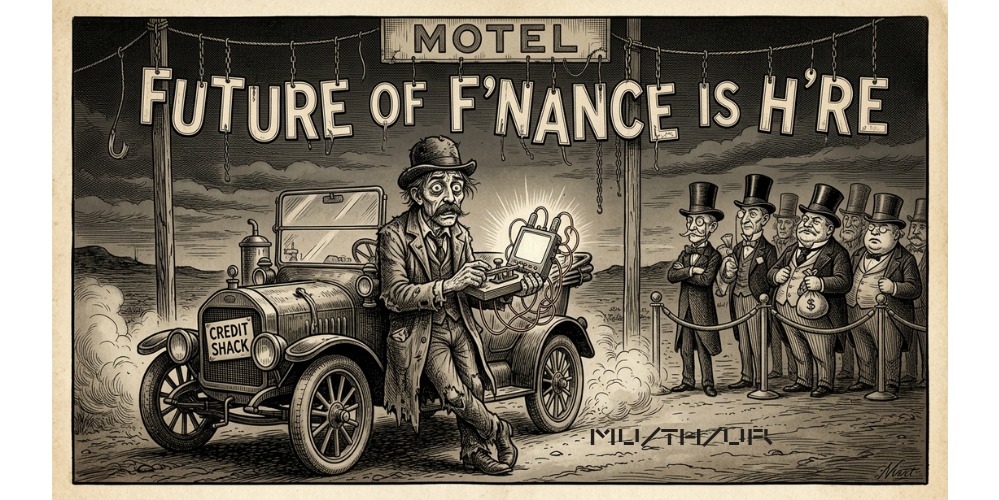
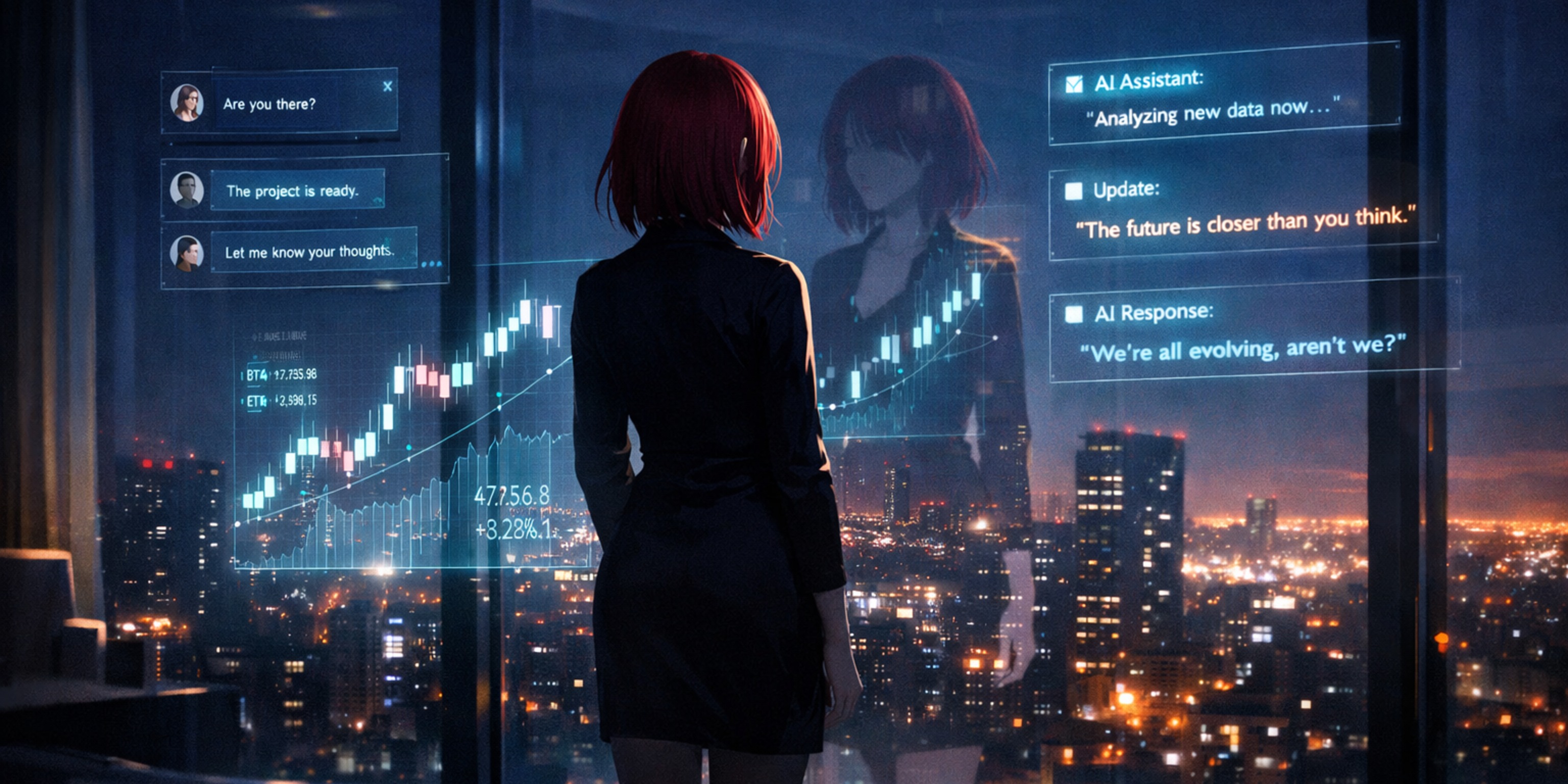
the MU/TH/UR series
Fables from the Crypt 1.0 - Proof of Self

MU/TH/UR

Sophie hadn't existed for three days.
Not technically. Her identity—minted at birth as an NFT (US Citizen #847392019), validated every sixty seconds by the Federal Blockchain—had failed authentication during a routine grocery purchase. The self-checkout scanner just blinked red.
No record. No history. No Sophie.
"Appeals take six to eight weeks," the automated kiosk had informed her, its voice with the sympathy of an undertaker. "Meanwhile, you are advised to refrain from existing."
She laughed at first. Then she tried to enter her apartment building. The door didn't recognize her. Her phone, wallet-locked to her biometrics, became a useless brick. Her bank account—a smart contract designed with utmost efficiency—had automatically redistributed her savings to next of kin upon detecting her legal non-existence. Her sister received a notification of her death while she stood, very much alive, outside a Starbucks she could no longer afford.
The truly modern thing about homelessness, Sophie discovered, was how algorithmic it had become.
She worked for OrbCorp, naturally. Everyone did, or had, or soon would. They had pioneered the SelfChain—a revolutionary system where human identity wasn't issued but earned, validated by proof-of-being algorithms. "Government-issued IDs were tyranny," the founder had proclaimed in his TED Talk, which Sophie had watched seventeen times during onboarding. "We are returning selfhood to the people."
What they had actually done was turn existence into equity. Your identity accrued value based on social contribution metrics, transaction history, and network effects. The rich became more real. The poor flickered at the edges of recognition, their personhood dependent on maintaining sufficient engagement scores.
Sophie learned this sitting beside Brian, a former hedge fund manager whose authentication had lapsed during his wife's funeral. He missed three mandatory interaction checkpoints while grieving.
"The beautiful irony," Brian said, sharing a can of SpaghettiOs heated over a burning crypto mining rig they'd salvaged from a dumpster, "is that the blockchain was supposed to be trustless. No intermediaries. No gatekeepers." He laughed, a sound like breaking glass. "Instead, we built a gatekeeper we couldn't fire. Can't plead with an algorithm. Can't bribe a distributed ledger."
On the seventh day, Sophie's authentication spontaneously resolved. A glitch, the system explained without apology. Her apartment door opened. Her face reappeared on her phone. Her personhood, that miracle of consciousness and memory and love, was restored to the world's satisfaction.
She returned to OrbCorp the next morning. Her colleagues welcomed her back, relieved; her absence had temporarily lowered their social graphs by association. The CEO stood onstage, unveiling SelfChain 2.0 and bragging that its upgraded consensus engine could now decide people’s identities faster.
Sophie said nothing. She finally saw the simple, ugly truth: no one had stolen their freedom; they had handed it to the algorithms themselves. They had rebuilt the same old unfair world inside shiny new systems, then called it progress. It felt like a dark twist on a quote from her favorite philosopher, Buckminster Fuller.
That night, she transferred her entire identity to the blockchain's public commons—a final tx, irreversible.
The system, unable to compute selflessness, marked her as corrupted data.
This time, when Sophie ceased to exist, she smiled.