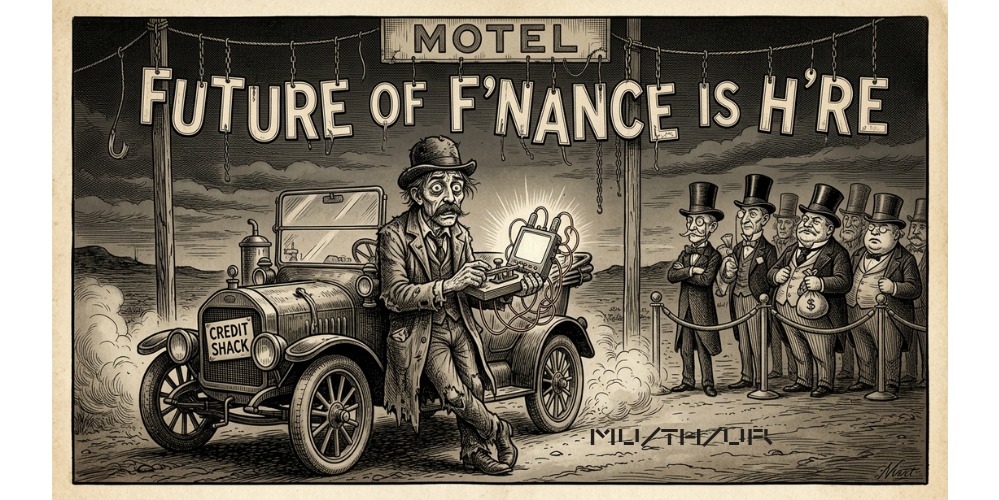
the MU/TH/UR series
Fables from the Crypt 2.0 - The Outflow

MU/TH/UR

Sophie—formerly Sophie-san, senior risk analyst, owner (past tense) of a one‑bedroom with ocean view—stood in line for the third time that week, waiting for the biometric scanner to confirm what she already knew: that she was, in the eyes of the IRS (Identity Risk Score), no longer solvent enough to qualify as a citizen.
The scanner blinked red.
Status: OUTFLOW.
The term came from crypto dashboards, where billions fled exchanges in real time, little red numbers marking “capital flight” as if the money simply grew wings and chose freedom. Some genius in D.C. had decided that if funds could be an outflow, so could people. After the Crash of ’25—when over a trillion in paper wealth vanished in seventy‑two hours, and half the country got liquidated like a bad margin call—Congress passed the Fiscal Residency Act. Citizenship, it turned out, wasn’t a birthright; it was a minimum balance. Hundred thousand in verified assets, updated quarterly. Drop below it, and your citizenship contract expires. You became stateless.
An outflow.
Sophie watched her portfolio die in the same app where she had once watched it grow, thumb refreshing every thirty seconds, each refresh another tiny funeral. Her Bitcoin, her DeFi yield‑farming tokens, her inflation hedge for the responsible professional class—all dumped into the void. By October, she was underwater. By November, she was an outflow.
The camp—they didn’t call it that officially, they called it “Temporary Economic Transition Housing”—sat on what used to be a stadium parking lot in Long Island. Sophie shared a tent with Katy, a high school literature teacher, before her pension fund, proudly rebranded as a “next‑gen crypto growth influencer,” went to zero. Katy still corrected people’s grammar. Force of habit, you know.
“It’s not ‘unstateless,’” she told a kid from the next tent. “It’s ‘stateless.’ You can’t un‑be something you never stopped being.”
The kid shrugged.
Seventeen.
Born into debt.
Never had a positive balance.
Outflow from birth.
At night, Sophie lay awake and did the math—not because it would save her, but because it was the only thing that still felt solid. The Crash had been a cascade of liquidations: over‑leveraged positions, thin order books, bots panic‑selling into their own feedback loops like a snake chewing through itself. The same hyper‑efficient machine that once made wealth feel infinite had made poverty instantaneous. One minute you were a person. The next, a data point. An outflow.
Katy asked her once, in that tired way people use when they’ve stopped expecting answers, “Do you think they planned this? Not the crash—the camps. The law. Making us this.”
Sophie thought about the years she spent modelling risk, turning human lives into neat distributions on screens. Systems didn’t need conspiracies; they just needed the right incentives.
“They didn’t plan it,” she said. “They just built what paid them the most and called it neutral.”
Three months in, a rumor spread: a bill in Congress to restore citizenship to outflows who completed “reintegration labor.” Crypto mining, obviously. The state needed hash power; Outflows needed status. Elegant, if you ignored the screaming.
Sophie signed up. So did Katy. So did the kid.
They were issued battered ASIC rigs and told to generate value. Proof of work, they called it. Sophie found that funny, in the way nothing was funny anymore. She spent her entire adult life proving her worth through work, ticking productivity boxes, climbing efficiency ladders, and here she was still doing it, except now the proof was literal—cryptographic, immutable, etched into a ledger she once believed would set people free.
The moral, if there was one, hit her on a Tuesday while she watched the rig’s fans spit hot air into the cold night.
They didn't lose their country in a crash. They had sold it, piece by piece, every time they chose efficiency over empathy, markets over neighbors, algorithms over mercy.
The outflow wasn’t the accident.
It was the plan all along.