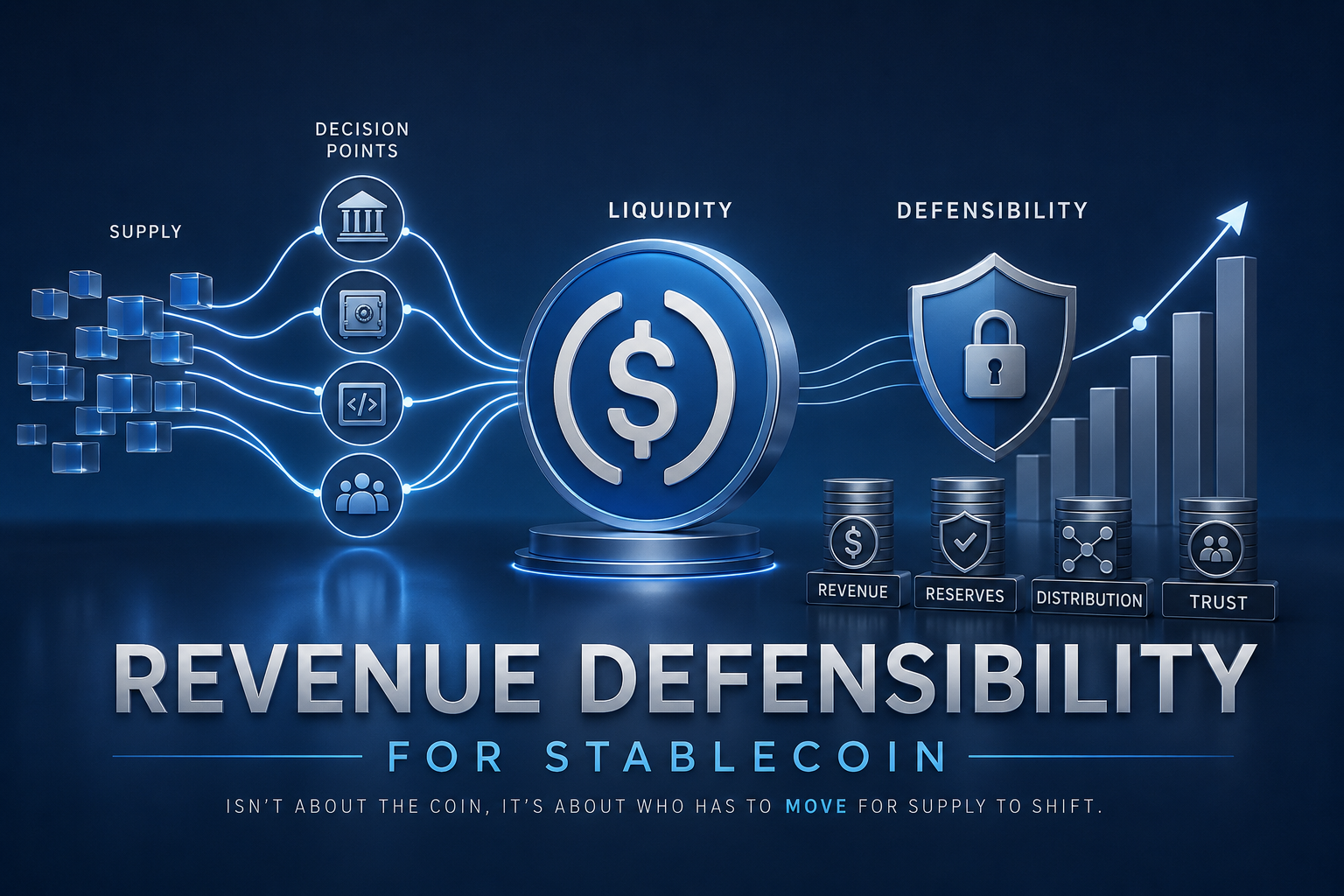
Most conversations about stablecoin defensibility start and end with the holder. USDT has a huge base of wallets, so it's sticky. USDtb sits inside Ethena's treasury as one line item among several, so it's fragile. Both are true, and both are really the same observation stated twice: a stablecoin's moat gets treated as a function of how many people hold it.
Wrong unit of analysis. Stablecoin supply sits behind four different kinds of decision-maker: the individual holder, the treasury allocator, the platform governor, and the protocol integrator. Each one faces a completely different cost to switch, and that cost, not the wallet count sitting on top of it, decides whether a stablecoin's revenue is defensible or one signature away from evaporating.
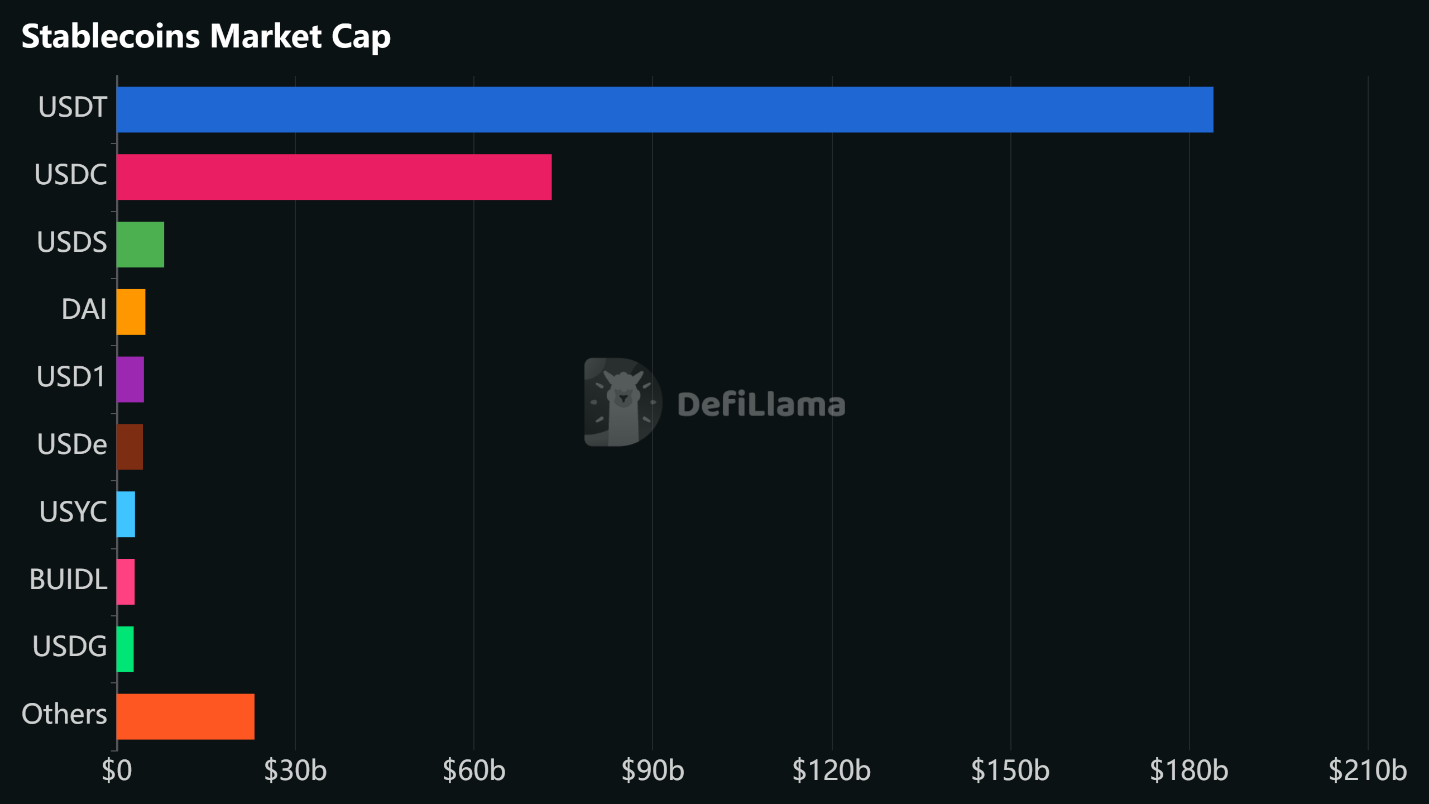
[Stablecoins Market Cap bar chart — USDT vs USDC vs rest, overall market]
Start with the individual holder, because USDT is the cleanest version of a distributed, high-friction base. Tether's own economics team reported 109 million on-chain wallets holding a nonzero USDT balance as of late 2024, more than double the number of wallets holding bitcoin (Tether Insights, December 2024). Worth flagging on the way past: that's the issuer measuring its own dominance, not an independently audited figure, and outside trackers using different chain coverage and holder definitions have landed on materially smaller counts for the sector as a whole. Even taking the conservative end of that range, USDT's base is enormous and, more importantly, thinly connected to any actual exit ramp. Direct fiat redemption requires account verification and a minimum of $100,000, so almost none of those wallets were ever plugged into Tether's primary market at all. They get dollars through an exchange, at a spread, on a platform they already trust. Switching away from USDT in Lagos or Buenos Aires isn't a token swap. It's re-onboarding to a new venue and hoping whoever you're paying will take what you're now holding instead of what they're used to.
That second part is the actual moat: defensibility held jointly by the wallet and whoever's willing to receive it. A two-sided network effect that a 200-basis point yield bump on some competitor does nothing to touch, because the person holding USDT in that corridor was never optimizing for yield in the first place.
Now the opposite end. Ethena's USDtb, backed overwhelmingly by BlackRock's BUIDL, was built as a shock absorber, so that when funding-rate stress hits USDe's peg, the protocol can rotate backing out of delta-neutral exposure into treasury-backed reserves instead. Not theoretical: during the 2024 funding compression, Ethena's stablecoin and tokenized-treasury share of backing rose as the rotation happened in real time. Fickle, exactly as advertised. But look at what makes it fickle. The decision-maker isn't a wallet, it's a risk committee looking at a dashboard, and the switching cost hasn't hit zero so much as it's been compressed onto one node instead of spread across millions. That produces a dynamic nobody talks about enough: concentrated-decision stablecoins don't just have thinner moats, they have winner-take-most flow, where whoever posts the best terms, this quarter gets the full allocation rather than a proportional slice. USDT erodes at a trickle, if it erodes at all. USDtb-style backend allocations can lose an entire position between two governance cycles.
The case that breaks the simple holder-versus-treasury frame is Hyperliquid's USDH, and it's underused because it only fully resolved two months ago. September 2025: Hyperliquid ran an on-chain validator vote to pick a native stablecoin issuer, explicitly to redirect the reserve income on its USDC deposits, estimated by outside analysts at the time to be worth somewhere between $150 million and $220 million a year, back into the platform instead of letting it flow to Circle. Eight bidders competed. Paxos offered 95 percent of yield back to the ecosystem, Frax and Agora offered 100 percent. Native Markets won anyway, with a smaller 50/50 split between HYPE buybacks and ecosystem growth, taking over 70 percent of delegated validator stake.
Eight months later, the result reversed. USDH's supply stalled around $100 million while USDC on the same platform grew to roughly $5 billion. Circle and Coinbase came back in May 2026 with an arrangement called AQAv2 that matched USDH's own yield-sharing structure, and Hyperliquid confirmed USDC as the quote asset across its markets going forward, with Circle handling minting, redemption, and cross-chain infrastructure. Analysts estimated the new deal shares somewhere between $135 million and $160 million a year back to the protocol, with room to grow well beyond that if stablecoin balances on the platform keep expanding.
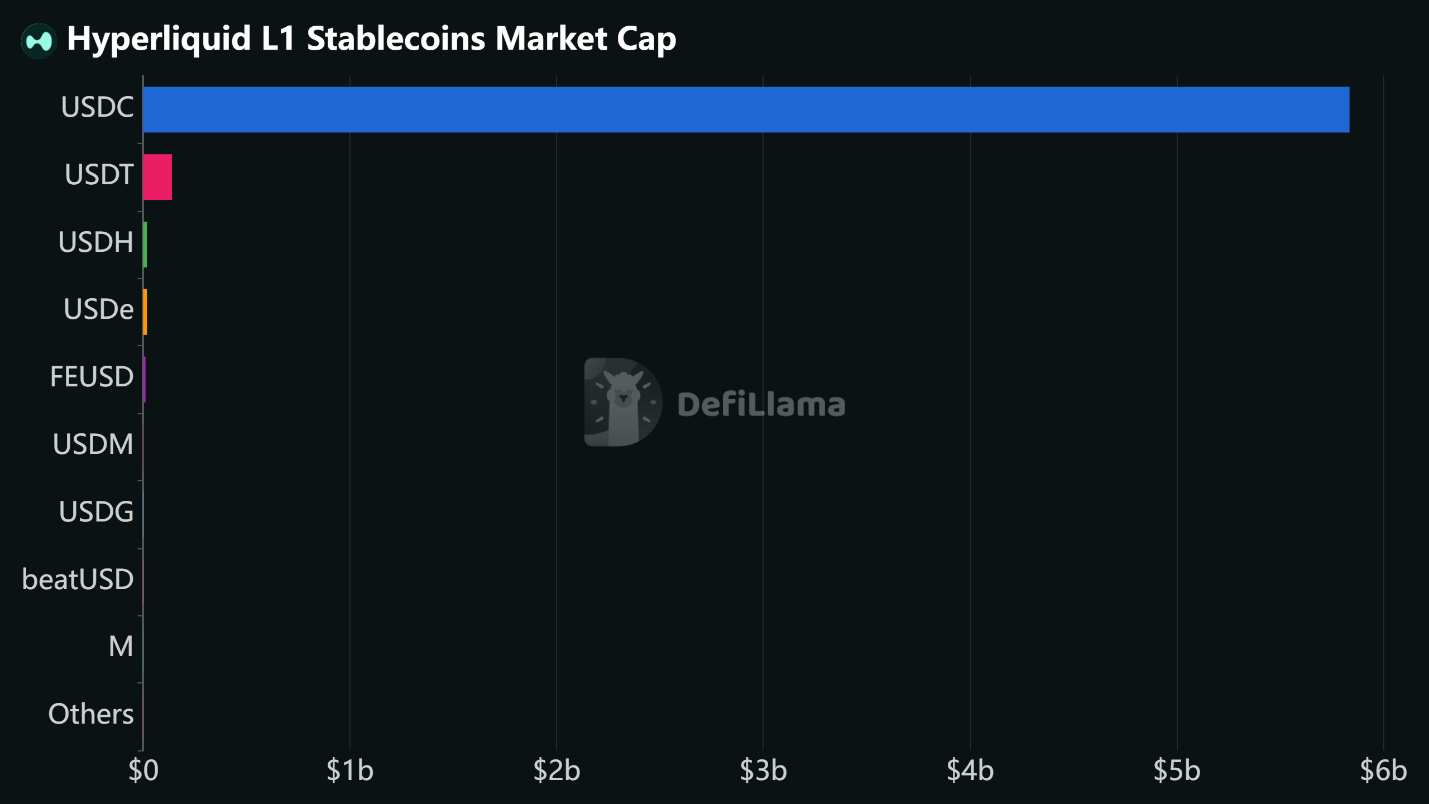
[Hyperliquid L1 Stablecoins Market Cap bar chart — USDC dwarfing USDH]
The vote had assigned a ticker. It hadn't manufactured liquidity, and liquidity was what actually mattered to the market makers who'd already built inventory and spreads around USDC, and to the traders who route around a thin book no matter what a validator vote says.
This is where the piece needs to be more careful than "switching is cheap; therefore, the moat is weak." That claim and "the moat is weak, therefore revenue is at risk" sound identical and aren't. The mechanism connecting them is contestability, not churn. Circle didn't need Hyperliquid's validators to actually vote USDC out to feel the pressure. The credible threat of losing the mandate is what forced Circle and Coinbase to offer a yield-sharing deal they'd never had to offer on undifferentiated USDC deposits before. Nobody switched. USDC never lost its position. Circle's margin on that flow still compressed, because a serious enough exit option does the same work as an exit, whether or not anyone actually walks. Closer to Bertrand competition than to customer churn, and a more precise way to say what a thin moat actually costs an issuer: not necessarily lost volume, but lost pricing power over the terms attached to the volume it keeps.
Underneath all three of these sits a fourth category that shows up nowhere in supply concentration data: collateral embedded inside lending markets. New assets going onto Aave sit through deferred technical and risk reviews from independent risk managers before approval, then get placed into isolation mode or e-mode categories that fix exactly what they can be borrowed against. Once something like sUSDe becomes reference collateral across several correlated-group configurations, replacing it isn't a vote. It's a re-underwriting project across every venue built on top of it.
A skeptical reader should ask for the concrete version of that claim, so here it is. In March 2023, days after USDC briefly depegged during the Silicon Valley Bank collapse, MakerDAO's own Risk Core Unit proposed diversifying DAI's collateral away from USDC and into GUSD and USDP. Governance voted it down, by contemporaneous reporting on the result 79 to 21, with the risk sitting in plain view the whole time. Actually, reducing USDC's share of DAI's backing, from roughly 50 percent down to single digits, took most of a year and ran through gradual substitution into real-world-asset vaults rather than a clean swap; DeFiLlama's own historical collateral data on the protocol shows USDC dropping from over $2 billion in the Peg Stability Module in early 2023 to under $500 million by that August.
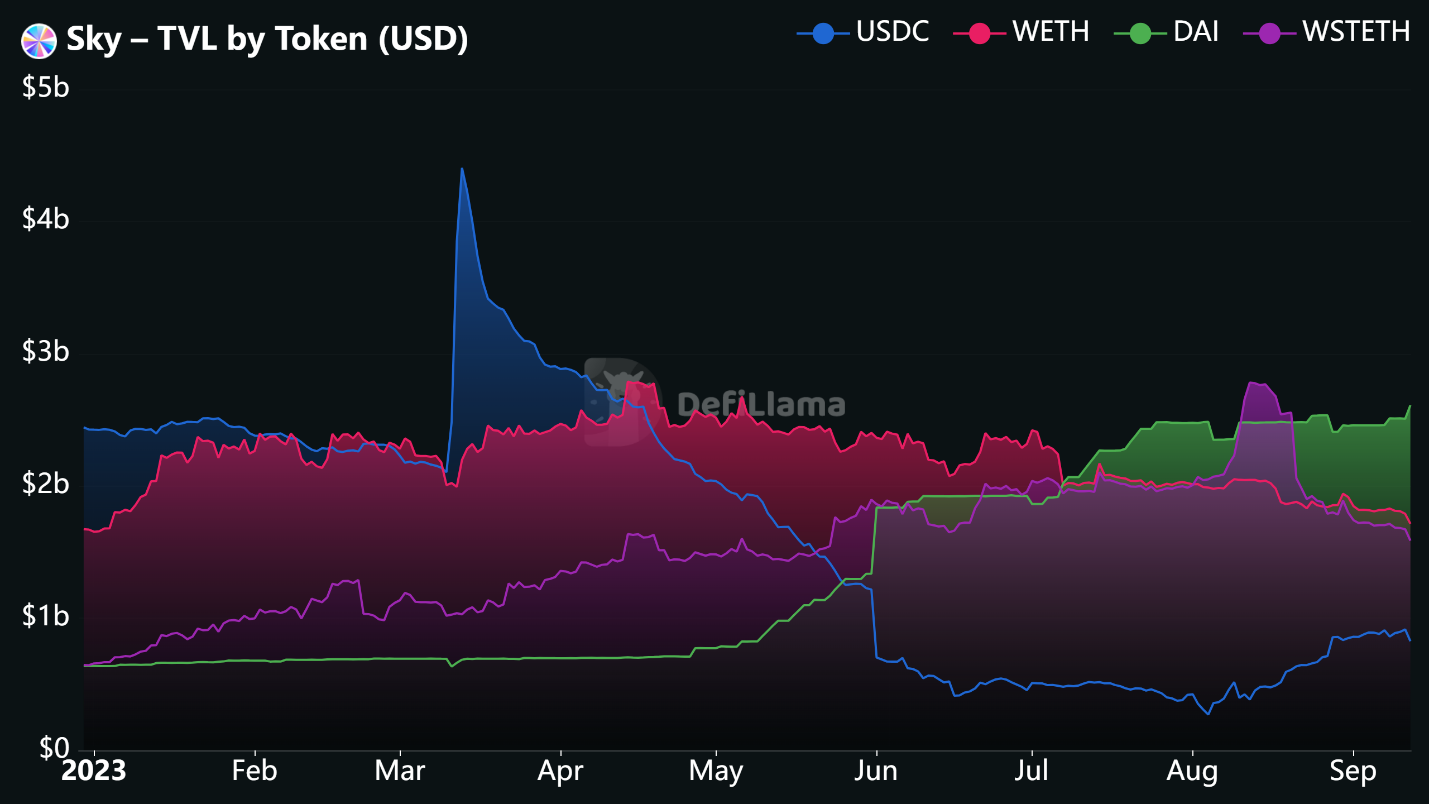
[Sky/MakerDAO TVL breakdown by token — USDC, WETH, DAI, WSTETH, Jan–Aug 2023]
That's the "treasury allocator" archetype, the one this piece elsewhere describes as having near-zero switching cost, failing to execute a switch quickly even with the risk fully visible. Any decision-maker's switching cost has a floor set by whether a redundant replacement already exists with comparable depth, and when it doesn't, even a single governance vote runs into the same wall a million retail wallets would.
Put these together and supply concentration alone stops telling you much. A stablecoin held in three wallets could have a thinner moat than one spread across three million, if those three wallets are treasuries that can reallocate on one signature and the three million are savers with no real alternative venue. Call the actual dimension decision-point concentration: how many economically independent actors would need to coordinate to move a meaningful share of outstanding supply, counting only actors who control that decision themselves rather than intermediaries executing it on their behalf. A hundred million retail wallets routed through three custodians aren't a hundred million decision points. They're closer to three.
A decision-weighted concentration index, using decision points rather than wallets as the unit, the same math as a Herfindahl index with a different denominator. The share of outstanding supply that could move within a single governance vote or API call, which would have flagged USDtb's fragility and USDT's durability from the same underlying data months before either mattered. Distribution entropy computed by decision-maker class rather than by address: self-custody retail against DAO treasury against CEX float against lending-market collateral pool. And the share of supply held by actors with a fiduciary obligation to diversify versus discretionary holders free to chase yield wherever it goes, since the first group's switching cost includes a legal duty the second group doesn't carry.
One prediction worth stating plainly, since the framework should be falsifiable: any stablecoin whose distribution depends on a governance mandate rather than liquidity it built itself will lose share back to the incumbent within a year, the moment the incumbent is willing to match the mandate's economics. USDH is the first clean test case, and it already played out the way the framework would have predicted before the reversal happened, not after. The vote can assign the ticker. It can't assign the depth.