(disclosure: this is my entry for the AirdropBuzz Creator Campaign. nobody from AirdropBuzz saw it before it went up, and nothing here is financial advice.)
I went through AirdropBuzz's public pages this week because a "risk checker for airdrop links" is the kind of tool I'd want open in another tab before I connect a wallet to anything. This is what the site is, what you get without paying, and one thing about the scores that confused me until I read the fine print.
Everything below comes from the public pages on airdropbuzz.com as of October 10, 2026. Where I haven't run something myself yet, I say so.
What AirdropBuzz is
AirdropBuzz describes itself as a crypto airdrop research and discovery site. In practice it's four things stacked together:
-
Airdrop guides, each with a "Potential Score" from 1 to 100.
-
Airdrop Updates, a dated log of changes to those guides.
-
Market Pulse, a rule-based market tracker.
-
Safety tools, including the AI Airdrop Risk Checker and an older Airdrop Risk Scanner.
There's also an iOS and Android app, a newsletter and a daily $BUZZ check-in. Skipping those here.
Airdrop Updates: the part I'd actually use most
Airdrop campaigns change after launch. Links move, tasks get swapped, eligibility rules show up late. The Airdrop Updates page records a note whenever AirdropBuzz makes a meaningful change to one of its guides. Each note has the date, what changed and a link to the updated guide. Small edits are excluded. When I checked, it listed 88 updated guides, with the newest notes dated Oct 10, 2026.
This is more useful than it sounds. If you saved a guide two weeks ago, you can see what changed before you redo a task or follow an old link. Their editorial policy says material guide revisions get a public "What changed?" note, so this page is the archive of those notes.
The Potential Score and the Opportunity Scoreboard
The Opportunity Scoreboard ranks active airdrops. When I looked it said 98+ active published airdrops were tracked. The score is explained on the "How We Score Crypto Airdrops" page. It mixes fundamentals, traction, task quality, risk signals and time-to-value, with a "heavy safety bias". The bands are:
| Score | Label |
|---|---|
| 80-100 | High signal |
| 50-79 | Promising |
| 1-49 | Caution |
The page says risk signals can cap the score, and that things like strict KYC, geo-blocking or expensive on-chain steps lower it. It also says plainly that the score is not a promise of rewards and that sponsored listings don't affect it. I can't verify the second part from the outside. It's their stated policy.
Market Pulse, briefly
Market Pulse is a rule-based market tracker. The page says it updates every 2 hours, and it uses Binance spot data, support/resistance levels and a Fear & Greed reading. I don't do market reads, so I won't judge it. One thing I liked: it publishes its own follow-through numbers. When I checked, the 2H, 4H, 12H and 24H follow-through rates were all between 48% and 50%, and the page labels that "Mixed follow-through". A tool that shows its own coin-flip stats instead of hiding them gets a bit more trust from me. The page also says it's market information only, not a promise of returns.
The AI Airdrop Risk Checker
This is the tool the campaign points to, so here's what the page actually says.
You paste an airdrop or project link and get an "AI-powered risk snapshot" before connecting a wallet. The checker looks for:
-
risky domains and fake brand domains
-
suspicious reward claims
-
wallet-action warnings (signatures, approvals)
-
unclear task costs
-
missing official-source signals
You need an account to use it. Anonymous visitors can read how it works, but can't scan URLs or see scan history. Registered users get 3 free scans per day and a private scan history. The FAQ says clearly that it can't guarantee a project is safe and calls it a "heuristic risk snapshot for research".
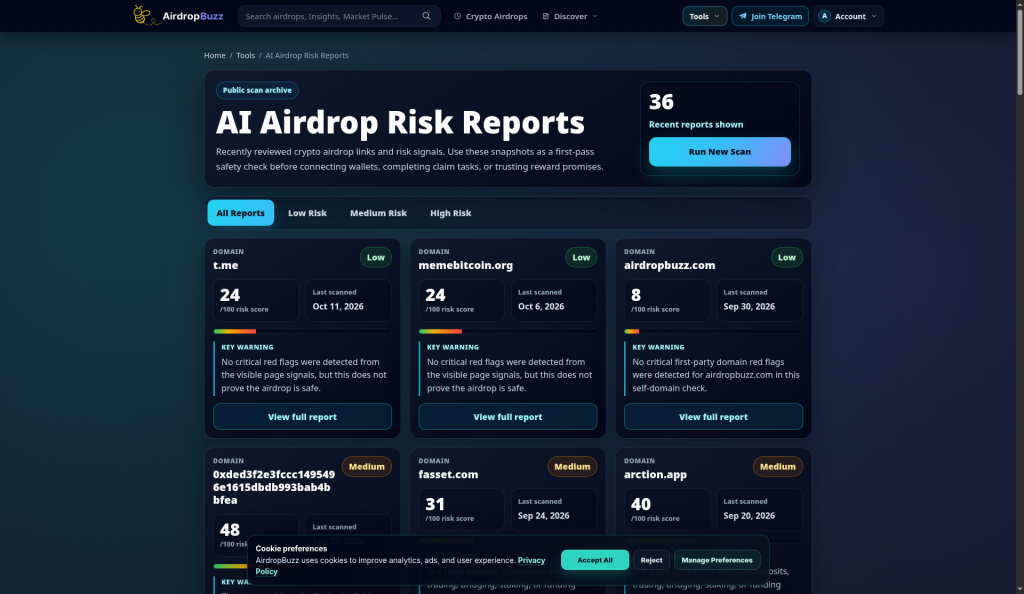
Some scans also become public reports. The AI Airdrop Risk Reports page had 36 recent reports when I checked, each with a domain, a risk score out of 100, a risk level and a key warning.
The thing that confused me: two tools, two opposite scales
AirdropBuzz has two scanners, and their numbers mean opposite things.
Airdrop Risk Scanner (MVP) at /tools/airdrop-risk-scanner is the older, lighter one. It checks HTTPS and basic security headers, domain age and registrar, whether there are docs/team/audit pages, official social links, and over-the-top "guaranteed" APY language. Its page says: "Higher scores imply stronger 'legit' surface signals." So on this one, high is good.
AI Risk Reports show a "/100 risk score". There, high is bad. 100/100 is labeled Critical.
Same domain, both tools: t.me showed up as 100/100 "Low" in the MVP scanner's recent scans, and as 24/100 "Low" in an AI risk report. Both say low risk, but if you only glance at the number, you'd read them as opposites.
I ran the MVP scanner on solana.com myself (no login needed). It came back 100/100, Low risk, with four green flags: HTTPS, domain older than a year, several info pages, and an official social link. No red flags listed. On this scanner that 100 is the best possible result. On the AI reports page, 100 would be Critical.
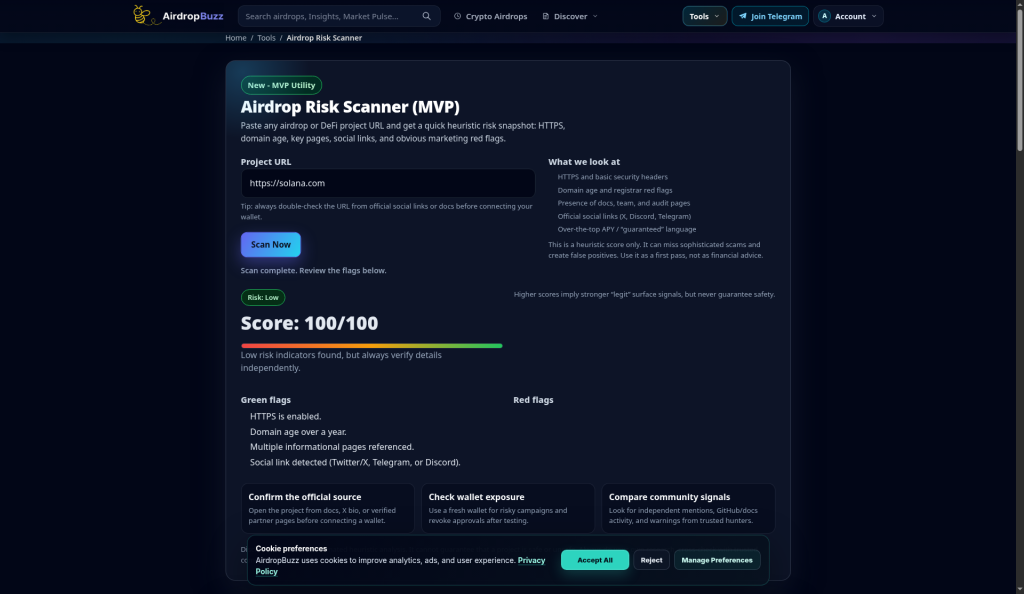
So look at the label (Low / Medium / High / Critical) and the red-flag list before the number.
The red flags matter more than the score
When I opened a few public reports, two of them made the point for me.
-
The report for opensea.io (scanned Jun 16, 2026) is 100/100 Critical. The red flags say the page "appears to mention seed phrases, private keys, or recovery phrases" and wallet connections. That's what a big marketplace page that warns users about seed phrases would trigger on.
-
The report for wallet-rescue.run.place (scanned Sep 10, 2026) is 28/100 Low, with "No critical red flags were detected from the visible page signals". It also adds "this does not prove the airdrop is safe".
Both reports also say: "This fallback safety scan is active because the external AI agent is unavailable." So at least some public reports came from a simpler fallback check, and the report tells you that if you scroll.
I'm not saying the second domain is a scam. I don't know. But a site called "wallet-rescue" on a domain like that is one I'd close without connecting anything, whatever the score says. The tool's own FAQ basically agrees: it's a first pass, and you still verify the official links yourself.
The checklist that comes with every report is honestly good: open the project from its official X/docs, use a fresh wallet, never share a seed phrase, revoke approvals after testing, be suspicious of "guaranteed" rewards. If a beginner only read that part of the page, that'd still be worth it.
Signing up
You can sign up and log in with Google or with a one-time code sent to your email (the email option came back in mid-October after a pause). There's no wallet login on the signup page, so you don't have to connect a wallet just to make an account. Guides, Airdrop Updates, the scoreboard, Market Pulse and the public risk reports are all readable without logging in.
Who it's for
If you're new to airdrops, the free parts that don't need an account (guides, Airdrop Updates, public reports, the safety checklist) already cover a lot. The AI checker is a reasonable second opinion with 3 free scans a day, as long as you read the label and red flags and don't treat the number as a verdict. If you farm a lot, Airdrop Updates is the bit that saves time.
What I'd like to see: one shared scale across both scanners, and the "fallback scan" notice near the top of each report instead of down in the summary.
Site: https://airdropbuzz.com Risk checker: https://airdropbuzz.com/tools/ai-airdrop-risk-checker/ Airdrop Updates: https://airdropbuzz.com/airdrop-updates