The short version
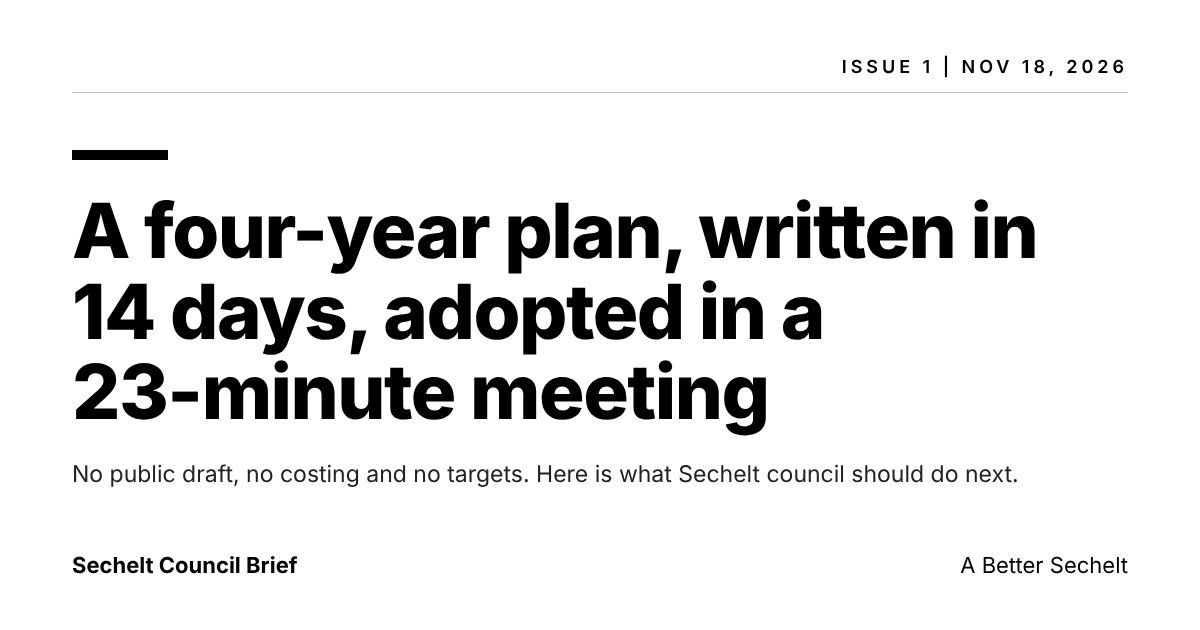
The new council's first regular meeting ran 23 minutes. Every motion carried, and none drew more than a few minutes of discussion. That includes a four-year Strategic Plan written in the 14 days since council was sworn in, brought forward by the mayor rather than through a staff report, and adopted without amendment. Five of the seven members are in their first term. Speed is fine for routine business. It's much harder to defend for a plan meant to set the District's direction until 2030, and council should now show residents how it will be measured.
Following up
This is the first issue, so there are no earlier asks to check yet. Instead, this issue launches the Sechelt Council Record, a separate, strictly factual log of every council decision and every commitment council or staff make on the record. The Brief gives opinion. The Record keeps score.
From this meeting, the Record now tracks these open commitments:
-
Meeting times review. Mayor Dhillon proposed reviewing Regular Council meeting times and days as a whole at Committee of the Whole, possibly as soon as the next week (21:03). The next Committee of the Whole is November 25.
-
6 pm start. Staff said Procedure Bylaw Amendment 568-06 can be adopted after two weeks' public notice, before the end of 2026.
-
Sunday construction notices. Staff will hand-deliver notices to nearby residents before any Sunday work on the Municipal Hall and Library project.
-
Return to Council Chambers. Meetings move back when remediation is done, expected January 2027.
-
Code of conduct. The mayor said council can take up the expected provincial update when it arrives.
-
Strategic Plan commitments. The Record logs the plan's concrete promises: update the Official Community Plan, complete the Development Cost Charge bylaw, update the Subdivision and Development bylaw, find a new site for the septage facility, and develop an integrated asset management plan.
One commitment is already done: at the November 4 inaugural meeting, council directed staff to draft a bylaw for a 6 pm start (Resolution 2026-11A-07), and it came back for three readings at this meeting.
The new council also inherits open business from the last one. On September 29, the previous council referred the Arrowhead Clubhouse funding request to the 2027 budget process, and sent the Sechelt Sewage Facilities Commission's September 4 minutes back to the commission "for clarification on the references to closure of a wastewater facility and system capacity." Both are worth watching, the second especially, given the new plan's promise to relocate the septage facility.
Main decisions
2026 to 2030 Strategic Plan
The Strategic Plan sets the priorities that guide budgets and staff work for council's four-year term. Mayor Dhillon brought it forward for adoption under his own name as a Request for Decision (12:44). It names four core values (transparency, civility, accountability, and responsible stewardship of public resources) and five priorities:
-
Community safety, wellness and crime reduction
-
A vibrant downtown and strong local economy
-
Housing, infrastructure and regional connections
-
Financial sustainability and good governance
-
Community and environmental resilience
Among the specific commitments: update the Official Community Plan, complete a Development Cost Charge bylaw, find a new site for the septage facility, advocate for better ferry service, push for a bigger municipal role in regional water supply planning, develop a coastal cycling corridor, limit tax increases, and only add staff positions where service needs or funding support them.
The report says the plan "was developed based on public feedback and the experience of Mayor and Council through a collaborative, independent process." Under financial implications it says only: "No immediate financial implications."
Mayor Dhillon said council wrote the plan in the 14 days since the election, with no consultants, and that it is "in line with" the 2026 to 2030 financial plan (13:54). He called it council's north star and said it reflects what residents told council members during the election. Councillor Inkster asked that council review it every year, or every six months for the more ambitious items (15:57). No one moved to make that a formal direction. Council adopted the plan without amendments.
Result: Carried. The chair said "none opposed" rather than asking whether anyone was opposed (16:39).
Our take: Fourteen days. That's how long it took to produce the document meant to steer Sechelt for the next four years. Councillors Inkster and Lamb have served on council before. Mayor Dhillon and Councillors Das, MacNeil, Moore and Whitaker had been in office for two weeks when they voted to adopt it.
Speed isn't the problem on its own. The problem is what was skipped to achieve it:
-
Orientation. The same two weeks were council's orientation, when new members are first briefed on how the District's budget, staff and infrastructure actually work.
-
Staff analysis. The plan came to council from the mayor, not through a staff report. Beyond "no immediate financial implications," the report gives no costing and says nothing about what the plan will cost over four years or what it will push aside.
-
Public input. The report says the plan was "developed based on public feedback." The public never saw a draft. If the feedback means what candidates heard during the campaign, that's real, but it isn't the same as asking residents about the plan itself.
-
Measurability. The plan has no targets, timelines or cost estimates, yet it promises to measure "whether our actions are making a meaningful difference."
The mayor said the plan fits the existing financial plan. If that's true, it raises a question of its own: if the plan needs no new money, what is it actually changing? Several of its headline items were already underway before this council took office. The third-quarter reports list the Official Community Plan update and the Development Cost Charge bylaw update as in progress, and the septage closure plan as an active capital project.
Councillor Inkster, one of the two members with council experience, asked for reviews every year, or every six months for the ambitious items. That's the right instinct. Right now it's a remark on the video, not a decision anyone has to follow.
What council should do: Direct staff, by resolution, to bring back an implementation plan before the 2027 financial plan is adopted next spring. It should name, for each commitment, a lead department, a target date, an estimated cost and how progress will be measured. Then adopt Councillor Inkster's suggestion formally: a public progress report every six months, with the first by June 2027. And publish the public feedback the report says the plan was built on.
Ask yourself:
-
Could a council two weeks into the job know enough about the District's finances and infrastructure to set four years of priorities?
-
Why didn't residents see a draft before it was adopted?
-
What will council point to in June 2027 to show the plan is working?
Council Code of Conduct (Bylaw No. 619, 2023)
Under the Community Charter, a new council must decide, within six months of its first regular meeting, whether to review its code of conduct, after first considering the principles of integrity, accountability, respect, leadership and collaboration. Sechelt adopted its current code in 2023. The staff report says council was briefed on the bylaw and the legal requirements during orientation and asked for it to come to this meeting.
The mayor moved that the code "does not require updates and remains the established council code of conduct" for 2026 to 2030 (17:06). He noted a provincial update is likely and said council can take that up when it arrives. He added that the law allows six months and council was doing it in two weeks. No councillor spoke to the motion.
Result: Carried, none opposed.
Our take: The law asks council to consider the five principles before deciding. Council may well have done that in orientation, but the public record shows no discussion at all. The Charter also says that if a council decides not to review its code, it must make a statement of its reasons available to the public on request. Confirming that the code "does not require updates" without reviewing it looks a lot like that kind of decision.
The same council rescinded its Council Communications Policy at the November 4 inaugural meeting, with no replacement yet on any agenda. So council has kept the conduct rules it inherited without discussing them, and dropped the communications rules it inherited without explaining why.
What council should do: Publish its statement of reasons for the code of conduct decision now, without waiting for a request. And by the end of January, bring forward either a replacement communications policy or a public explanation of why none is needed.
Ask yourself:
-
What did council weigh when it decided the 2023 code needs no changes?
-
What now guides how council members communicate on District business?
Council meeting times (Procedure Bylaw Amendment No. 568-06, 2026)
Regular Council meetings will start at 6 pm instead of 7 pm. Council asked for the change at its November 4 inaugural meeting, and this meeting already started at 6 pm. Committee of the Whole times are not affected. Council gave the bylaw three readings (18:54). Final adoption comes after two weeks of public notice, which staff said means the change takes effect before the end of the year.
The staff report gives no reason for the change beyond council's request. It lists no implications of any kind: policy, financial, or strategic plan.
Councillor Moore suggested revisiting it quickly and moving to a start earlier than 6 pm (19:58). Staff laid out the options: proceed tonight, direct staff to revise the bylaw, or take it to Committee of the Whole. The mayor proposed discussing meeting times and days as a whole at Committee of the Whole, possibly as soon as next week.
Result: Carried. The chair asked for those in favour but did not ask whether anyone was opposed (21:35).
Our take: When and where council meets decides who can watch in person and who can speak at question period. A change like that deserves a reason on the record, and this one has none, beyond "council asked." An even earlier start, as Councillor Moore suggested, would make in-person attendance harder for anyone who works a regular day.
What council should do: Before any further change to meeting times or days, publish the reason and ask residents, even with a short online survey, before the Committee of the Whole decides. Use the two-week notice period on 568-06 the same way.
Ask yourself:
-
Who is a 6 pm start better for, and who is it worse for?
-
Will residents be asked before meetings move earlier again?
Committee and liaison appointments
Council assigned members as leads, alternates and liaisons to 20 committees and outside bodies, from the Advisory Planning Commission to Sunshine Coast Tourism. A revised list replaced the one first published, "to include additional appointments requested by members of Council"; the report doesn't say which were added. The mayor read the full list aloud so online viewers could hear it (2:45). Councillor Inkster asked about the Ferry Advisory Committee, which is not on the list. The mayor said Inkster is already on it and nothing changes. Councillor Das is the SCRD board alternate for 2026 to 2027, alongside Mayor Dhillon, appointed alternate on November 4.
Result: Carried, none opposed.
Our take: By our count from the District's list, not including all-council roles, Mayor Dhillon holds 11 appointments and Councillor Das 10, while other councillors hold three to five each. That's a lot of meetings for two people, and it means much of council's outside knowledge flows through the same two members. Council also has a standing agenda item for members' reports, and at this meeting it was empty.
The Ferry Advisory Committee matters too. Better ferry service is one of the plan's named commitments, and the appointment isn't on the list council approved.
What council should do: Add the Ferry Advisory Committee appointment to the published list. And make liaison reporting routine: a short written report under "Council Reports" from each lead at least once a quarter, so residents can see what these appointments produce.
Ask yourself:
-
Can two members carry 21 appointments and still prepare well for council itself?
-
How will residents know what council's liaisons are hearing?
Council meeting location change and noise bylaw variance
Council Chambers, the Community Meeting Room at 5797 Cowrie Street, is under repair for water leaks and structural problems, and the staff report notes "unexpected additional rot repair." Work is expected to run until January 2027. Council approved both staff recommendations (10:43):
-
Hold all council and committee meetings at the Operations Centre boardroom, 5400 Dusty Road, starting November 25, until the work is done.
-
Allow the contractor, Signia Construction, to work on Sundays on the Municipal Hall and Library remediation project. One Sunday, November 22, has been requested so far.
Mayor Dhillon said moving furniture and scaffolding for every meeting costs taxpayers money, and that Sunday work should help finish the job faster and on budget. The staff report says the location change has no financial implications and that Sunday work reduces the risk of cost overruns. Neither puts a number on it. Notice of the move will go out on sechelt.ca, social media and the notice board at Municipal Hall. Staff offered an option to also publish notice in the Coast Reporter. Council didn't take it.
Result: Carried, none opposed.
Our take: A practical decision. Two details are worth following. The Sunday-work approval has no cap or end date, though only one Sunday has been requested so far. And the extra rot likely affects cost. The third-quarter capital report lists "Municipal Hall and Library Remediation" as completed and "District Hall and Library Remediation, Phase 3" as in progress, without separate figures for each.
What council should do: Ask staff for the project's current total cost against its approved budget, and the number of Sunday work days used, in a public report before meetings return to Chambers. And publish the location notice in the Coast Reporter too. Not every resident follows the District on social media.
Ask yourself:
-
What is the project's total cost now, compared with its approved budget?
Also on the agenda
Weather station at the airport
Council approved a five-year extension, to the end of 2031, of the District's licence letting Environment Canada run an automatic weather station at Sechelt Airport (7:13). The licence fee stays at $1 for the five years. The station's data is public and the District uses it to model local conditions. Carried.
Third-quarter finances
By September 30, the District had collected 98% of its budgeted operating revenue and spent 58% of its operating budget, close to last year's 100% and 60% (7:55). Staff said spending is lower mainly because the RCMP contract is billed in the fourth quarter. The mayor praised the report. Council asked no questions. For information only, no vote. The attachments tell a fuller story:
-
Capital projects: $26.0 million approved for 2026, $5.8 million (22%) committed by September 30, leaving $20.2 million with one quarter to go.
-
Facilities: $9.6 million budgeted, $1.6 million (17%) committed.
-
"General" capital: $5.6 million budgeted, $171,000 (3%) committed. It holds two lines: capital engagement, design, planning and permitting, and the Sunshine Coast Drought Mitigation Project, which has not started.
-
One-time operating projects: $3.4 million approved, $1.5 million (44%) committed.
-
Not started include the Drainage Master Plan, the Urban Forest Plan, the drought mitigation project, and RCMP items for body-worn cameras, high-potency drug processing, building security cameras and vehicle barriers.
Our take: Underspending capital is common across BC municipalities, but 22% committed by the end of September points to a large carry-forward into 2027. Some of the unstarted items line up with council's own top priority, community safety. Others, like drought mitigation, line up with its fifth, community and environmental resilience. A council that wants to "limit tax increases" needs to know how much of this year's money is still unspent before it sets next year's budget.
What council should do: Ask staff for a list of 2026 capital projects expected to carry forward, with amounts and reasons, before 2027 budget deliberations begin.
Ask yourself:
-
How much of 2026's capital plan will roll into next year, and will the 2027 budget account for it?
Minutes adopted
Council adopted the minutes of the September 29 regular meeting and the November 4 inaugural meeting (21:49). The inaugural minutes record that council named Councillor MacNeil acting mayor to February 4 and Councillor Das to May 5, appointed Councillors Inkster and Whitaker as regional district directors with Mayor Dhillon as alternate, made Mayor Dhillon and Councillors Das and MacNeil signing authorities, rescinded the Council Communications Policy, and moved this year's remaining regular meetings to 6 pm. The District is currently led by an acting Chief Administrative Officer, who is also its Director of Planning and Development.
The September 29 minutes belong to the previous council. None of the seven current members was at that meeting: Councillor Inkster was absent, and the others weren't on council. As adopted, they use the same resolution number, 2026-09-D18, for two different resolutions, and date one set of commission minutes "September 4, 2029."
Our take: Adopting a previous council's last minutes is routine, and someone has to do it. But minutes are the legal record, and these went through with two errors anyone could spot. What council should do: Have staff correct the duplicate resolution number and the date before the minutes are signed.
Received for information (consent agenda)
Council received three items without discussion (23:07):
-
A Diabetes Awareness Month proclamation.
-
Community safety working group update (November 3). The new community safety coordinator job has been posted twice and revised to add an enforcement focus. The District will trial two-way security cameras on District property, and plans signage and fines for dumping furniture and refundables near the Hightide, RainCity and nearby empty-lot sites. BC Housing is proposing a small group to work on individual housing plans. Councillor MacNeil now represents council on the group.
-
Regional greenhouse gas inventory. The Sunshine Coast Regional District board referred its 2022 community emissions inventory, which includes a Sechelt-specific profile. Coast-wide emissions were 168,449 tonnes, down from a 2013 peak, and most come from passenger and commercial vehicles. The regional district offered to present to council.
Our take: Community safety is council's first priority, and the plan promises to measure "whether our actions are making a meaningful difference." The monthly update is the natural place to do that, but right now it reports activity, not results. And the Official Community Plan update needs emissions targets under the Local Government Act, so the regional inventory is directly useful.
What council should do: Ask that the safety working group's monthly update include a few consistent measures (calls for service, nightly security check results, cleanup and dumping incidents) so residents can see the trend. And accept the regional district's offer of a presentation, timed to the Official Community Plan work.
Ask yourself:
-
How will residents know whether the community safety work is making a difference?
-
Will council take up the offer of a presentation?
The pattern so far
This is the first issue, so this is a baseline. These are the themes the Brief will track, and where each stands after one meeting:
-
Speed over deliberation. Every motion passed, with little debate, in 23 minutes. Some of that is a new council finding its feet. But the items that moved fastest were the ones that most deserved scrutiny: a four-year plan, the rulebook for councillor conduct, and the hours residents can attend meetings.
-
Transparency and what happens off the record. Transparency is the first core value in council's own plan. So far, the reasoning behind the biggest decisions happened in orientation sessions residents never see, and question period still happens after the cameras stop.
-
Measurable accountability. The Strategic Plan has no targets, dates or costs. Councillor Inkster's call for regular reviews is the opening; it isn't yet a commitment.
-
Capital delivery. 22% of the 2026 capital budget committed with a quarter left. Watch the carry-forward.
-
Concentration of roles. The mayor and one councillor hold 21 outside appointments between them, and the District is led by an acting CAO who also runs planning and development.
Living up to its own core values means council showing its work at the table, not just in rooms residents can't see.
What residents said
The agenda had no delegations and no correspondence. A public question period followed adjournment, with one person waiting online, but the video ends before any questions (24:49).
Our take: Question period is the one regular chance for residents to put a question to council directly, and in Sechelt it happens after the meeting is formally adjourned. That placement matters. It keeps the exchange out of the minutes and out of the video too. Residents who can't attend in person never hear what was asked or how council answered.
That sits awkwardly with council's own Strategic Plan. The plan lists transparency as a core value and commits to "visible teamwork and direct public engagement to ensure community input continuously shapes municipal decisions." Engagement that only the people in the room can see isn't very visible. The meeting is already being streamed. Keeping the camera on for question period would be a simple, visible step.
What council should do: Council has already promised a Committee of the Whole review of meeting times and days. Put question period on that same agenda: move it back inside the meeting, before adjournment, so it is livestreamed and noted in the minutes.
Ask yourself:
-
Why should a resident's question to council be less public than a delegation's presentation?
-
Will a council that names transparency as a core value put question period back on the livestream?
Coming up
-
Wednesday, November 25, 3 pm: Committee of the Whole. Council discusses items in more detail here, and recommendations go to a regular meeting for a final vote. The mayor suggested meeting times and days could come up here. The agenda wasn't posted at the time of writing.
-
Wednesday, November 25, 3 pm: Regular Council to Closed Meeting. Council meets briefly in public to vote on closing the rest of the meeting. Under the Community Charter, councils can meet in private only for specific topics, such as land, legal advice or personnel. Decisions made in private are reported publicly later, under "Release of Closed Meeting Items."
-
Tuesday, December 1, 5:30 pm: Advisory Planning Commission.
-
Wednesday, December 2, 6 pm: Regular Council. With two weeks' notice, final adoption of the 6 pm bylaw could come here.
-
Wednesday, December 9, 3 pm: Committee of the Whole, followed by a Regular Council to Closed Meeting at 3:30 pm.
-
New location: From November 25, meetings are at the Operations Centre boardroom, 5400 Dusty Road, until construction at Municipal Hall wraps up, expected January 2027.
How to watch and take part
-
Watch live or later: District of Sechelt YouTube channel
-
Attend: Operations Centre boardroom, 5400 Dusty Road, during Municipal Hall construction, or by Zoom. Links are at the top of each agenda.
-
Agendas and minutes: pub-sechelt.escribemeetings.com
Corrections
Spot an error? Email abettersechelt@proton.me with a link to the public record and it will be fixed here.
About this newsletter
Sechelt Council Brief is an independent look at District of Sechelt council meetings, written by A Better Sechelt. It is not affiliated with the District, any member of council, or any group. Each item starts with what happened, based on the agenda, staff reports and meeting video. "Our take" is opinion, written to prompt questions, and is always labelled. The District's minutes record whether a motion carried, but they only record how individual members voted when a councillor asks for their opposition to be noted. Votes reported here come from the meeting video.
For the factual log of every decision and commitment, see the Sechelt Council Record.
Questions, tips and corrections: abettersechelt@proton.me.
Sources: Revised agenda and attachments, Regular Council Meeting, November 18, 2026 (District of Sechelt, eSCRIBE). Meeting video (District of Sechelt YouTube). November 4, 2026 inaugural meeting minutes.