

Triply Periodic Minimal Surface (TPMS) lattices—particularly the gyroid architecture—have emerged as a transformative class of architected metamaterials. By decoupling structural performance from the intrinsic properties of the base material, they offer exceptional stiffness-to-weight ratios and progressive energy absorption.
But as we push the boundaries of additive manufacturing (AM), a critical question remains: How do we push polymeric TPMS lattices to perform closer to metallic structures without sacrificing their lightweight advantages?
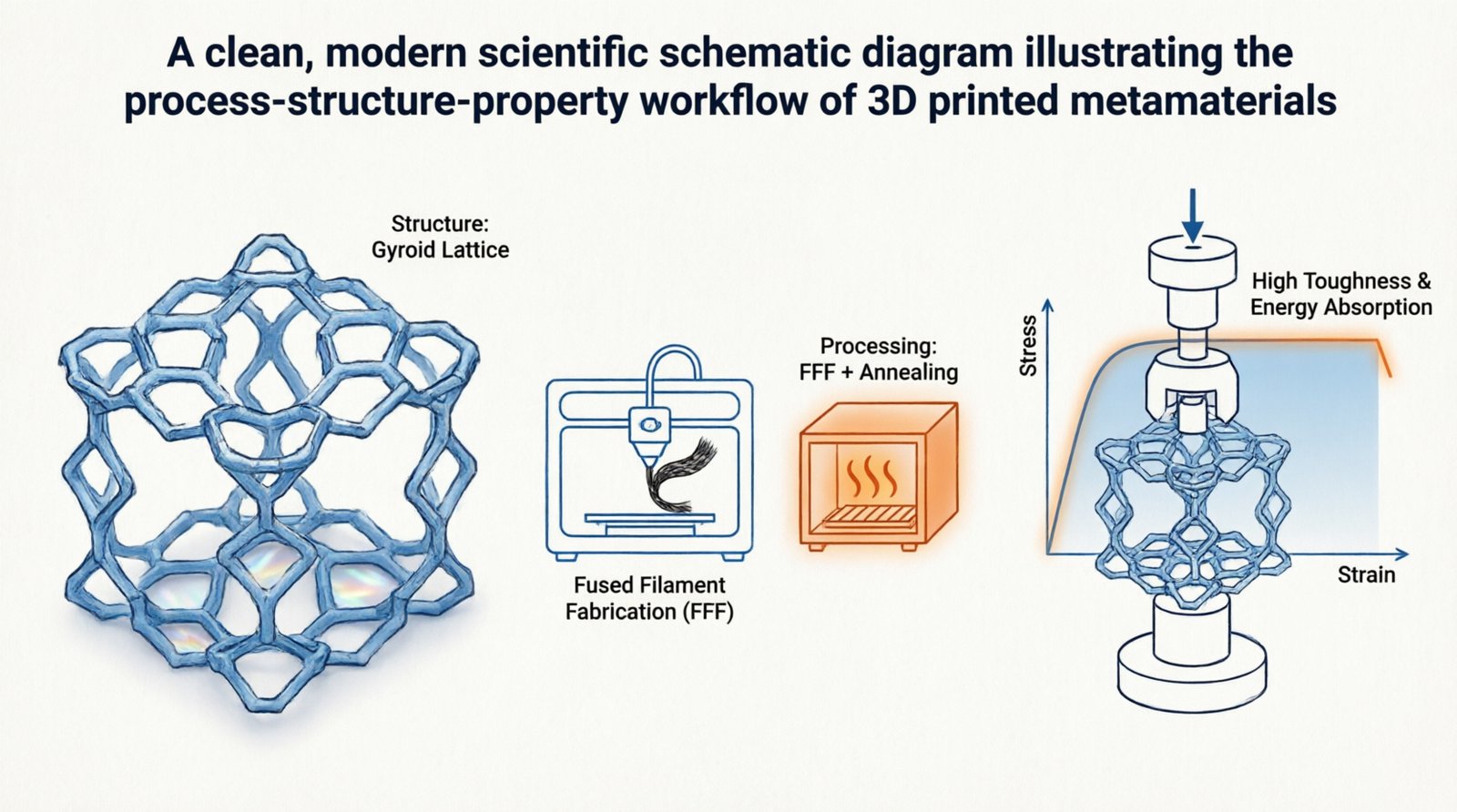
In our recently published paper in Progress in Additive Manufacturing, my colleagues and I at NYU Abu Dhabi systematically investigated the process–structure–property relationships of fiber-reinforced TPMS lattices (Figure 1). Specifically, we looked at whether adding chopped carbon fibers, combined with post-print thermal annealing, could fundamentally alter the deformation mechanics of gyroid structures.
Here is a technical summary of what we found.
The Experimental Matrix
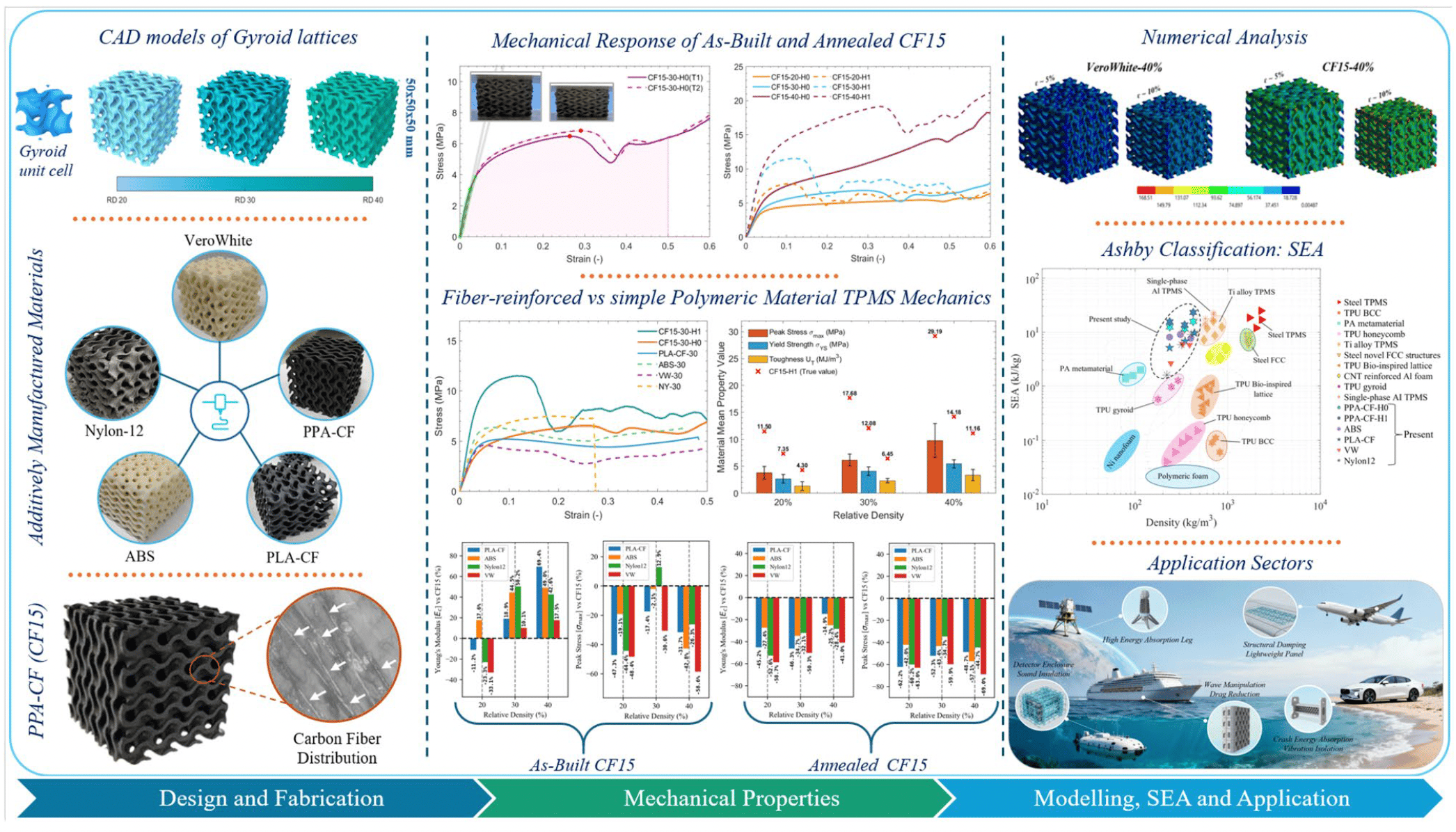
We didn't just look at one material. To isolate the effects of fiber reinforcement and architecture, we fabricated gyroid TPMS lattices across three relative densities (20%, 30%, and 40%) using five distinct polymeric systems:
-
VeroWhite (PolyJet)
-
Nylon 12 (SLS)
-
ABS (FFF)
-
PLA-CF (10% chopped carbon fiber, FFF)
-
PPA-CF (15% chopped carbon fiber, FFF)
We subjected these to quasi-static compression testing and validated the deformation mechanisms using non-linear Finite Element Analysis (FEA). We also applied a post-print thermal annealing process (80 °C for 8 hours) specifically to the PPA-CF specimens to unlock latent mechanical performance.
Key Discoveries: The Synergy of Density and Fibers
Our results showed that simply adding fibers to a low-density lattice isn't enough. The true magic happens at the intersection of high relative density and fiber reinforcement.
The 40% Density Threshold: At lower densities (20%), architectural compliance dominates, and material differences are less pronounced. However, at 40% relative density, the PPA-CF (CF15) lattices exhibited massive strain-hardening. The compressive stress increased from ~5 MPa at yield to over 15 MPa at a strain of 0.5, vastly outperforming neat polymers like ABS and Nylon 12, which suffered from premature collapse or stress plateaus.
Progressive Collapse: Unlike more brittle composites (like PLA-CF) or compliant resins (VeroWhite), the as-built PPA-CF gyroids exhibited extended plateau regions. The chopped fibers promoted effective stress redistribution, leading to a progressive, layer-by-layer collapse ideal for energy absorption.
The Game Changer: Thermal Annealing
The most significant breakthrough of our study was the effect of thermal post-processing on the PPA-CF lattices. Annealing at 80 °C fundamentally modified the post-yield behavior:
-
Peak Stress: Increased by ~40%.
-
Toughness (Energy Absorption): Increased by up to 60%.
Why does this happen? Annealing increases crystallinity in the PPA matrix, relaxes residual stresses from the FFF process, and drastically improves the fiber–matrix interfacial bonding.
Approaching Metallic Performance
To put these numbers into perspective, we calculated the Specific Energy Absorption (SEA).
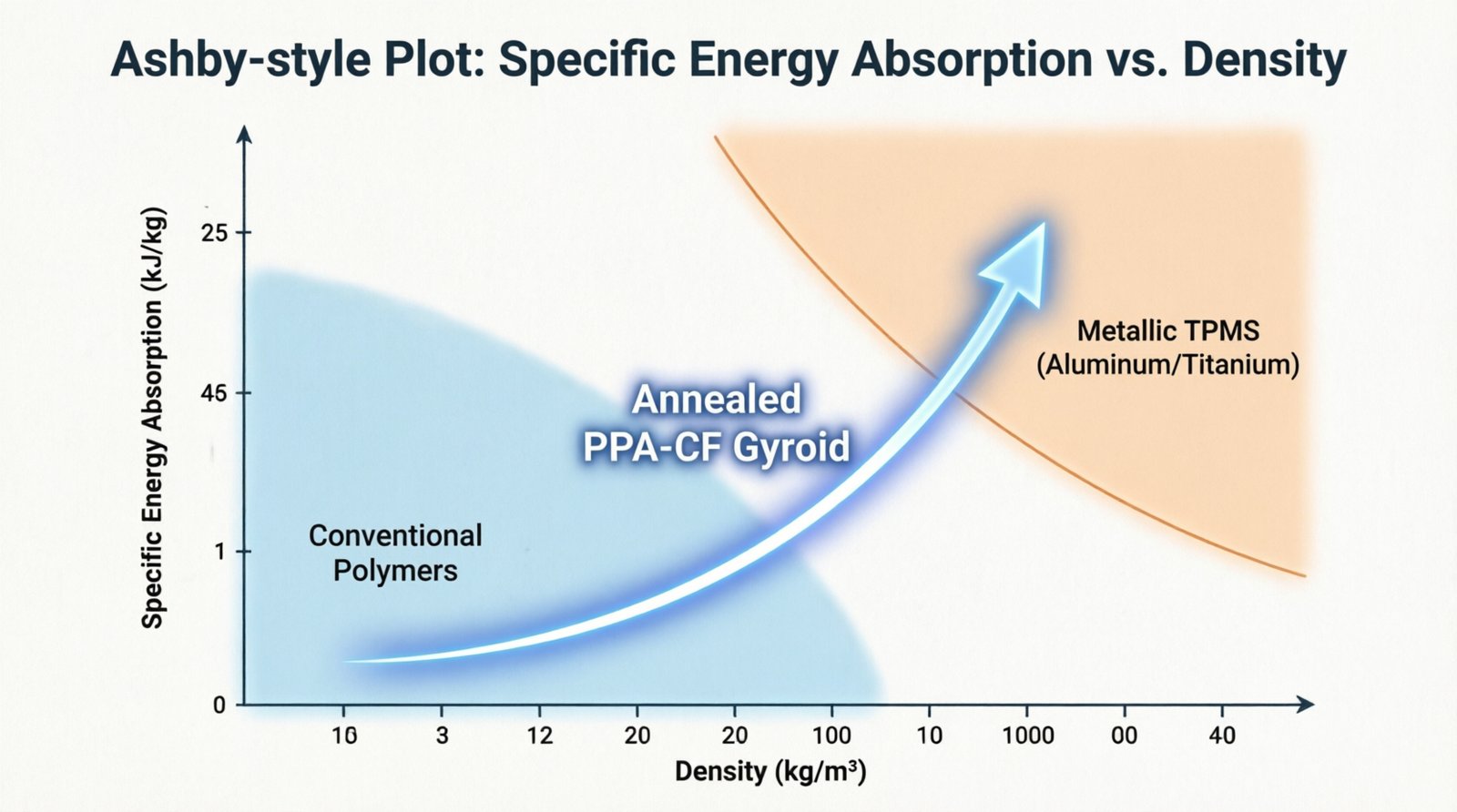
Annealed PPA-CF gyroids achieved an SEA of 24–25 kJ/kg at densities of just 200–430 kg/m³.
To contextualize this: these values are highly competitive with single-phase aluminum and titanium alloy TPMS structures, and they achieve similar energy absorption to steel-based metamaterials at a density reduction of nearly 1,500 kg/m³ (Figure 2). We effectively bridged the performance gap between lightweight polymeric foams and heavy metallic lattices.
The Engineering Trade-Off: Strength vs. Ductility
As materials engineers know, there is no free lunch. While thermal annealing unlocked massive gains in peak strength and toughness, it introduced a critical trade-off.
Our FEA and experimental data showed that annealing reduces the post-elastic ductility of the base composite. Instead of a smooth, continuous plateau, the annealed lattices (particularly at 30% density) exhibited localized stress drops and inner shear plane failures. The fibers, while highly aligned in the extrusion direction to resist in-plane membrane stresses, are poorly oriented to resist out-of-plane shear stresses once significant plasticization occurs.
The takeaway for design: If your application requires a perfectly smooth, constant plateau stress, as-built PPA-CF or ductile neat polymers might be preferable. But if your design criteria prioritize maximum peak load-bearing capacity and total energy absorption per unit weight, annealed PPA-CF is the superior choice.
Conclusion
Our study demonstrates that material selection is just as critical as geometric design in architected metamaterials. By coordinating the control of relative density, chopped carbon fiber reinforcement, and thermal post-processing, we can engineer polymer-based TPMS lattices that rival metallic structures in energy absorption, while maintaining a fraction of the weight.
This opens up exciting new avenues for lightweight impact protection, aerospace structural components, and biomedical implants.
📖 Read the full open-access paper here: https://doi.org/10.1007/s40964-026-01791-9
Data and supplementary materials are available on Zenodo.
What are your thoughts on the trade-offs of thermal annealing in FFF composites? Have you experimented with post-processing TPMS structures for specific energy absorption? Let me know in the comments or connect with me on Website/Bluesky/Lens.
#AdditiveManufacturing, #Metamaterials, #3DPrinting, #MaterialsScience, #TPMS, #Engineering