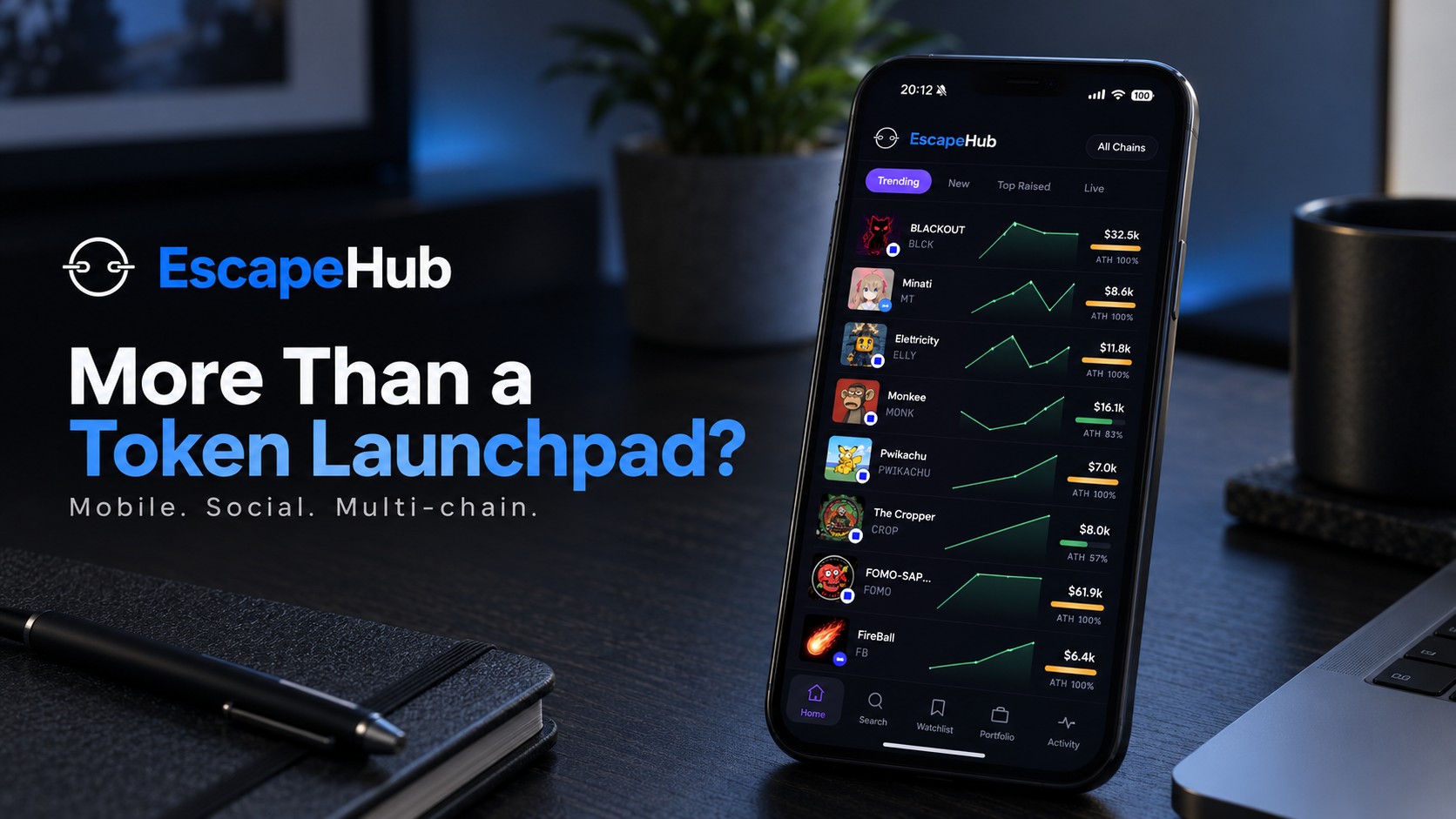
Crypto doesn’t have a shortage of token launchpads.
It has a shortage of platforms that normal people can actually use.
Pump.fun proved something incredibly important: if you remove enough friction from launching and trading tokens, people will use the product.
No coding. No manually creating liquidity pools. No complicated token deployment process.
Pick a name. Pick a ticker. Launch.
It was simple, fast and perfectly suited to the culture of crypto.
But there is one problem with every successful idea in this industry:
Once it works, everyone copies it.
Bonding curves are no longer unique.
Automatic DEX migration is no longer unique.
Creator fees are no longer unique.
Launching a token in a few clicks is no longer unique.
So the interesting question is no longer:
“Who can build another Pump.fun?”
The interesting question is:
“What comes after Pump.fun?”
And that’s where EscapeHub starts to get interesting.
Instead of building another single-chain token launcher, EscapeHub is attempting to combine token creation, trading, mobile apps, embedded wallets, fiat onboarding, social discovery, creator monetization and multiple blockchains inside one ecosystem.
That’s a much bigger bet.
And after actually spending time testing the product myself, I think EscapeHub deserves considerably more attention than it is currently getting.
First, a quick disclosure
Before going any further, transparency matters.
I hold ESCAPE tokens and I have participated in beta testing of the EscapeHub iOS application.
During testing, I have created tokens, traded through the platform, reported bugs and submitted ideas and feedback. I have also watched multiple issues get fixed and improvements get implemented during the testing process.
I am not part of the EscapeHub team, this article is not sponsored, and nobody asked me to write it.
I obviously have an interest in the project succeeding, so I am not pretending to be a completely neutral observer.
Instead, I want to explain why I personally think the project has a compelling product thesis, while also looking at what it still needs to prove.
Nothing here is financial advice.
Pump.fun Proved the Market - But It Also Raised the Bar
It would be ridiculous to discuss EscapeHub without giving Pump.fun credit.
Pump.fun changed the way tokens are launched.
Every token begins through a bonding-curve mechanism, allowing trading before traditional liquidity is established. Successful tokens can later graduate into broader trading infrastructure.
Pump.fun has also expanded beyond being a simple token launcher. It now has its own trading infrastructure, creator incentives and mobile presence.
That matters when evaluating EscapeHub.
EscapeHub doesn’t deserve attention simply because it has a bonding curve.
It doesn’t deserve attention simply because tokens can automatically migrate.
It doesn’t deserve attention simply because creators can earn fees.
Competitors already do these things.
The reason EscapeHub interests me is the combination of everything around those features.
EscapeHub Is Trying to Build the Entire User Journey
Think about how fragmented crypto still is.
Imagine somebody completely new to crypto sees a token they want to buy.
First they might need to download a wallet.
Then understand what a seed phrase is.
Then buy crypto somewhere else.
Then transfer it to the wallet.
Then select the correct blockchain.
Then find the right trading platform.
Then connect the wallet.
Then approve transactions.
Then make sure they are interacting with the correct token contract.
Only after all of that can they make a trade.
For experienced crypto users, this feels normal.
For everyone else, it is terrible product design.
EscapeHub’s approach is essentially:
Why should the user have to care about all of that?
EscapeHub is being built around an embedded self-custody wallet, streamlined transactions, mobile access and fiat onboarding.
It also aims to support Solana together with several major EVM networks inside the same ecosystem.
The desired experience becomes much closer to:
Open app. Create wallet. Add funds. Discover token. Trade.
That’s the kind of user experience crypto needs if it wants to reach people beyond the current Web3 audience.
One App. Solana and EVM.
This may be one of EscapeHub’s biggest strategic advantages.
The crypto industry loves talking about interoperability.
The average user doesn’t.
Users don’t want to think:
“Is this token on Solana or EVM?”
They don’t want five wallets.
They don’t want five launchpads.
They don’t want to understand bridges before they can participate.
They want to open an app and find what they’re looking for.
EscapeHub is attempting to bring Solana and multiple EVM ecosystems into one platform.
That means a user interested in a Solana token doesn’t necessarily need one platform while somebody interested in a Base or BNB Chain token needs another.
They can potentially exist within the same environment.
And this is where EscapeHub begins to look less like a conventional launchpad and more like a cross-chain consumer platform.
That distinction could become very important.
How Does EscapeHub Actually Compare?
No comparison is perfect.
These platforms evolve quickly, and they don’t all target exactly the same users.
But their positioning reveals something important.
EscapeHub
EscapeHub is attempting to combine Solana and multiple EVM networks in one platform.
It includes bonding-curve launches, automatic graduation, creator incentives, embedded wallets, a mobile-first strategy, social discovery and fiat onboarding.
EscapeHub is also developing its own Solana trading infrastructure through EscapeSwap.
Pump.fun
Pump.fun is the established heavyweight.
It has enormous brand recognition, existing liquidity, creator activity and a powerful network effect.
It operates primarily around the Solana ecosystem and has its own post-graduation trading infrastructure through PumpSwap.
Raydium LaunchLab
Raydium has deep infrastructure within Solana.
Its LaunchLab system supports token launches, bonding curves and configurable mechanisms that connect directly into the broader Raydium ecosystem.
Four.meme
Four.meme has established a meaningful position inside the BNB Chain ecosystem.
It provides token-launch infrastructure and connects successful launches into established BNB Chain liquidity infrastructure.
So who wins?
That’s actually the wrong question.
Pump.fun has something EscapeHub cannot simply code overnight:
Distribution.
Liquidity.
Brand recognition.
Creators.
Users.
Network effects.
Raydium has serious Solana infrastructure.
Four.meme has established itself inside the BNB Chain ecosystem.
EscapeHub’s advantage is different.
EscapeHub is attempting to combine an unusually large number of these capabilities inside one consumer-facing product.
Solana and EVM.
Mobile and desktop.
Token creation and trading.
Wallet and fiat onboarding.
Creators and social discovery.
And potentially, through EscapeSwap, the trading infrastructure that comes after graduation.
EscapeHub doesn’t need to win every individual feature comparison.
The interesting part is how many of those features it is trying to connect.
The Mobile-First Part Is More Important Than It Sounds
“Available on mobile” and “built for mobile” are two completely different things.
Crypto spent years building products for desktop browsers and then trying to make them usable on smartphones afterward.
That made sense when the typical DeFi user had MetaMask open beside six browser tabs.
It makes far less sense if crypto wants mainstream consumers.
Most people live on their phones.
They shop there.
They bank there.
They communicate there.
They invest there.
They discover new products there.
So why should launching or trading a token require a complicated desktop-style Web3 workflow?
EscapeHub’s strategy is built around making the experience feel more like a normal mobile application.
I have personally been testing the iOS version.
And that matters to my view of the project.
There is an enormous difference between:
“Our roadmap says we will build an app.”
and:
“There is an app in my hand and I am finding bugs in it.”
A beta product obviously doesn’t guarantee success.
But it removes one of the biggest concerns attached to many small crypto projects:
The possibility that the product exists mainly as a promise.
I Actually Tested It
This is probably the part of EscapeHub that changed my view the most.
I didn’t simply buy tokens, read the website and wait.
I’ve used the iOS application as part of the testing group.
I’ve created tokens.
I’ve traded tokens.
I’ve encountered issues.
I’ve reported those issues.
And I’ve watched fixes arrive.
I’ve also submitted ideas and seen feedback from testers influence the product.
Anyone who has followed crypto for long enough knows how different that is from the typical presale experience.
Many presales look like this:
Website. Roadmap. Token. Promises. Wait.
Here, product development is happening while the project is still early.
That doesn’t tell us whether EscapeHub will eventually attract one thousand users, one hundred thousand users or millions.
But it tells us something more fundamental:
The team is actually building.
And execution is what eventually turns a roadmap into a business.
The Creator Economy Might Be One of the Cleverest Parts
Launchpads need traders.
But traders go where the tokens are.
And tokens go where the creators are.
That means one of the most valuable groups EscapeHub can attract isn’t necessarily traders.
It’s creators.
EscapeHub has designed creator fees into its bonding-curve system.
That creates a direct financial incentive for creators to bring their communities with them.
But the idea goes beyond one person earning a fee.
Creator revenue can potentially be distributed between multiple participants.
That could include:
Developers.
Artists.
Community managers.
Marketers.
Collaborators.
Instead of a token being a one-off speculative launch, it starts to resemble a small on-chain creator economy.
And if creators have a financial reason to bring their audiences to EscapeHub, the platform gains something much more valuable than traditional advertising:
Distribution.
Creators Bring Communities. Communities Bring Volume.
This is where the network effect could begin.
Imagine a creator with a large audience launches a token.
The creator has an incentive to promote it because trading generates creator revenue.
Their followers arrive.
Some begin trading.
Some discover other tokens.
Some eventually create tokens themselves.
Those new creators bring their own communities.
More tokens create more content.
More content creates more discovery.
More discovery creates more trading volume.
And more volume makes the platform more attractive to additional creators.
The cycle becomes:
Creators.
Communities.
Tokens.
Trading.
Fees.
More creators.
That’s how a launchpad can potentially become an ecosystem.
The technology matters.
But distribution is the moat.
Crypto Launchpads Are Becoming Social Networks
This is another area where I think people underestimate EscapeHub’s strategy.
Ask yourself why memecoins spread.
Usually it isn’t because somebody carefully analysed their financial statements.
It’s because someone posted something.
Someone created a meme.
A community formed.
A creator talked about it.
A trend started.
Someone saw it on X.
Someone else shared it on Telegram.
Memecoins are fundamentally social assets.
Yet most trading infrastructure still treats the social layer as something happening somewhere else.
EscapeHub wants discovery, profiles, feeds, watchlists, trending tokens and token launches inside the same environment where users can trade them.
That creates an interesting possibility.
What if the next major token launchpad looks less like a traditional DEX and more like a social discovery platform with a trading engine underneath it?
You don’t open TikTok already knowing exactly what video you’re looking for.
The feed shows you something.
You engage.
Then you discover something else.
Apply the same concept to tokens:
Discover.
Follow.
Share.
Trade.
Create.
Suddenly the social layer isn’t just a nice extra feature.
It becomes the acquisition engine.
The Whitelist Feature Solves a Very Real Problem
One of the more interesting EscapeHub features is whitelisted token launches .
Anyone who has participated in launches knows the problem.
A creator announces a token.
The community waits.
Trading opens.
Bots arrive before normal users can react.
The people who were supposed to form the early community can end up buying after automated systems have already entered.
EscapeHub’s approach allows creators to define an initial group of wallets that can participate while the whitelist is active.
The important part is that the system is designed to be enforced on-chain rather than only through the website interface.
That makes the restriction harder to bypass simply by avoiding the normal user interface.
It sounds like a small feature.
But I think it’s exactly the type of product decision that matters.
Identify something that is frustrating about existing token launches.
Then build a solution.
Then There Is EscapeSwap
This is where the strategy becomes more ambitious.
A bonding curve is only the beginning of a successful token’s life.
Eventually it graduates.
Pump.fun understood this and built PumpSwap.
EscapeHub is taking a similar strategic approach on Solana with EscapeSwap .
Why does that matter?
Because if EscapeHub launches a successful token and immediately sends all future trading activity somewhere else, part of the network effect leaves the platform.
A native DEX allows more of that activity to remain inside the ecosystem.
More launches can produce more graduates.
More graduates can produce more trading volume.
More trading volume can generate more fees.
That creates a much deeper ecosystem than simply charging users to create tokens.
The ESCAPE Token Still Has to Prove Its Economic Role
This is where I become more cautious with crypto projects.
There are thousands of platforms where the product and the token have almost nothing to do with each other.
The platform can succeed while the token remains irrelevant.
That is weak token design.
EscapeHub is attempting to create a closer relationship between platform usage and the ESCAPE token .
The project describes ESCAPE as having utility within the ecosystem, including areas such as staking, platform functions and other economic mechanisms.
That is more interesting than a token whose entire thesis is simply:
“Our community is strong, therefore the price should rise.”
But there is an important qualification.
A mechanism on paper has little economic significance if the platform doesn’t generate meaningful usage.
The token therefore ultimately depends on the same thing as the platform:
Real users.
Real trading.
Real activity.
That’s exactly how it should be evaluated.
Security and Accountability Matter Too
Crypto has trained users to accept something that would be strange almost anywhere else.
Send money to people on the internet and hope the product eventually appears.
EscapeHub has taken steps to build more formal infrastructure around the project.
There is also third-party security documentation available for the ESCAPE token contract.
Hacken publicly lists an audit of the ESCAPE smart contract.
That does not mean EscapeHub cannot be hacked.
No legitimate smart-contract audit means that.
And an audit of one contract should never be treated as an audit of every future component of an entire platform.
But independent security work is still better than simply claiming that security has been taken seriously.
So Why Isn’t EscapeHub Already Huge?
Because features don’t create success by themselves.
This is the part every bullish thesis needs to acknowledge.
EscapeHub is entering a market with serious incumbents.
Pump.fun already has the brand.
It already has users.
It already has liquidity.
It already has creators.
It already has its own trading infrastructure.
Those are network effects.
And network effects are much harder to copy than software.
Raydium already has deep infrastructure on Solana.
Four.meme already occupies an established position within the BNB Chain ecosystem.
EscapeHub can build a technically broader product and still fail if nobody uses it.
That’s the biggest risk.
Not whether another feature gets added.
Whether enough people care.
EscapeHub Doesn’t Need to Kill Pump.fun
This is where I think the comparison often goes wrong.
People love narratives like:
“This is the Pump.fun killer.”
I don’t think EscapeHub needs to kill Pump.fun.
That isn’t even the most interesting opportunity.
Pump.fun can remain enormous on Solana.
Four.meme can remain relevant on BNB Chain.
Raydium can remain critical infrastructure.
EscapeHub could still build a significant ecosystem by solving a different problem:
Becoming the place where users don’t have to care which blockchain they’re using.
Imagine opening one application and seeing:
A new Solana launch.
A trending Base token.
A creator you follow launching something on BNB Chain.
An Ethereum project.
Your watchlist.
Your wallet.
Your trades.
Your social feed.
All without constantly switching platforms.
That’s a broader vision than simply copying Pump.fun.
Why I Think EscapeHub Has a Real Chance
There are several things that make the project particularly interesting to me.
First, it is attacking fragmentation.
Solana and EVM ecosystems normally live in separate worlds.
EscapeHub is trying to put them behind one interface.
Second, it is designing for mobile from the beginning.
Not “our website also works on a phone.”
A genuine mobile product.
Third, it is reducing onboarding friction.
Wallet creation.
Fiat funding.
Simplified transactions.
Fewer reasons for a newcomer to give up before completing their first trade.
Fourth, it gives creators a reason to care.
Creators earning from trading changes the economics of user acquisition.
Instead of EscapeHub having to acquire every user itself, creators can bring their own audiences.
Fifth, it understands that tokens are social.
Discovery and community aren’t separate from memecoin trading.
They are often the reason memecoin trading exists.
Sixth, there is already a real product being tested.
I’ve personally used it.
That doesn’t prove product-market fit.
But it does prove that the project has moved beyond a presentation and a roadmap.
And seventh, the team appears to iterate.
As a tester, this is the part that’s hardest to capture in a normal feature comparison.
Software is never finished.
The question is whether developers respond when users find problems.
From my own experience during beta testing, bugs have been reported, discussed and fixed, and tester feedback has influenced the product.
That feedback loop matters.
The Biggest Challenge Is Now Distribution
At this stage, I’m less interested in whether EscapeHub can add another feature.
It already has an ambitious feature set.
What I want to see is:
Can it attract creators?
Can creators attract communities?
Can those communities generate sustainable trading volume?
Can EscapeHub turn first-time users into returning users?
Can the social layer create organic discovery?
Can it make multi-chain trading feel invisible rather than complicated?
If the answer to those questions is yes, then the technology underneath becomes extremely valuable.
If the answer is no, another twenty features won’t fix it.
The next stage isn’t primarily a development challenge.
It’s a network-effect challenge.
This Is What Makes the Opportunity Interesting
Established platforms have a major advantage:
They are established.
But that creates an interesting asymmetry with smaller projects.
If EscapeHub were already processing enormous volume and had millions of active users, everybody would know about it.
The reason an early-stage project can be interesting is precisely because the market hasn’t yet decided what it can become.
That comes with dramatically higher risk.
It also means there is considerably more distance between:
What the project is today.
And what it could become if the product finds product-market fit.
That’s the bet.
Not that EscapeHub invented the bonding curve.
It didn’t.
Not that every competitor is obsolete.
They aren’t.
And not that success is guaranteed.
It isn’t.
The bet is that combining the strongest parts of token launchpads, mobile consumer apps, creator platforms and social discovery into one multi-chain ecosystem creates something users actually want.
Pump.fun Proved the Model. EscapeHub Is Trying to Expand It.
Pump.fun proved that people want frictionless token creation.
The next question is whether users also want frictionless token discovery.
Frictionless onboarding.
Frictionless mobile trading.
Frictionless multi-chain access.
And whether creators want to build communities around those tokens inside the same ecosystem.
That’s what EscapeHub is trying to answer.
Maybe it works.
Maybe it doesn’t.
Crypto is brutally competitive and no amount of good technology guarantees adoption.
But after testing the product myself, studying what the platform is trying to build and comparing it with today’s launchpad landscape, I keep coming back to the same conclusion:
EscapeHub isn’t interesting because it does one thing nobody else can do.
It’s interesting because it’s trying to bring many things that already work into one place and remove the friction between them.
That is a much harder product to build.
It’s also potentially a much bigger one.
Pump.fun proved there was a massive market for making token creation easy.
EscapeHub is betting that the next opportunity is making the entire crypto experience easier.
If the team can execute on that vision and, more importantly, attract the creators and users required to create a real network effect, EscapeHub may eventually stop being described as just another token launchpad.
It may need a different category entirely.
Disclosure
I hold ESCAPE tokens and have participated in beta testing of the EscapeHub iOS application.
I am not employed by EscapeHub and this article was not sponsored or commissioned by the EscapeHub team.
The opinions expressed here are my own.
Digital assets are highly speculative and can result in the complete loss of invested capital.
This article is for informational purposes only and is not financial advice.
Sources and Further Reading
EscapeHub FAQ and Product Information
https://escapehub.ai/faq/
EscapeHub Fees
https://escapehub.ai/learn/escapehub-fees/
EscapeHub Whitelisted Launches and Anti-Snipe System
https://escapehub.ai/blog/whitelisted-token-launches-anti-snipe/
EscapeSwap
https://escapehub.ai/blog/escapeswap-solana-dex/
EscapeHub Tokenomics
https://escapehub.ai/tokenomics/
Hacken ESCAPE Audit
https://hacken.io/audits/escape/sca-escape-escape-token-jul2025/
Pump.fun Bonding Curve Documentation
https://pump.fun/docs/bonding-curve
Pump.fun Fee Documentation
https://pump.fun/docs/fees
Raydium LaunchLab Documentation
https://docs.raydium.io/products/launchlab/bonding-curve