Follow one event from the shelf
Forget the sensor brochures for a moment. The best way to understand retail IoT is to follow a single event from the moment it is emitted to the moment it changes a decision — because that journey is where every hard engineering problem lives, and where most deployments break down.
A customer lifts a jar off a smart shelf. The weight cell registers a drop, an overhead camera sees a hand enter the shelf zone, an RFID reader stops seeing one tag. Three sensors, three signals, one physical action — and none of them, alone, is trustworthy. What happens between that moment and "decrement SKU 88213 to four units, and if it hits two, reorder" is the entire discipline of retail IoT. This piece traces that path for the engineers who build it.
The event contract at the edge
The first stop is the edge gateway, and the first design decision is a normalization boundary. Each sensor family speaks its own dialect; a device adapter translates every reading into a canonical event schema before anything downstream touches it.
This is not busywork — it is the decoupling that keeps the platform alive across hardware refreshes. When a vendor discontinues a shelf sensor, you write a new adapter, not a new platform, and everything above the edge stays stable no matter what churns beneath it.
The edge also runs inference that cannot wait for a round trip to the cloud. Computer-vision models interpret camera frames locally and emit compact events — "hand entered zone," "likely non-scan at lane 6" — rather than shipping raw video upstream, which would be too expensive and too slow at estate scale.
Ingestion has to assume the network is bad
Our event now has to travel from one of hundreds of stores to a central platform. The naive version of this fails on the first rainy Saturday when a store's connectivity drops.
A production ingestion layer is built around a few assumptions:
-
Connectivity is intermittent; the edge must buffer locally and replay on reconnect without losing or duplicating events.
-
Volume is enormous — a national estate produces billions of events a day — so the streaming backbone is sized for that from day one, not retrofitted.
-
Ordering and idempotency matter, because the same physical action arrives as several signals and a naive consumer will double-count.
This is textbook high-throughput streaming engineering, and it is where the "hardware program with some software" framing quietly collapses. Serious retail IoT is a custom software development program with a hardware dependency, and the ingestion layer is the proof.
Reconciliation: turning three lies into one truth
Now the interesting part. Our weight drop, camera event, and RFID change all describe the same jar — but each is individually unreliable. RFID reads bounce and see neighboring aisles; cameras see reflections; weight cells drift with temperature.
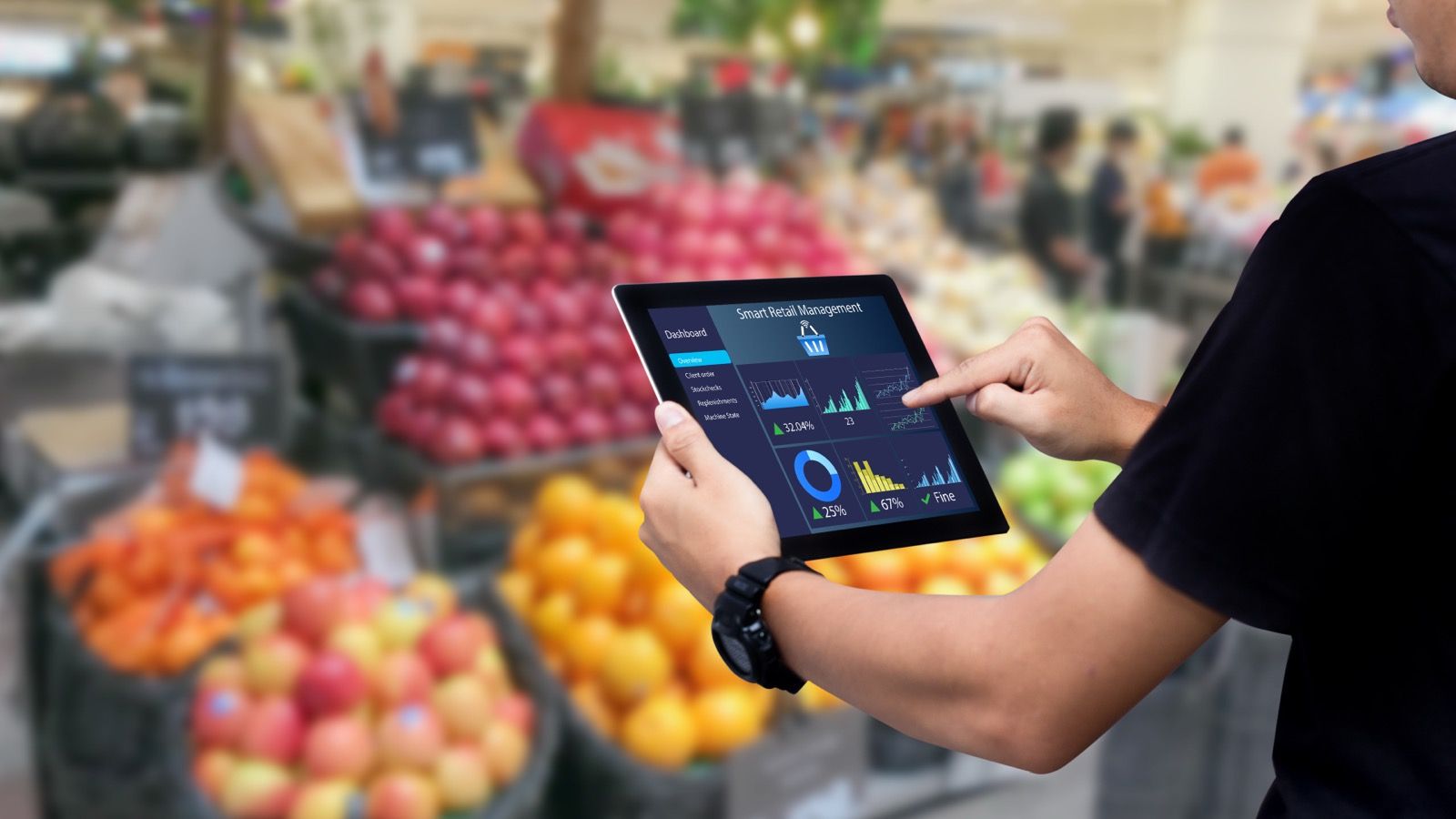
The intelligence layer fuses these with point-of-sale data and the planogram to produce a single calibrated state estimate: not "a tag disappeared" but "there is a 92 percent probability four units remain." Most retailers sit at 65 to 75 percent SKU-level accuracy; disciplined fusion lifts that above 95 percent. The output that matters is confidence, not a raw reading.
Crucially, this is a modeling problem, not a rules problem. Threshold logic cannot express "these three noisy signals jointly imply a stockout with 88 percent confidence." Machine learning can. That is why mature inventory platforms are built on models rather than if/else ladders.
From estimate to automated action
A confident state estimate is still just data until something acts on it. The final hop wires model output into agentic workflows that take the next step directly and pull in a human only for exceptions:
-
A stockout estimate crosses a threshold, so the system creates a replenishment order.
-
A compressor's vibration signature drifts, so a work order is dispatched before the freezer fails.
-
A localized demand signal moves, so a price or assortment adjusts for that store's actual foot traffic.
Many teams then add an LLM integration as a query surface, so a non-technical manager can ask "which stores had the worst availability this weekend and why" and get an answer grounded in the pipeline's own data — finally making years of telemetry usable by the people who run stores.
The parts that decide whether it scales
Trace enough events and the same architectural choices keep determining success:
-
Edge versus cloud split — what must run locally for latency and cost, versus what centralizes.
-
Model ops across a physical fleet — versioning, staged rollout, per-store drift monitoring, and rollback, because accuracy decays as store conditions drift and untended models rot.
-
Security in a public space — device identity, encrypted transport, secure OTA updates, and PCI-aware design, because a compromised gateway is a path into the payment environment.
-
Privacy by minimization — process video at the edge, transmit only anonymized events, never raw footage.
None of these is a hardware decision — all are platform and AI development decisions, and getting them right is what turns a three-store pilot into a national rollout where each new store is cheaper to add than the last.
For the strategic side — high-ROI use cases, realistic costs, and how to phase the build — read the full guide: IoT in Retail: the software layer that turns store sensors into margin. Or talk to our team if you are scoping a build or rescuing a stalled one.
Frequently Asked Questions
How many events does a retail IoT platform actually handle?
A national retail estate with hundreds of stores can generate billions of sensor events per day across shelf sensors, RFID, cameras, and environmental probes. The streaming and ingestion backbone must be designed for that volume from the outset — retrofitting scale onto a pilot architecture almost always forces a rebuild.
What happens to sensor data when a store loses connectivity?
In a well-built pipeline, the edge gateway buffers events locally and replays them on reconnect, using idempotency keys so nothing is lost or double-counted. Designing for intermittent connectivity is essential because store networks are unreliable, and losing an afternoon of events silently corrupts downstream inventory and demand models.
Why is a canonical event schema important in retail IoT?
A canonical schema decouples the platform from specific hardware. Device adapters normalize each sensor family's payload into one common event format, so replacing a discontinued sensor means writing a new adapter rather than rewriting downstream services. Without this boundary, every hardware refresh becomes a costly platform migration.
Can rule-based logic replace machine learning for inventory accuracy?
Not reliably. Reconciling noisy, conflicting reads into a trustworthy count is a probabilistic problem — expressing "these signals jointly imply a stockout with 88 percent confidence" is exactly what models do well and threshold rules do badly. Rule engines can complement a model but cannot substitute for the fusion layer that produces calibrated confidence.
How do agentic workflows fit into a retail IoT pipeline?
Agentic workflows consume model outputs and take the next operational action automatically — placing replenishment orders, dispatching maintenance, adjusting prices — escalating to a human only for exceptions. They turn the platform from a dashboard that waits to be read into an operating layer that acts on its own conclusions.
What is the most common pipeline mistake in smart retail builds?
Consuming raw sensor streams directly instead of fusing them first. Acting on a single unreconciled read is worse than ignoring it, because noisy data erodes trust in the whole system. The fix is a reconciliation layer that combines signals with sales and planogram data before any decision.