

It's the peer-to-peer stablecoin market ordinary people built for themselves.
Receipts below.
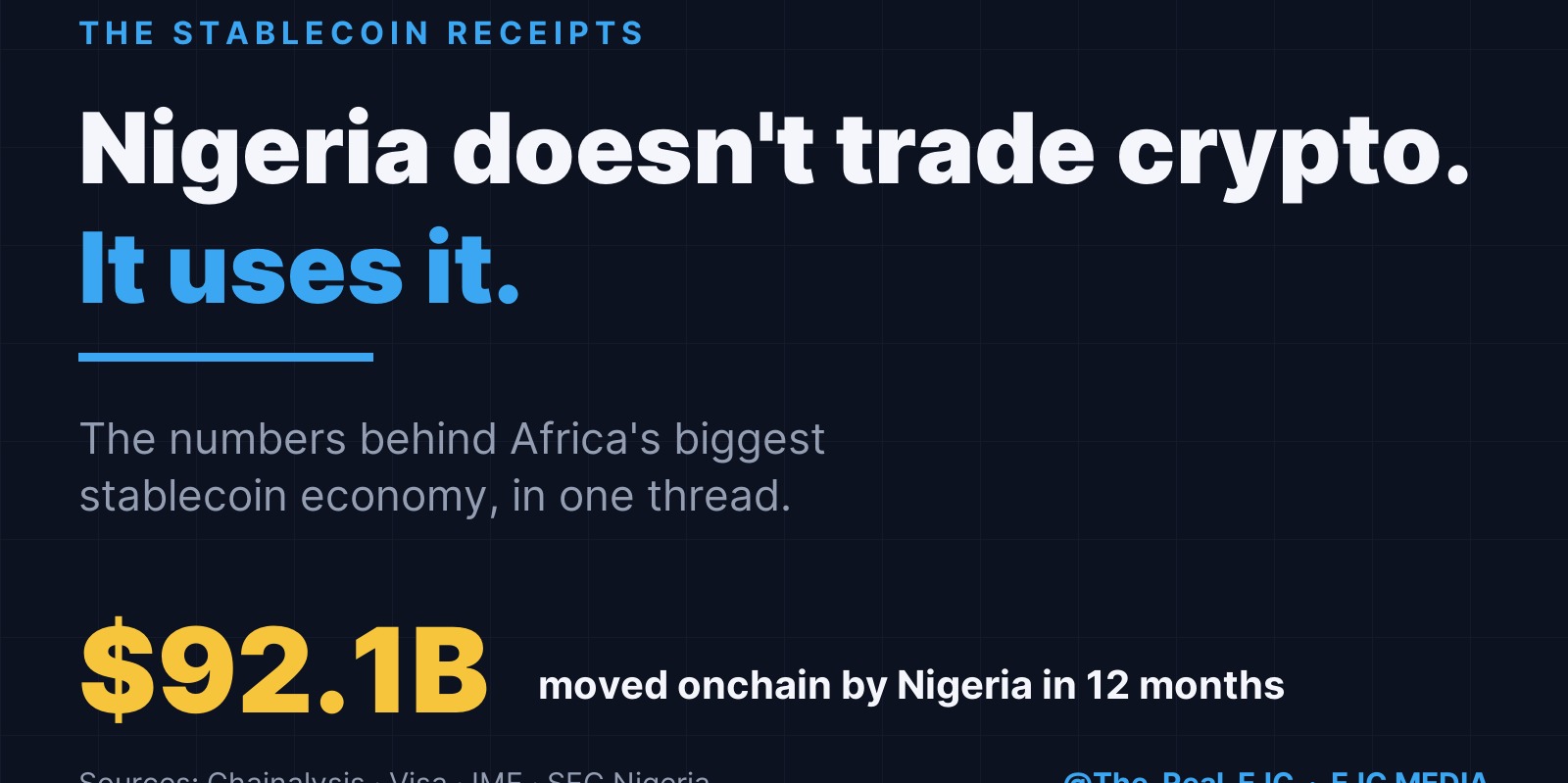
Nigeria received $92.1B in on-chain crypto value between July 2024 and June 2025, nearly triple South Africa. The wider region grew 52% year on year to $205B while most regions shrank.
This isn't speculation money. Look at what people actually buy.
@chainalysis
Stablecoins, not Bitcoin. On-chain stablecoin volume was 43% of all sub-Saharan African crypto activity in the year to June 2025, and in H1 2026 they made up 96% of Nigeria's domestic peer-to-peer transfers.
People aren't buying coins to hold. They're moving money.
Context: the naira lost roughly 70% of its value against the dollar between June 2023 and early 2025.
When your savings can lose 70% in 20 months, "hold dollars" stops being investing advice. It's survival.
A Visa-backed survey of 2,541 crypto users across five emerging markets: in Nigeria, saving in dollars is the #1 use case. 77% of Nigerian users hold more than 10% of their assets in stablecoins. 47% use them mainly to just access dollars.
The real money movement is boring and enormous: importers settling trade, freelancers paid from abroad, families receiving remittances. An estimated $26B in stablecoin volume moved through Nigeria in 2024, mostly USDT for trade finance.
The IMF flagged something odd: an estimated 98% of eNaira wallets were inactive. A government wallet nobody used, while informal USDT P2P trades thrived. The lesson: you can't mandate savings currency. People choose what works.
@IMFNews
The regulators caught up. After the 2024 Binance crackdown and P2P delisting, the SEC licensed exchanges, digital assets got legal status under the 2025 investment law, and from January 2026 stablecoin issuers need 1:1 reserves, approved custodians and monthly attestations.
Now the formal layer is being built on top: cNGN, the regulated naira stablecoin, went live on the Celo blockchain in August with instant cNGN-to-dollar swaps, and Circle invested in Flutterwave in July to run USDC settlement across 34 African markets.
@circle
Nigeria doesn't trade crypto. It uses it. The next billion users won't arrive because someone explained blockchain to them. They arrive when holding a dollar finally works in your pocket. Nigeria got there first. Watch the rest of the continent use the blueprint.