

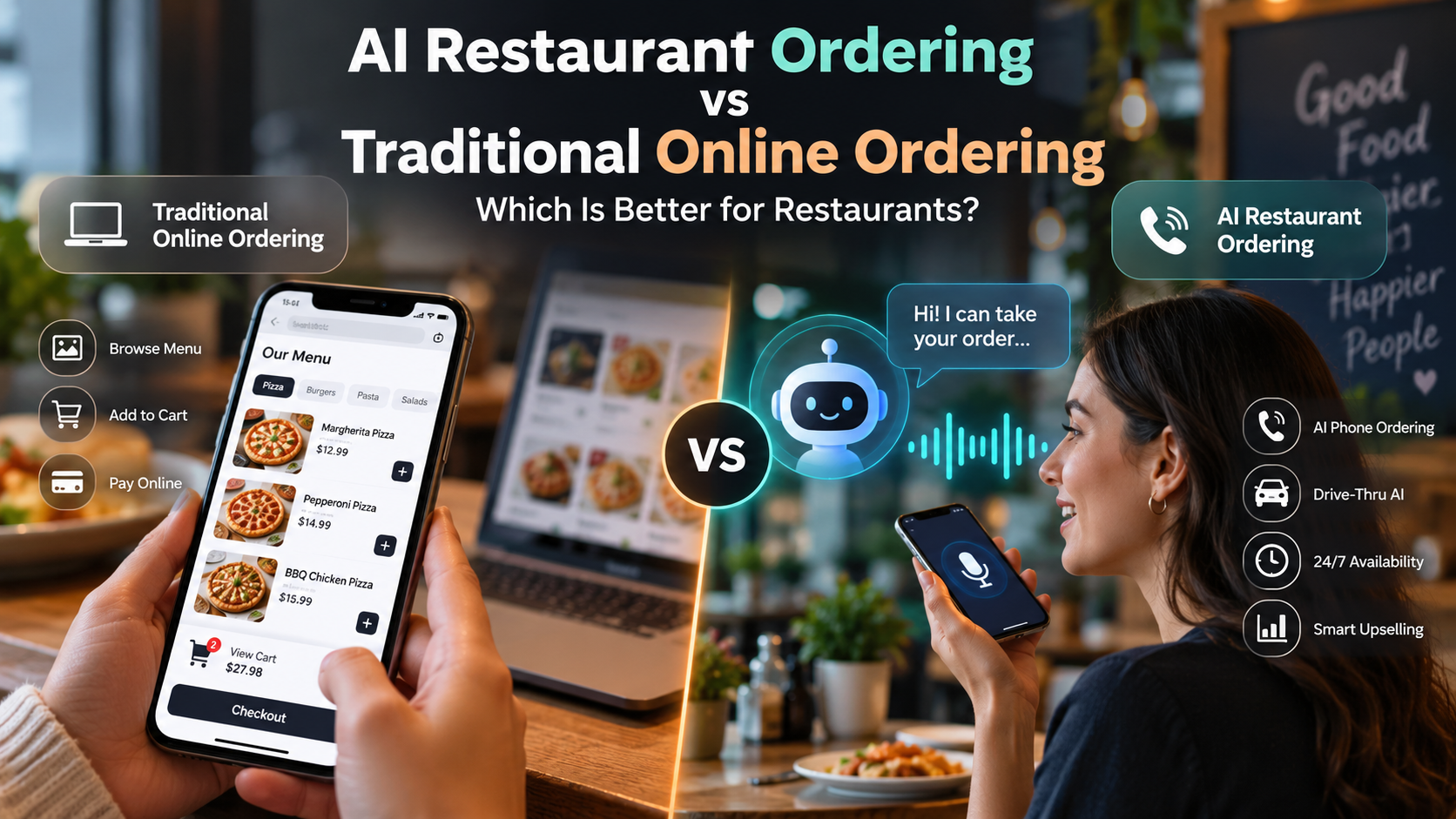
Restaurant technology has changed significantly in recent years. Customers can now order food through websites, mobile apps, self-service kiosks, delivery platforms, and increasingly, conversational AI. As restaurants look for better ways to manage orders, reduce missed calls, and improve customer service, AI restaurant ordering is becoming an important alternative to traditional online ordering.
But does AI really offer more value than a conventional restaurant ordering system?
The answer depends on the restaurant's needs, order volume, customer preferences, and operational setup. Traditional online ordering remains useful, particularly for customers who prefer browsing a visual menu. However, AI can add another layer of convenience by allowing customers to interact naturally through voice and conversational interfaces.
Let's compare AI restaurant ordering with traditional online ordering and examine which approach may work best for modern restaurants.
What Is Traditional Online Restaurant Ordering?
Traditional online ordering allows customers to browse a restaurant's menu through a website, mobile application, or digital ordering platform. Customers select their preferred items, customize their orders, add them to a cart, and complete payment digitally.
A typical food ordering system follows a straightforward process:
-
The customer opens the restaurant website or app.
-
They browse the menu.
-
They select food and beverage items.
-
They choose available customizations.
-
They review their order.
-
They make payment.
-
The restaurant receives the order.
This approach has become standard across restaurants of different sizes. Customers are familiar with clicking through menus, viewing food photos, checking prices, and completing transactions without speaking to an employee.
Traditional online ordering can include restaurant websites, mobile apps, QR-code menus, self-service ordering pages, and third-party delivery platforms.
However, this model generally depends on customers navigating the interface themselves. If they have a question about an item, want to make an unusual modification, or prefer speaking to someone, they may need to call the restaurant.
What Is AI Restaurant Ordering?
An AI restaurant ordering system uses artificial intelligence and conversational technology to interact with customers and assist with the ordering process.
Instead of requiring customers to navigate every menu option manually, AI can understand natural-language requests and respond conversationally. Depending on the technology and integrations available, an AI ordering solution can answer questions, take orders, handle modifications, recommend additional items, and transfer complex interactions when needed.
For example, a customer could say that they want a large pizza with specific toppings and a particular crust. Rather than navigating multiple menu screens, they can communicate their request naturally.
This is one of the major differences between conventional ordering and AI in restaurants.
Artificial intelligence can potentially support several restaurant operations, including:
-
Phone ordering
-
Customer questions
-
Order taking
-
Upselling
-
Reservations
-
Drive-thru ordering
-
Customer service
-
Repetitive administrative interactions
As artificial intelligence restaurants become more common, the goal isn't necessarily to remove every existing ordering channel. Instead, AI can complement websites, apps, kiosks, and other restaurant technologies.
AI Restaurant Ordering vs Traditional Online Ordering: Key Differences
The two approaches solve similar problems but provide different customer experiences.
| Feature | AI Restaurant Ordering | Traditional Online Ordering |
| Customer interaction | Conversational | Click or tap based |
| Menu browsing | Conversational and/or digital | Primarily visual |
| Phone ordering | Can be integrated | Usually requires a separate process |
| Menu questions | AI can answer | Customer searches for information |
| Order modifications | Can understand natural-language requests | Customer selects available options |
| Upselling | Can provide conversational recommendations | Usually static or interface-based |
| Availability | Can operate beyond normal staffing hours | Website/app can remain available |
| Peak-hour support | Can automate repetitive interactions | Depends on digital ordering capacity |
| Personalization | Can use conversational context | Often more limited |
| Drive-thru applications | Possible with AI voice technology | Usually separate from online ordering |
The biggest difference is the interaction model. Traditional online ordering asks customers to operate a digital interface, while AI ordering can allow them to communicate naturally.
7 Advantages of AI Restaurant Ordering
1. Faster Order Taking
During busy periods, every additional minute spent handling an order can affect restaurant operations.
AI-powered ordering can streamline repetitive interactions by automatically collecting customer requests, confirming items, and handling common questions.
For restaurants with significant ordering volumes, this can help reduce the pressure placed on employees during peak periods.
2. Fewer Missed Phone Orders
Phone ordering remains important for many restaurants, particularly pizza shops, takeout businesses, and restaurants with loyal local customers.
However, employees may not always be able to answer every call while managing food preparation and customers inside the restaurant.
An AI Phone Answering Service can help address this problem by answering incoming calls and handling eligible customer interactions.
Instead of reaching voicemail or waiting for an employee to become available, customers can interact with an AI-powered phone system.
This can be particularly useful during lunch and dinner rushes when call volumes increase.
3. 24/7 Customer Assistance
A restaurant may not have employees available to answer every customer question around the clock.
AI systems can potentially provide automated assistance outside traditional staffing hours, depending on the restaurant's setup and operating requirements.
This could include answering frequently asked questions, providing menu information, or assisting with eligible ordering requests.
For restaurants looking to extend customer access without staffing a phone line around the clock, AI can be an attractive option.
4. Better Upselling Opportunities
Upselling is an established restaurant practice, but employees may not consistently suggest additional items during every interaction.
Conversational AI can be designed to make relevant recommendations during the ordering process.
For example, after a customer orders a meal, the system could suggest:
-
A beverage
-
Dessert
-
Additional toppings
-
A side dish
-
A larger meal
-
A promotional item
The objective isn't simply to recommend more products. The recommendations should be relevant to the customer's order and presented naturally.
5. More Consistent Customer Experience
Restaurant employees have different levels of experience, communication styles, and product knowledge.
An AI ordering system can provide a standardized interaction based on the restaurant's configured information and workflows.
For multi-location businesses, this can be especially valuable because customers can receive a more consistent ordering experience across locations.
6. Reduced Pressure on Restaurant Staff
Restaurant employees often have to manage several responsibilities simultaneously.
During a rush, staff may be:
-
Preparing food
-
Serving customers
-
Managing online orders
-
Answering phone calls
-
Handling payments
-
Resolving customer questions
Automating repetitive phone and ordering interactions can reduce some of this workload.
The objective is not necessarily to eliminate human employees. Instead, AI solutions for restaurants can take care of repetitive tasks while employees focus on operations that require human attention.
7. Scalability for Multi-Location Restaurants
Restaurant chains face a unique challenge: maintaining consistent service across multiple locations.
An AI-powered restaurant ordering system can provide a standardized framework for handling customer interactions, subject to the restaurant's technology integrations and operational configuration.
This can make AI particularly interesting for businesses managing high call volumes across multiple locations.
Where Traditional Online Ordering Still Has Advantages
Although AI offers several benefits, traditional online ordering isn't going away.
In fact, digital ordering has several advantages that restaurants should consider.
Familiar Customer Experience
Many customers already understand how website and app ordering works.
They can quickly browse a menu, select items, review their cart, and complete payment.
Visual Menu Browsing
Traditional online ordering is particularly effective for customers who want to see food photos, descriptions, prices, ingredients, and available options before ordering.
A visual interface can make it easier to compare different menu items.
Easy Order Review
Customers can typically review their entire cart before checkout.
This gives them a clear overview of quantities, modifications, prices, and other order details.
Existing Customer Adoption
Restaurants that already have an established website or mobile ordering platform may not need to replace it.
Instead, AI can complement existing channels by adding another way for customers to interact with the business.
AI Phone Ordering vs Traditional Online Ordering
One of the strongest use cases for restaurant AI is phone ordering.
While online ordering requires customers to navigate a website or app, phone ordering allows customers to simply call the restaurant and communicate their requirements.
A phone ordering system powered by AI can potentially:
-
Answer incoming calls
-
Understand customer requests
-
Provide menu information
-
Handle order modifications
-
Confirm orders
-
Recommend relevant items
-
Manage high call volumes
-
Escalate complex requests
This can be particularly useful for restaurants where customers frequently place takeout or delivery orders by phone.
When Should Restaurants Consider an AI Phone Ordering System?
AI phone ordering may be worth considering for restaurants that experience:
-
High phone-order volume
-
Frequent missed calls
-
Long hold times
-
Busy lunch or dinner periods
-
High takeout demand
-
Limited phone staff
-
Complex phone orders
-
Multiple restaurant locations
An answering service for restaurants can already help manage incoming calls, but AI can potentially take this concept further by combining call answering with conversational ordering and automated customer assistance.
AI Drive-Thru vs Traditional Drive-Thru Ordering
Drive-thru operations represent another area where AI can make a significant difference.
Traditional drive-thru ordering usually requires an employee to listen to the customer, enter the order, confirm the items, and communicate any relevant information.
Drive Thru AI uses voice-based artificial intelligence to automate some of these interactions.
With an AI Drive Thru system, customers can potentially communicate naturally while the technology captures and processes their requests.
Depending on the implementation, AI can help with:
-
Taking orders
-
Understanding modifications
-
Confirming items
-
Answering common questions
-
Suggesting additional products
-
Managing repetitive ordering interactions
For high-volume QSRs, this can create opportunities to improve consistency and reduce some of the workload associated with traditional order taking.
AI Restaurant Ordering vs Traditional Ordering: Which Is More Cost-Effective?
There isn't one universal answer.
Restaurants should look beyond the initial technology cost and consider the total operational impact of each ordering method.
Important factors include:
-
Software costs
-
Employee labor
-
Call volume
-
Missed orders
-
Average order value
-
Order accuracy
-
Peak-hour demand
-
Training requirements
-
POS and technology integrations
-
Scalability
-
Customer adoption
For example, a restaurant receiving only a few phone calls each day may not have the same need for AI as a high-volume restaurant that receives hundreds of calls during peak periods.
The best food ordering system is therefore the one that solves the restaurant's actual operational challenges while delivering a positive customer experience.
Which Restaurants Benefit Most From AI Ordering?
Quick-Service Restaurants
QSRs often deal with high transaction volumes and strict expectations around speed.
AI can support ordering channels such as phone ordering and drive-thru operations.
Pizza Restaurants
Pizza orders often involve multiple customizations, including toppings, sizes, crust types, sauces, and quantities.
Conversational ordering can make these interactions easier to manage.
Takeout and Delivery Restaurants
Restaurants that depend heavily on phone orders can use AI to help manage incoming calls and ordering requests.
Multi-Location Restaurant Chains
AI can help standardize customer interactions and ordering workflows across multiple locations.
Busy Independent Restaurants
Independent restaurants with limited staffing may benefit from automating repetitive customer interactions without having to build a large customer-service team.
How to Choose the Right Restaurant Ordering System
Before choosing an AI or traditional ordering platform, restaurant owners should evaluate their specific requirements.
Consider the following:
1. Ordering Channels
Determine whether your customers primarily order through websites, apps, phone calls, kiosks, or drive-thru channels.
2. AI Capabilities
If considering AI, evaluate how well the system understands natural-language requests and handles real-world restaurant conversations.
3. POS Integration
Integration with existing restaurant technology can be an important consideration when implementing an AI ordering solution.
4. Menu Management
The system should accurately reflect current menu items, prices, modifiers, availability, and other relevant information.
5. Order Customization
Restaurants should test whether the system can handle common modifications and special requests.
6. Upselling
Look at whether the system can make relevant recommendations without creating an annoying customer experience.
7. Phone Ordering Support
If phone calls represent a significant source of orders, evaluate the platform's phone capabilities carefully.
8. Drive-Thru Capabilities
QSRs should consider whether the solution supports their drive-thru requirements.
9. Analytics
Reporting can help restaurants understand call volumes, ordering patterns, and other operational metrics.
10. Scalability
The technology should be capable of supporting the restaurant as its order volume or number of locations grows.
Can AI Replace Traditional Online Ordering?
AI doesn't necessarily need to replace traditional online ordering.
In many cases, the better approach is to combine multiple channels.
A modern restaurant could offer:
-
Website ordering
-
Mobile ordering
-
Phone ordering
-
AI phone ordering
-
Self-service kiosks
-
Drive-thru ordering
-
Third-party delivery ordering
Different customers have different preferences.
One customer may prefer browsing a visual menu on a smartphone. Another may prefer calling the restaurant. A QSR customer may prefer a drive-thru.
Rather than choosing a single channel, restaurants can build an omnichannel restaurant ordering system that gives customers multiple ways to order.
This is where AI can complement traditional digital ordering rather than compete directly with it.
Why Restaurants Are Moving Toward AI-Powered Ordering
The growing interest in AI in restaurants is driven by several operational priorities.
Restaurants are looking for ways to:
-
Improve service speed
-
Reduce missed calls
-
Manage labor more efficiently
-
Handle peak-hour demand
-
Improve ordering consistency
-
Increase order opportunities
-
Provide better customer experiences
-
Scale operations
AI is particularly useful when it is applied to repetitive, high-volume tasks.
Rather than treating artificial intelligence as a replacement for every restaurant process, businesses can identify specific areas where automation can provide measurable value.
Phone ordering and drive-thru interactions are two examples where conversational AI can have a practical role.
VOICEplug: AI Solutions for Modern Restaurants
For restaurants exploring AI-powered ordering and customer communication, VOICEplug provides restaurant-focused AI solutions designed around voice and conversational experiences.
Its technology can support use cases such as AI phone answering, phone ordering, restaurant voice interactions, and AI Drive Thru experiences.
For restaurants dealing with high call volumes, missed orders, repetitive customer questions, or busy drive-thru operations, an AI-powered approach can provide an additional layer of automation while allowing staff to focus on in-store operations.
The key advantage is not simply replacing traditional ordering. Instead, solutions such as VOICEplug AI can help restaurants expand their ordering capabilities and connect customers with the business through more convenient conversational channels.
Restaurants can explore whether AI-powered phone ordering, customer service, or drive-thru automation fits their existing operations and technology stack.
Conclusion
The choice between AI restaurant ordering and traditional online ordering isn't necessarily an either-or decision.
Traditional online ordering remains valuable because it gives customers a familiar, visual, and convenient way to browse menus and place orders. However, AI introduces conversational capabilities that can help restaurants manage phone ordering, customer questions, upselling, and drive-thru interactions.
For restaurants with high call volumes, busy peak periods, or significant phone-order demand, AI can provide an additional way to improve operational efficiency and customer accessibility.
The future of restaurant ordering is likely to be increasingly omnichannel, combining websites, apps, phone ordering, kiosks, drive-thru technology, and conversational AI.
For businesses evaluating AI solutions for restaurants, the most important question isn't whether AI should completely replace traditional ordering. It's where AI can solve real operational problems and create a better experience for both customers and restaurant staff.
VOICEplug can be part of that transition by helping restaurants explore AI-powered phone answering, voice ordering, and drive-thru automation as part of a modern restaurant technology strategy.
Frequently Asked Questions
What is an AI restaurant ordering system?
An AI restaurant ordering system uses artificial intelligence and conversational technology to interact with customers, answer questions, take orders, handle modifications, and potentially provide recommendations. Depending on the solution, it can operate through phone, voice, or other conversational channels.
Is AI restaurant ordering better than traditional online ordering?
Neither option is universally better. Traditional online ordering is excellent for customers who prefer visual menu browsing, while AI ordering can provide a more conversational experience. Many restaurants can benefit from using both.
Can AI take phone orders for restaurants?
Yes. An AI Phone Answering Service can be designed to answer restaurant calls, understand customer requests, provide menu information, and handle eligible phone orders depending on the system's capabilities and integrations.
What is an AI phone answering service for restaurants?
An AI phone answering service uses conversational AI to handle incoming restaurant calls. It can answer common questions, provide information, assist with orders, and potentially route more complex interactions to staff.
Can AI handle complex food orders?
Modern conversational AI can handle many types of menu modifications and ordering requests, but capabilities depend on the specific technology, restaurant configuration, menu complexity, and integrations. Restaurants should test real-world ordering scenarios before implementation.
What is Drive Thru AI?
Drive Thru AI refers to artificial intelligence technology that can interact with customers through voice during drive-thru ordering. It can potentially capture orders, understand modifications, confirm items, and support other repetitive ordering interactions.
Can AI replace a restaurant answering service?
AI can automate many routine call-answering tasks traditionally handled by an answering service. However, restaurants may still benefit from human support for complex, unusual, or sensitive customer interactions.
How do AI solutions for restaurants improve efficiency?
AI can automate repetitive customer interactions, help reduce missed calls, support phone ordering, manage peak-hour demand, and provide consistent responses. The exact benefits depend on the restaurant's workflow and implementation.