

"Every industry eventually develops an economy around its greatest asset. In Web3, that asset isn't always code or capital. More often than not, it's belief."
Blockchain was born out of distrust.
Distrust in governments that could inflate currencies without accountability. Distrust in financial institutions that controlled access to wealth. Distrust in corporations that owned our data, our identities, and increasingly, our digital lives.
The promise of blockchain was beautifully simple: remove unnecessary middlemen, redistribute power, and create systems where communities—not institutions—owned the future.
For many, that promise remains alive.
Across the world, thousands of developers continue to build open-source software, founders dedicate years to solving difficult problems, and communities voluntarily contribute their time because they genuinely believe they are helping create something bigger than themselves.
But every successful movement creates its own economy.
As Web3 matured, another economy quietly emerged alongside the technology. One built not on smart contracts or cryptography, but on attention, influence, optimism, and human emotion.
An economy where communities themselves became assets.
Where participation became a metric.
Where narratives became products.
Where hope became something that could be harvested.
I call this Narrative Farming.
Narrative Farming is the practice of extracting value from a community's hope, participation, attention, or belief while creating disproportionately greater value for the project, founder, influencer, or ecosystem than for the people who made that growth possible.
Unlike scams, Narrative Farming is rarely illegal.
Unlike rug pulls, it rarely happens overnight.
Many projects that fall into this pattern begin with genuine intentions. Some eventually build meaningful products. Others simply become trapped inside an incentive system that rewards visibility more than value, announcements more than execution, and engagement more than outcomes.
This article is not an accusation against any individual or project.
It is an examination of incentives.
Because incentives shape behavior far more consistently than intentions ever do.
One of the most repeated phrases in blockchain is "community first."
Every project claims to be community-driven.
Every ecosystem celebrates builders.
Every roadmap speaks about empowering users.
Every founder thanks the community for believing in the vision.
But somewhere along the journey, an uncomfortable question begins to emerge.
If a project's community disappeared tomorrow, what would the project actually lose?
Would it lose people whose lives were genuinely improved by the product?
Or would it lose engagement, impressions, content creators, moderators, ambassadors, and unpaid marketers?
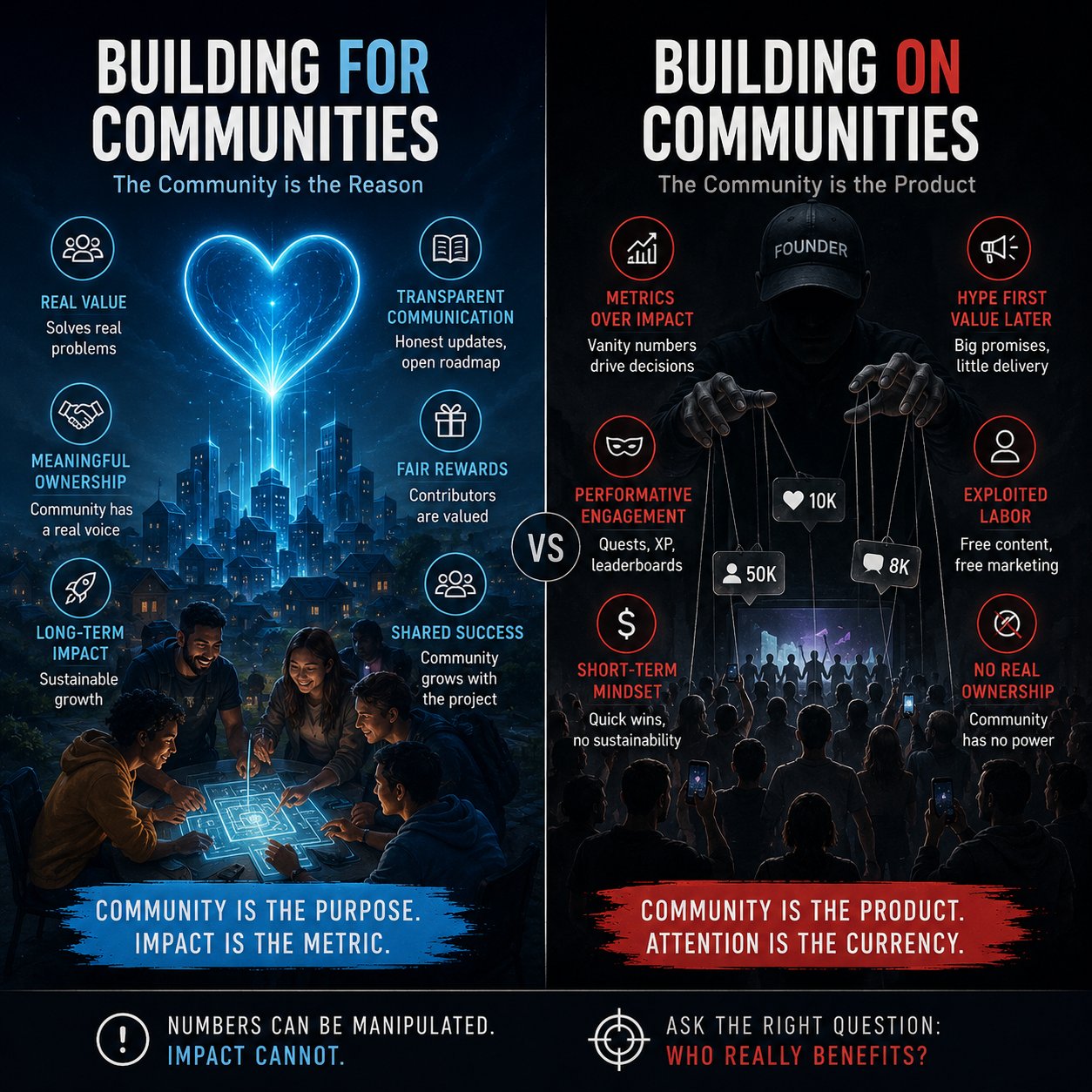
There is an important difference between building for a community and building on top of one.
A project built for its community measures success by the lives it improves, the problems it solves, and the opportunities it creates.
A project built on its community often measures success through social metrics—followers, impressions, wallet addresses, Discord members, transactions, or engagement rates.
These numbers can look impressive on dashboards and investor decks.
But dashboards do not necessarily reflect impact.
Communities should never exist merely to increase the valuation of a project.
They should be the reason the project exists in the first place.
Grant programs are among the greatest innovations in modern blockchain ecosystems.
Without them, many wallets, developer tools, public goods, educational platforms, and open-source infrastructure simply would not exist. Ecosystems such as Ethereum, Base, Optimism, Celo, Solana, and Arbitrum have collectively invested millions of dollars into developers because they understand that healthy ecosystems require builders.
The problem, however, is not grants.
The problem is what grants sometimes begin to reward.
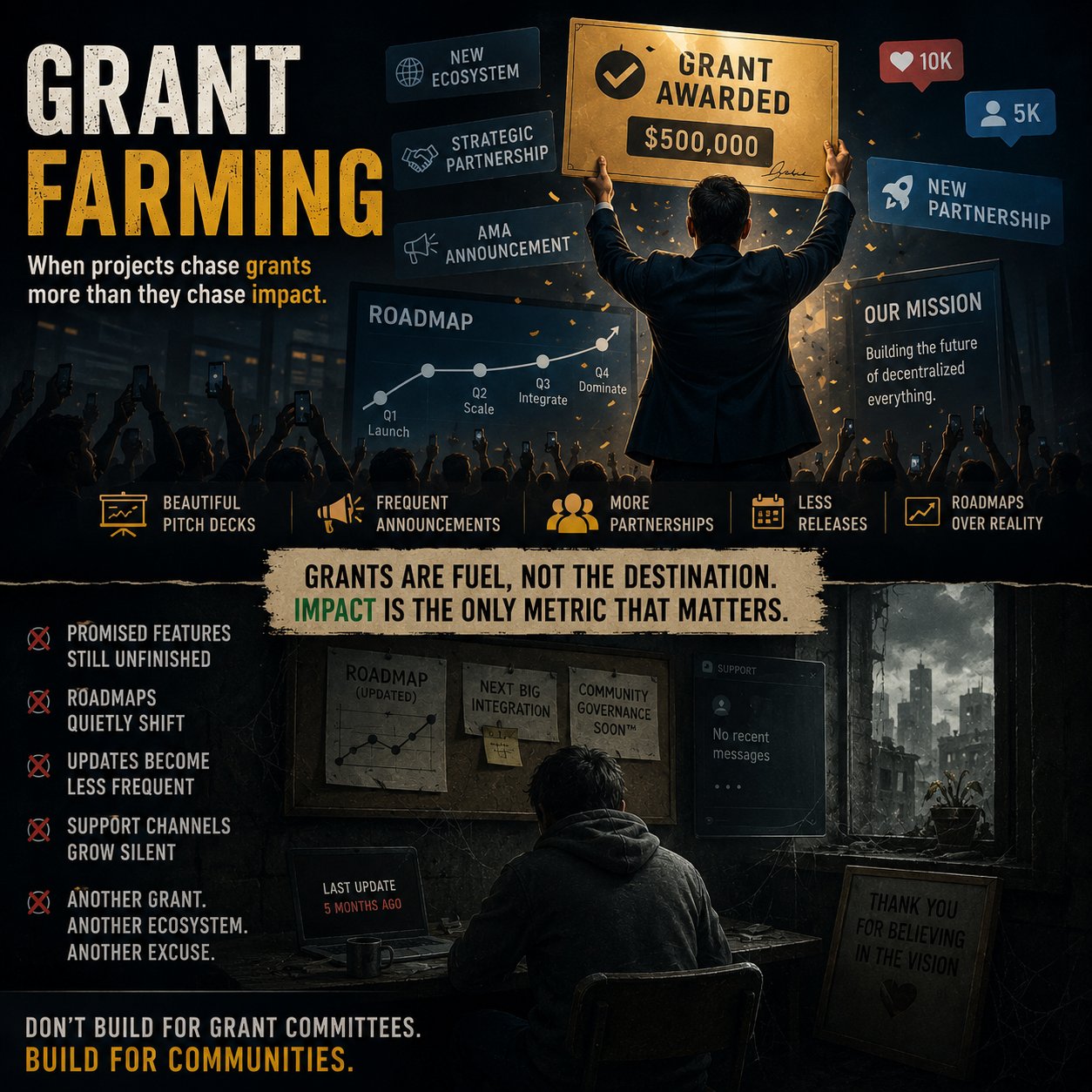
Some projects gradually stop building primarily for users and begin building for grant committees.
Instead of asking, "What do our users need next?" they begin asking, "What would improve our chances of winning another grant?"
Pitch decks become more refined than the product itself. Announcements become more frequent than releases. Partnerships multiply while development slows. Beautiful roadmaps replace measurable execution.
A project secures funding, celebrates publicly, and receives congratulations across social media. The community shares the announcement, believing this new funding will accelerate development.
Months later, little changes.
The promised features remain unfinished.
The roadmap quietly shifts.
Community updates become less frequent.
Support channels grow silent.
Then another announcement appears.
Another ecosystem.
Another grant.
Another opportunity.
The founders continue progressing professionally. Their network expands. Their visibility increases. Their résumés become stronger.
The community, however, often remains exactly where it started.
Winning grants should never be the finish line.
Communities benefiting from those grants should be.
Perhaps the greatest irony in Web3 is that communities were meant to own the internet.
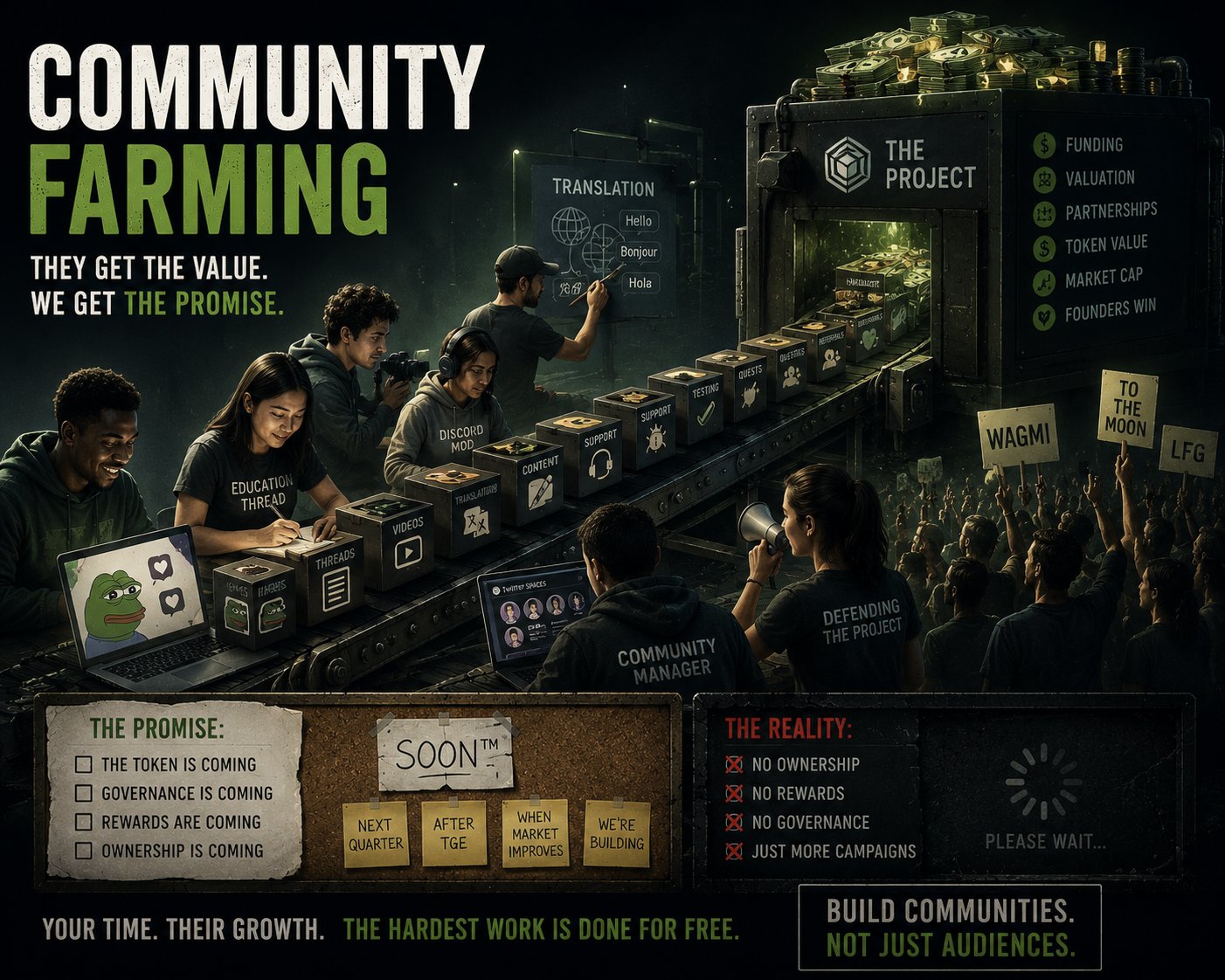
Instead, many communities have unintentionally become unpaid growth teams.
Every day thousands of people dedicate countless hours creating memes, writing educational threads, producing videos, translating documentation, moderating Discord servers, hosting Twitter Spaces, inviting friends, completing quests, testing beta products, and defending projects during moments of criticism.
Most do this voluntarily because they believe they are helping build something meaningful.
Many are told that ownership will eventually follow participation.
The token is coming.
Governance is coming.
Recognition is coming.
The rewards are coming.
Sometimes they do.
Many times they don’t.
By the time reality catches up with expectation, the project has already received enormous value through community-generated content, engagement, visibility, and user acquisition.
The community believed they were owners.
In practice, many functioned primarily as volunteer marketers.
This isn’t exploitation because contributors weren’t paid.
It becomes exploitation when projects continuously extract value from community participation without creating proportional value in return.

Attention has become one of the most valuable currencies in Web3.
Every ecosystem wants active users.
Every founder wants engagement.
Every protocol wants growth.
As a result, participation increasingly becomes gamified.
Users collect points.
Earn XP.
Complete quests.
Mint NFTs.
Refer friends.
Post screenshots.
Like tweets.
Comment under announcements.
Join Spaces.
Everything begins to feel like progress.
Yet an important question is rarely asked.
Progress toward what?
Many users spend months participating in elaborate engagement campaigns without any meaningful clarity regarding what those efforts ultimately lead to.
Sometimes the engagement itself becomes the product.
A project announces a campaign.
Thousands participate.
The campaign trends across social media.
Metrics increase.
Investors notice.
The ecosystem celebrates "growth."
Whether participants actually benefited becomes a secondary conversation.
Communities should never confuse activity with ownership.
Engagement alone does not create value unless it eventually translates into meaningful outcomes for the people generating it.
Influencers have become one of the most powerful institutions in blockchain.
Many genuinely educate.
Many expose scams.
Many help new users navigate an increasingly complex industry.
Their contributions should not be ignored.
But influence creates incentives.
Social media platforms rarely reward accuracy.
They reward attention.
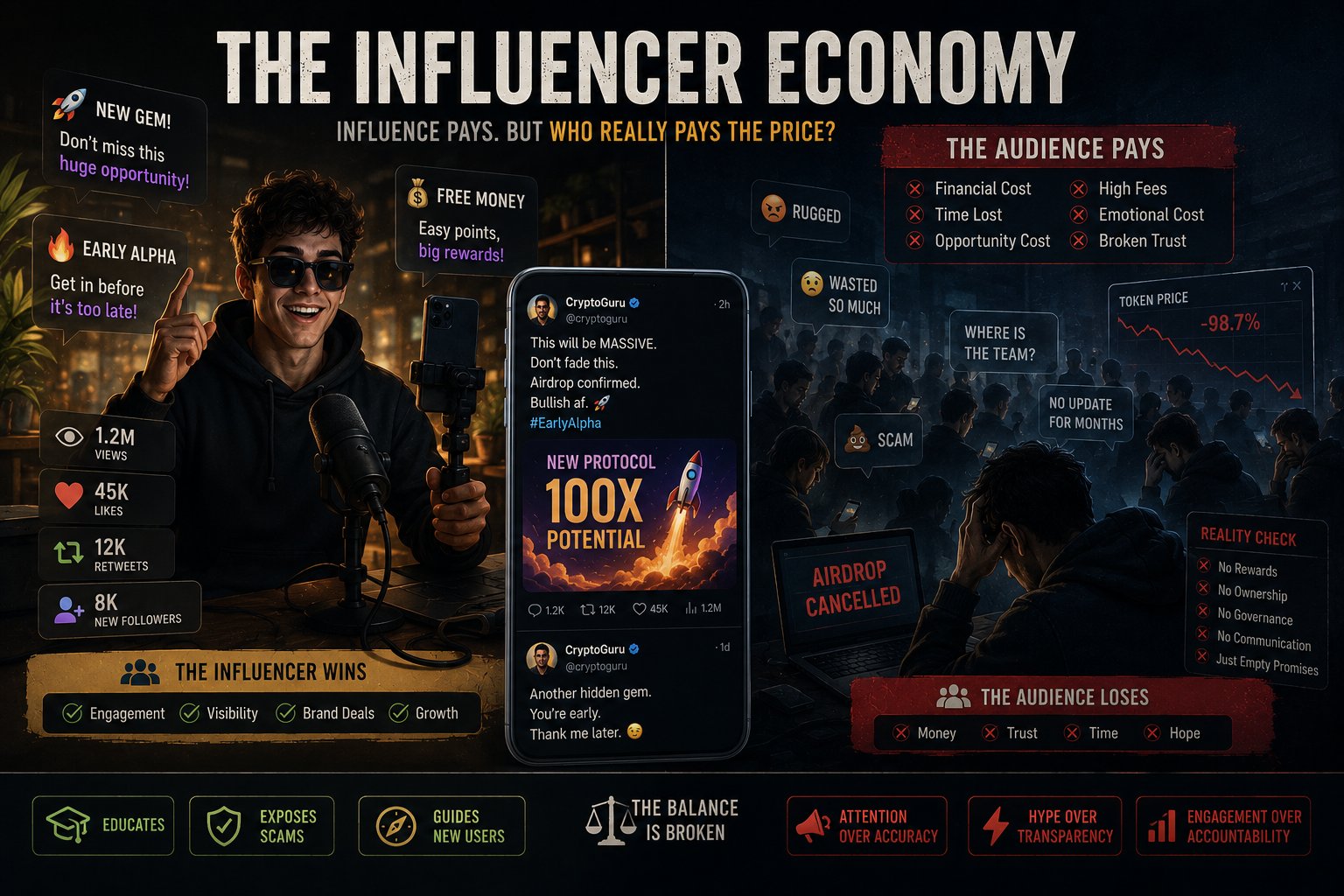
A post saying, "This looks interesting, but please do your own research," rarely reaches millions.
A post saying, "Don't miss this opportunity," often does.
Over time, urgency becomes content.
Every protocol becomes "massive."
Every campaign becomes "free money."
Every points program becomes "early alpha."
Communities rush to participate, bridge assets, spend transaction fees, complete tasks, and invite friends.
Some opportunities become successful.
Many quietly disappear.
The influencer, however, often loses very little regardless of the outcome.
The engagement has already been generated.
The impressions have already been counted.
The audience assumed the financial and opportunity cost.
The creator captured the visibility.
Again, this is not an accusation against every influencer.
It is an observation about the incentives created by platforms where engagement is rewarded more consistently than accountability.
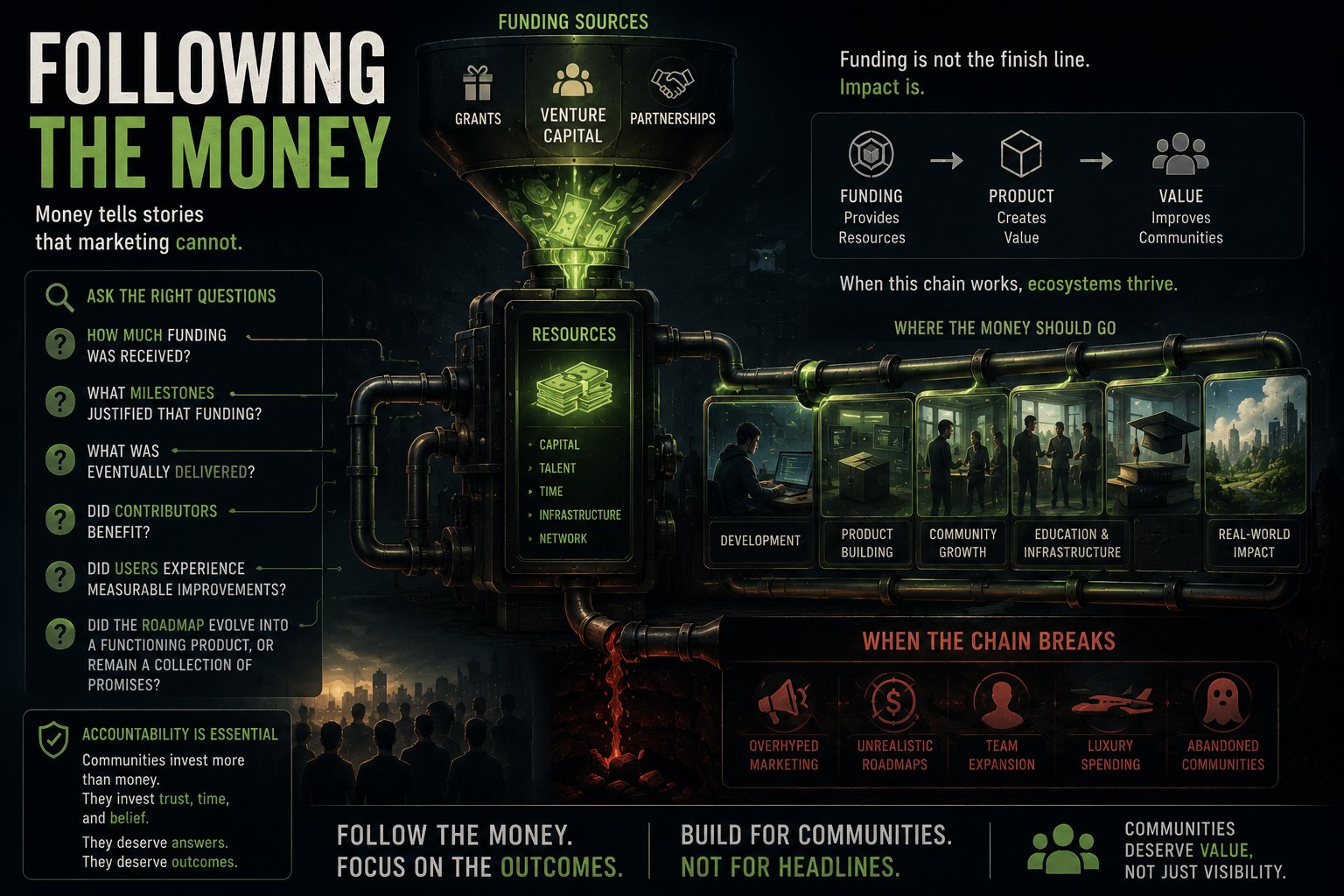
One of the simplest ways to understand any ecosystem is to follow the flow of incentives.
Money tells stories that marketing cannot.
When investigating a blockchain project, asking whether it won a grant is only the beginning.
More important questions quickly emerge.
How much funding was received?
What milestones justified that funding?
What was eventually delivered?
Did contributors benefit?
Did users experience measurable improvements?
Did the roadmap evolve into a functioning product, or remain a collection of promises?
Similarly, venture funding deserves similar scrutiny.
Raising capital is not inherently positive or negative.
It simply provides resources.
The more meaningful question is how those resources translated into outcomes for the community that believed in the vision.
Funding should create products.
Products should create value.
Value should improve communities.
When that chain consistently breaks, it deserves examination.
It is often sitting in plain sight.
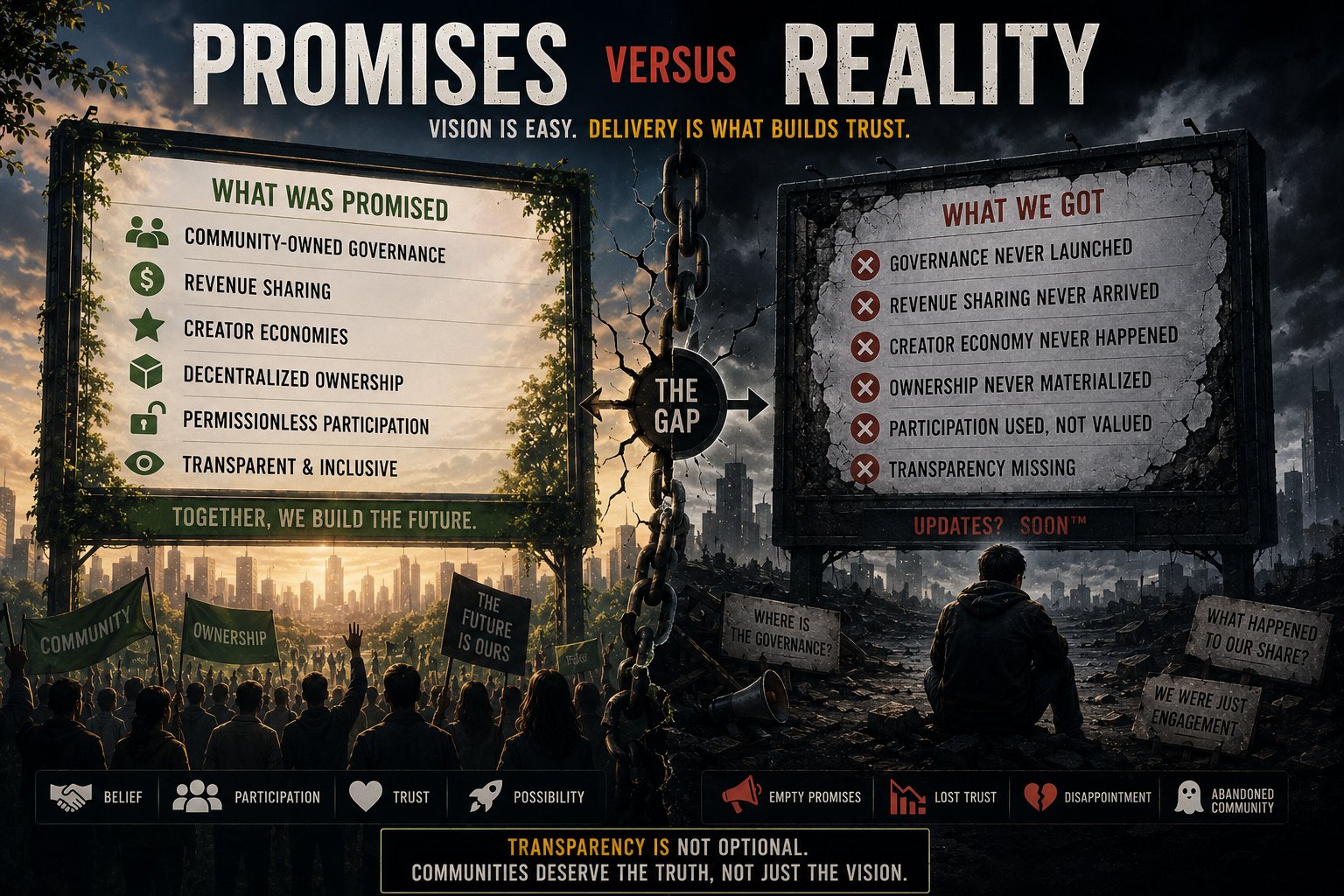
Projects announce ambitious visions.
Community-owned governance.
Revenue sharing.
Creator economies.
Decentralized ownership.
Permissionless participation.
Years later, those same communities frequently discover that the governance never launched, ownership never materialized, revenue sharing never arrived, and participation primarily generated engagement rather than influence.
This does not automatically imply dishonesty.
Roadmaps change.
Markets evolve.
Building is difficult.
But transparency demands acknowledging the distance between promise and reality.
Communities deserve to know not only what changed, but why it changed.
Trust grows through honest communication.
Not perfect execution.
Blockchain loves numbers.
Wallet addresses.
Followers.
Transactions.
TVL.
Downloads.
Discord members.
Hackathon submissions.
These numbers are useful.
But they are incomplete.
Perhaps we should begin celebrating different metrics.
How consistently does the team ship updates?
How active is development?
How many issues are resolved?
How frequently is documentation improved?
How many community suggestions become actual features?
How many contributors remain active after one year?
These questions tell us far more about a project's health than social media impressions ever could.
Marketing creates expectations.
Execution creates trust.
The greatest damage caused by Narrative Farming is rarely financial.
It is cultural.
Every abandoned roadmap makes communities slightly more skeptical.
Every broken promise makes contributors less willing to volunteer.
Every delayed reward makes participation feel increasingly transactional.
Eventually, even genuinely ethical builders inherit distrust they never created.
Entire ecosystems begin suffering from reputation fatigue.
People stop believing.
Not because blockchain failed.
But because expectations repeatedly exceeded delivery.
Trust is incredibly difficult to earn.
Remarkably easy to monetize.
Almost impossible to rebuild once exhausted.
Despite everything discussed throughout this essay, this is not a pessimistic view of blockchain.
Because another Web3 exists.
There are founders who quietly build for years without chasing headlines.
Projects that publish transparent updates even when progress is slow.
Grant recipients who exceed expectations and openly document every milestone.
Communities that genuinely influence governance.
Influencers who disclose partnerships and admit mistakes.
Teams that reward contributors fairly.
Builders who understand that trust compounds more slowly than hype, but lasts significantly longer.
These people rarely dominate timelines.
Yet they represent the future worth building.
They remind us that blockchain's greatest innovation was never simply technology.
It was coordination between strangers built upon shared belief.
That belief deserves protection.
This article is intended as the beginning of a broader investigation rather than its conclusion.
The next phase of this research will examine blockchain projects across multiple ecosystems—including Ethereum, Base, Celo, Optimism, Arbitrum, Solana, Polygon, and others—by comparing public promises with measurable outcomes.
The investigation will review grant announcements, GitHub repositories, product releases, governance activity, funding rounds, community engagement, roadmap execution, and user adoption over multiple years. Rather than attempting to judge intentions, the goal is to identify recurring incentive patterns where community participation generated significant value while long-term benefits for contributors remained limited.
The purpose is not to identify villains.
It is to better understand the systems that shape behavior across Web3.
Every generation inherits technologies capable of changing the world.
Blockchain may be one of ours.
But technology alone has never been enough.
Healthy ecosystems require more than smart contracts.
They require integrity.
They require accountability.
They require communities that are treated as partners rather than marketing strategies.
Narrative Farming does not happen because every founder is dishonest.
It happens because incentives quietly encourage behavior that prioritizes attention over outcomes, visibility over delivery, and storytelling over measurable impact.
Recognizing these patterns is not an attack on Web3.
It is an attempt to protect what made Web3 worth believing in from the very beginning.
This is Part One.
For Part Two, I want to investigate real experiences from builders, contributors, moderators, grant recipients, and community members across different ecosystems.
If you've ever supported a project that promised ownership, transparency, meaningful rewards, or long-term value but failed to deliver, share your experience in the comments. Every submission will be independently verified using public records, archived announcements, onchain data where available, and project documentation before being included.
The goal isn't to expose people.
The goal is to understand the incentives shaping our industry and to ask whether the communities that built Web3 are truly sharing in the value they helped create.


