
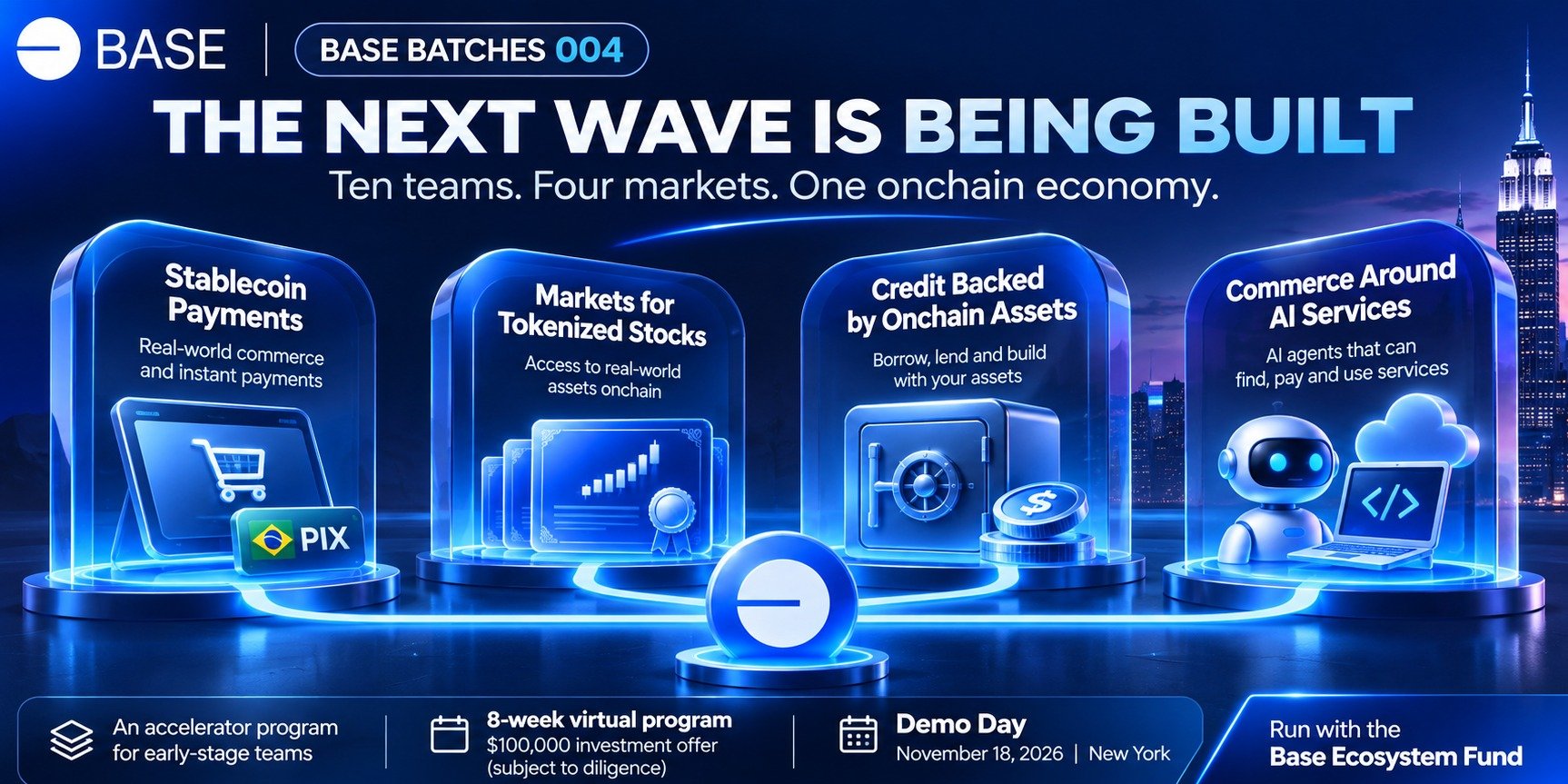
Ten early-stage teams reveal where the next wave of onchain adoption could come from.
When people discuss blockchain growth, they usually reach for familiar numbers: transactions per second, daily active addresses, total value locked, or trading volume.
Those metrics matter. But they don't always tell us what people are actually building or what problems they are trying to solve.
Sometimes, a much better signal is the kind of businesses choosing to build on a network.
On November 3, 2026, Base introduced the ten teams selected for Base Batches 004, its latest accelerator cohort, run in partnership with the Base Ecosystem Fund.
What caught my attention wasn't simply the number of participants. It was the range of problems they are working on.
These aren't ten teams chasing exactly the same crypto trend. Their work points toward four connected areas: everyday payments, tokenized asset markets, onchain credit, and commerce around AI services. base.org
One of the biggest challenges for stablecoins has never been the technology itself. It has been connecting digital dollars to the payment systems people already use.
The cohort includes projects working on:
Self-custodial payments connected to Brazil's PIX network.
Stablecoin liquidity and foreign-exchange hedging for businesses in Africa and emerging markets.
Merchant point-of-sale payments using an iPhone, with settlement in stablecoins on Base.
This is an important distinction.
A payment product becomes useful when merchants and customers can use it without having to rethink their entire financial routine.
Putting an asset onchain is only the first step.
People also need ways to trade it, manage exposure and protect themselves against changing market conditions.
The new cohort includes builders exploring tokenized options, self-custodial investment platforms and exchanges designed for tokenized assets with offchain order matching and onchain settlement.
In my view, this is where tokenization becomes more than a new way to represent ownership.
It begins to create the foundations for a different financial marketplace.
Another area receiving attention is borrowing against assets.
Some teams are exploring ways for Bitcoin holders to access stablecoin liquidity, while others are developing credit products involving crypto and tokenized stocks.
The interesting opportunity is not simply creating another lending market.
It is making capital more accessible without necessarily requiring people to sell the assets they already hold.
Of course, responsible collateral management and risk controls will determine whether these models can work sustainably.
The fourth area may be one of the most interesting over the next few years.
AI agents increasingly need access to paid services, computing and APIs.
The cohort includes teams working on helping API providers understand how AI agents discover and pay for services, as well as an exchange for AI inference the computing used to generate model responses.
This suggests a new kind of customer is emerging.
An AI agent may not have a human-style shopping experience, but it still needs to discover services, compare options and pay for resources.
That creates a different set of infrastructure requirements.
According to the official announcement, the program combines an eight-week virtual accelerator with dedicated advisors, weekly support, expert access and fundraising education.
Participating teams receive a $100,000 investment offer from the Base Ecosystem Fund, subject to the fund's diligence review and program terms.
The cohort will present its products and progress at Demo Day in New York on November 18, 2026. base.org
I think this cohort reveals something important about the direction of Base.
A healthy ecosystem cannot depend on one successful application category.
Payments need stable liquidity. Tokenized assets need trading infrastructure. Credit needs reliable collateral systems. AI commerce needs efficient ways for software to discover and pay for services.
These markets are different, but they can reinforce one another.
A merchant accepting stablecoins, an investor managing tokenized assets, a borrower accessing liquidity and an AI agent paying for computing may all rely on the same underlying network.
That is a much more interesting vision than simply competing for transaction counts.
Still, an accelerator cohort is a starting point, not proof of product-market fit. These teams are early-stage builders. Their ideas must still survive real users, regulation, competition, liquidity constraints and execution.
But I like the direction.
The next chapter of blockchain adoption may be written by businesses that solve ordinary problems in ways that happen to be powered by onchain infrastructure.
The future isn't just about building a faster blockchain. It's about building businesses that have a reason to use one.
@jessepollak
@brian_armstrong
#Base #Coinbase #BaseBatches #BuildOnBase #Web3 #Stablecoins #OnchainEconomy #AIAgents
Platform / Project: basekit.online
Developer Name: Mehmet Çelik
Username (GitHub / Farcaster): temhemc
Base Builder ID:
bc_h8ua8gs9