
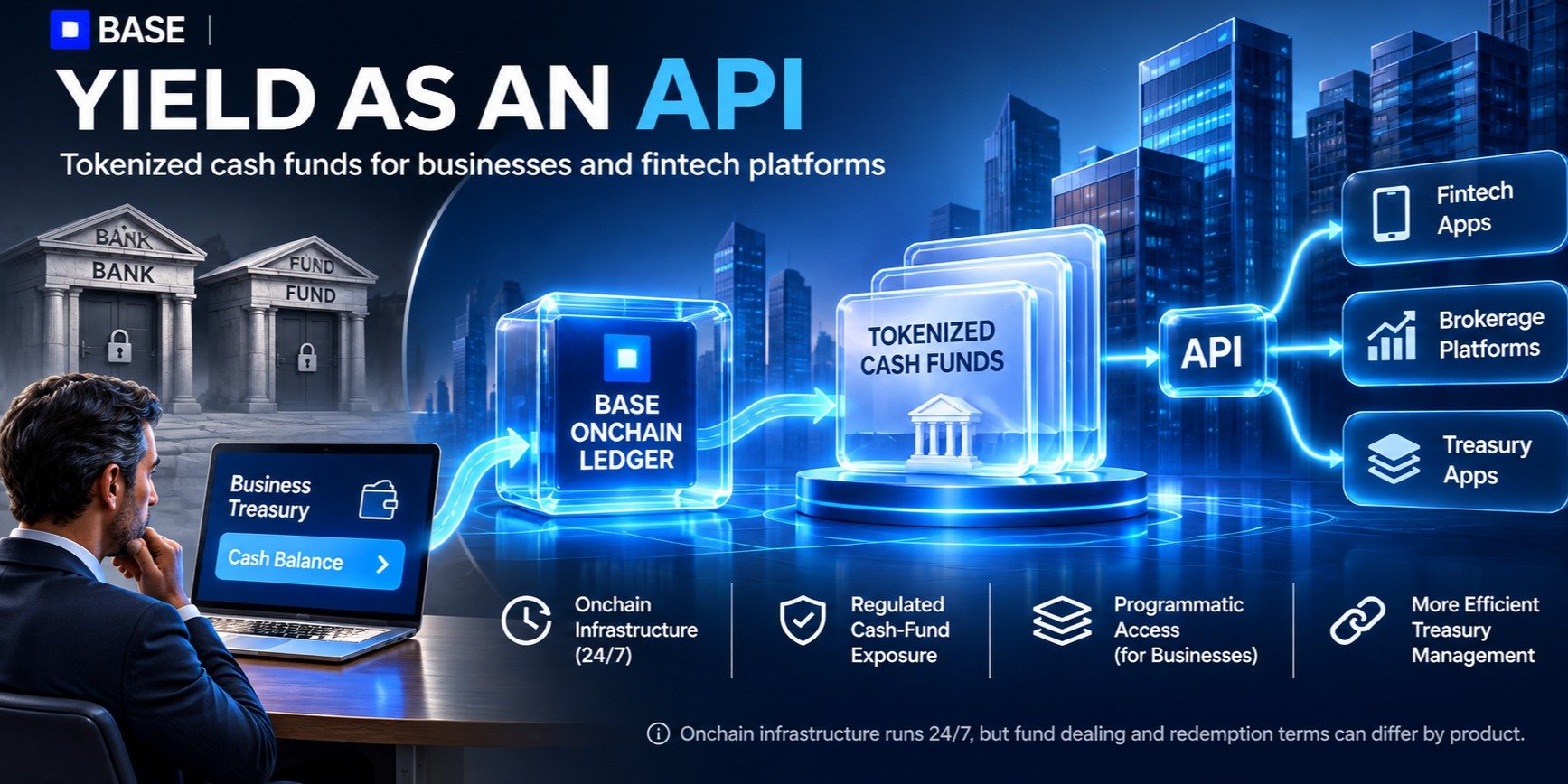
How Base is helping bring tokenized cash funds closer to everyday businesses and financial platforms.
There is a problem that rarely gets enough attention in the conversation about business finance.
Companies hold cash because they need it. They have payroll to meet, suppliers to pay, invoices to settle and unexpected expenses to handle.
But having money available and making that money work efficiently are two different things.
For many businesses, accessing investment products has traditionally meant dealing with separate accounts, different financial institutions, administrative processes and redemption schedules.
What if that experience could become much simpler?
A new Base customer story published on November 4, 2026, highlights an interesting approach from Spiko: bringing cash funds and business treasury management closer together through tokenized infrastructure and APIs. Base
The interesting part of Spiko is not simply that it offers tokenized cash funds.
It is the way those products can be distributed.
Businesses and individuals can access Spiko's funds directly, while fintech companies, brokerages and crypto platforms can use its API to offer similar products to their own customers.
In other words, a financial platform does not necessarily need to create and operate its own fund business to provide customers with access to cash-fund products.
It can integrate an existing infrastructure instead.
That changes the role of yield.
Rather than being a separate product that customers must actively search for, it can become a feature inside the financial application they already use.
Spiko's API documentation describes several integration possibilities, including access to fund information, account data, deposits, withdrawals and distribution services for eligible partners. Spiko
Spiko operates across public blockchains, with Base among the networks supporting its infrastructure.
The advantage of putting fund shares and money-related records on a public blockchain is that they can use a common, inspectable ledger rather than relying exclusively on disconnected internal systems.
Base provides the fast, low-cost onchain environment that can support these applications.
For businesses, the goal is not to become blockchain experts. It is to access useful financial services through familiar interfaces.
For financial platforms, the opportunity is to integrate new products without having to build every component themselves.
That is a more practical application of blockchain technology than simply moving another asset onto a chain.
In its Base customer story, Spiko reported:
$2.7 billion in assets under management, based on company-reported September 2026 figures.
Approximately $10 billion in cumulative fund flows since launch, representing subscriptions and redemptions.
These are Spiko-wide figures, not assets or transaction volume attributable exclusively to Base.
Spiko also reported its $2.7 billion figure in its October 6 company update, describing growth across its business and financial-platform distribution. Base
The numbers are interesting, but the infrastructure model is what deserves attention.
There is an important distinction between blockchain availability and financial-product availability.
The underlying onchain infrastructure can operate around the clock, but fund subscriptions, dealing and redemption terms may follow the rules and schedules of the individual product.
Spiko's own documentation describes different liquidity terms for its different fund products.
These are investment products, not ordinary bank deposits. They carry risks, including potential loss of principal, and access depends on eligibility and geographic restrictions. Base
It is worth understanding those differences before treating tokenized cash funds as a replacement for immediately available operating cash.
I think one of the most promising directions for Base is helping financial platforms become more useful without forcing them to build an entire financial institution from scratch.
Imagine opening a business finance application and finding that payments, treasury management, investment access and reporting are connected in one place.
The customer does not need to know which blockchain is processing the underlying records.
The business simply needs a product that works, transparent terms and reliable access to its money.
That is where APIs become important.
They allow financial capabilities to travel between applications. They also create opportunities for smaller fintech companies to offer services that once required much larger operational structures.
But success will depend on more than integration. Regulation, custody, liquidity, risk management and customer protection remain essential.
Spiko is an independent company, not a Coinbase or Base product. Its use of Base is one example of how businesses can build financial services on public blockchain infrastructure. Base
For me, that is the bigger story.
The next generation of financial applications may not compete by offering more buttons. They may compete by quietly connecting more useful financial infrastructure behind a single experience.
And sometimes the most important blockchain feature is the one the customer never has to think about.
@jessepollak
@brian_armstrong
#Base #Coinbase #Spiko #Tokenization #OnchainFinance #FinTech #Stablecoins
Platform / Project: basekit.online
Developer Name: Mehmet Çelik
Username (GitHub / Farcaster): temhemc
Base Builder ID:
bc_h8ua8gs9