
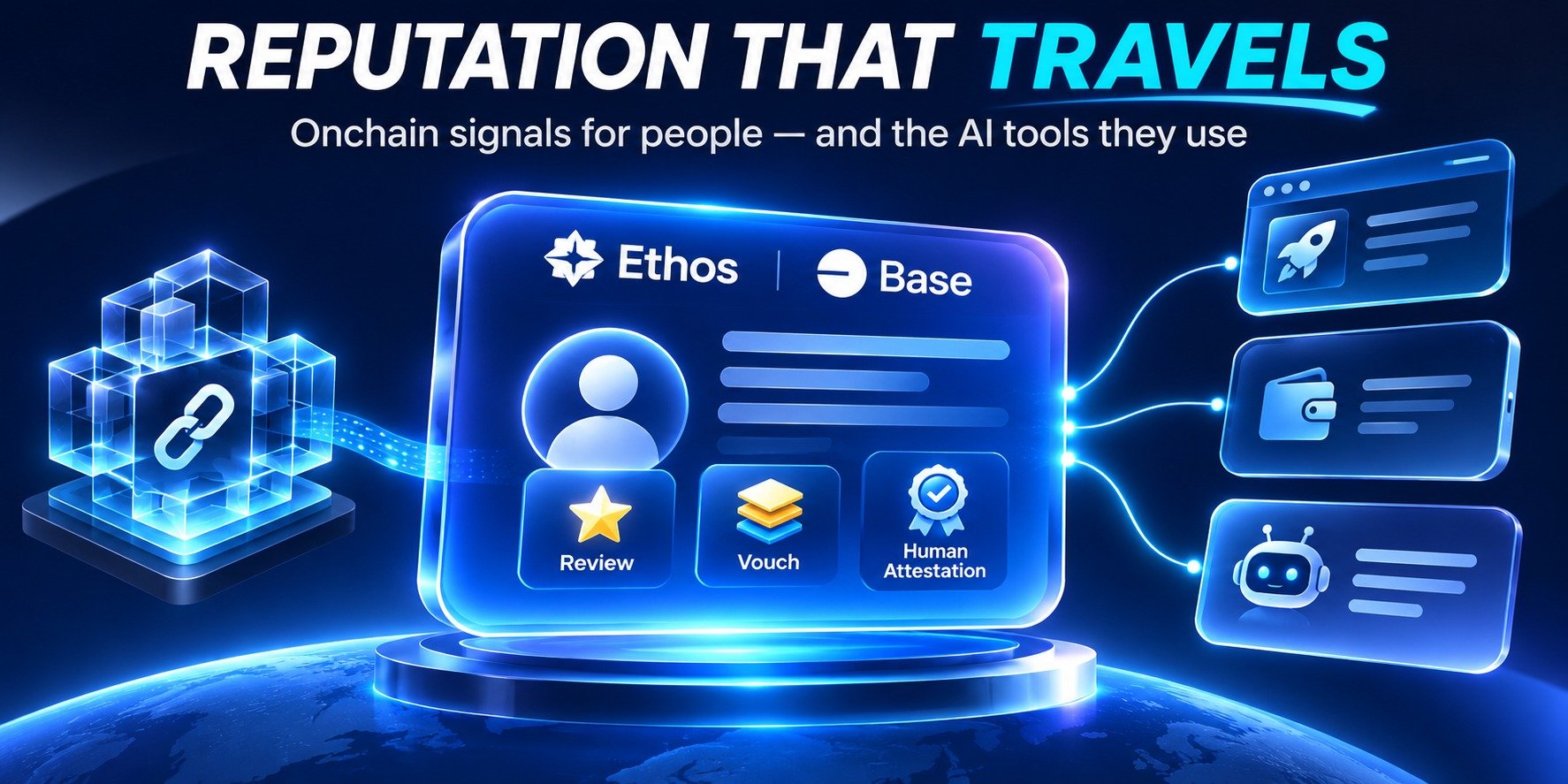
Why portable onchain reputation could become an important layer of the AI-powered internet.
Imagine asking an AI assistant whether a crypto project is worth researching.
Until recently, you might have expected the assistant to look at the project's website, token information, social media activity and perhaps a few public discussions.
But what if it could also examine the reputation history of the people behind that project?
That possibility is becoming more interesting.
On October 28, 2026, Ethos published an observation that caught my attention. An X user, @lex_node, noticed that Grok appeared to use Ethos reputation scores while making a decision. Ethos responded that it had been actively working to make its profiles, reviews, vouches and other reputation data discoverable to large language models.
This was an observed interaction, not an announced formal partnership between Grok and Ethos. But it raises an important question: could onchain reputation become part of the information AI systems use when evaluating people and projects? Ethos
Today, digital reputation is fragmented.
Your professional history may live on one platform. Your community contributions are somewhere else. Your trading history, public reviews and relationships may be scattered across several applications.
The problem is simple: when you move between platforms, much of that context gets left behind.
Ethos is trying to approach this differently on Base.
Its system combines several reputation signals:
Reviews from other community members.
Financially backed vouches from people willing to put assets behind their support.
Attestations and human-verification credentials.
Credibility scores that can be surfaced in other applications.
The important design choice is that reputation is not intended to remain trapped inside a single interface.
Base's Ethos customer story explains that developers can interact with Ethos smart contracts from their own applications, while its API makes credibility scores available in other products. Base also points to Legion, which displays Ethos scores on project pages. Base
Ethos reported the following figures on October 2, 2026:
863,683 reputation actions: reviews, vouches and attestations combined. These are activities, not unique people.
33.8 million X accounts scored: this measures scoring coverage, not registered profiles or active users.
$7.22 million backing reputation: assets committed to vouching on Base, including WHUF, measured at that point in time.
These figures suggest that reputation infrastructure is being built at a meaningful scale. They should not, however, be confused with verified user counts or proof that fraud has been eliminated. Base
On October 28, Ethos also reported that its Human Verification system had passed 1,300 verified humans.
Its approach is different from systems that require an iris scan, facial scan or government identification document.
According to Ethos, an applicant is reviewed by three independent human verifiers who have themselves reached a specified credibility threshold. The process can involve a live video call, voice call or in-person interaction. The resulting credential is recorded onchain and designed to be portable across applications.
The system also creates accountability: applicants and verifiers both have credibility at stake if they violate the rules. Ethos
It is an interesting experiment in a world where bots are becoming increasingly convincing.
I think this is one of the more overlooked areas of the onchain economy.
We spend a lot of time discussing token prices, liquidity, transaction speed and new financial products. But as more activity moves onchain and as AI agents begin interacting with users and applications knowing who or what is behind an account becomes increasingly important.
A portable reputation layer could help an application make better decisions without rebuilding an entire trust system from scratch.
It could help a marketplace assess sellers, a community evaluate contributors, or an AI assistant find additional context before recommending a project.
But there is a serious challenge.
A reputation score is not the same thing as truth.
Reviews can be manipulated. Vouches can reflect personal relationships. Scores can become outdated. Even a verified-human credential does not automatically prove that someone is honest, competent or acting in good faith.
For reputation systems to earn trust, they will need transparency, context, meaningful accountability and ways to challenge incorrect information.
That is why I find the combination of onchain records and portable credentials more interesting than any single score.
The real opportunity is not to create one universal number that decides who deserves trust. It is to give people and applications better information with which to make their own decisions.
And if AI assistants increasingly consult public reputation records, the history we build online may become more consequential than we expect.
In the next internet, your reputation may travel further than your profile.
@jessepollak
@brian_armstrong
#Base #Coinbase #Ethos #OnchainIdentity #AI #Web3 #DigitalReputation
Platform / Project: basekit.online
Developer Name: Mehmet Çelik
Username (GitHub / Farcaster): temhemc
Base Builder ID:
bc_h8ua8gs9