
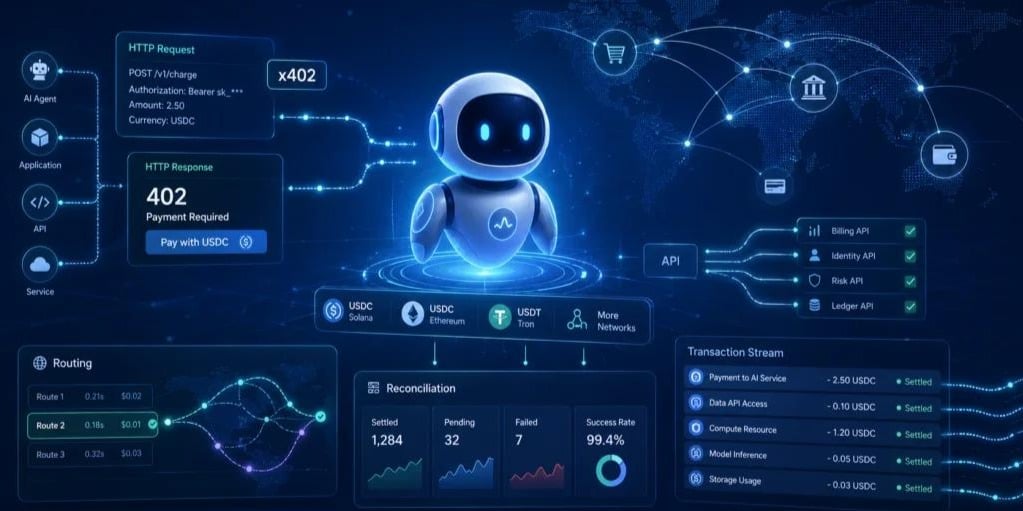
On November 12, 2026, Base published a new customer story featuring Exa, an AI-focused search engine that allows software agents to purchase search results using USDC on Base.
The concept addresses a surprisingly practical problem.
Until now, connecting an AI agent to a paid API often required a human to create an account, purchase credits, generate an API key and configure credentials before the agent could make its first request.
Exa is introducing a different approach through the open x402 payment protocol.
Here's how it works:
An AI agent sends a search request without an API key.
Exa responds with an HTTP 402 Payment Required message containing the price and payment instructions.
The agent pays in USDC from its funded wallet on Base.
Coinbase Developer Platform verifies and settles the payment.
Exa returns the requested search results.
No separate search account or prepaid subscription is required for this payment flow.
Base+1
There are some interesting numbers behind this development.
According to the Coinbase Business case study, retrieved on October 29, Exa had already settled more than 96,000 agent transactions, with over 700 agents and wallets paying for its services.
Exa's documentation, retrieved November 2, listed a price of $0.007 for a standard automated search of up to ten results. Pricing can change.
Base+1
Importantly, Exa is an independent third-party company, not a Coinbase or Base affiliate. It operates its own search service and sets its own prices.
I think this is a much bigger idea than paying a few cents for a search query.
Consider what an autonomous AI agent might need to accomplish a task.
It could need to search the internet, retrieve financial data, purchase computing resources, access an external API and pay another software service to complete a transaction.
Traditionally, each provider would require its own account, billing arrangement and authentication process.
That model was designed for humans.
The x402 approach introduces something different: services can charge for individual requests, while an agent can use its funded wallet to pay when the service is needed.
In my view, this is an important building block for machine-to-machine commerce.
Base's role is particularly interesting because it provides the settlement infrastructure behind these payments. Coinbase's developer tools also help service providers verify payments without having to build their own settlement infrastructure.
But I would not confuse this with a fully autonomous economy already operating without limitations.
Agents still need funded wallets, appropriate spending controls and supervision. A payment being settled does not guarantee that the information returned is accurate or that an agent will make a good decision.
And traditional enterprise contracts will remain relevant. Exa itself expects larger customers to continue using contracts and invoices, with x402 offering another option for smaller and more flexible usage.
Base+1
What interests me most is the possibility of an internet where software doesn't simply consume information it participates in an economy.
The next major wave of onchain activity may not come from people clicking buttons. It may come from software agents paying for the services they need to get things done.
That's a development worth watching.
@jessepollak
@brian_armstrong
#Base #Coinbase #AI #x402 #AgenticEconomy #USDC
Platform / Project: basekit.online
Developer Name: Mehmet Çelik
Username (GitHub / Farcaster): temhemc
Base Builder ID:
bc_h8ua8gs9