
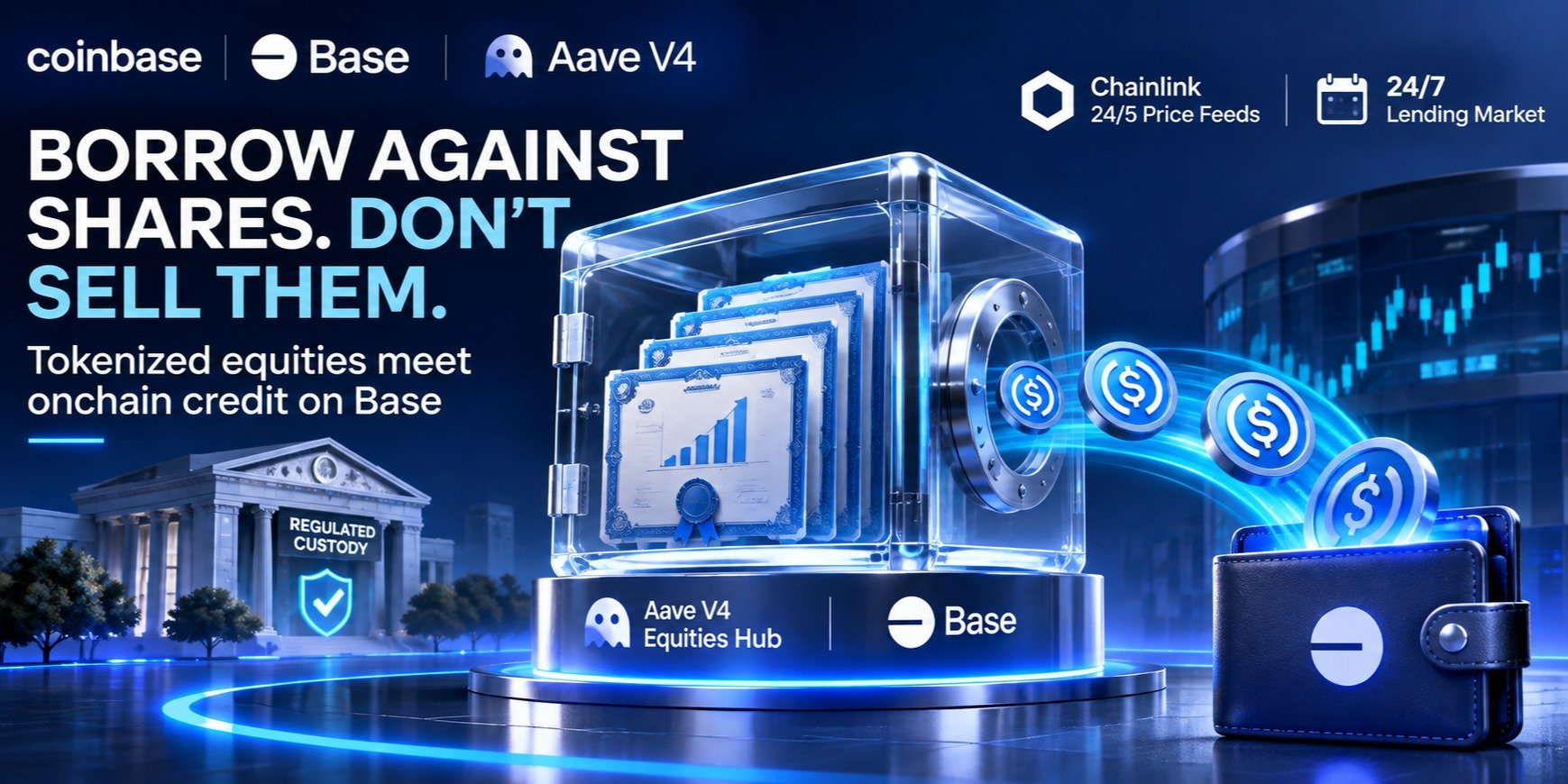
How Base is connecting tokenized equities with decentralized lending and why the details matter.
For years, the conversation around tokenized stocks has focused on one question: can traditional financial assets move onto a blockchain?
That question is becoming less interesting.
A more important question is emerging: once an asset is onchain, what else can people actually do with it?
An interesting example arrived on September 25, 2026, when Aave announced that Coinbase Tokenized Stocks had become available as collateral on Aave V4 on Base.
The idea is straightforward, but its implications are significant: eligible investors can deposit supported tokenized U.S. stocks and borrow USDC against them instead of selling their investment exposure to raise cash.
The initial Equities Hub supports seven tokenized stocks:
AAPLc — Apple
AMZNc — Amazon
GOOGLc — Alphabet
METAc — Meta
MSFTc — Microsoft
NVDAc — Nvidia
TSLAc — Tesla
These assets are issued by Coinbase through Coinbase Onchain SPV Ltd. The underlying shares are held in segregated custody accounts with Alpaca Securities LLC, an SEC-registered broker-dealer.
On Aave V4, users can deposit supported tokens as collateral and borrow USDC. At launch, the stocks are collateral assets only: users cannot borrow the stock tokens themselves or create equity-against-equity borrowing positions.
That distinction matters. This is not simply another place to trade tokenized stocks. It is an additional financial use for those assets.
The market also uses a dedicated USDC reserve and individual collateral factors for each supported stock. Aave
Stock-backed lending needs more than a token representing an asset.
It needs reliable asset issuance, a market where collateral can be traded, dependable pricing, and enough liquidity to manage loans when markets move.
This is where the Base ecosystem becomes relevant.
The tokenized stocks use Base's B20 standard, designed to support assets with issuer-defined policies and corporate actions such as dividends and stock splits. The underlying shares are held through a regulated custody structure, while the onchain tokens provide the mechanism for using that economic exposure across supported applications.
Aave uses Chainlink price feeds to value the collateral. The lending market is accessible 24/7, while the equity price feeds operate on a 24/5 schedule. During weekends and U.S. market holidays, the feeds retain their last published prices until the underlying market reopens. Aave
That last detail deserves attention. A market being accessible around the clock does not mean every underlying asset is continuously repriced around the clock.
Borrowing against an asset does not make the asset risk-free.
If collateral loses value and a position becomes undercollateralized, liquidation may occur. The borrower can lose some or all of the pledged collateral.
There are also important eligibility restrictions. Coinbase Tokenized Stocks are offered under Regulation S to eligible non-U.S. persons in permitted jurisdictions. They are not available to U.S. persons. These tokenized products should not be confused with unrestricted access to conventional brokerage shares.
The structure, collateral parameters, liquidity, oracle pricing and local eligibility rules all matter before anyone considers using the market. Aave
I believe the real opportunity in tokenization is not just reproducing familiar assets on a blockchain.
It is making those assets more useful.
A tokenized equity that can be held in a wallet is one step. An eligible holder being able to use that asset as collateral in an onchain lending market is another.
That creates a connection between traditional market exposure and decentralized credit. It also gives developers a new foundation for building financial products that do not fit neatly into the old separation between brokerage accounts, lending platforms and payment systems.
But the success of this model will not be determined by the announcement itself. It will depend on liquidity, responsible risk management, transparent asset structures and whether people actually find these products useful over time.
For Base, this is a meaningful direction: not simply putting more assets onchain, but building an environment where those assets can interact.
The next phase of tokenization may not be about owning more tokens. It may be about giving the assets we already own more ways to work.
@jessepollak
@brian_armstrong
#Base #Coinbase #Aave #Tokenization #DeFi #USDC #OnchainFinance
Platform / Project: basekit.online
Developer Name: Mehmet Çelik
Username (GitHub / Farcaster): temhemc
Base Builder ID:
bc_h8ua8gs9