
Crypto payments have a reputation problem. On one side, you have custodial processors that hold your funds, charge steep fees, and can freeze your account without notice. On the other, you have pure self-hosted setups so complex they require a dedicated DevOps engineer.
PayRam was built to dismantle both extremes: a self-hosted payment processor you can spin up in ten minutes, accept over twenty cryptocurrencies, and connect to AI agents without writing boilerplate code.
Two features stand out as genuinely novel right now. The first is PayRam's Card-to-Crypto Fiat Onramp, which lets customers pay with a card and lets merchants settle in crypto without touching a centralized exchange. The second is PayRam's Model Context Protocol (MCP) server, which wires your payment infrastructure directly into large language models, enabling fully autonomous, AI-driven payment workflows.
PayRam is a self-hosted cryptocurrency payment processor that is secure, private, and resistant to censorship. The core pitch is simple: you become your own payment processor. There are no intermediaries holding your funds between a customer's payment and your wallet.
The installer fits into a single bash command, and the platform supports Bitcoin, Ethereum, Tron, USDT across multiple chains, and more. Beyond basic payment acceptance, PayRam offers payment links, a full REST API, a TypeScript/JavaScript SDK, multi-brand setups, SmartSweep for automated fund consolidation, and customer deposit wallets.
The Onramp and MCP servers push the platform from a solid payments tool into genuine infrastructure for the next generation of internet commerce.
The biggest friction point in crypto commerce is not volatility or regulation. It is the onboarding gap. Most consumers do not own crypto. They have a debit card. Telling them to buy crypto on an exchange and then transfer it to pay is a conversion killer.
PayRam's Card-to-Crypto Fiat Onramp collapses that gap into a single checkout step.
Think of it as a foreign currency exchange desk built directly into your checkout page. Your customer pays in euros. You receive USDT. No exchange accounts, no manual conversions, no delay.
The Onramp allows merchants to accept customer payments in fiat currency while receiving settlements in crypto through PayRam. The flow is seamless:
Customer selects a product and proceeds to checkout
They choose card payment and the Onramp widget loads inline, no redirect required
The customer pays in their local fiat currency using any of 300+ supported payment methods
PayRam converts the amount in real time and settles the equivalent in the merchant's chosen cryptocurrency
The merchant sees a confirmed crypto payment in their PayRam dashboard, with no exchange interaction required
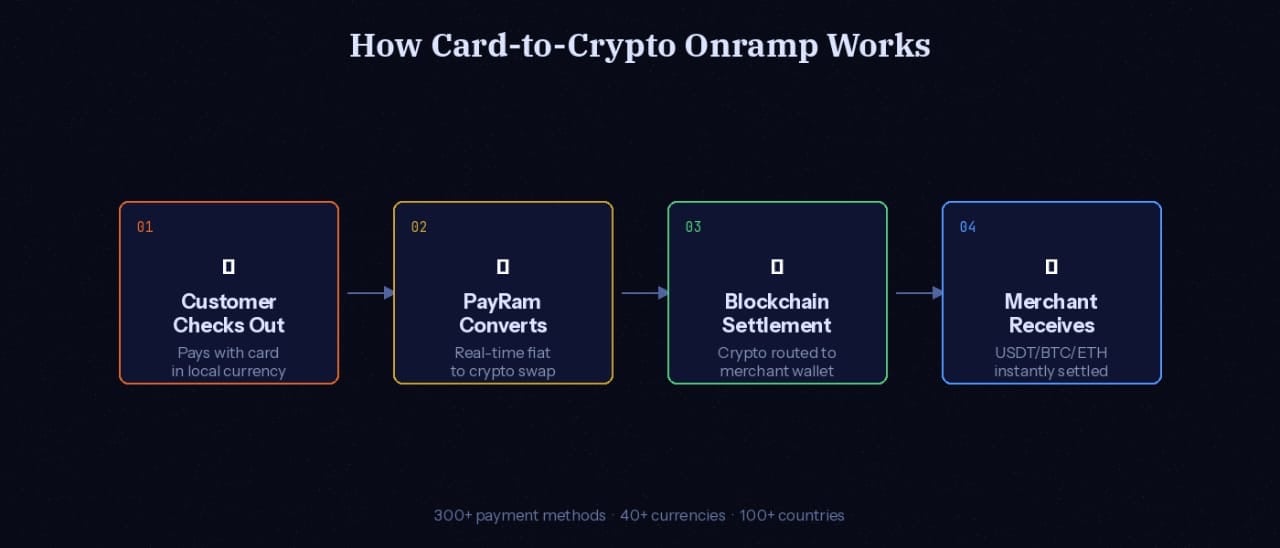
Global reach is built into the Onramp from day one. PayRam supports over forty fiat currencies and over three hundred payment methods, spanning major card networks, local payment schemes, and digital wallets across more than a hundred countries. Customers in Brazil, Germany, Nigeria, and South Korea can all pay in their local currency while the merchant receives a single, unified crypto settlement.
Imagine a developer tools startup that wants to price globally in USD but accept payments from users across Southeast Asia who predominantly use local bank transfers. Before PayRam's crypto onramp, this required a separate payment gateway, a crypto exchange account, a treasury process to convert receipts, and a reconciliation workflow.
With the Onramp embedded in checkout, the startup accepts local payments natively, settles in USDT, and eliminates three steps from their finance stack.
The Model Context Protocol is a standard that lets AI assistants connect directly to external tools and data sources. If you have used Claude or Cursor with connected integrations, you have used MCP. PayRam's MCP server extends this standard to crypto payments, meaning an AI agent can create payment intents, initiate payouts, manage webhooks, and run referral campaigns without a human touching a dashboard.
MCP is to AI agents what REST APIs were to web apps in 2005. PayRam's MCP server is the payments endpoint that the agentic economy has been waiting for.
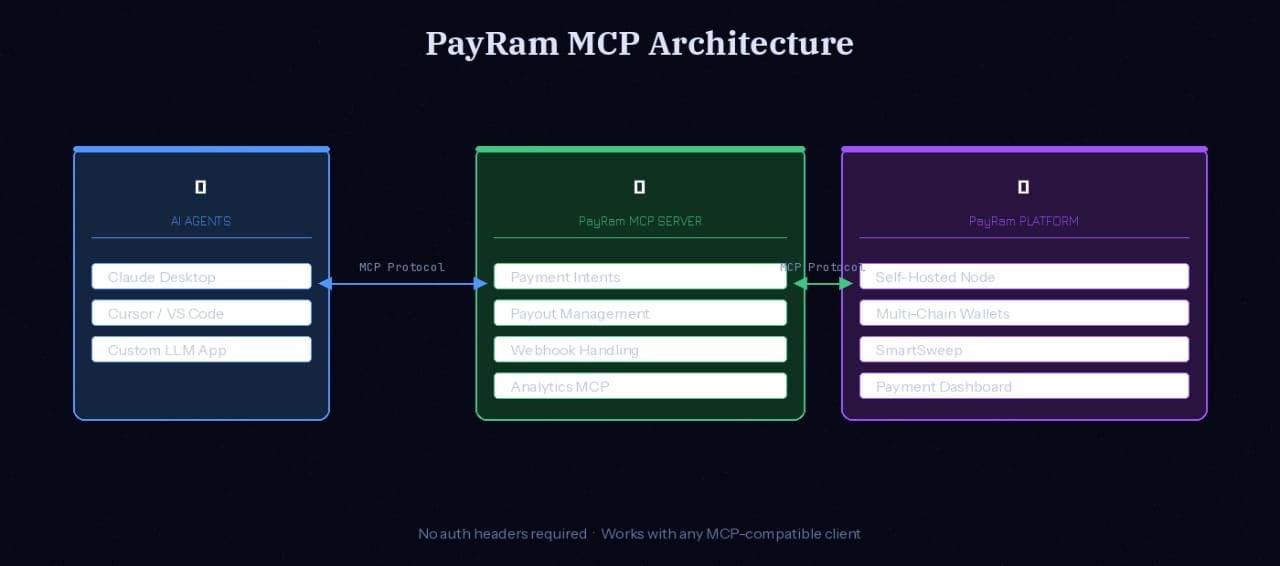
The PayRam MCP server surfaces the following capabilities to any connected AI assistant:
Payment Operations — Create payment intents, track status, and manage end-to-end payment flows autonomously.
Payout Management — Initiate and monitor payouts across multiple blockchains and supported currencies.
Webhook Handling — Receive and process webhook events including signature verification and status updates.
Referral System — Configure campaigns, track referral activity, and manage reward distribution automatically.
Integration Assistance — Access guided setup instructions, recommended best practices, and implementation examples tailored to your backend framework.
A key detail: no authentication headers are required when using the hosted PayRam MCP endpoint. The server works with VS Code, Cursor, Claude Desktop, and any generic MCP-compatible client. Configuration is a single JSON block pointing to the PayRam MCP HTTP endpoint.
Alongside the core payment MCP, PayRam ships an Analytics MCP that gives AI agents read access to transaction data, volume trends, and business performance metrics. This unlocks a class of use case that goes beyond payments execution and into payments intelligence: an agent that not only processes payouts but proactively flags anomalous transaction patterns, generates weekly revenue summaries, or recommends pricing adjustments based on conversion data.
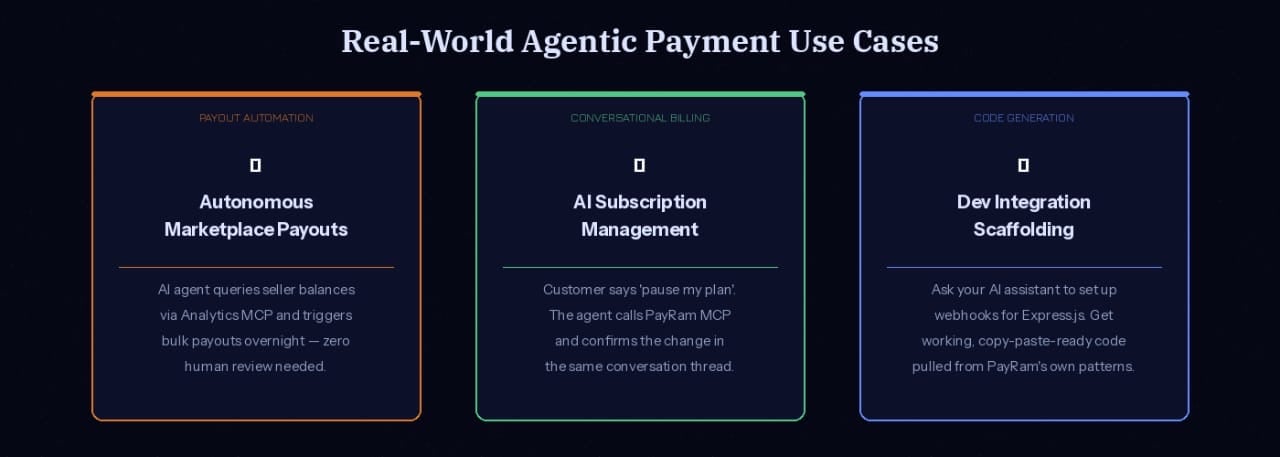
Autonomous marketplace payouts. A peer-to-peer marketplace with thousands of sellers can wire an AI agent to distribute weekly earnings. The agent queries completed transactions via the Analytics MCP, calculates each seller's balance, and triggers payouts via the Payment MCP without human review of individual rows. What was a two-hour finance team task becomes a scheduled job that runs overnight.
AI-native subscription management. A subscription platform can give its AI customer service agent the ability to issue refunds, upgrade plans, or pause billing directly through a conversation. The customer says "pause my subscription for two months," the agent calls the PayRam MCP, and the billing adjustment is confirmed in the same chat thread. No support ticket, no human handoff, no delay.
Developer-first integration scaffolding. The MCP server provides guided setup instructions and generates implementation snippets for commonly used backend frameworks. A developer using Claude Desktop can ask "set up PayRam webhooks for my Express.js app" and receive working, copy-paste-ready code tailored to their stack, drawn directly from PayRam's own integration patterns.
The Onramp and the MCP are not isolated features. They represent two ends of a complete payment lifecycle built on non-custodial, developer-friendly infrastructure.
The Onramp solves the demand side: any customer, anywhere, can pay using the tools they already have. There is no requirement to hold crypto or interact with an exchange. The platform handles conversion invisibly, and the merchant receives crypto in a wallet they control.
The MCP solves the supply side: businesses can automate the entire payment workflow using AI agents, from creating a payment intent to reconciling a payout, without human intervention and without surrendering custody of funds to a third-party processor.
The gap between "accepting crypto payments" and "running a fully automated crypto payment operation" has historically required significant engineering. PayRam closes that gap with a self-hosted processor, a native onramp, and an AI-ready payment server that works with the tools developers and businesses already use.
PayRam is open-source and self-hosted. Full documentation covering deployment, onboarding, API integration, the TypeScript SDK, MCP configuration, and Onramp setup is available at docs.payram.com.
For teams that want a guided walkthrough, PayRam offers live demos through its sales calendar. For developers who want to explore MCP payments hands-on, the hosted MCP endpoint is available at mcp.payram.com with no registration required to start testing.
The infrastructure for autonomous crypto commerce is here. The only question is how fast you want to adopt it.