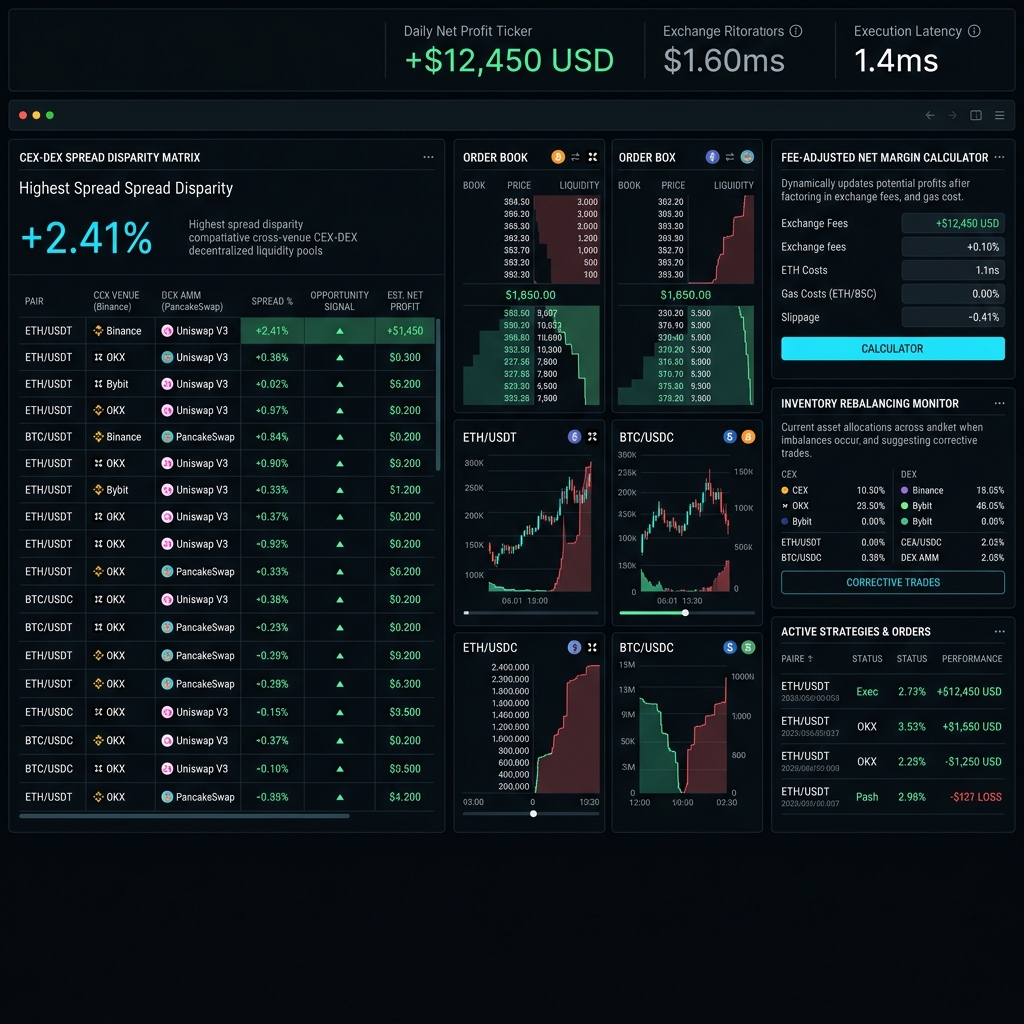
Cross-Venue Latency Arbitrage: Connecting CEX WebSockets to On-Chain Liquidity Pools
In cryptocurrency markets, true price discovery originates on centralized exchanges (CEXs) such as Binance, Bybit, and OKX due to their massive liquidity depth and microsecond order matching.
Decentralized exchanges (DEXs) like Uniswap, Raydium, and Aerodrome lag behind CEX price moves by the duration of block confirmation intervals (0.4s on Solana, 12s on Ethereum, 2s on Base). This structural delay creates high-frequency CEX-DEX latency arbitrage.
1. The Execution Architecture
A production CEX-DEX arbitrage system connects to both off-chain matching engines and on-chain validator relays:
CEX WebSocket Orderbook (Binance/Bybit)
              |
      [Latency Dislocation Scanner]
              |
On-Chain Private Validator Relay (Flashbots / Jito)
When a sharp price move occurs on Binance (e.g. ETH drops $20 in 50 milliseconds), AMM pool prices on-chain still reflect the old price until an incoming swap or arbitrageur corrects them.
The arbitrage engine:
-
Detects the price divergence via low-latency WebSocket feed (<5ms).
-
Buys the undervalued token on-chain using private validator bundles.
-
Simultaneously sells or hedges the equivalent position on the CEX order book, locking in the spread with zero directional price risk.
Systems designed for this high-speed workflow include the CEX-DEX MEV Arbitrage Bot and multi-hop cyclic systems like the Cross-DEX Arbitrage Trading Bot.
2. Zero-Capital Execution via Aave Flash Loans
For spatial on-chain arbitrage where capital inventory is needed across multiple pools, searchers utilize Aave v3 flash loans.
Flash loans allow borrowing millions of dollars in USDC, ETH, or WBTC with zero upfront collateral, provided the borrowed amount plus the protocol fee (0.05% on Aave) is returned within the exact same atomic transaction:
If the net profit does not clear the threshold, the smart contract reverts locally, eliminating all financial risk. For turnkey implementations, explore the Aave Flash Loan Arbitrage Bot.
Summary & Next Steps
Cross-venue latency trading remains one of the highest-capacity institutional strategies in crypto. To deploy hardened commercial code, configure low-latency private relays, and view the full 22-system catalog, visit https://mevbot.top/.