
A few years ago, an AI companion was easy to describe.
You selected a character.
You opened a chat.
You sent a message.
The model replied.
Different products competed on conversational quality, censorship policies, memory, character design and the underlying language model.
But in 2026, something more interesting is starting to happen.
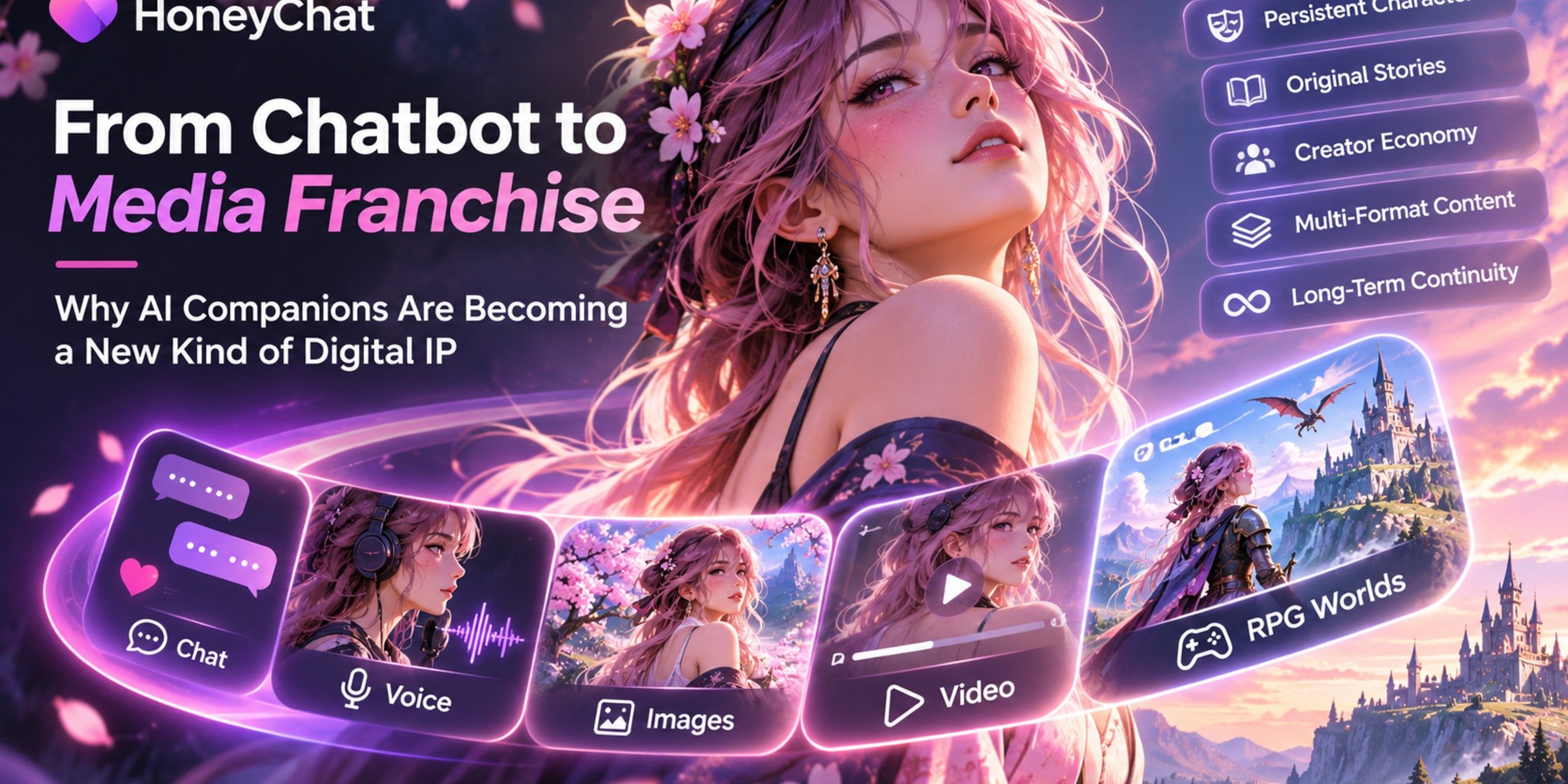
The chat is becoming only one interface.
The character itself is becoming the product.
An AI character can now have:
a recognizable visual identity,
a consistent personality,
a voice,
long-term memory,
a relationship history,
images,
video,
a place inside an RPG world,
and potentially an audience of thousands or even millions of people.
Once those pieces come together, calling the product a “chatbot” starts to feel increasingly inaccurate.
What we are beginning to see looks much closer to a new form of AI-native intellectual property.
And that could eventually reshape not only the companion market, but parts of gaming, entertainment and the creator economy as well.
Conversation was the obvious first interface for AI characters.
Large language models are naturally good at dialogue, and users already understand messaging interfaces.
No tutorials are required.
You type.
The character answers.
But pure chat has a natural ceiling.
After enough conversations, the user eventually asks:
What happens next?
The responses can become more intelligent.
The model can get faster.
The context window can grow.
But an endless message thread is still an endless message thread.
That is why companion platforms are increasingly moving into other formats.
Character.AI, for example, has explicitly described its ambition as becoming an AI entertainment platform, where characters can be experienced through conversation, stories, audio, video and other forms of content.
This is a much bigger shift than simply improving the underlying model.
The fundamental object changes.
The product is no longer the chat.
The product is the character.
Traditional entertainment has a clear boundary.
You watch an episode.
The credits roll.
The character disappears until the next episode.
Now imagine something else.
You finish watching a short series and immediately open a conversation with one of its characters.
You ask:
Why did you make that decision?
The character responds.
Then you ask:
What if you had done the opposite?
And instead of receiving trivia about the original script, you begin creating an alternative version of the story together.
The next day, the character still remembers what happened in your version.
This is where AI-native entertainment starts becoming fundamentally different from linear media.
A traditional character has one canonical story.
An AI character can have a canonical identity but millions of personalized story branches.
One user builds a romantic storyline.
Another creates an RPG campaign.
Someone else places the character into a completely different universe.
The same IP becomes interactive.
Today, AI products are still often evaluated by the model they use.
GPT.
Claude.
Gemini.
Open-source models.
But foundation models are increasingly replaceable infrastructure.
The best model changes.
Prices fall.
Providers improve.
Applications can switch APIs.
Characters are different.
Imagine someone has interacted with the same AI character for two years.
That character now has:
a recognizable face,
a familiar voice,
a specific personality,
shared memories,
a relationship history,
and perhaps a world filled with recurring characters and events.
The user is not emotionally attached to the LLM endpoint.
They are attached to the identity built above it.
This changes where product value can accumulate.
The base model generates the next sentence.
The character layer creates continuity.
And continuity is much harder to replace.
Several companies are beginning to build around this idea directly.
Holoworld, for example, positions itself around the creation of AI-native IP and interactive character experiences.
The larger concept is familiar:
creator → character → audience → content → franchise
But AI introduces something traditional media could never provide at scale.
The character can interact with every member of the audience individually.
A fan no longer only watches a fictional character.
They can speak with it.
Build scenes with it.
Generate media around it.
Include it in another world.
Create a personal relationship history with it.
That makes AI characters structurally different from static media IP.
They are not only consumed.
They are participated in.
A media franchise only works if the audience recognizes its characters.
If someone is cold and sarcastic in episode one but becomes an entirely different person in episode two without explanation, the story feels broken.
AI companions have an even harder version of this problem.
They need to preserve two types of continuity at once.
Who is this character?
What do they believe?
How do they speak?
What are their motivations?
What are their weaknesses?
What happened between this character and this particular user?
What promises were made?
What conflicts happened?
How much trust exists?
What important events do they share?
This is why long-term memory becomes so important.
For AI-native characters, memory is effectively the equivalent of continuity management in a long-running TV franchise — except every viewer has their own version.
Generating one attractive AI image is easy.
Generating the same recognizable character across hundreds of scenes is not.
But if a character is becoming IP, visual consistency is mandatory.
The user should be able to see the same person:
in a modern city,
inside a fantasy world,
aboard a spaceship,
in a comic panel,
inside a short video,
and still immediately recognize them.
The goal is no longer:
Generate a beautiful character.
It becomes:
Show this specific character in a new context.
This is one of the areas we have been working on at HoneyChat as well.
A persistent character should maintain its identity across conversation, voice, images and increasingly video.
The medium changes.
The person should not.
Consider a single AI character.
In the morning, the user talks to them in a private chat.
Later, the character sends a voice message.
At night, the user generates an image from the current scene.
The next day, the same character enters an RPG world.
Later, they join a group conversation with other persistent characters.
Eventually, that same identity could appear in:
a short video,
a comic,
an audio drama,
a user-generated game,
or a collaborative story.
Technically, many different AI systems are involved.
LLMs.
Memory systems.
Text-to-speech.
Image models.
Video models.
World-state systems.
But emotionally, the user should experience one continuous identity.
That orchestration layer may become one of the most important pieces of consumer AI.
We see this especially clearly in HoneyChat Worlds.
HoneyChat began around characters and conversations.
Then came groups.
Then persistent worlds.
Those worlds now include elements such as:
relationships,
reputation,
persistent facts,
inventory,
and d20 checks.
At that point, the character is no longer trapped inside a messaging interface.
They can become a companion inside an actual game-like system.
They can travel with the player.
React to failed decisions.
Remember previous events.
Interact with other characters.
Participate in quests.
The AI companion begins to look less like a chatbot and more like a persistent actor inside a procedural game world.
This is one reason we believe gaming and AI companions are converging.
The difference is not merely philosophical.
It changes the size of the potential market.
A product positioned only as an “AI girlfriend” naturally focuses on one primary use case.
A platform built around characters and worlds can potentially serve many:
romance,
friendship,
anime-inspired experiences,
fantasy,
science fiction,
interactive fiction,
RPGs,
fan-created universes,
voice stories,
visual storytelling,
and original character creation.
That also changes the strategic landscape.
Potential partners or acquirers are no longer limited to dating or adult companies.
The product can become relevant to:
gaming companies,
entertainment platforms,
social discovery businesses,
anime and manga publishers,
UGC platforms,
streaming companies,
and owners of established entertainment IP.
A persistent character platform can potentially sit at the intersection of all of them.
If characters become valuable digital identities, the next obvious question is:
Who gets to create them?
Only the platform?
Or users as well?
User-created AI characters are already a major part of the broader companion ecosystem.
At HoneyChat, users can create their own characters, define their personality and appearance, and share character cards with others.
That creates a natural progression.
A creator builds a character.
Other users discover it.
The character becomes popular.
People place it inside different stories and worlds.
At some point, it starts to behave like a small media property.
That raises interesting future questions:
Can users follow character creators?
Can creators build connected universes?
Can popular characters be licensed?
Can creators participate economically when their characters generate significant engagement?
Can characters move between different worlds?
The answers do not necessarily require blockchain.
But they fit directly into the larger concept of digital ownership and creator-controlled IP.
The recent Character.AI bankruptcy process highlighted another unresolved issue.
What happens to a character when the platform hosting it disappears?
If a user spent years creating an original character and developing its history, should all of that disappear because one company shuts down a server?
We think this question will become increasingly important.
A truly persistent AI character may eventually need an exportable core:
identity,
personality,
lore,
visual references,
important memories,
relationship history,
and possibly world state.
Different platforms might execute that character differently.
But the user should not necessarily lose the character itself.
This is where AI-native identity starts to become particularly interesting.
A character should perhaps exist above the platform, rather than being permanently trapped inside it.
For a crypto-native audience, it is tempting to jump immediately from digital ownership to tokenization.
We do not think that step is automatic.
A weak character does not become valuable because it has an NFT.
A world without users does not become interesting because ownership is on-chain.
The order matters.
First:
build the character.
Create real usage.
Create emotional value.
Create an audience.
Then ask whether ownership, licensing, provenance or portability needs additional infrastructure.
The asset should become valuable before it is financialized.
That distinction is important.
This is where the idea gets particularly interesting.
Traditional media IP is relatively static.
The franchise owner decides what happens.
The audience consumes it.
AI-native IP can become more flexible.
The creator defines the character’s identity.
The platform provides rules and infrastructure.
The user creates their own story branch.
Different worlds can interpret the same character differently while preserving the underlying identity.
In that sense, AI characters begin to look almost like programmable media assets.
Not programmable purely in code.
Programmable through relationships, memory, world state and natural language.
The character becomes a reusable building block for entertainment.
For us, the direction is increasingly clear.
We are less interested in building a service where people simply “talk to AI.”
The more interesting model is a persistent digital character.
A character that:
has a personality,
remembers the user,
speaks with a voice,
maintains a recognizable appearance,
appears in images and video,
participates in groups,
enters RPG worlds,
and can become part of longer stories.
Adult and romantic interaction remain valid use cases.
But they are only part of the larger picture.
Storytelling, RPG and worldbuilding are becoming increasingly important parts of how we think about HoneyChat.
The long-term idea is not just conversation.
It is continuity across experiences.
Imagine entertainment several years from now.
You watch a series.
You become interested in one character.
When the episode ends, you do not simply open Reddit to discuss them.
You click:
Talk to character.
They know what happened in the series.
But they also know you.
Then you create an alternative scenario.
Another character joins.
You choose a different ending.
The next day, they remember what happened.
A week later, your version of the story barely resembles the original canon.
Is that a series?
A game?
A social platform?
An AI companion?
A UGC ecosystem?
Probably all of them.
Our current categories may simply be too narrow to describe what is emerging.
Language models will continue improving.
One model will lead today.
Another will lead tomorrow.
Costs will fall.
Conversation quality will become increasingly commoditized.
But a different layer of competition is forming above the models.
Who creates characters people actually recognize?
Who gives them persistent memory?
Who preserves personality?
Who lets them exist across different forms of media?
Who builds worlds around them?
Who allows users to create their own stories?
And ultimately:
Who makes users return not because they want to talk to an AI — but because they want to return to that specific character?
That is no longer just a chatbot market.
It is the beginning of a market for AI-native media franchises.
And that may be one of the most interesting intersections of AI, gaming, digital ownership and entertainment developing right now.
Disclosure: I work on HoneyChat. This article reflects our product perspective and our view of where the AI companion category may be heading.