
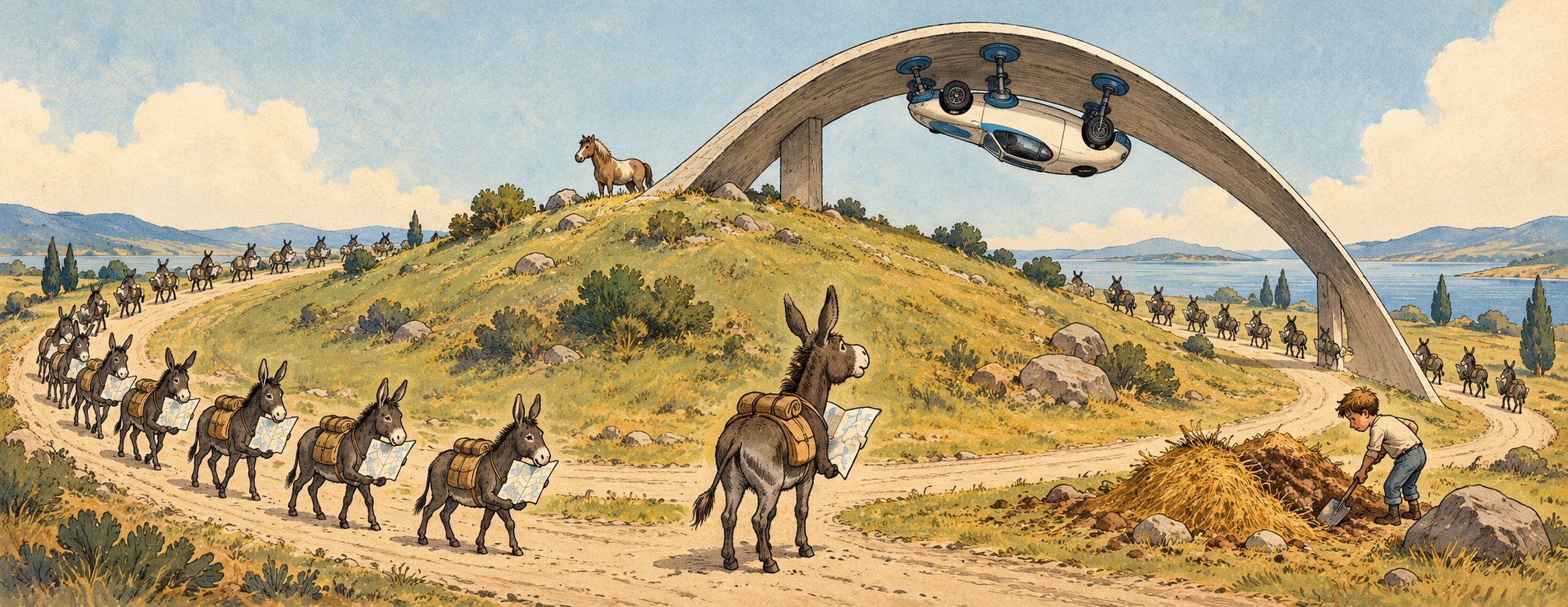
There is something about the environment you grow up in. It gets into you before you have language for it: what counts as normal, what you think you can ask for, which people you imagine you can become. And then there is some other thing inside you that may or may not line up with all of that. Disposition, maybe. Something you are born with. Your soul, if that is the word you use. I have never been able to prove it. I only know the feeling of having an internal compass that seemed to point somewhere the people around me could not see.
There are other ways to get your bearings. A library. The internet. A person whose life has taken a turn yours has not. God forbid, TikTok. They can open a window or hand you a different little room and call it the world. The question is whether you go looking, or mostly take what is put in front of you. I suspect most of us get fed far more than we search. That sounds smug. The meme below probably does not help.
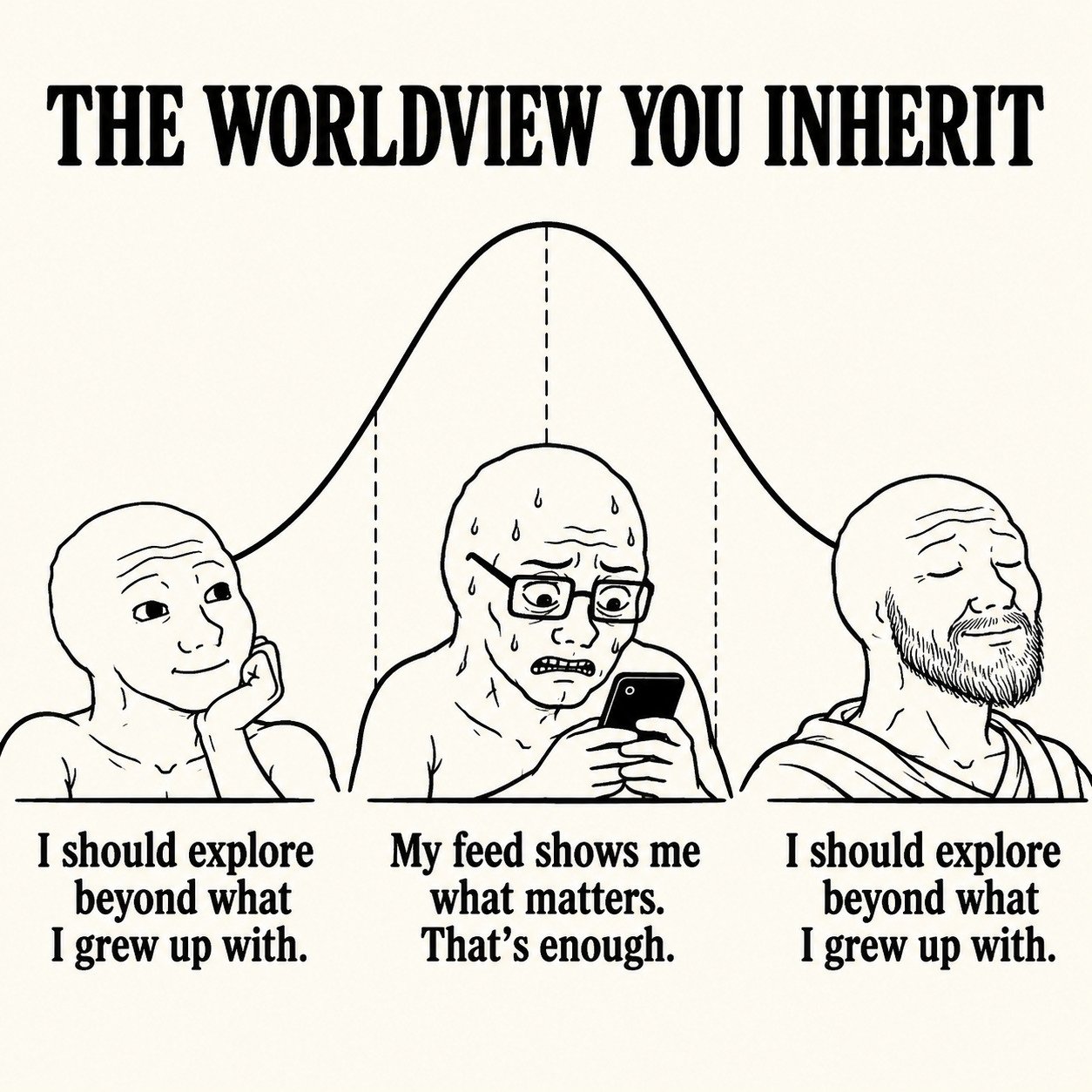
I know it is a cartoon, not a census. Still, the middle of that curve feels familiar: life is busy, there are immediate things to do, and the feed is already there when you pick up your phone. You do not have to be stupid or incurious to follow the path already laid out. You just have to be tired, or have somewhere to be. I have done it myself. The trouble starts when the thing you were handed becomes the only thing you can picture.
From a young age, I had opinions that seemed out of step with the people around me. I learned it to just keep them internally rather than articulating or arguing about a point I didnt agree on it, it was easier that way. Or maybe I had a sense that I could do more than they thought I could, and no idea how to turn that into a life. When I did achieve something that did not fit their view of me, I could feel the mixture: a bit of belittlement, a bit of bewilderment. I may have misread some of it. I only have my own side of the story. But the feeling was real. Opportunity looked abundant and unreachable at the same time. I could imagine getting somewhere; I could not see a road from here to there.
It was a cell with no bars and no door. If you have seen The Truman Show, you know the dramatic version: Truman's boat hits the edge of the set, and the painted sky gives itself away as a wall. I did not get that moment. Nothing fell from the sky. I just had a growing sense that there was more out there, while the room I was in offered no obvious way to reach it.
After what felt like a run of failures, marijuana moved from a weekend thing to a daily thing. It never took over my everyday life, but it gave me a way to sedate the discomfort, the restlessness, the yearning. I do not need to pretend it was secretly good for me, or claim it was the cause of everything. It was what I knew how to reach for. For a while, it turned down a signal I did not know how to read.
Only years later did it become obvious. I should have iterated. Tried again, and again, and again. Let the attempts teach me what the map could not. I do not know that the detours were necessary. When Marc Landers wrote, “perhaps it was even a good thing,” the perhaps mattered to me. I can make some sense of the past now without insisting that every bad turn was secretly a gift.
The story I use for this is about two brothers. In the version I know, their parents give one boy a room full of toys and the other a room full of horse manure. One brother sits there looking at the mess. The other starts digging. There must be a pony in there somewhere.
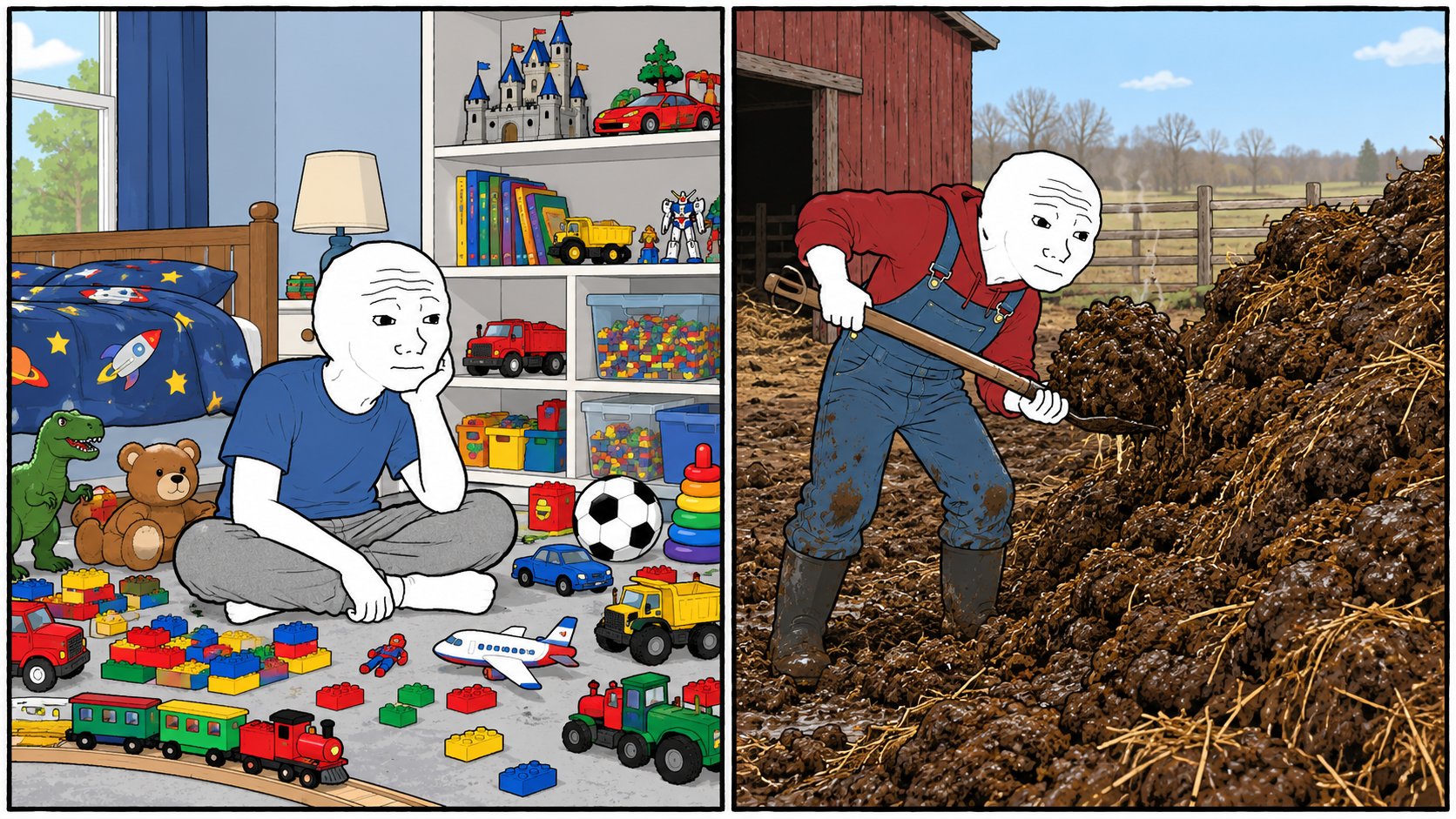
People usually tell it as an optimism joke. I do not love that. Sometimes the manure is just manure, and you have to stop digging. The lesson, as I take it, is less “believe a pony is coming” than “do not decide what a place is from the doorway.”
That is the local version of the problem. You use the resources close by and learn to work around the things you cannot change. Often that is sensible. Love, shelter, food, warmth: those are not philosophical ideas. They need attention today. But a workaround can quietly harden into a world view. You learn to make a poor fit tolerable, then mistake your tolerance for evidence that nothing else would fit.
Relocating is the hardest easy path I know. The decision is one thing; after it, the steps are small. The dread comes with a whole imaginary future attached: the money running out, the loneliness, the unfamiliar customs, the feeling that you have made a mistake and cannot undo it. Those are real concerns. “Just move” is useless advice to anyone whose family, health, finances, or obligations make that choice impossible.
But if you can move, it helps to remember the options are not simply “stay” or “fall off the edge.” You can go back. You can stay. You can go somewhere else. That is the whole list. The first move seems to contain every possible consequence; after it, you deal with one day at a time. With another attempt, you are no longer the person who has never done it. Something in you has changed, even if the place did not work out.
I keep thinking of electricity here. Current follows the paths available to it; engineers use resistors, diodes, transistors and switches to shape what happens next. We have learned to derive intelligence from sand. In our own lives, though, we can leave the old wiring alone for years simply because it is already there. Familiarity is a powerful circuit. It does not have to be the only one.
What brought all this back last week was a car going upside down in Texas.
At its October 15 reveal, a white Tesla Roadster prototype climbed a curved ramp, drove upside down using suction, then used SpaceX-supplied thrusters to flip through the air and land. Tesla says production is targeted for 2028, so this was a prototype spectacle; nothing in it tells us that a production car will do the same. Still, I watched the thing go up the ramp and felt the frame of “car” shift a little. It was on a road, then it was upside down, then it came back down. Reuters covered the reveal.

I posted about the feeling it gave me on Farcaster.
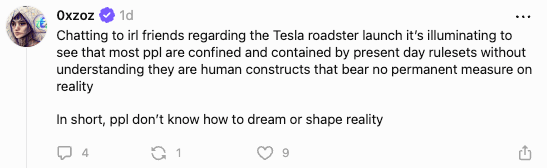
Phil replied with the phrase that made the connection click:
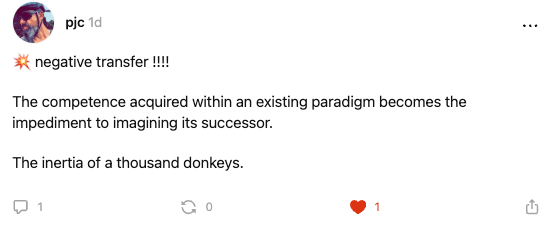
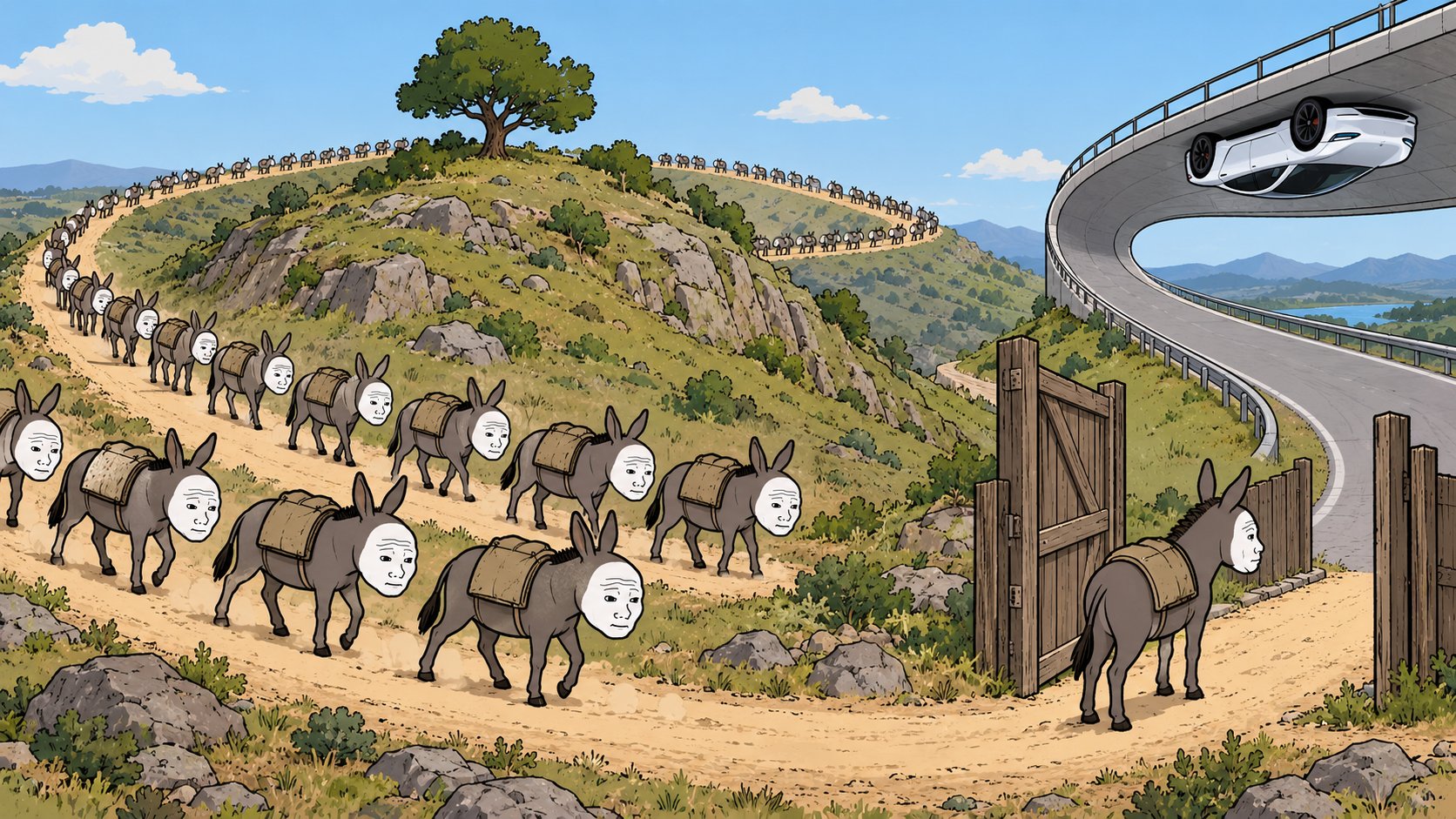
That study does not prove that all of society is shuffling behind a thousand donkeys. The move from a chessboard to a culture is mine. But the mechanism feels recognizable. Competence gives you a way through; eventually the way through becomes the only thing you notice. A rule that once helped you can start editing out the evidence that the problem has changed.
This is where rules get complicated. They are made by people, but they are not all arbitrary fences. Some are old injuries turned into procedures. Aviation is full of them, and for good reason. This is fitting as it was one of the arguments I experienced irl regarding why the Tesla Roadster was stupid and wouldnt work.
The Air Commerce Act passed in 1926 because the airplane was becoming a commercial machine and the country needed shared safety standards around it. A few years later, air traffic controllers were out on the field waving flags at pilots. In the 1930s, route controllers moved little boat-shaped weights, nicknamed “shrimp boats,” across maps and blackboards. They had no direct radio link with the aircraft. A century later, the same shared sky is managed through radar, radio and automation. The flags were not a natural law; they were what the system looked like before the next tools arrived. (FAA history)
Some aviation rules carry a crash inside them. In 1978, United Flight 173 ran out of fuel while the crew focused on a landing-gear problem. The plane crashed near Portland; ten people died. That accident, along with others, helped push aviation toward crew resource management: changing how information and concerns move around a cockpit, so the whole crew can contribute to the decisions. Checklists and safety remained. What had to change was how information moved through the cockpit, so important concerns could be heard and acted on. (NTSB safety study · NASA history of crew resource management)
The standards for building aircraft change too. In 2017, the FAA replaced many detailed design prescriptions for small airplanes with performance-based airworthiness requirements. The safety objective stayed in place; manufacturers had more than one way to meet it. A new design could use a new method and still be judged against the same safety measure. (FAA explanation of the Part 23 rewrite · Final rule)
That distinction gets lost when we live only in the present. Pick up today's rulebook and you do not see the crash report it grew from. Stare only at the crash report and you may miss that the equipment has changed. You need to know what the old rule was protecting before you decide whether its method can move.
Steve Jobs said in a 1994 interview that “everything around you that you call life was made up by people that were no smarter than you.” It is a line that can be misread as permission to bulldoze everything. I take it more narrowly. Most of what feels permanent was put together by people with the knowledge and blind spots of their time. We can inherit it without pretending it is nature. (Steve Jobs Archive)
That gets back to my own small version. I had taken the edges of my local map for the edges of the world. I do not think every bad thing happens for a reason, or that the years I lost were the price of a lesson. I know that when I finally started trying things again, the room stopped looking quite so sealed. I could not see the whole road. I could at least see another step.
I still do not know whether I was born with a compass. I know the map I was using was not the whole place. Maybe its a little bit of schizophrenia, maybe its intuition, or maybe its just the beginning of infinity.