

In 1913, Henry Ford’s moving assembly line didn’t just change car production; it transformed society. It shifted people from artisanal, whole-process work to hyper-specialised tasks. Workers became defined by a single skill, tethered to a single station, their value measured by output per minute. It was a pivotal moment of the industrial age. That specialisation created unprecedented productivity and lower consumer prices, but it also reshaped communities, education systems, and even social identities. Entire cities and economies were built around this new rhythm of labour.
For over a century, that logic dominated how we organised work: fragment tasks, specialise skills, and let the system carry the product from start to finish.
Now, more than a century later, AI is reversing that model. Instead of fragmenting work, it is re-integrating it back together. A single person can now perform multiple steps of a process that once required an entire department from researching, analysing, drafting, designing, even coding, all in a single workflow, powered by AI tools.
This emerging shift doesn’t yet have a widely accepted name. In this article, I call it Reverse Fordism, focusing on the AI-driven reintegration of tasks that were once split apart in the age of the assembly line.
But this new power raises a critical question: does this shift make us modern-day artisans, or does it risk turning us into one-person assembly lines?
In Fordism, efficiency came from specialization. Complex work was broken down into narrow, repeatable tasks to maximize the output of the assembly line.
In the late 20th century, Post-Fordism emerged. Production became more flexible, technology enabled customization, and workers often handled a wider range of tasks, but still within fragmented structures and global supply chains.
Now, we're entering an era of Reverse Fordism, where efficiency comes from integration. AI allows a single person to orchestrate a process that once required an entire team.
Where you once might have been one cog in a larger machine, you are now expected to manage the whole mechanism, often through digital platforms that track progress from start to finish. You command powerful AI tools (tools you likely don’t own) that substitute for the repetitive labor once done by many. This shift fundamentally changes job design, skill requirements, and the very structure of teams.
This is happening right now, and it projects an image of empowerment that we instinctively want to be true. But it represents a fundamental change to the social contract of work. It creates a new kind of pressure where fewer people are asked to do more, potentially leaving a growing number of people with less work, or none at all. The promise of creative control is shadowed by questions of stability and inclusion.
Will we look back on this as a revolution that liberated workers, or one that concentrated opportunity into the hands of a few?
To understand the deeper implications of Reverse Fordism on the general health of our societies, it helps to borrow from sociology: Maslow’s hierarchy of needs.
Maslow suggests that human motivation builds in layers, like a pyramid. At the base are physiological needs (food, shelter, rest) followed by safety needs like security and stability. Above these come love and belonging (relationships, community), esteem (recognition, respect, confidence), and finally self-actualisation, or the fulfilment of one’s creative and personal potential. The idea is simple: if the lower layers aren’t secure, people can’t fully focus on the higher ones.
Human Needs Pyramid (Maslow):
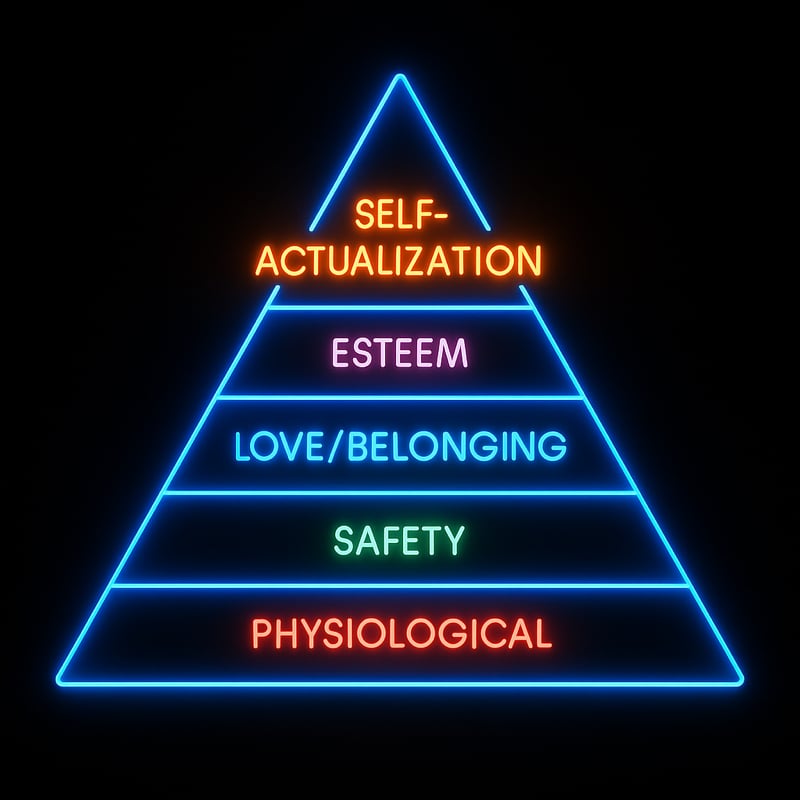
During the Fordist era, the assembly line moved workers from whole-process, craft-based roles to highly specialised, repetitive tasks. This came at the cost of variety and creative fulfilment, but it provided stability in the lower layers of Maslow’s pyramid. Wages were steady, jobs were secure, and the rhythm of work was predictable; enough to meet physiological and safety needs for millions. The trade-off was clear: security for monotony.
Post-Fordism, which emerged in the late 20th century, brought more flexibility into production. Technology enabled customisation, globalisation opened new markets, and workers often took on a broader range of tasks. In theory, this allowed for more skill development and opportunities to reach the higher levels of the pyramid. In practice, however, this flexibility often came with casualisation, outsourcing, and greater job insecurity; eroding the very base that people needed to climb higher.
Reverse Fordism, powered by AI, forces a critical choice. On one hand, by collapsing tasks into integrated roles, it dangles the promise of work that finally engages the top of the pyramid: esteem, recognition, and true self-actualization. On the other hand, if this model is used simply as a tool for cost-cutting, reducing headcount without reinforcing support systems, it threatens to shatter the very foundation the pyramid stands on. Without a secure base of safety and stability, the promise of a more fulfilling work life will remain a privilege for a few, not a possibility for the many.
If Reverse Fordism sounds like a return to more integrated, autonomous work, there’s a reason: before Fordism, much of the economy was made up of self-employed farmers, artisans, and shopkeepers. These workers controlled their entire process. From sourcing materials, creating the product, to selling it. They often owned the tools or workshops they used, and even in the early industrial period, small teams could still complete an entire product from start to finish.
Fordism disrupted this by shifting ownership and control from the worker to the company. You no longer “owned” your product or process, you were a specialised contributor in a vast corporate system, responsible for one repetitive step in a tightly managed chain.
Reverse Fordism certainly carries echoes of that earlier autonomy. An individual can once again manage a process from end to end, from design to delivery, much like an artisan. On the surface, it looks like a return to ownership. But this parallel hides a critical difference: the pre-Fordist artisan owned their hammer, their workshop, and their trade. Today, the tools are sophisticated AI platforms, and the "workshop" is a digital infrastructure owned by someone else.
This raises the crucial question: does this new model truly return ownership to the worker, or does it simply create a more convincing illusion of it?
Like any major shift in the organisation of labour, Reverse Fordism comes with two faces.
On one side, the opportunities are clear: more autonomy over workflows, the ability to develop a wider range of skills, and the agility for small teams, or even individuals, to produce at a scale that once required large departments. With AI taking over repetitive tasks, workers can focus more on creative, strategic, and high-value activities. For those outside the corporate world, the barriers to starting a business are lower than ever. AI makes it far more feasible, cost-effective, and time-efficient to launch and operate as a solo entrepreneur or small team.
On the other side, the risks are equally real and easier to overlook. Job compression means fewer people doing the work of many, with the rest excluded from the system entirely. This could affect both ends of the talent spectrum: highly qualified professionals who aren’t considered “generalist enough” for lean AI-enabled teams, and juniors who may never get the chance to develop critical skills in the first place.
For both groups, the lower layers of Maslow’s pyramid (income, job security, stability) become fragile or inaccessible. This is not just an individual problem; it’s a societal one, with potential knock-on effects on mental health, community cohesion, and long-term economic resilience.
Inside the system, burnout becomes more likely when broader scopes aren’t matched with lighter expectations. Relying on AI for complex tasks can lead to skill erosion over time, and the growing gap between those who can leverage AI effectively and those who cannot will deepen inequality.
These are speculative risks, but they are grounded in observable trends today. And they will shape the road ahead, leading us toward very different possible futures.
The trajectory of Reverse Fordism is not predetermined. How it will shape society depends on the choices organisations and states make in the coming years, in how they deploy AI, structure work, distribute the gains, and protect those at risk. Below are three plausible futures, each with very different implications for human needs and well-being.
In this scenario, organisations use the efficiency gains of AI to invest in people, and states actively create policies that secure fair wages, ensure job stability, and encourage continuous learning. The base layers of Maslow’s pyramid remain secure: income, safety, and stability are protected for the majority. With essentials covered, workers can climb toward esteem and self-actualisation. AI handles repetitive work, freeing people to focus on creative, strategic, and relational tasks. Small, multi-skilled teams thrive inside companies, while outside the corporate world, entrepreneurs and freelancers use AI to build sustainable businesses without burning out. Economic growth is paired with broad-based opportunity because both corporate strategy and public policy are aligned toward inclusion.
Here, Reverse Fordism delivers on efficiency but not on inclusion. Organisations optimise for speed and cost, while states react slowly, providing minimal safety nets and limited reskilling programs. Inside companies, those who adapt as generalists keep their jobs, but the pace is relentless. Safety and belonging needs are met for most, but esteem and self-actualisation are occasional luxuries rather than daily realities. Many highly qualified specialists, and juniors who never get the chance to develop critical skills, are left outside the system. Some find a foothold in entrepreneurship, others depend on patchwork support systems or underfunded public programs. The corporate world becomes leaner, faster, and more competitive, but the human cost is unevenly distributed, and policy responses fail to close the gap.
In this future, both organisations and states prioritise short-term gains over human well-being. Companies strip teams to the bone, overloading the remaining workers with end-to-end responsibilities dictated by AI systems. States fail to create effective protections, allowing precarity to spread. Safety and physiological needs become unstable for many, making higher levels of the pyramid unreachable. Outside corporate walls, displaced workers try to create independent income streams but remain dependent on platforms, algorithms, and payment systems they do not control. “Owning” the process offers little real security when the infrastructure is owned by someone else. Skills erode, errors multiply, and innovation slows as both corporate and independent workers operate under constant precarity, with no meaningful safety net in sight.
History shows that the benefits of efficiency gains are never automatic; we must bend the arc of progress toward shared prosperity.
If we want the golden age of multi-skilled, purpose-driven work, organisations must reinvest AI’s productivity gains into people, not just profit margins. That means fair wages, humane workloads, and continuous learning opportunities that keep the base of Maslow’s pyramid secure for all workers.
At the same time, states must adapt governance to match the speed and scale of technological change. This includes robust safety nets, policies that prevent exclusion from the labour market, and regulation of the platforms and infrastructures on which independent workers depend. Without this, we risk building a system where the strongest thrive while the rest are left behind.
Reverse Fordism has the potential to broaden opportunity, but it can just as easily narrow it. The outcome will depend on whether we design systems where everyone can strive and not just survive.
Reverse Fordism is only the first act. It is reshaping how we work today, but it is also laying the groundwork for what could come next; an Artificial Revolution that will extend far beyond the workplace. Just as Fordism once reshaped not only production but also communities, education, and culture, this next phase could redefine entire social systems.
In this future, the generalists who adapt to AI may remain under corporate control, while others are pushed into a precarious independence mediated by powerful platforms such as Meta, Google, or Amazon. Owning more of the process will not necessarily mean owning the means to shape it. The freedom to create may be real, but the terms of that freedom will still be dictated elsewhere.
If prosperity is to be broadly shared, we will need to create another type of “means,” one suited for the digital age. That could mean decentralised economies, cooperative platforms, or other forms of shared infrastructure that return control of data, algorithms, and distribution to the people who generate value. Without that shift, the Artificial Revolution risks becoming just another chapter in the long history of concentrated power.
_____________________________________________________________
It is crucial to acknowledge the perspective that shapes this entire analysis. The historical arc from Fordism to Reverse Fordism is a narrative born from Western industrial capitalism. The AI technologies themselves are not neutral; they are predominantly developed and scaled by Western companies, imbued with a specific set of cultural and economic values.
As these tools and work methodologies are exported globally, they risk imposing a single model onto a diverse world. The effects of this "Artificial Revolution" on the labor markets of the Global South, on collectivist cultures, or on economies with different social safety nets will not be a simple echo of the changes described here. They will create unique challenges and opportunities that lie beyond the scope of this article but demand their own urgent attention.