

On one path, I could deploy a robust MVP on Ethereum, showcase verifiable “on-chain AI” primitives, secure funding, demonstrate trust-minimized proofs for AI decisions and capital flows, and then spend the year ahead navigating mainnet pressures, audits, and ecosystem expectations. On the other, I could shift core development into a more efficient, zk-native environment, reject the fundraise-first, innovate-later playbook that has quietly hollowed out so many crypto projects, and fully realize the vision of end-to-end verifiable agents.
That tension defined Obsqra’s earliest days, back when it was still just an “experiment” on Ethereum. This account explains why I pushed beyond the MVP, why Starknet ultimately became the forge for zkML breakthroughs, and how basic “AI intent receipts” evolved into a system capable of routing DeFi capital with cryptographic proof. In a year shaped by Starknet’s Grinta upgrade, BTCFi expansion, and ongoing debates over Ethereum alignment, there’s a certain poetic irony in building zk receipts that provide undeniable receipts amid the tribal noise.
By conventional crypto startup logic, especially in the post-Dencun era, the standard path was defensible. Roll out privacy pools on the EVM. Implement a verifiable AI commitment scheme. Enforce DAO constraints on-chain. This wasn’t yet about full zkML or autonomous agents, but about laying foundations: proving an AI’s decision, verifying its commitment, and ensuring constraints held in a trust-minimized environment. Build it, call it Phase 1, pitch it as “scalable infrastructure,” and line up investor meetings.
In the 2025 funding climate, that story could have worked. Claim verifiable AI with integrity. Showcase live proofs and receipts. Tease “Phase 2.5” with full zkML just over the horizon. And I did deliver that on Ethereum: commit-reveal mechanics running, a constraints engine enforcing rules, zk receipts tracking capital movement. This wasn’t vaporware. It was deployable, inspectable code.
But when I stepped back and scrutinized the stack, the gap was obvious. The system verified intent, not execution. And in an ecosystem where Ethereum L2s like Starknet were already hitting peak throughput while Ethereum itself pushed sharding and rollup optimizations, settling for partial proofs felt like shortchanging the technology. Trustlessness demands more than promises and demos.
Phase 2.5 had always been on the site: full zkML, advanced proofs beyond commitments. At first, it felt like a hurdle. Audits stalled without deeper integration. Funding capped until the system was complete. Scaling blocked without mainnet-viable proofs. The message distilled down to a blunt fork: zkML on Ethereum, or don’t bother.
That left two options. Stay on mainnet, grind through audits under gas volatility, raise capital while Ethereum debated sequencer decentralization, and pay L1 premiums for every iteration. Or acknowledge that even post-Dencun — despite massive fee reductions — Ethereum mainnet simply isn’t optimized for zkML experimentation, especially as Starknet’s 2025 roadmap began unifying Ethereum and Bitcoin settlement.
I’ve watched teams take the first route. Public iteration hardens into rigid roadmaps. Flexibility dies early. I chose differently and doubled down on the stack.
Tracking zk peers beyond the hype cycle, I shared Obsqra’s progress: EVM deployment, privacy pools, verifiable AI intents, on-chain DAO enforcement. The feedback was consistent: solid foundation, but scaling zkML purely on Ethereum would hit hard walls. “Look at Starknet,” people said.
That reframed Phase 2.5 entirely — not as a dead end, but as a release valve. Prove the concept on Ethereum. Move the lab to Starknet. Bridge liquidity back to ETH. Finish the proofs where they’re economically feasible.
Ethereum became one structural pillar, not the whole building — especially as Starknet’s Grinta upgrade and BTCFi initiatives began bridging ecosystems rather than isolating them.
The architecture finally clarified. On Ethereum (obsqra.fi): privacy pools, verifiable AI intents, DAO constraints, capital routing, and a familiar UX anchored in Ethereum’s security guarantees amid growing conversations about quantum resistance.
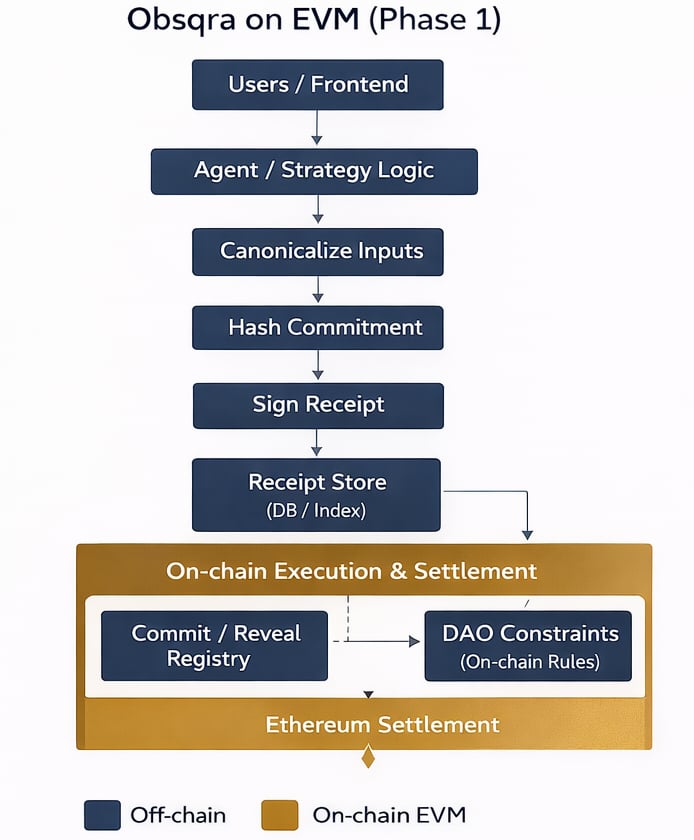
On Starknet (starknet.obsqra.fi): the zkML risk engine, STARK proofs, SHARP settlement back to Ethereum L1, and a native prover environment accelerated by rapid codebase and decentralization improvements.
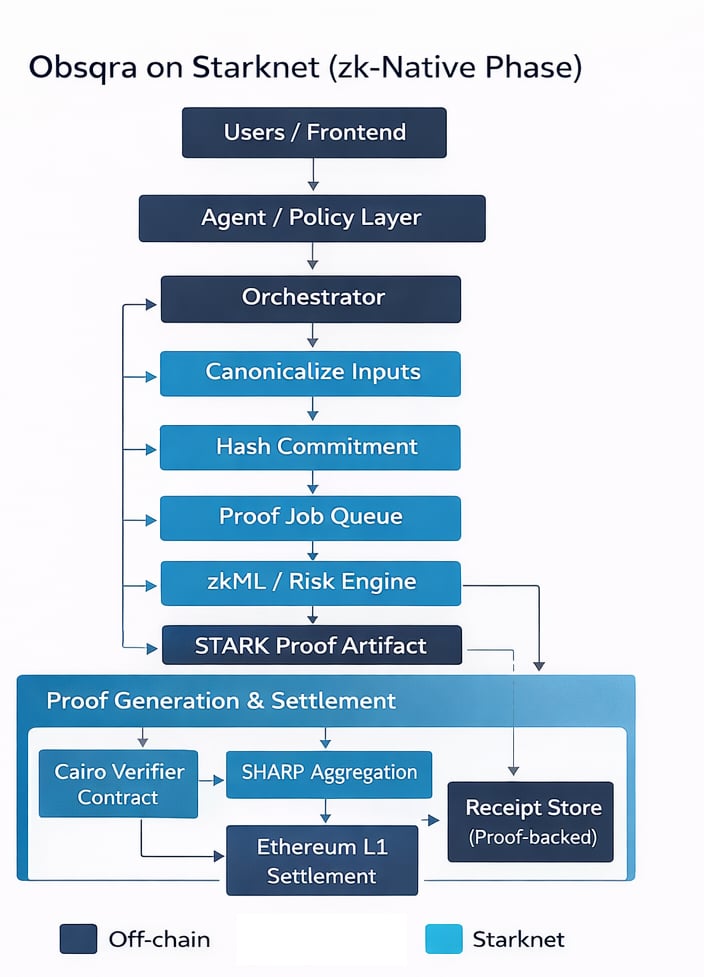
The linking layer became chain-agnostic: Starknet handles proofs and models at a fraction of Ethereum’s cost; Ethereum handles settlement and liquidity. This mattered in a year that included Starknet outages and recoveries, because resilience comes from architecture, not ideology.
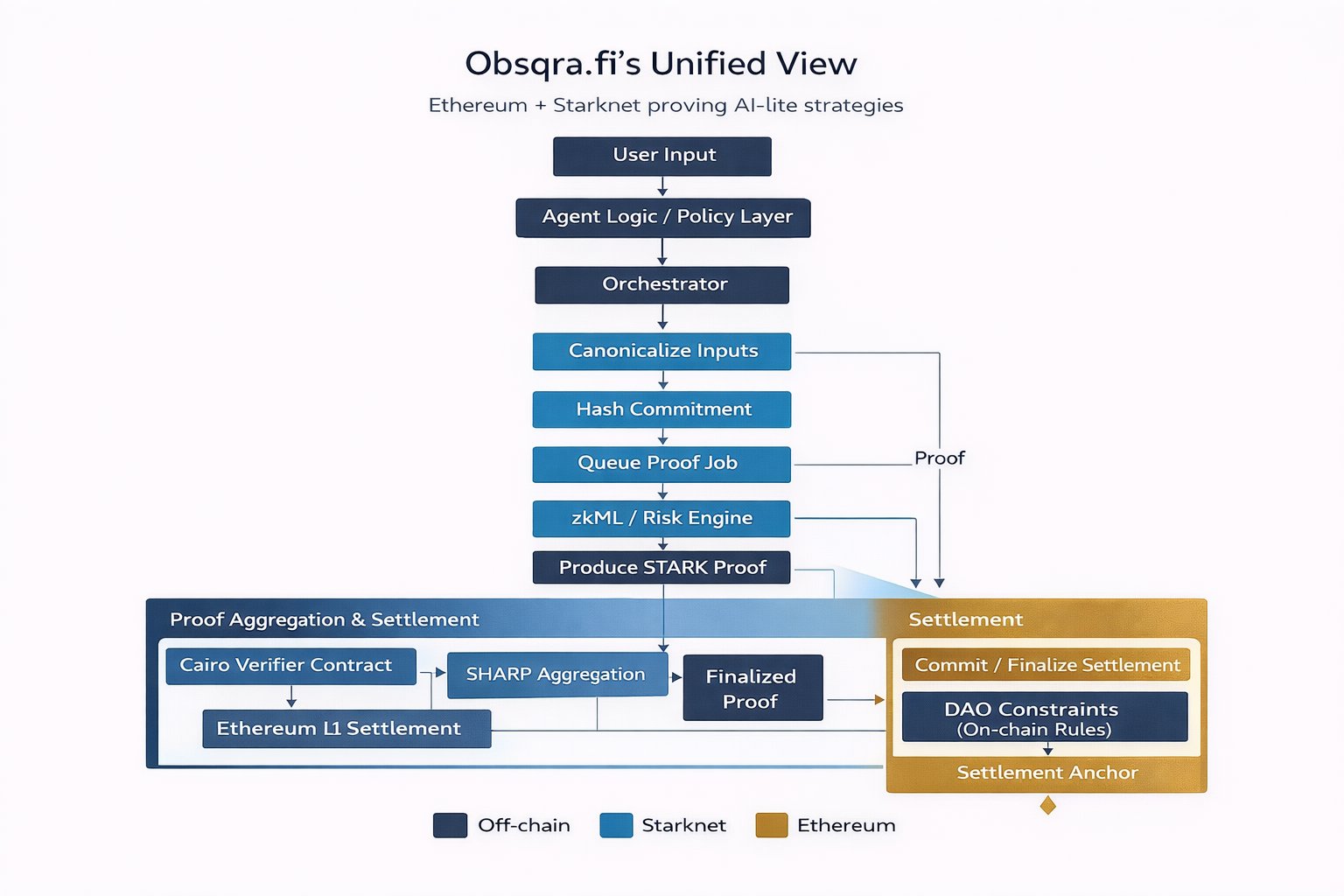
The vision stayed intact: verifiable agents, execution privacy, settlement proofs, cryptographic trust. The division of labor became explicit. The EVM hosts zk-AI primitives for mainnet DeFi. Starknet provides a zk-native environment for expressive agent systems, with SHARP anchoring results back to L1 and aligning with Starknet’s expanding Bitcoin and multichain posture. Two chains, one system, not competing products, but unified infrastructure for autonomous economies.
That unification forced a reckoning with my own demos. The EVM prototype was genuine, but parts of it relied on staging shortcuts: UI mock hashes, demo toggles swapping simulated data, visuals not always synchronized with on-chain state, proofs not fully tied to rebalances. Founder shortcuts. “Demo now, integrate later.” Later never comes unless you force it to.
Starknet forced the cleanup. Toggles were removed. Proof badges only appeared for real jobs. Rebalances mapped directly to database records. The UI stopped pretending. The fixes weren’t heroic, hours for orchestration, days to purge demos, but the mindset shift was permanent. You can’t preach “trustless trust” while simulating trust. If you build receipts, your receipts have to be real.
That irony played out loudly during Ethereum–Starknet alignment debates, especially as Starknet’s Bitcoin integrations sparked accusations of being “unaligned.” Meanwhile, I was bridging both ecosystems with proofs.
On Starknet, I finally tackled what I’d avoided on the EVM: full DeFi flows. A simple yield aggregator emerged, deposit ETH, swap to STRK, provide liquidity, open positions, earn yield, nothing revolutionary, but fully traceable. Wallet deposits, pool interactions, and testnet activity were all verifiable. Layered on top were the risk engine, STARK-proven decisions, and backend logging. It was closer to a real verifiable agent than any pitch-deck MVP, especially as Starknet’s BTCFi efforts opened new capital pathways into zkML systems.
The whitepaper evolved accordingly. Obsqra stopped being framed as a DeFi or privacy project and became what it actually was: verifiable agent infrastructure for autonomous economies. Capital agents, data agents, multi-chain orchestrators — all requiring provable rules, execution receipts, and lifecycle accountability.
The system solidified into layers. On EVM: privacy routing, Groth16 proofs, AI commit-reveal, DAO constraints. On Starknet: zkML engines, STARK proofs, SHARP settlement, Cairo contracts, and lifecycle services powered by continual VM and prover upgrades. Version 2 unified everything into a cross-chain proof graph, a single verification API, and an agent gateway for audits across chains.
In practice, Ethereum validated the concept. Starknet enabled scale. And the receipts — the actual cryptographic receipts, proved the build amid controversy.
What once felt like a distraction became essential. For builders, the lesson is simple. If you just need an MVP, stay on mainnet and call it zkML. If you’ve validated the idea but feel the trust gaps, you need a forge, whether Starknet or another zk-native environment, especially in a post-Grinta world where Ethereum settlement and Bitcoin capital converge.
For me, the answer is clear. Starknet is the forge. Ethereum is the settlement layer. Obsqra is the arc between them.
It doesn’t just function.
It proves it.