

Let me start somewhere that feels distant but is not.
In the 1960s, if you wanted to understand the future of computing, you studied IBM. Mainframes. Centralized infrastructure. Enormous capital requirements. A small number of institutions controlling access to computation on behalf of everyone else. The assumption was simple: scale implies concentration. Concentration implies control. Control implies permanence.
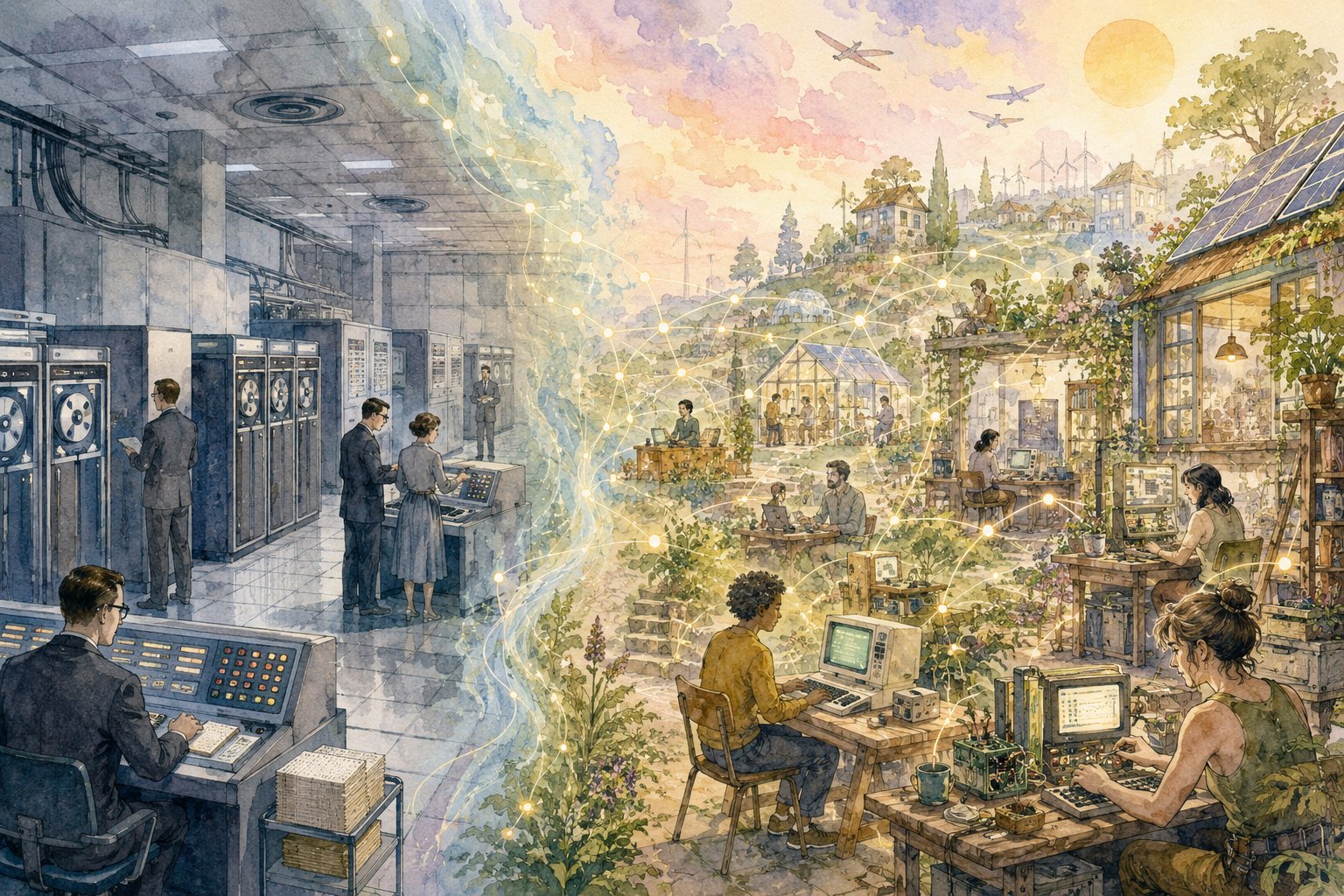
Then something happened that looked, at first, like a toy.
Personal computers were worse than mainframes on almost every measurable metric. Slower. Less reliable. Fragmented. Inefficient. IBM itself launched one largely as a defensive move, not expecting it to matter. But the PC did not win by being a better mainframe. It won by introducing a completely different architecture: distributed ownership, modular software ecosystems, open participation, local autonomy. The bottleneck shifted. It moved from compute production to compute deployment. From centralized control to distributed participation.
IBM did not dominate the personal computing era. Not because they lacked capital or talent but because they were optimizing the wrong layer of the stack.
Go back further and the pattern repeats.
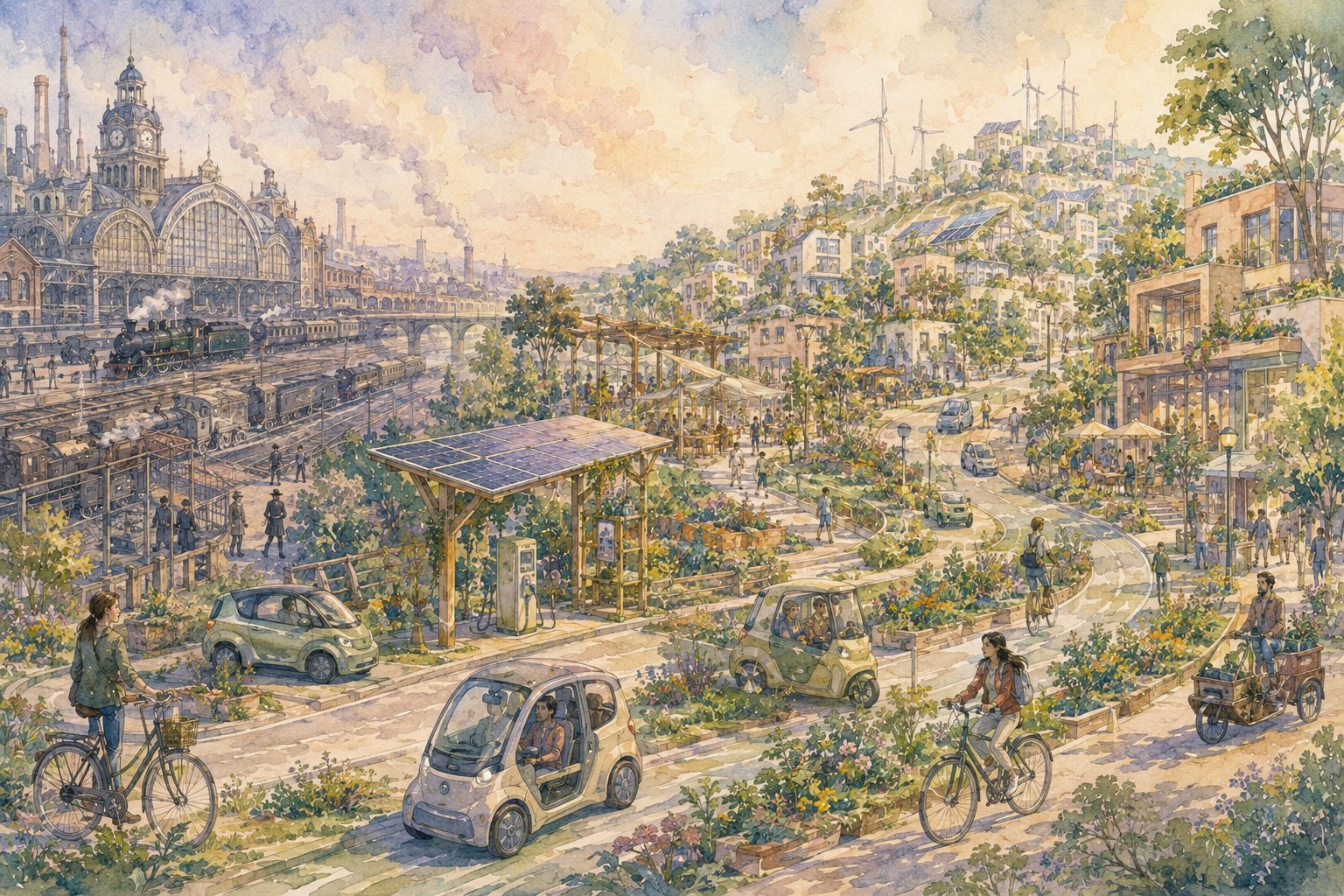
The great railway companies of the nineteenth century were the hyperscalers of their time. Enormous capital concentration. Critical infrastructure. National scale. And they were genuinely transformative — for their era. But the winners of rail did not automatically become the winners of the automobile age.
Why not?
Because the shift from rail to automobile was not merely technological. It was architectural. The automobile required roads, not tracks. Distributed fuel distribution, not centralized stations. Individual ownership, not ticketed access. Suburbs, not rail hubs. The entire coordination model changed. A new system had to be built around the new technology, and the incumbents who had optimized for the previous system were often the last to see it. The decisive factor was not the combustion engine. It was the governance and economic architecture that emerged around it.
There is a version of this story that is particularly relevant for Europeans.
France had Minitel. A sophisticated, state-backed network, operational from the early 1980s, providing services that the rest of the world would not see for another decade: online shopping, train reservations, messaging, information services. Technically impressive. Well-governed. Nationally deployed.
The open Internet ate it alive.
Not because TCP/IP was technically superior in every respect. But because the Internet's architecture was fundamentally different: permissionless. Composable. Open. Anyone could build on it without asking permission. Anyone could participate in creating value, not just consuming it. The scaling logic was distributed participation and not centralized provision. Minitel optimized one paradigm brilliantly. The Internet invented a different paradigm entirely.
Europe, which spent years mourning this loss as a cautionary tale about missing the wave, may now be misreading its own history. The lesson is not: move faster on the current paradigm. The lesson is: recognize when the paradigm itself is about to change.
Here is what I think is actually happening right now.
Open-source and open-weight models are compressing the capability gap between frontier proprietary systems and widely accessible models faster than almost anyone predicted. The cost of inference is falling. The difference between what you can run locally and what requires a hyperscaler data center is shrinking every quarter — not at the margins, but at the core. Intelligence is becoming a commodity, so the serious question is no longer whether it will happen, but what comes after.
And this is exactly where the interesting thing occurs: Once intelligence becomes abundant, the bottleneck shifts. It moves from producing intelligence to coordinating it. From centralized ownership of models to distributed deployment of capability, and from who has the largest model to who has the best architecture for putting intelligence to work at scale, across many actors, in ways that generate real productive value. So, the decisive variables become deployment, orchestration, legitimacy, trust, resilience, and participation in value creation. In other words: governance.
Not in the sense of regulation imposed from outside but in the sense of production infrastructure. Embedded, architectural, native to the system.

This is where history becomes genuinely useful rather than merely decorative.
We tend to remember the Renaissance through its most visible outputs: painting, sculpture, architecture, science. But the Renaissance was equally a revolution in coordination architecture. Double-entry bookkeeping. Merchant banking. Commercial insurance. The letter of credit. Republican civic institutions. The university. The printing press as distribution infrastructure.
All of these where not only economic, artistic or scientific inventions but also institutional inventions. New ways of coordinating economic activity, sharing knowledge, organizing production, distributing surplus, governing collective decisions. The artistic and scientific flowering was possible because the coordination infrastructure underneath it changed.
The industrial revolution followed the same pattern. The steam engine was real, but it was not sufficient. What transformed society was the railway as coordination infrastructure, industrial finance, standardized time zones, mass public education, corporate law, logistics networks, the factory as organizational form. The economic transformation required an institutional transformation.
I think AI is now at a similar inflection point.
The models exist. The capability exists. What does not yet exist — what has not yet been invented — is the coordination architecture that will allow that capability to generate its full civilizational impact. That architecture is the next frontier.
This is the uncomfortable implication for anyone thinking about Europe's AI strategy.
The current instinct — sovereign compute, national champions, catching up on model scale — is an inversed version of the Minitel move. It tries to optimizes the previous paradigm. It competes on the incumbent's terms. And it arrives late, with less capital, in a race where the structural advantages have already been consolidated elsewhere. Consider a minute that US top companies plan to spend almost 2.000.000.000.000$ of Capex for AI in 2026: a million of millions of millions (do I even get this right?).
Even leaders of the most advanced AI labs increasingly acknowledge a version of this problem. If AI generates enormous productive abundance while simultaneously disconnecting most people from participation in that production, redistribution becomes the only remaining policy option, which is why UBI increasingly enters the conversation. But redistribution after production is not the only possible architecture.
The deeper question — the actually frontier question — is whether participation in AI-driven production can itself be distributed. Whether the coordination layer of AI can be designed so that more people are participants in value creation, not merely recipients of whatever the hyperscalers choose to share.
That is not a welfare question. It is an architecture question.
I find myself back where I ended after the displacement of scarcity experiments (see there: https://paragraph.com/@antoinevergne/the-displacement-of-scarcity.
There are two genuinely possible paths.
The first is hyperscaler consolidation. A small number of actors control the models, the compute, the deployment infrastructure, and the economic surplus generated by abundant intelligence. Redistribution mechanisms — UBI, wealth taxes, public funds — attempt to route some of that surplus back to people who have been structurally disconnected from production. It is not a dystopia. It may work, partially. But it is a world where most people are passengers in an economy they do not participate in building.
The second path requires more imagination. It starts from the same observation — intelligence is commoditizing, the bottleneck is shifting to coordination — and asks: what if the coordination architecture itself were designed for distributed participation? What if governance were not added on top of AI systems as an afterthought, but embedded into their production architecture from the beginning? What if the next Frontier AI Lab were not a hyperscaler at all, but a coordination-native institution — one that scales through distributed participation rather than centralized ownership?
This is what I have been calling Syntropolis. Not a governance project layered over AI. A different theory of what the productive architecture of AI could look like once intelligence stops being the scarce resource.
The question is whether participation in AI-driven production can scale as fast as intelligence itself. That is the actual frontier hypothesis.
And if history is any guide — from railways to automobiles, from mainframes to personal computing, from Minitel to the open Internet, from craft production to industrial capitalism — the answer will not come from optimizing the current paradigm more efficiently, but it will come from someone who noticed that the scaling logic had changed.
The future of AI may not belong to the largest model, it may belong to the best coordination architecture.
This essay builds on The displacement of scarcity and is part of an ongoing exploration of Syntropolis — a coordination-native model for the AI economy.