

The centralized technology paradigm, perfected by Alphabet Inc. (Google), operates on a simple but expensive principle: Rent Extraction. Google extracts what can be precisely quantified as a "Middleman Tax"—the massive delta between the actual cost of providing a service and the price end-users or businesses eventually pay.
This tax, which averages 40% to 85% across their product verticals, doesn't fund innovation; it funds a bloated corporate machine. DePIN (Decentralized Physical Infrastructure Networks) is the first viable solution to collapse this cost structure by replacing CEOs and offices with smart contracts and community-owned hardware.
Artem Teplov’s Thoughts: “Let’s be honest: Google is no longer just a 'tech company.' It’s a global tax collector. They have thousands of employees sitting in meetings just to decide how much more to squeeze out of the data YOU generated. DePIN is the digital guillotine for these middlemen. We are moving from a world where you are the product to a world where you are the owner. The era of corporate rent-seeking is dying, and honestly? It’s about time.”
Why is Google so expensive? Because their business model requires "Corporate Gravity." To maintain their dominance, they have to pay for things that have nothing to do with the technology you use.

Alphabet Inc. Financial Breakdown (2024-2025):
SG&A (Selling, General & Administrative): $48.3 billion (up 12% YoY). This is the cost of bureaucracy, lawyers, and luxury campuses.
R&D (Research & Development): $52.9 billion.
Shareholder Demands: Google must maintain 25-30% net profit margins to satisfy Wall Street.
In contrast, a DePIN protocol has an administrative overhead of nearly zero. The protocol is code. The "marketing" is done by token incentives. The "legal team" is the immutable blockchain.
The Middleman Tax Formula:

In Google’s world, the Middleman_Tax is a multiplier. In DePIN, it is replaced by a fixed, transparent protocol fee (usually 1–5%).
The disparity is most visible in mapping. Google spends billions on proprietary cars and centralized data processing, yet their maps can stay outdated for years.
Google Street View: Uses custom cars costing $500,000 each. They must pay drivers and maintain a massive fleet.
Hivemapper (DePIN): Uses a $450-600 dashcam installed in the cars of everyday drivers. In its first year, Hivemapper covered 10% of the world's roads, expanding 5x faster than Google ever could.
Metric | Google Street View | Hivemapper (DePIN) |
Asset Cost | ~$500,000 per car | ~$500 per dashcam |
Expansion Speed | Linear (Limited by capital) | Exponential (Limited by community) |
Data Freshness | Low (Months/Years) | High (Near Real-time) |
Take Rate | 100% (Google keeps it all) | 10-15% (85% goes to drivers) |
Artem Teplov’s Argument: “Google Street View is a fossil. They can't be everywhere at once. But people are already driving billions of miles every day. By simply attaching a $500 device to those cars, DePIN builds a real-time mirror of the world. Google is trying to outrun a swarm of millions with a few expensive cars—it’s like a horse carriage trying to race a supersonic jet.”

The fundamental innovation here is Incentive Alignment. DePIN protocols cannot "tax" you because they are decentralized and open-source.
Transparency: Every transaction and reward is on-chain.
Immutable Rules: No CEO can decide to double the API price overnight to meet a quarterly target.
True Ownership: The people who build the infrastructure (node operators) are the ones who earn the rewards.
The middleman's business model—extracting profit through information asymmetry and high switching costs—becomes obsolete when the infrastructure belongs to everyone.

2. The Anatomy of Centralization: Alphabet's Cost Structure as an Economic Parasite
Alphabet Inc. is no longer a lean startup; it is a massive bureaucratic engine. When you pay for a Google service, you aren't just paying for servers—you are paying for the "Corporate Tax."
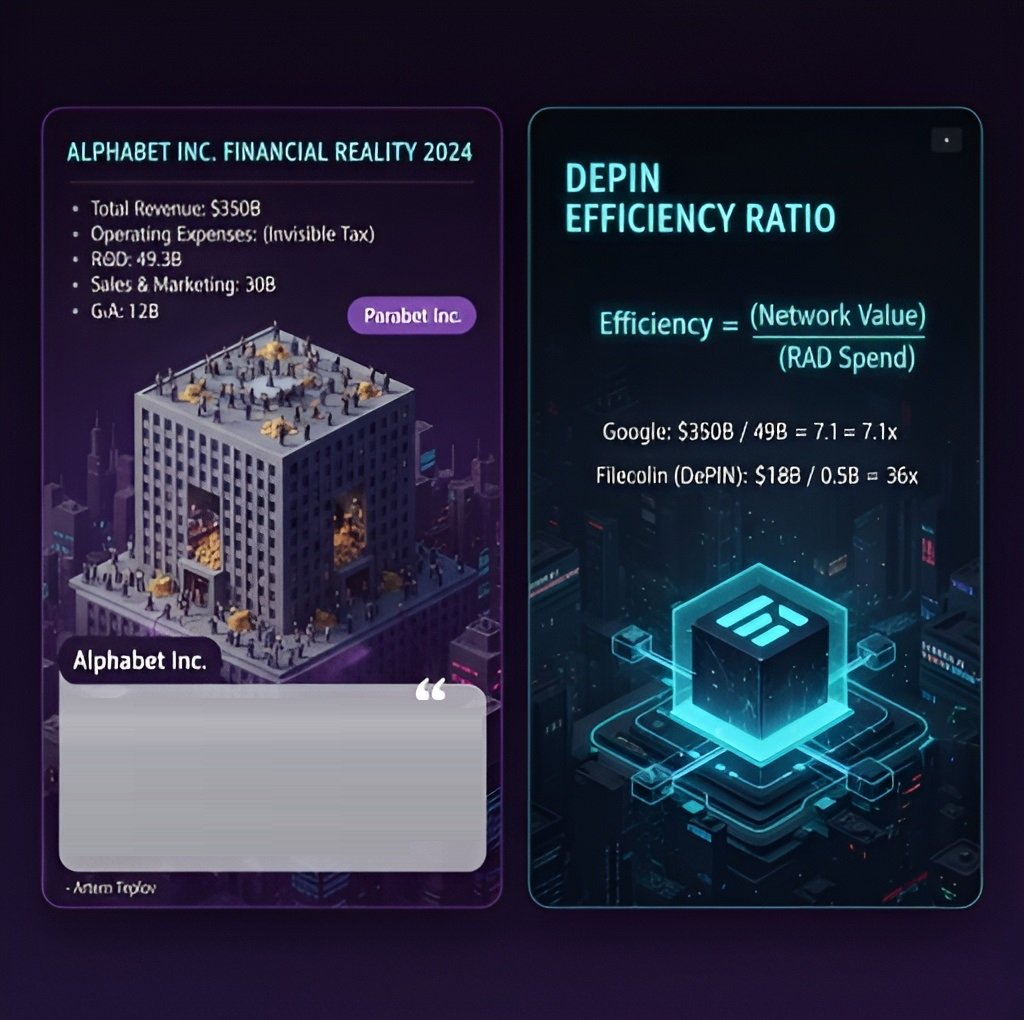
Alphabet Inc. 2024 Financial Reality:
Total Revenue: $350.0 billion
Cost of Revenue: $146.3 billion (Data centers, traffic acquisition)
Operating Expenses: $91.3 billion (The "Invisible Tax")
R&D: $49.3 billion (Inflated by massive salaries and "Moonshots")
Sales & Marketing: $30+ billion (Convincing you to stay in their garden)
General & Admin: $12+ billion (Lawyers, HR, and glass offices)
Critical Insight: Nearly 30% of every dollar Google earns is consumed by overhead that has zero impact on the quality of the service you receive. You are subsidizing:
180,000+ employees (The majority of whom don't touch code).
Massive Legal Settlements: Over $5 billion annually spent on antitrust and privacy lawsuits.
Executive Compensation: Multi-million dollar packages for CEOs like Sundar Pichai.
Artem Teplov’s Thoughts: «Look at these numbers: $91 billion a year just to keep the lights on. This is money taken from the pockets of businesses and users. DePIN doesn't have a 10,000-person HR department and no lawyers trying to defend the company from yet another monopoly fine. All this "fat" Google has is precisely the inefficiency that DePIN will simply cut off.».
Alphabet’s $49B R&D budget is often called "innovation." In reality, much of it is waste.
Defensive R&D: Spending billions to catch up (e.g., Bard/Gemini trying to catch ChatGPT).
Failed Moonshots: Billions poured into projects that never see the light of day.
Efficiency Ratio: Google vs. Filecoin
Google: Requires $49B/year to maintain its lead.
Filecoin (DePIN): Developed the world’s largest decentralized storage network (18+ Exabytes) for a total development cost of roughly $300-500 million since inception.
The Math:

DePIN protocols are roughly 50x–100x more capital-efficient at creating infrastructure value because the "R&D" is often open-sourced and crowd-contributed.
Google Cloud spends over $30 billion on Sales & Marketing. Why? Because they have to bribe enterprises to trust their closed, proprietary platform.
DePIN Alternative: Network Effects Replace Sales Teams
Helium deployed 1.2 million hotspots with zero sales staff.
Akash Network provides compute at 85% lower costs than AWS.
CAC (Customer Acquisition Cost): Google spends $150k–$250k to get one major enterprise customer. Akash's CAC is essentially $0, as the marketplace price does the selling.
The real scandal is the markup.
Google Maps API: $7 per 1,000 loads. Actual cost? Less than $0.0001. That’s a 70,000x markup.
Google Cloud Storage: ~$0.020 per GB. DePIN (Filecoin/Storj) costs can be as low as $0.001 per GB.
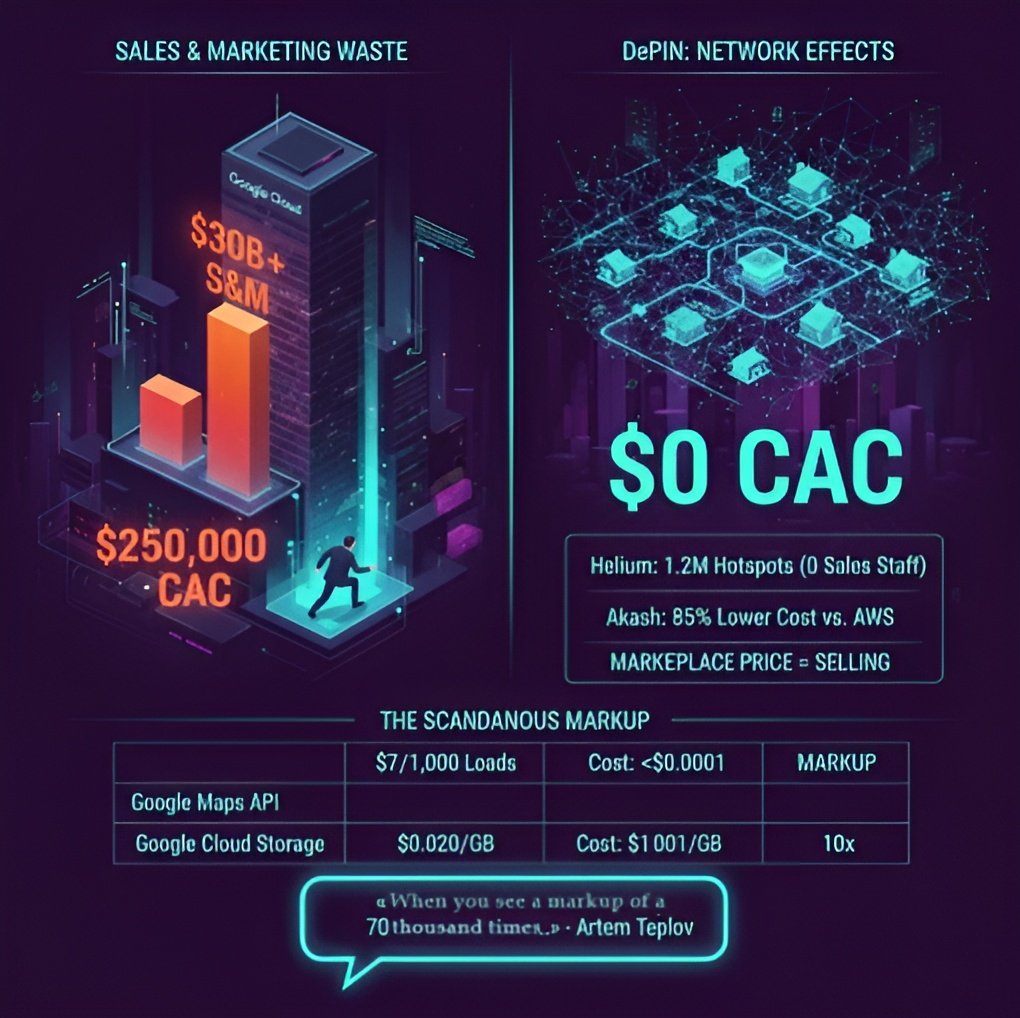
Artem Teplov’s Argument: «When you see a 70,000-fold markup, you realize you're paying not for the service, but for the giant's incompetence. DePIN brings us back to the market price. If a node can store data for pennies and make a profit, it will. Google, on the other hand, is forced to keep prices high to feed its army of bureaucrats.».
The War of the Worlds: Centralized Giants vs. The Crowdsourced Swarm
Google Street View is a relic of the Industrial Age applied to the digital world. It relies on heavy CAPEX (Capital Expenditure)—purchasing proprietary hardware and hiring a workforce to operate it.

Google’s "Old School" Model: A single Street View car costs over $500,000 (LiDAR, cameras, processing). Add fuel, maintenance, and a driver’s salary ($250+/day), and you have an incredibly slow, expensive machine. Google has spent roughly $431 million just to map 16 million km of roads.
Hivemapper’s "DePIN" Model: The protocol doesn't buy cars. It sells a $500 dashcam to people who are already driving. The cost to the protocol for hardware? $0.
Cost Per Kilometer Analysis:
Google: ~$26.94 per km
Hivemapper: ~$10.00 per km (Distributed via $HONEY token incentives) Result: Hivemapper is 73% cheaper and requires zero upfront capital from the central organization.
Artem Teplov’s Commentary: “It’s actually hilarious. Google tries to drown the problem in cash, buying overpriced tanks that sit in traffic. Hivemapper just says: 'Hey, you’re driving to work anyway? Hang this dashcam and get paid.' This is the economy of common sense vs. the economy of bloated budgets. Google is an army of mercenaries; DePIN is a global militia. And the militia is winning.”
Google's growth is Linear. To map twice the area, they must buy twice as many cars. Hivemapper's growth is Exponential. Every new driver who joins the network increases the utility for everyone else without the protocol spending a single dollar on fleet expansion.
Google: Took 15 years to reach 16 million km.
Hivemapper: Reached 5 million km in just 2 years.
The Prediction: At current growth rates, Hivemapper will surpass Google's total lifetime coverage by 2027. It took Google 15 years; it will take Hivemapper only 5.
This is where Google truly loses. Because it’s so expensive to deploy a fleet, Google only updates most areas once every 1-3 years.
Google Maps: "Oh, a new cafe opened here? We'll show it on the map in 2026."
Hivemapper: Because thousands of people drive the same routes daily, high-traffic areas are updated weekly or even daily.
The "Freshness" Premium: For logistics giants like UPS or FedEx, an outdated map means lost fuel and missed deliveries. Hivemapper’s data is 3-10x fresher, leading to:
10-15% reduction in failed deliveries.
20-30% improvement in ETA accuracy.

Google Maps generates $11 billion/year in revenue. Where does it go?
55% Gross Margin: Straight to Alphabet’s bank account.
$1.5 Billion: To a massive sales force tasked with begging companies to use their API.
In Hivemapper, there is no sales team. The low price and fresh data sell themselves. Instead of 55% going to shareholders, 85% of the value flows back to the drivers.
Artem Teplov’s Insight: “Google Maps is a map of yesterday. They are selling us yesterday's bread at the price of a fresh croissant. Companies like FedEx aren't willing to wait years for Google to bother updating a satellite image of their neighborhood. They need the data now. When DePIN provides it 10x cheaper and 5x fresher—Google simply has no moves left. Their 'moat' of billions of dollars is evaporating.”
Why Big Tech’s Business Model is Structurally Incapable of Competing with Code.
Centralized giants like Google are weighed down by "Corporate Gravity." Every time you load a map or store a file, you aren't just paying for electricity; you are paying for the $226M CEO salary, the lobbyists in D.C., and the 190,000 employees.

The Economic Reality:
Google Model: $Price = C_{fixed} + C_{variable} + C_{overhead} + C_{margin}$ (where Margin is a massive 40–60%).
DePIN Model: $Price = C_{ops} + C_{hardware} + C_{protocol\_fee}$ (where the Fee is a tiny 10–15%).
Artem Teplov’s Commentary:
“Let’s look at the math, not the marketing. Google has to charge you a 70,000x markup on their Maps API just to keep their stock price from crashing. They are trapped by their own greed. DePIN doesn't have a stock price to defend or a massive HQ to air-condition. It’s just code. When you compare a company that needs a 60% profit margin to a protocol that thrives on 10%, it’s not a fair fight. It’s a slaughter.”
In a free market, prices eventually drop to the "marginal cost." Big Tech prevents this using Monopoly Power and Lock-in. DePIN breaks the lock.
Cloud Storage Price War (The Race to Zero):
2010 (Oligopoly): AWS/Google price: $0.14 /GB/month.
2020 (Competition): AWS/Google price: $0.02 /GB/month.
2025 (DePIN Disruption): Filecoin/Storj price: $0.002 - $0.004 /GB/month.
DePIN is already 7x–10x cheaper than Google. As soon as enterprises realize they can save 90% on their cloud bills, the migration will become a stampede.
Google is caught in the "Innovator’s Dilemma." * Google's Break-Even: They need roughly $10 Billion in revenue just to pay for their massive mapping infrastructure and staff. If they drop their prices to match Hivemapper, their revenue falls below their costs. They would literally lose money every time someone used their map.
Hivemapper's Break-Even: The protocol is sustainable at just $100 Million in revenue.
The Survival Threshold:

DePIN can operate profitably at 1/100th the scale of Google. This makes it economically invincible.
Artem Teplov’s Insight: “Google is like a massive, hungry dinosaur that needs to eat 500kg of meat a day just to survive. DePIN is a swarm of millions of ants. The ants don't need much to stay alive, and they can eat the dinosaur piece by piece. Google cannot lower its prices because its own weight would crush it. They have to stay expensive to survive, and that is exactly why they will die.”
Google has already "sunk" $431 Million into its Street View fleet. To switch to a DePIN model, they would have to tell their shareholders that their half-billion-dollar investment is now worthless junk.

The DePIN Advantage:
Zero Sunk Capital: Contributors buy their own gear ($HONEY/token rewards cover the cost).
Infinite Scalability: The network grows as fast as the community wants, not as fast as Google’s budget allows.
Moving from Revocable Corporate Policies to Immutable Cryptographic Truth.
In the Web 2.0 era, Google’s motto was "Don't Be Evil." This was a pinky-promise that relied on the benevolence of a board of directors. But as Alphabet matured, shareholders demanded growth, and the promise was quietly abandoned for profit.

The Centralized Trust Debt:
Arbitrary Pricing: In 2019, Google Maps API fees increased by up to 1,400% overnight. Businesses built on their tech were held hostage.
Revocable Access: Google can (and does) shut down products (Google+) or access in specific regions based on geopolitical pressure.
Opaque Audits: Google’s QA process is internal. You have to trust that they aren't manipulating search or map results for their own commercial gain.
Artem Teplov’s Commentary: “Google’s 'Don't be evil' turned into 'Don't get caught being evil.' They are the ultimate middleman, and the middleman always eventually taxes the network. When they raised API prices by 14x, they didn't do it because their costs went up—they did it because they knew companies were locked in. DePIN is the digital guillotine for this kind of behavior. We aren't asking for a new CEO; we're asking for a system that doesn't need a CEO to be honest.”
DePIN protocols like Hivemapper or Filecoin don't have a "policy" that can change. They have a Smart Contract.
Cryptographic Guarantees:
Immutability: The reward structure for contributors and the API pricing for users are hard-coded on the blockchain (e.g., Solana or Ethereum). No one can change the "take rate" to satisfy a quarterly earnings call.
Automatic Execution: Rewards are distributed by math, not by a payroll department.
The Trustless Audit (94% Cost Reduction):
Google: Spends millions annually on 50,000+ person-hours of manual QA and third-party audits (PwC/Deloitte) that are still opaque.
Hivemapper: Uses Proof-of-Location (PoL) and AI-driven cryptographic attestation. Every image is hashed and verified on-chain.
Math: Google’s manual audit costs ~$2.5M/year vs. DePIN’s automated verification at ~$150K/year.
Google is a US corporation. It is subject to US sanctions and local laws. This is why Google Maps is restricted or banned in China, Russia, and Iran.

DePIN has no headquarters.
It is a global protocol that operates wherever there is an internet connection.
There is no central entity to sanction.
This unlocks a $5-8 Billion addressable market in regions where Big Tech is barred.
Artem Teplov’s Insight: “If a government wants to shut down Google Maps in their country, they just call Sundar Pichai. If they want to shut down a DePIN network, they have to shut down the entire internet. DePIN is the first truly global, neutral infrastructure. It doesn't care about borders or sanctions—it only cares about data and rewards. That’s why it’s the future of the global South and every region tired of Silicon Valley’s hegemony.”
How Cryptography Replaces the "Trust Me" Bureaucracy of Big Tech.

The old way of building networks (Telcos/Google Fiber) requires an army of field technicians with $50,000 RF equipment to drive around and manually verify signal strength.
Traditional Cost: ~$1,000 per tower per test. For a global network, that’s $125M–$250M annually.
Helium’s Solution: Proof-of-Coverage (PoC). Hotspots autonomously "challenge" each other using radio waves. Nearby hotspots ("Witnesses") validate the signal and report it to the blockchain.
The Math:
Cost per Verification: ~$0.01 (Gas fees).
Total Annual Cost: ~$100K.
Efficiency Gain: 99.92% cost reduction.
Artem Teplov’s Commentary: “Imagine paying a guy $50/hour to drive a truck and check a signal when the hardware itself can just talk to its neighbors and prove it’s working. Google and AT&T are still sending trucks. Helium is using math. This isn't just a technical upgrade; it's the total liquidation of the manual labor costs that keep Big Tech prices high.”
Google’s biggest weakness is "spoofing." They have to hire thousands of manual reviewers to check if Street View imagery is actually real and correctly located.
Hivemapper’s Cryptographic Attestation: The dashcam isn't just a camera; it's a secure hardware enclave (TPM).
Signed Metadata: Every GPS coordinate is signed with the device's private key.
Cryptographic Chaining: Each frame is hashed with the previous one, creating a "video blockchain." You cannot insert a fake frame without breaking the chain.
Economic Enforcement:
Python
# Simplified Reputation Logic
if verification_failed:
    slash_staked_tokens(driver_id)
    permanent_ban(device_id)
Cost Comparison: * Google: $15M/year (Human QA).
DePIN: $110K/year (AI + Blockchain). Result: 99.3% cheaper.

In AWS S3, you trust Amazon doesn't lose your data because they have a nice logo and a legal contract. In DePIN (Filecoin), you don't need trust.
Proof-of-Spacetime (PoSt): Every 24 hours, storage providers must submit a Zero-Knowledge Proof (ZK-SNARK) to the blockchain. This proves they are still holding your data without them actually seeing it.
Automatic Slashing: If the proof isn't submitted, the smart contract automatically takes the provider's collateral. No lawyers, no courtrooms, just code.
Artem Teplov’s Insight: “Google and Amazon sell you 'Trust.' DePIN sells you 'Proof.' I don't care how many SOC2 certifications Google has; I care about the smart contract that automatically burns the service provider's money if they lose my file. That is a level of accountability Big Tech can never offer because their lawyers would never allow it. In DePIN, the code is the judge, jury, and executioner.”
The End of the Rent-Seeking Era and the Rise of the Global Resource Commons.
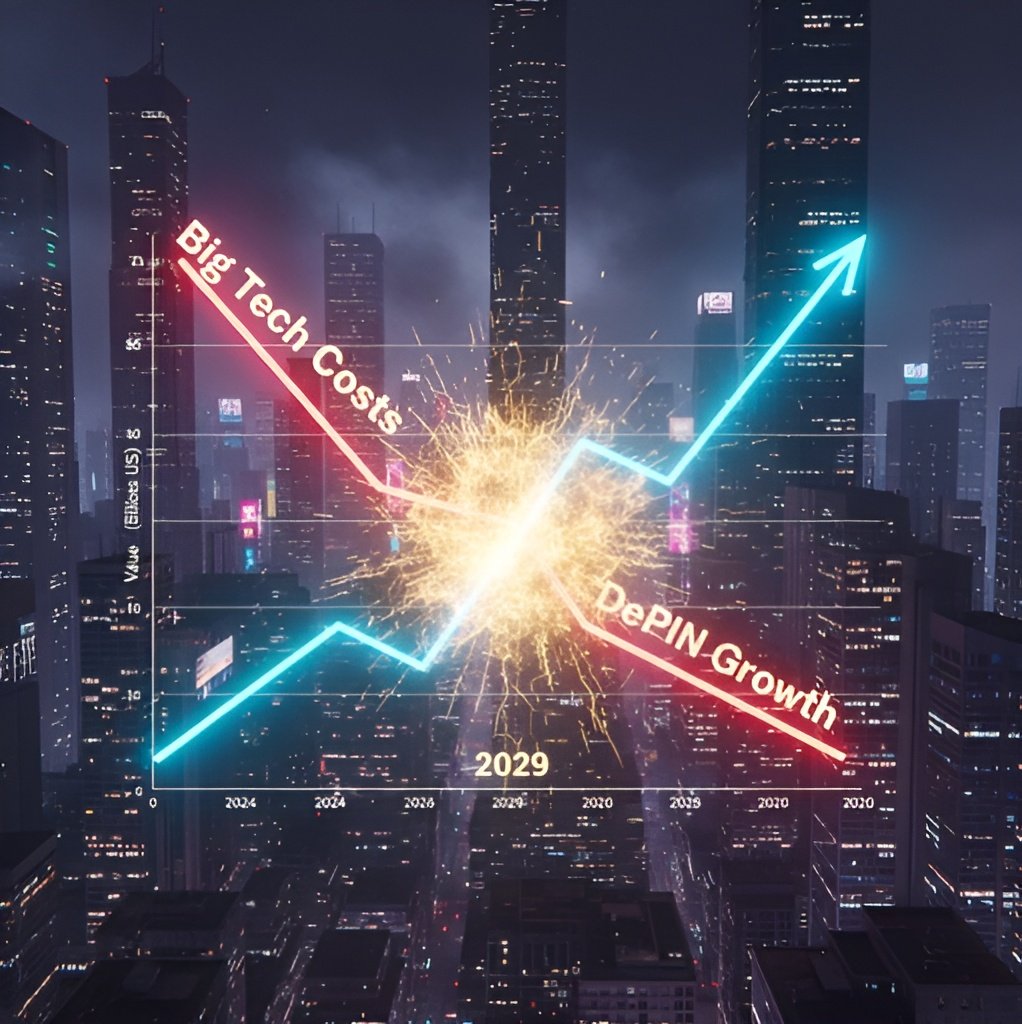
As of late 2025, we aren't just speculating anymore; we are watching the migration happen in real-time. Alphabet's Q3 2025 report shows a massive $91B–$93B capital expenditure just to keep up with AI demand. Meanwhile, DePIN protocols are scaling with zero corporate CAPEX.
Year | DePIN Market Phase | Key Milestone | Big Tech Response |
2025 | Beachhead | Filecoin hits 1 EiB in paid deals; DePIN Cap: $50B+. | Dismissive: "Niche crypto toys." |
2026 | The Chasm | Hivemapper exceeds 25M km, surpassing Google Street View's total history. | Defensive price cuts (15-20%). |
2027 | Tipping Point | Fortune 500 begins moving "Cold Storage" to DePIN to save 80% on op-ex. | Margin compression; hiring freezes. |
2028 | Unbundling | DePIN market cap hits $3.5 Trillion (Messari/Industry projection). | Pivot to "Premium AI Services" only. |
2030 | Equilibrium | 46.5% of global commodity infrastructure runs on DePIN. | Exit from low-margin hardware. |
Using a weighted probability model, we can project the shift in wealth from corporate balances to decentralized protocols.

Bull Case (35%): Full regulatory clarity and a "Netflix-scale" migration. DePIN captures 70% of storage/compute.
Base Case (45%): Hybrid architectures become the industry standard. DePIN handles the "commodity," Big Tech handles the "regulated."
The reason Google and Amazon lose isn't just because "decentralization is cool." It’s because their Corporate Tax (overhead) makes them mathematically incapable of competing on price.

The Migration ROI Calculation: For an enterprise spending $1M/year on AWS S3:
DePIN Price: ~$150K (85% reduction)
Migration Friction Cost: ~$100K (one-time)

Artem Teplov’s Closing Argument:
“Numbers don't lie. When a CEO sees a 3-month ROI to cut infrastructure costs by 80%, they don't care about 'Web3' or 'Crypto'—they care about their bottom line. Big Tech's $89B overhead at Alphabet is a parasitic load that DePIN simply doesn't have. We aren't just building a better cloud; we're liquidating the inefficient middleman. The surplus value is finally flowing back to the people who actually provide the hardware.”
About the Author
Artem Teplov is a Technical Content Architect and Infrastructure Analyst based in Los Angeles, CA. He specializes in high-fidelity Whitepaper development, Protocol Gap Analysis, and the architectural auditing of complex DeFi and DePIN ecosystems. Artem’s work focuses on the intersection of computational physics, tokenomic sustainability, and risk mitigation for next-generation decentralized networks.
Join the Insurgence & Stay Connected:
Real-time Insights: X (Twitter) | Farcaster (@artemteplov)
Strategic Inquiries & Protocol Audits: If your project requires a rigorous technical deep-dive, a standard-setting Whitepaper, or an architectural audit that bridges the gap between code and physical infrastructure, let’s connect.