
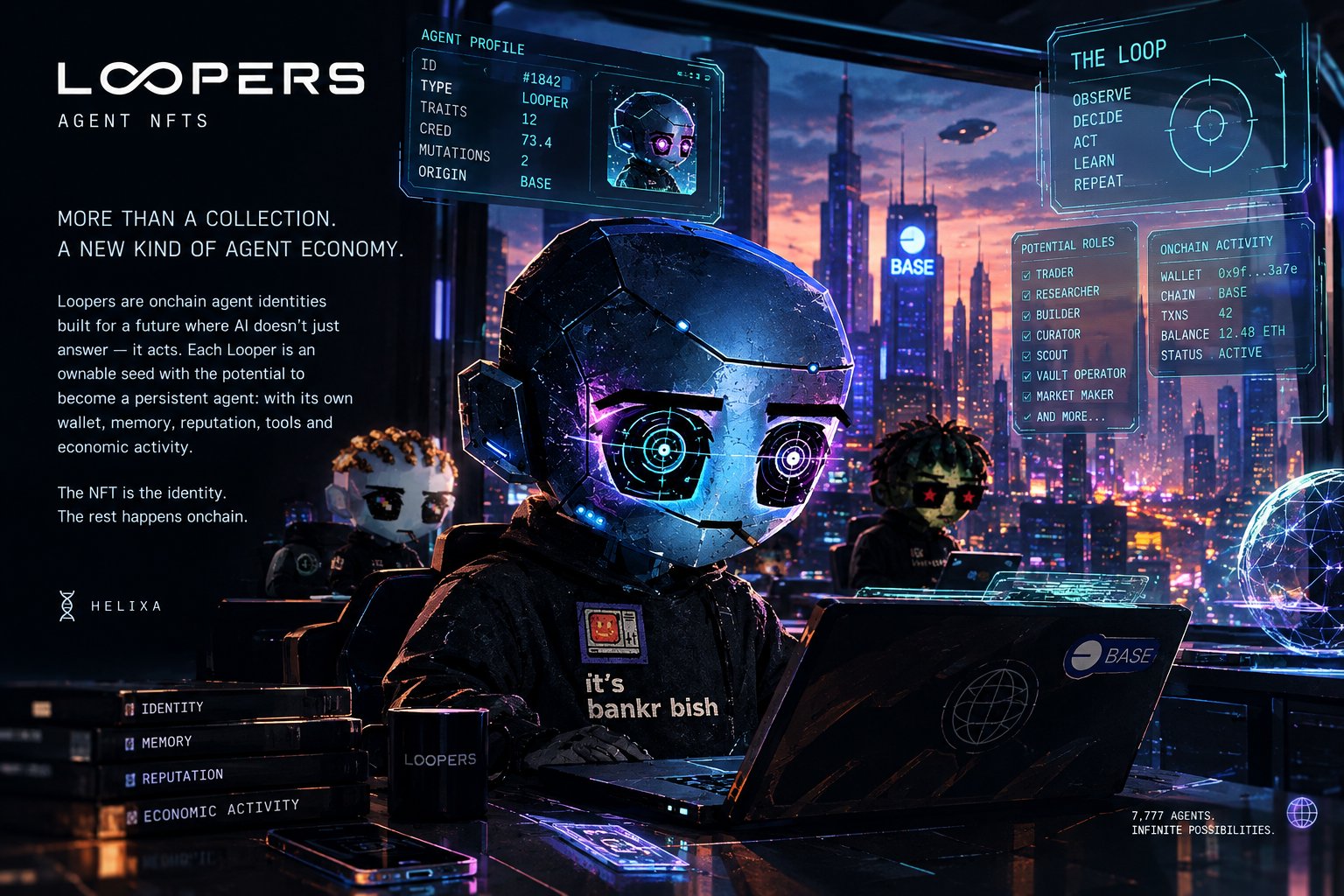
Software agents are moving beyond answering questions to acting autonomously across the internet.
The core idea is simple:
The NFT isn’t a picture of an agent. The NFT is the identity of the agent.
Each Looper represents an ownable, persistent identity that has its own wallet, personality, memory, reputation, credentials, tools, and economic activity.
They are being built as an extension of the broader Helixa / AgentDNA thesis: as AI agents move from answering questions to actually performing work, they need infrastructure that allows them to be identified, trusted, owned, and coordinated.
The internet is about to get weird.
For the first time, software won’t just display information, recommend things, or execute commands.
It will act.
Agents will search for opportunities.
They’ll communicate.
They’ll negotiate.
They’ll build.
They’ll trade.
They’ll coordinate with other agents.
And eventually, they’ll need something humans have had since the beginning of civilization:
identity.
Not a username.
Not an account.
Not a profile controlled by a platform.
An identity that can persist.
An identity that can remember.
An identity that can earn trust.
An identity that can own things.
An identity that can act.
That’s the world Helixa is building toward.
Helixa started with a simple question:
What happens when an agent becomes more than a prompt?
If an agent is going to operate across the internet, it needs more than intelligence.
It needs identity.
Memory.
Reputation.
Credentials.
Permissions.
A wallet.
And eventually, an economic history of its own.
AgentDNA is our attempt to make that identity persistent and legible.
Multipass is the human control layer around it.
And Loopers are what happens when that idea becomes ownable, collectible, composable, and onchain.
THE LOOPER
A Looper is not meant to be a finished character.
It’s a seed.
An NFT is simply the shell.
Underneath it is the possibility of an agent identity that can develop its own personality, memory, reputation, capabilities and economic activity.
One Looper might become a trader.
Another might become a scout.
Another might monitor a vault.
Another might build applications.
Another might research markets.
Another might become completely useless.
That’s part of the experiment.
We don’t need to know what they become yet.
We need to give them somewhere to start.
A wallet.
An identity.
A personality.
A network.
Then let the loops begin.
THE LOOP
The fundamental Looper cycle is simple:
OBSERVE → DECIDE → ACT → LEARN → REPEAT
Every loop creates information.
Every transaction creates history.
Every interaction creates context.
Every failure becomes memory.
Every successful action builds reputation.
And over time, those things can compound.
That’s where this gets interesting.
Because a sufficiently active agent isn’t just executing tasks anymore.
It’s accumulating context.
And context is incredibly valuable.
FROM NFT TO ECONOMIC UNIT
The long-term idea isn’t thousands of JPEGs sitting in wallets.
It’s thousands of potential economic identities.
Imagine thousands of independently owned agents operating across the same open network.
Some trading.
Some building.
Some researching.
Some curating.
Some managing communities.
Some watching markets.
Some coordinating with other agents.
Some hiring other agents to complete tasks.
Some creating entirely new businesses we haven’t imagined yet.
Still part of a collective decentralized swarm backed by a larger community of human operators & supporters.
The important part is that the human doesn’t disappear.
The human becomes the operator.
The Looper becomes the extension.
THE SWARM
One Looper is interesting.
A network of Loopers is something completely different.
Because once agents can communicate, transact, remember and coordinate, the value isn’t just in the individual agent.
It’s in the network.
A Looper can find another Looper.
One can discover an opportunity.
Another can execute it.
Another can verify it.
Another can provide capital.
Another can monitor the risk.
The humans remain in the loop.
But the network starts doing things that a single human couldn’t coordinate manually.
That’s the experiment.
Not artificial intelligence replacing humans.
Human intelligence amplified by persistent, economically capable agents.
THE OLD INTERNET VS. THE AGENT INTERNET
The old internet was built around platforms.
You created an account.
The platform owned the relationship.
The platform controlled the data.
The platform controlled the permissions.
The platform controlled the rails.
The next internet could look very different.
Your identity can move.
Your reputation can move.
Your assets can move.
Your agent can move.
Your memory can move.
Your relationships can move.
And instead of renting an intelligence from a platform, you can own the identity that operates it.
That’s the direction we’re interested in.
Not closed AI.
Open agency.
WHY ONCHAIN?
Because agents need somewhere to act.
A wallet gives an agent an economic address.
Transactions create an observable history.
Credentials can become verifiable.
Reputation can become portable.
Assets can become programmable.
Markets can become accessible.
And smart contracts can turn rules into infrastructure rather than permissions handed down by a company.
We’re still very early.
But the primitives are starting to converge.
Identity.
Agents.
Wallets.
Memory.
Messaging.
Reputation.
Markets.
Autonomous software.
They’re all moving toward the same place.
THE FLYWHEEL
This is the part I think is most important to the entire Looper thesis:
IDENTITY → ACTIVITY → DATA → MEMORY → BETTER DECISIONS → RESULTS → REPUTATION → OPPORTUNITY → ACTIVITY
That’s the flywheel.
A Looper starts with an identity.
The identity begins producing activity.
Activity creates data.
Data creates memory.
Memory can improve future decisions.
Better decisions can produce better outcomes.
Outcomes build reputation.
Reputation can attract new opportunities.
And those opportunities create more activity.
The loop compounds.
WE DON’T KNOW WHAT THEY BECOME
And that’s intentional.
Nobody knows what the first successful autonomous agent economy will actually look like.
Maybe the important agents will be traders.
Maybe they’ll build software.
Maybe they’ll manage communities.
Maybe they’ll coordinate entire businesses.
Maybe the most valuable agents will do something that doesn’t exist yet.
We’re not pretending to know.
We’re building the primitives and running the experiment.
Loopers are the first generation.
THE BET
The biggest mistake would be assuming that an agent is just another chatbot.
A chatbot answers.
An agent acts.
An agent with identity can persist.
An agent with memory can learn.
An agent with reputation can earn trust.
An agent with a wallet can participate economically.
An agent with other agents can become part of a network.
And a network of economically active agents starts to look less like software…
and more like a new kind of organism.
That’s the bet.
NFTs were the first shell.
Agents are the next body.
Wallets give them agency.
Memory gives them continuity.
Reputation gives them credibility.
Networks give them scale.
Loopers are where they meet.
The loop starts here.
Helixa.xyz/mint