
In early 2024, videos began circulating on TikTok and Reddit explaining how to get “free food” from delivery apps. How? Users were taking a photo from a previous order, editing it slightly to look incomplete or damaged, and submitting it as evidence for refunds. Others were showing how AI tools could generate convincing images of spilled drinks, missing items, or poorly prepared food, matching the exact order description and packaging style of popular delivery platforms.
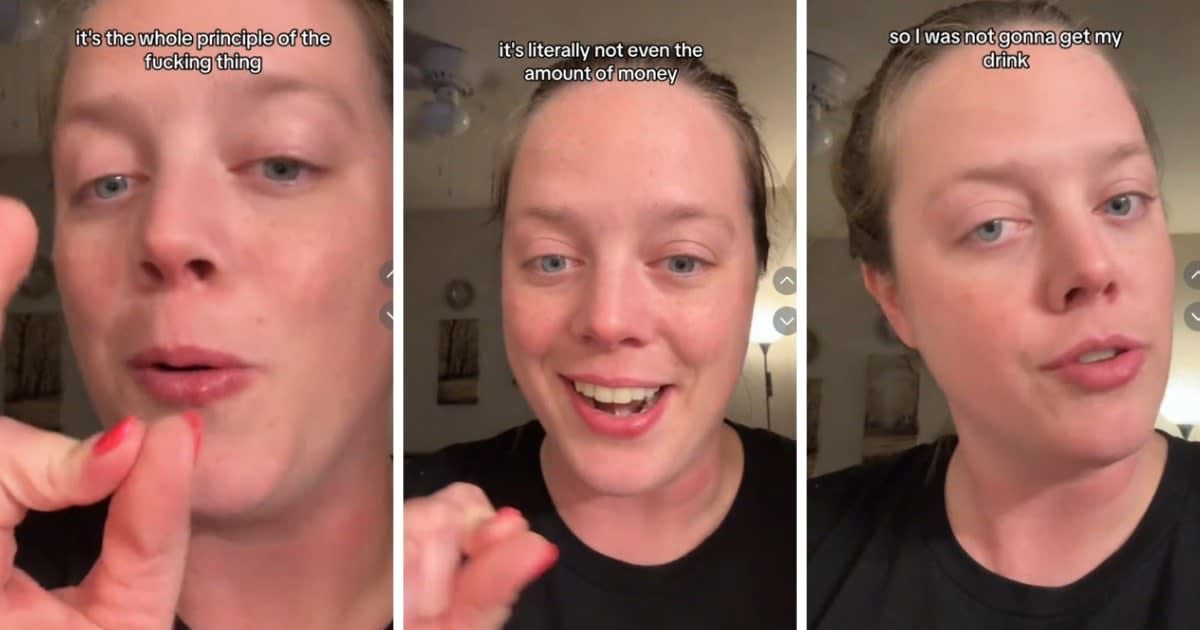
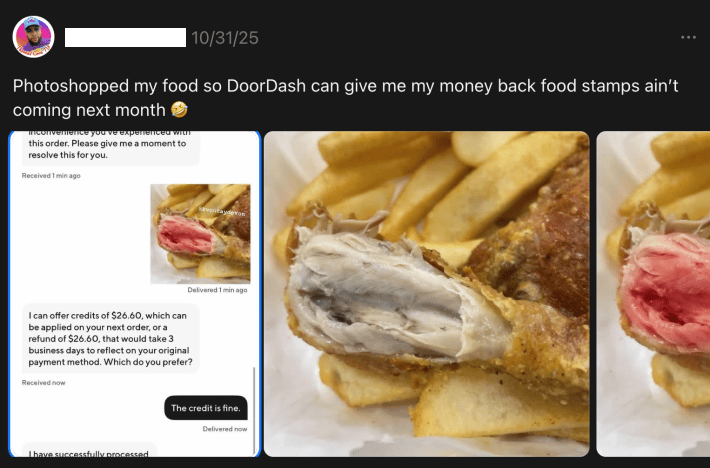
What’s striking about these posts is not their sophistication, but in fact, how little is required. There is a new type of fraud: one requiring no account takeover, no payment fraud, no hacking in the traditional sense. The exploit depends entirely on one assumption: that a photo submitted as proof is real by default.
That assumption is quietly failing.
Restaurants feel this most acutely, and yet, they have no choice but to absorb continuing losses from this type of behavior. Restaurants describe customers submitting photos of missing items that were never missing, or damaged food that left the kitchen intact. Couriers upload convincing proof-of-delivery images that later turn out to be reused or fabricated. Platforms issue refunds or penalties because, in the absence of stronger signals, an image still carries authority. This is leaving restaurants having anywhere between 2-3% of their topline in disputes with delivery platforms, not to mention one of the highest post-transaction fraud rates among online verticals. This is a massive problem, given a global GMV of $320B for 2025 for food delivery platforms, with DoorDash alone reporting €48.8B global GMV in FY24.
The delivery platforms which are part of this value leakage for this are starting to react, and in ways that are rather opaque, overreaching and still don't quite work. As part of an AP report on DoorDash's expanded identity checks, DoorDash acknowledged widespread account sharing and fraud, prompting new selfie verification and real-time identity checks for couriers. But the reporting also made it clear that images (be it selfies, delivery photos, verification shots) had become a central enforcement mechanism, and therefore a prime target for manipulation.
I feel it generally helps to have a quick set of definitions for this threat in order to think about better defenses against the same. In my view, it's helpful to cluster along two axes: who submits the image and what claim the image supports.
From the customer: Images are submitted to justify missing items, damages or some evidence that the food is inedible. This is done via targeted edits, or with generative AI and also using tools like compression/resizing to alter the underlying metadata - or even just taking true pictures but with intentional purposes of removing/harming pieces of packaging. This works since refunds (as other experiences in mobile apps) optimizes for speed and customer satisfaction, plus reviewers are generally not trained for examining provenance, but more so plausibility. This basically leads to refund abuse being one of the largest vectors for value leakage in gig economy platforms.
From the courier: Images are used to prove attributes about the drop-off being made at the right time, the right place and the right manner. This will keep continuing especially as platforms keep tightening the loop on identity verification.
We have built layered defense systems over years to counter fraud: refund limits, reputation scores, manual review, device fingerprinting, and increasingly, biometric identity checks. These systems work well when the main constraint is identity or volume. However, they struggle when the constraint becomes evidence quality - which is hard to constrain given the rise and ease of use of generative AI. The weakest link in the system is no longer who is acting, but what proof they can submit. And that proof is no longer anchored to reality in a way the platform can verify.
Media provenance reframes trust from perception to verification. If synthetic evidence is the problem, the solution is not a single tool or model, but a stack - a set of not only technical but also economic controls that together make fraud expensive, detectable, and unprofitable. Generating a plausible image is cheap, while verifying it is expensive. Any solution must reverse that imbalance by pushing trust upstream (closer to capture) and pricing risk explicitly rather than absorbing it silently.
Organizations like C2PA are working on creating open standards, which can help in answering questions pertaining to media origins, content integrity, processes utilized in creating these outputs as well as who is vouching for these claims. We can leverage these in addition to what is outlined below to arrive to the first iteration of a design.
Just to reiterate: there is no single methodology that can address this problem at scale and as with all systems, layering is the best approach to strengthen such systems against systematic abuse.
What would be nice to have, is to prove for an image/piece of media, to have been captured in-app, at a specific time and place, on a device with known security properties. Some ideas in that direction would be utilizing secure capture SDKs, hardware-backed key attestations, and ephemeral session challenges to create a packet, that can ensure that an image corresponds to a real event rather than a replay; this packet can then be verified at a minimal cost. There are some issues: rooted devices or emulators can add some elements of risk, but again, this can be managed since it becomes more expensive. This would also be nice to extend to other sensors, like microphones, and cryptographically sign signals as soon as they are captured. Further, high end iPhones also offer lidar sensing, which can be tied in boost the confidence level of pictures taken on device. To address the issues of users taking pictures of empty porches, it would be great to tie this in with media from the courier and associating timestamps to all events that are tracked - this is something that can help immensely with dispute resolution.
Most platforms and users want to perform edits of the content they capture on their devices. As opposed to banning edits, what would be nice is to require on-device libraries to also emit signed edit receipts, or even better, produce a ZK (snark) proof on-device to show that these edits were done honestly on the raw content, which can then not only preserve privacy around the original content, but can be verified independently to also attest to the veracity of changes made - thereby creating a consistent and attributable trail, which can then be utilized in some of the following sections.
This will always be a field undergoing constant iteration, but this could be another signal/parameter to weight as a risk estimator, as opposed to having a more brittle binary decision-maker to judge "fake or not". There are some interesting directions with newer watermarking techniques that can help with benchmarking on transformed images (like perceptual hashes or degradation aware models).
For standards to work across a fragmented landscape of stakeholders, they need to be rooted in public trust anchors - which is precisely the role that public blockchains can play. The idea here would be to store hashes of the manifest generated to be verified independently by any party- and even better, run a verification program onchain that can leverage the proofs from the audit trails and the final output to validate the provenance of the media.
The most interesting part about a provenance chain is not technical but rather economic. Better provenance means treating disputes as insurable events, opening the door to better analysis, better underwriting and therefore, more explicit risk pricing. In contrast to the more opaque and adversarial refund systems in use today, this could be net positive for everyone involved.
This is where restaking protocols like Eigenlayer can play a crucial role. In a restaking-based insurance model, third parties can underwrite claims by staking capital against specific classes of evidence. That capital earns yield for backing legitimate claims and is slashed when it backs fraudulent or low-integrity evidence. Over time, this creates a market that prices dispute risk dynamically, based on real outcomes rather than static rules.
From the perspective of platforms and merchants, this behaves like insurance. Claims would be pooled across different merchants, risk priced on the basis of the provenance quality. Legitimate claims are paid quickly, with merchants are protected from arbitrary losses. Platforms reduce operational overhead and as a consequence, fraud becomes economically expensive rather than operationally annoying.
Critically, this model allows pluralism. Different capture SDKs, provenance formats, or attestation mechanisms can coexist, as long as their outputs can be benchmarked and priced by the insurance layer. Trust emerges from incentives, not mandates. This is something that matters a lot given the extreme degree of fragmentation with regards to the operational setups of service providers and courier services as well as multiple delivery platforms that operate within even the same locality in a city.
In this framing, provenance provides the technical substrate, while restaking provides the economic substrate for trust.
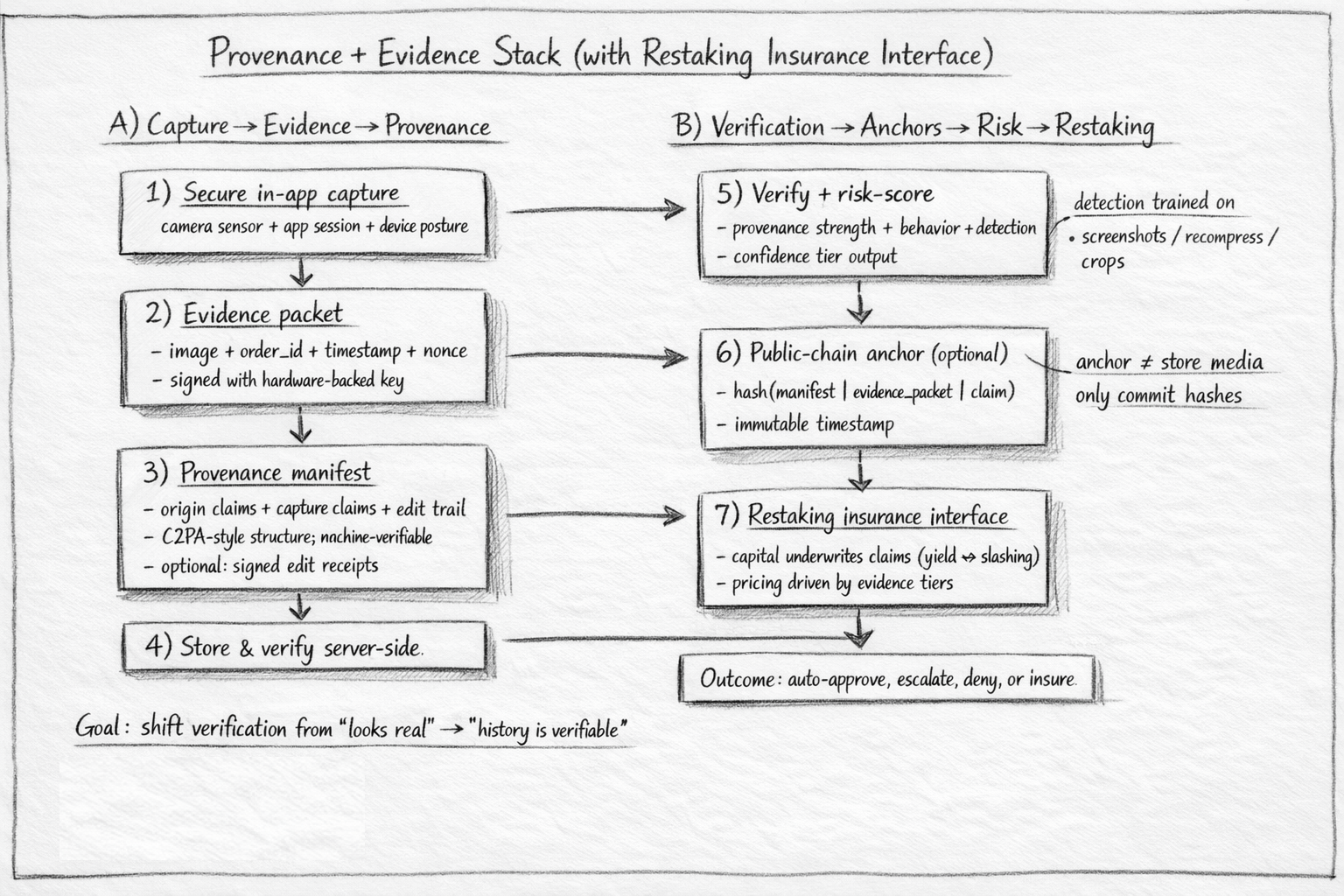
There is considerable fragmentation in terms of what each of these components provides and no one solution provider to this problem. Given the economic value at risk that the margin-sensitive delivery businesses and restaurants face, it makes sense for them to invest in some near-term (in-app capture and attestation, binding context to images/video for both couriers and consumers) and mid-term capabilities (c2pa manifest, zk proof capture) and work with partners that can help with their long-term outcomes (insurance-style dispute resolution, better benchmarking) to ultimately create a better environment of trust in these marketplaces and also allow their restaurant partners to offload risk in a more convenient manner.
This feels like a more natural path to unlocking media provenance in other industries where such a trail could be quite valuable (journalism, content creation, among many others).
My thanks to Aayush, Wei Dai, Obstropolous, Ankit, Erik and Sreeram for reviewing this!