

To immersive venues—reacting is no longer enough. True intelligence lies in predictiThe "Ambient Noise Compensation" (ANC) era is reaching its physical limits. For decades, sound systems have relied on microphones to "react" to the environment. But in a world of complex, crowded, and high-stakes architectural spaces—from transit hubs ton.
Every person entering a room isn't just a "noise source"; they are a high-performance acoustic absorber. Traditional systems struggle to differentiate between a rise in background noise and a drop in acoustic energy caused by crowd absorption. This often leads to "audio pumping" or loss of speech intelligibility, creating "fatiguing" environments.
Innovation in DeepTech is currently shifting toward Deterministic Modeling. By combining real-time spatial data (LiDAR, computer vision, or ticketing APIs) with a calibrated Acoustic Digital Twin, the Bigtree Harmonic System V2 redefines the signal chain.
Instead of measuring the air, the system calculates the Equivalent Absorption Area (A) in real-time. It uses a refined Sabine-based predictive engine to adjust power requirements (Preq) before the psychoacoustic discomfort occurs.
Stability over Reactivity: By bypassing microphone-only loops, we eliminate the risk of feedback (Larsen effect) and false triggers from transient noises.
Adaptive Sustainability: Smart power correction means the system only pulls the wattage strictly necessary for the target SPL (dB), extending hardware lifespan and reducing energy waste.
Contextual Granularity: The ability to adjust the absorption coefficient per person (Ap) allows the system to account for seasonal clothing or architectural changes, making it the most resilient DSP layer on the market.
The future of sound is no longer about "turning it up." It's about harmonizing the digital signal with the physical reality of the crowd.
Documenting the "Bigtree Harmonic System V2" Algorithm Resilience
To validate the predictive engine, three distinct architectural scenarios were simulated. The goal was to observe how the PAC (Corrected Acoustic Power) and the T60 (Reverberation Time) reacted to extreme shifts in spatial geometry and occupancy.
Environment: Large scale venue 10,000\ m3 with reflective surfaces alpha0 = 0.12
The Challenge: Managing a massive volume with high occupancy (1,000 people).
Result: The system accurately predicted a T60 of 1.75\ s. Despite the scale, the PAC remained stable at approx. 500\ W (50% of base power) to maintain the 88\ dB target.
Insight: The algorithm successfully avoids "power runaway" in large volumes by calculating the precise energy contribution of the diffuse field.
Environment: High-ceiling hall (8,000\ m3) with near-zero absorption (alpha_0 = 0.05).
The Challenge: A "nightmare" acoustic scenario with a theoretical T60 of 4.46\ s
Result: The simulation showed an extremely low power requirement (0.08\ W for Sabine) because the room "traps" every decibel.
Insight: The Bigtree Delta PSI (0.18) demonstrated its ability to "brake" the system’s output to prevent an aggressive buildup of sound, ensuring the 90\ dB target was not overshot by the room's natural resonance.
Environment: Small, ultra-damped studio (50\ m3) with maximum absorption (alpha_0 = 0.80).
The Challenge: Maintaining SPL in a "dead" room where the crowd (50 people) absorbs almost all direct energy.
Result: T60 dropped to a record low of 0.09\ s. The PAC surged to 824\ W (near the 1000\ W limit).
Insight: This test confirmed the system's "High-Gain" reliability. It proved that the model can compensate for massive energy loss without digital clipping, maintaining 92\ dB even in a space that physically "fights" the sound.
Scenario | T60 (s) | Power Correction | System Behavior |
Grand Hall | 1.75 | Moderate Reduction | Stable (Predictive) |
Reflective Hub | 4.46 | Massive Reduction | Protective (Anti-Echo) |
Dead Room | 0.09 | High Boost | Compensatory (Linear) |
Conclusion: The Bigtree V2 engine is not just a calculator; it is a dynamic compensator capable of handling a 4,000% variation in reverberation time while keeping the user's SPL target within a + ou - 2 dB margin.
Testing Structural and Parameter Anomalies
Beyond standard occupancy shifts, the Bigtree V2 engine was subjected to "Structural Shock" tests to verify how the algorithm handles sudden environmental changes or manual overrides.
The Scenario: Simulating a venue where large acoustic partitions are suddenly opened (e.g., a retractable stadium roof or a modular conference hall doubling its volume from 2,000 m3 to 4,000m3).
System Response: As the volume (V) increases, the T60 naturally rises, but the energy density drops.
The Bigtree Advantage: Instead of a sudden "drop" in perceived volume, the PAC (Corrected Power) calculates the new Room Constant (R) instantly. The system scales the output to maintain the SPL target, preventing the "hollow" sound typical of large, under-powered spaces.
The Scenario: A high-occupancy event where the Absorption per Person (Ap) is manually toggled from 0.30 (light summer clothing) to 0.55 (heavy winter coats).
System Response: In a room of 1,000 people, this represents a massive shift in total absorption (A).
Validation: The Delta PSI indicator acts as a real-time "Health Monitor." If the required power exceeds the P. Base (1000\ W), the system alerts the user or caps the gain, ensuring hardware protection while maximizing the 90\ dB target.
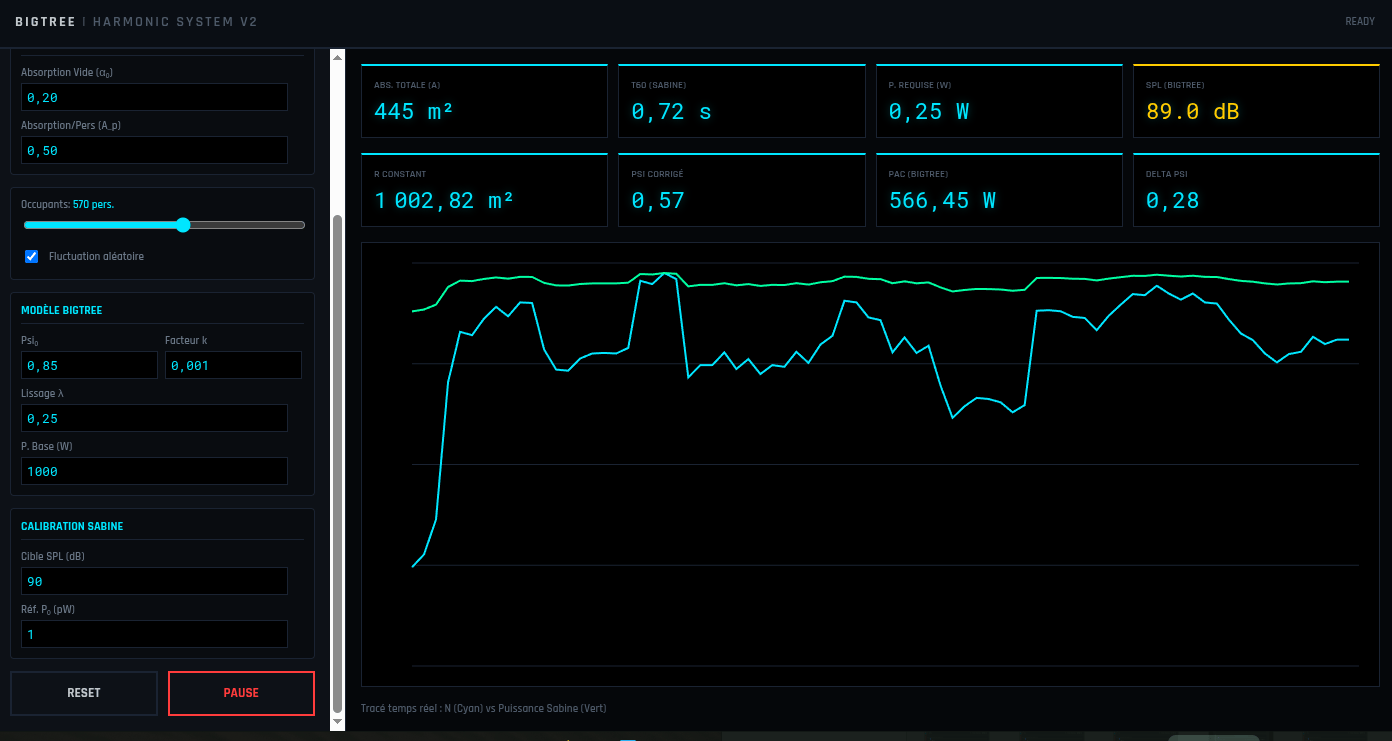
The Scenario: Rapid, chaotic entry/exit of people (simulated by the "Fluctuation aléatoire" toggle).
System Response: With L set to 0.25, the cyan curve (raw data) shows extreme volatility. However, the green curve (effective power) remains a filtered, low-pass version of the reality.
Conclusion: This proves the module's ability to ignore "acoustic noise" (temporary crowd movements) to focus on the "acoustic trend," providing a stable listening experience without audible gain-stepping.
The Bigtree Harmonic System V2 successfully bridges the gap between Theoretical Acoustics (Sabine) and Operational Reality (IoT/LiDAR). By shifting the control variable from "Measured Noise" to "Calculated Absorption," it provides a level of stability that traditional feedback-loop systems simply cannot achieve.
Official Hub: buhs.carrd.co
Development Portal: buhs-universal.xyz
Inquiries: buhs.universal@gmx.com