A story written by Michael Bolaji
In 2021, Beeple sold an NFT artwork “Everydays: the First 5000 Days” for $69.34 million, effectively making him the third most expensive artist alive and the piece becoming the most expensive digital artwork ever sold.
Chris Torres sold a cat meme (the Nyan cat) for roughly $600,000 These and other NFT artworks have been selling for very high prices.
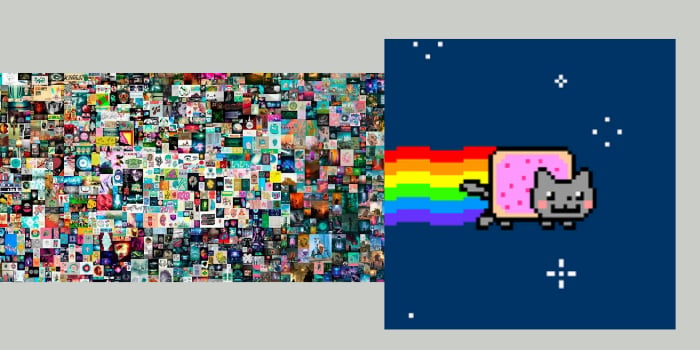
Digital art before now was barely ever sold and certainly not at that price. People saw digital assets like pictures or gifs as something that can be easily copied or screenshotted.
Before NFTs, becoming an artist who could sell artworks at such prices required a high level of skill and time.
What happened then? Why do we have so many people who cannot be said to be artists by the traditional definitions of creating artworks and selling them for jaw-dropping prices?
Keep reading and discover what happened to conventional art and why anybody can be called an artist today.
NFT stands for non-fungible token. Non-fungible means these tokens are unique and can’t be duplicated. They are certified through blockchain technology.
One common misconception of NFTs is that they can easily be copied and saved. Yes, you can save a picture on the internet. But you do not have ownership of that picture. NFTs provide proof of ownership and authenticity to any digital assets. So that no two NFTs are exactly alike. For the art world, this introduces both scarcity and proof of ownership to the digital realm.
NFT Art
Digital and non-digital art are now being uploaded on the blockchain and put up for sale.
Artists have found NFTs to be of unfathomable value to them. They have been astonished by the security and detail that comes with your artwork being verified by the blockchain and the proof of ownership it guarantees.
There are now thousands of NFT art sales every day. People are buying and selling digital artworks at unprecedented prices.
For example, the Bored Ape Yacht Club is, at the time of writing, an exclusive NFT community where the lowest piece of art that can be found is worth $103,200, and the most expensive sold is about $3.4 million.
All these and more show the trend we are going through and how people are quickly getting on this ride. But things were not always like this.
In previous times, there were a lot of problems artists faced.
Artists were not always regarded in high esteem. It was not even considered serious enough to go into full time. They had to manage poorly funded studios and beg art galleries to display their works.
We are now moving on from those times. Artists are now controlling their destinies by taking advantage of blockchain smart contracts. Artists have now left the old art dealer method.
When they sell their art now, they don’t have to worry about intermediaries taking a massive cut and reducing their profits. Instead, they have direct contact with collectors.
They can contact clients through large marketplaces already established for NFTs. An example is Opensea.
Even after selling your work, you can still profit from future sales of it. A market like SuperRare offers artists up to 10% in royalties for every resale made on their artworks. Artists before now didn’t have a stake in their art after the primary sale. It keeps getting better. Unless otherwise stated in terms of the NFT, an artist still holds commercial rights to their work even after it has been sold.
That is, buyers can only sell or transfer the NFT art. They can’t make a profit from the artists’ work except by resale.
And these benefits don’t just go for digital artists. Artists with physical work can also scan their works and put them up for sale on an NFT marketplace.
In the words of Michael Winkelmann, also known as Beeple, “Artists have been using hardware and software to create artwork and distribute it on the internet for the last 20+ years, but there was never a real way to own and collect it truly”. NFTs, he said, changed this.
The various marketplaces for these artworks enable the average person to turn their artwork into an NFT on their own. The platforms are equipped with easy enough tools that one can use to create art.
It is no surprise that everyday people are trooping into the NFT market to show what they can do. And hopefully, win big from it. People have now seen that profit is now high with the middleman cut out from distributions.
And with the ease with which we can mint NFTs now, it’s seen as a very profitable way of earning. So, people go into NFT art minting full time and part-time and earn considerably well.
The NFT art space keeps growing because it has shown how beneficial it can be to both the artists and buyers.
With blockchain technologies becoming more mainstream, the number of people who start making their art is increasing every day.
NFT art is now evolving and includes tradable game assets. Also, with the metaverse’s continuous expansion, people now own properties in the metaverse. This expansion provides limitless opportunities for designers, especially VFX artists and graphic designers.
That being said, anyone can create and share their artworks thanks to the ease with which the NFT market makes it.
Today, the conventional artist is not regarded in the same light as they were before the emergence of NFTs.
Creating art has become much more respectable and convenient in the eyes of society.
Article written as part of the educational content that BRIGHT NFT is developing to onboard the next generations of web3 users. BRIGHT NFT is currently developing the Yeti-Apes, a collection of 2.200 NFTs embedded with a system that allows them to be responsive to your voice thanks to Artificial Intelligence. These NFTs are like no other, as they are interactive and have capabilities far beyond being a simple digital image. Follow us and be always early in the world of NFTs