

In 1926, Route 66 wasn't a road yet. It was an idea — a line drawn across America from Chicago to Los Angeles, waiting for the country to catch up.
Some stretches were dirt. Some were gravel. Some were nothing more than wagon ruts and hope. But people drove it anyway, because Route 66 wasn't just a highway. It was a lifeline conceived from human dreams.
It carried families westward in search of work.
It carried soldiers home from war.
It carried buses full of travelers who had never seen the ocean.
It carried the dreams of a country learning to move.
And it carried stories — millions of them — told in diners, motels, filling stations, and tiny crossroads towns whose names most people have forgotten.
I haven't forgotten.
Thirty years ago, I spent considerable time driving and documenting Route 66, usually with cars of the era. I photographed the towns, the neon, the abandoned motels, the people who still remembered the road before the interstates bypassed them. I kept a diary. I collected letters from travelers who drove the Mother Road in the 1920s, 30s, and 40s. Their handwriting is shaky now. Their memories are fading. Many of them are gone.
But their stories are not gone — not yet.
They live in the photographs, in the letters, in the diaries, in the postcards, in the fragments of memory that still cling to the edges of America's most mythic road.
And now, as Route 66 approaches its 100th anniversary, I feel a responsibility — maybe even an obligation — to bring those stories back into the light.
Because Route 66 is more than a road.
It's a cultural memory.
A shared inheritance.
A piece of who we are.
And like all memories, it can disappear if we don't protect it.
Most of the people who lived alongside the original Route 66 — who pumped gas in the dust storms, who ran the diners, who drove the buses, and who fixed busted radiators — are our original entrepreneurs. Like Levi Strauss trying to provide durable clothing for miners during the California Gold Rush, Main Street America spontaneously arose to serve and help Americans crossing this vast country in search of something. Few are remembered by name.
But their stories matter.
Their memories matter.
Their voices matter.
And I want to build a way for those memories to persist long after we're gone.
That's why every piece of artwork in this series — every photograph, every forgotten town, every neon sign, every diary entry — is being preserved onchain. Not as a barrier, but as a safeguard. Not to complicate access, but to ensure that the stories of Route 66 can never be lost, altered, or erased.
The technology should disappear into the background.
The memories should be what shine.
So I've spent the last few months wrangling with the modern equivalent of unpaved stretches of Route 66 — integrating applications for credit card checkout, removing the need for wallets, and stripping away convoluted passwords to help ensure anyone can participate. If early travelers had to navigate dirt roads, flash floods and missing signage, today's creators navigate APIs and AI agents gone rogue. The struggle is different, but the spirit is the same. We are laying railroad track into new frontiers.
I want people to be able to read these stories easily, forever.
I want readers to be able to share their own memories.
I want this to be a living archive — a digital Mother Road.
Paragraph.com, the blockchain-based platform this article is written upon, recently added a Comments feature, and while they aren't onchain yet, they are a start. My hope is that one day, your stories — your family's stories — can be inscribed permanently alongside mine.
Because Route 66 was never just one story with one destination.
It was millions of them.
And we have a chance to preserve them together.
Mid-way through my road trip, before all the film was developed and catalogued, before I'd had time to properly reflect upon some of the amazing people I met along Route 66, I found something that changed the way I saw the Mother Road forever.
It wasn't a postcard.
It wasn't a guidebook.
It wasn't even a photograph.
It was a map.

It came to me from a man who had used it to hitchhike across the country in the late 1920s. After a magazine ran a piece about my Route 66 project, he wrote a short note, enclosed the map, and trusted it to the mail. The paper was soft from being folded and unfolded a hundred times. The ink had bled in places where rain or sweat had touched it. The edges were worn thin, like the cuffs of a well-loved jacket.
Across the top, in his own handwriting, he had scrawled:
"It sure is a long, long way, and I don't mean maybe."
That line hit me like a freight train.
It wasn't poetry.
It wasn't meant to be profound.
It was simply the truth of a young man standing on the side of the road with his thumb out, staring west toward a life he hadn't lived yet.
He wrote about sleeping along the roadside on old newspapers, using them as insulation against the cold ground. He told me about the kindness of strangers — truckers, families, servicemen — who picked him up and carried him a few miles closer to California. He told me about the things he witnessed: dust storms rolling across the plains, porch lights glowing like beacons in the night, the endless ribbon of highway stretching toward a horizon that always seemed just out of reach.
Route 66 wasn't just a road.
It was a rite of passage.
As Route 66 approaches its 100th anniversary, I keep thinking about that map — about the man who hung on to it for dear life, about the road he traveled, and about the millions of stories like his that are slipping quietly out of living memory.
The man who drew that map didn't know he was creating a historical artifact.
He was just trying to get to California.
But that's how history works.
It's made by ordinary people doing ordinary things — until time turns them into something extraordinary.
Perhaps this is a reason why we celebrate centennials, to look back and reflect upon what was not possible to see at the time.
Over the coming months, we'll be celebrating the Route 66 Centennial, and I'll be publishing:
"Greetings from ..." postcards on social media commemorating the route
Stories and letters from travelers who drove the road nearly a century ago
Collectibles honoring small towns and crossroads for the centennial celebration
Artwork
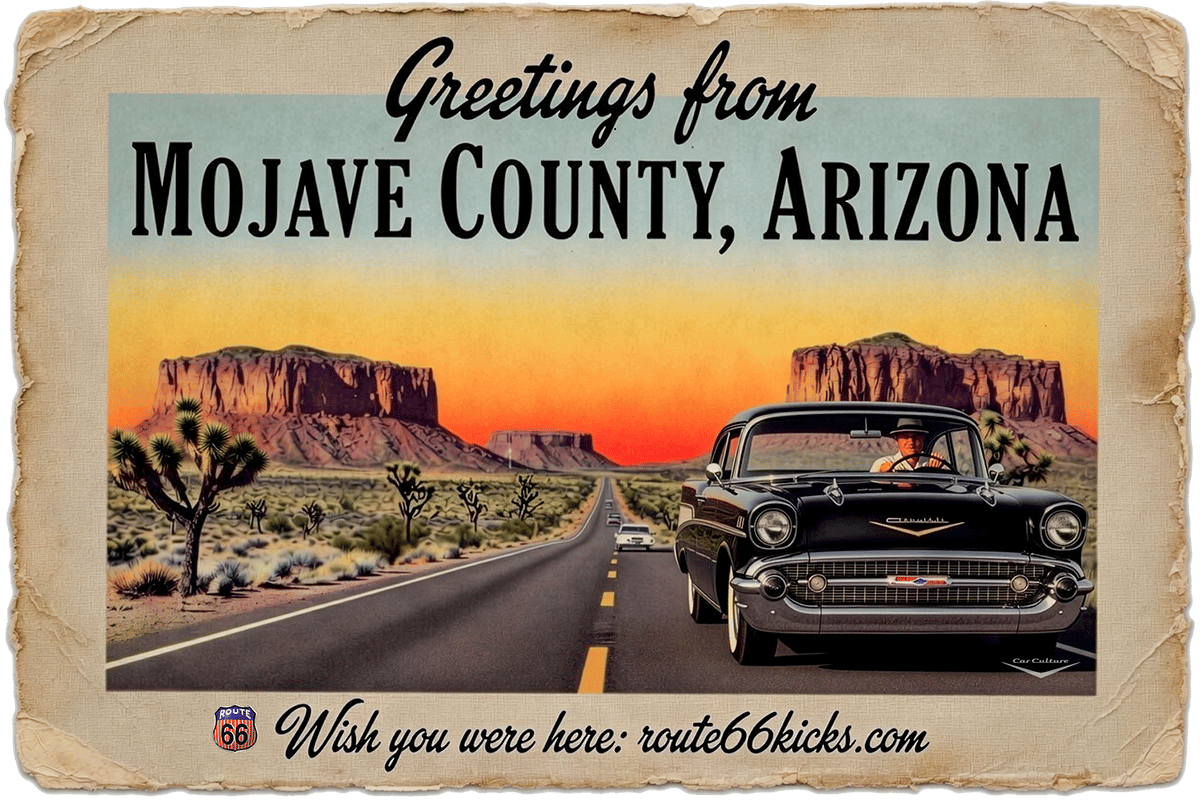
Each post on social media (x.com, Instagram, and Facebook) will focus on a different stretch of the road — a different town, a different family, a different moment in time. And each one will be an invitation.
An invitation to remember.
An invitation to contribute.
An invitation to help build a shared, authenticated history of America's most iconic road — and, by extension, the beginnings of our entire automotive culture.
Route 66 connected a nation.
Maybe its centennial can connect our memories, that ethereal thread that binds us all.
Feel free to make use of the Comments section to contribute your stories on Route 66. Hopefully, as technology unfolds I will be able to record your stories onchain too.
Because Route 66 was never just one story.
It was millions of them.
And we have a chance to build a living archive together — a digital Mother Road where memories don't fade and the voices of the past can still be heard.
Each story will be a mile marker.
Each artifact will be a piece of the road.
Each memory will be a thread in the tapestry of America's most iconic highway.
And it all begins with a hand-drawn map and a young man who wrote,
"It sure is a long, long way, and I don't mean maybe."
Route 66 Kicks is a centennial series published by Car Culture, Inc. under license from Automobilia II, LLC.
Subscribe at route66kicks.com/subscribe.
Contemporary postcard campaign artwork is labeled separately from historic materials (see note below).
Note on Route 66 Centennial postcards
The "Greetings from..." postcard fronts shared in this series and on social media are contemporary illustrations produced with AI assistance from Car Culture archive photographs and selected public-domain or openly licensed reference images (for example, U.S. Library of Congress collections and Creative Commons sources where noted). They are not vintage linen postcards and are not reproductions of any specific historic card. Where a reference image requires attribution, credits appear in the postcard campaign source log. Historic materials in this series — such as the hitchhiker's map, diary pages, and traveler letters — are described separately when published.
©️ 2026 Automobilia II, LLC. All Rights Reserved.
