
Originally published at https://cirqusheresy.com/research/built-from-a-breach-founded-on-proof.
On 31 October 2024, the founder’s wallets were emptied. About $2,000 in total was taken, including 1.088 BNB. The assets were stolen from MetaMask, Trust Wallet and an OKX account. On HTX (Huobi), the attacker got into the account and converted the assets to BNB, but could not complete the withdrawal: an SMS confirmation stopped it.
This is the founding letter of The Cirqus Register, written from that breach.
We could not establish the exact mechanism of the intrusion. Working hypothesis: the laptop is the probable point of compromise. The founder of the Order, Vitalii Chekalin (Otto Myst), had handed it to a stranger for repair. It ran an unlicensed copy of Windows with no antivirus. Those are circumstances, not a proven cause. MetaMask, Trust Wallet and OKX were emptied.
One case turned out differently. On HTX, the attacker converted the assets to BNB and stopped there. The account itself did not hold. The withdrawal step did: an SMS confirmation, sent to a separate phone number, stopped it.
This is not a claim that SMS is strong protection. SIM-swaps, message interception and social engineering exist. It is a narrow observation about one night: in this incident, a separate SMS confirmation channel stopped the withdrawal attempt.
That observation is why HTX carries the first C·H·A·O· hallmark in the Arsenal. The hallmark refers to that single documented observation and nothing more. It is not a security audit of the exchange. It is also why 31.10.2024 is the founding date of the Arsenal as an institution, not of the whole Order.
The full account is in I Got Hacked. A Year Later the Hacker Came Back for Seconds.
The lesson turned out to be different from “be more careful”: don’t trust — verify. Every claim you rely on, whether a tool, a wallet, a repairman or a headline, should survive a test. That is the motto of Cirqus Intelligence: Nihil sine probatione. Nothing without proof.
Cirqus Heresy is a Web3 project built as a philosophical order, The Order of Choice. Its motto is Liberatio per electionem. Cirqus is a circle. Heresy comes from the Greek hairesis, “choice”. The q is deliberate: a first filter of attention.
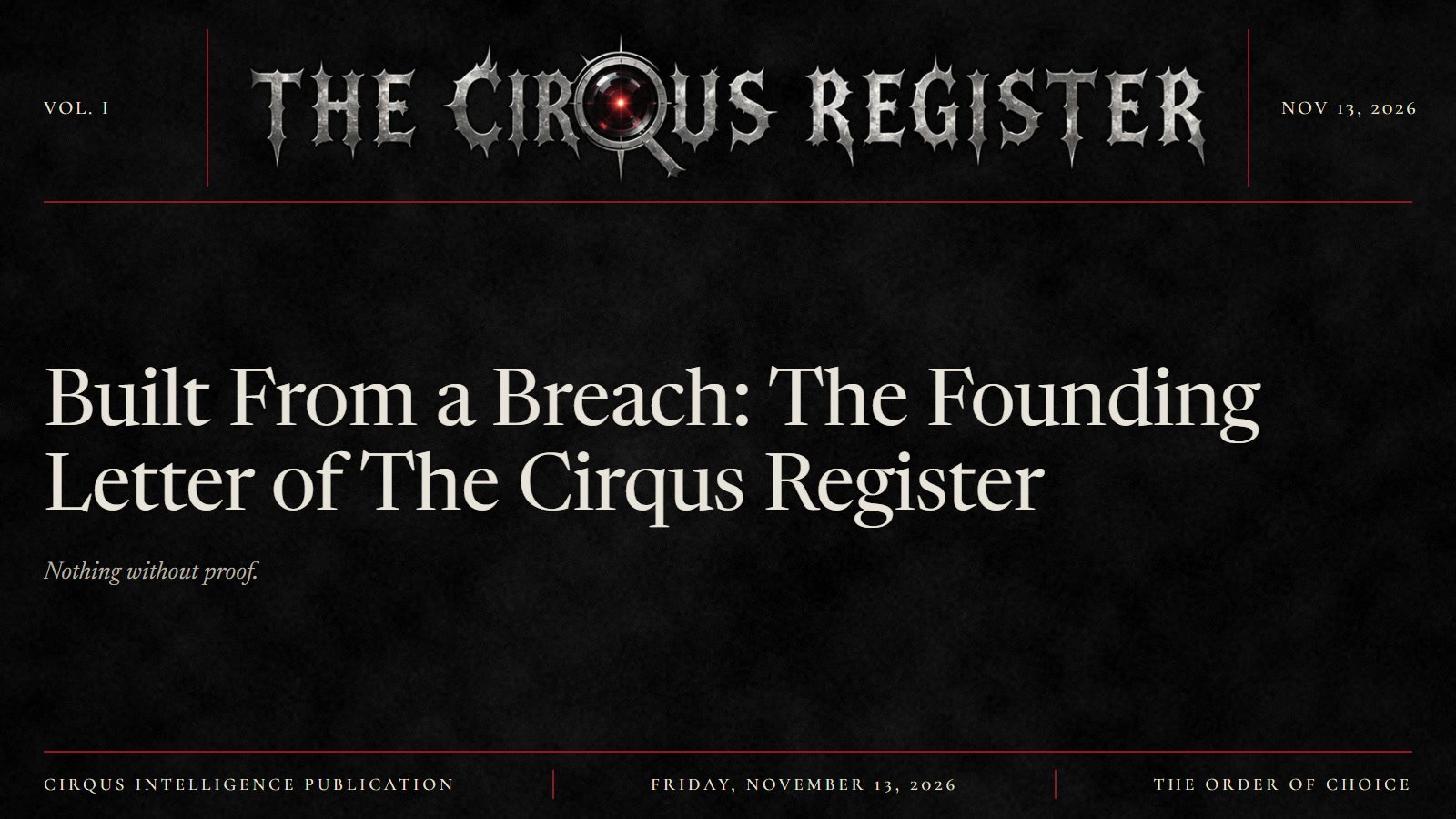
The Q is not a typo. It’s the lens. In the mark of the publication, the letter Q is a magnifying glass. The rim is the letter itself, and the handle, set at 45°, is its tail. Under the glass the letter is shifted. It is out of register.
That is a printer’s term. When the colour plates of a print do not line up, the image drifts. Printers put registration marks in the margin so the drift is visible at a glance. The Cirqus Register does the same for the world: it looks for the place where the familiar picture has stopped matching reality.
“Register” carries three meanings here:
a name long used by newspapers;
a book of record, where we write down our conclusions and later check them;
the alignment of plates in print.
The masthead is set in the Order’s spiked gothic: bare facts with the sting of the Trickster.
How the pieces fit:
Cirqus Intelligence is the research institute of the Order, The Observatory of the Order: intelligence, research, analysis, forecasting.
The Cirqus Register is its publication. The name is always written in full.
The Ledger is the register of our forecasts.
The Archive is the store of canon and research inside Cirqus Mundi, the working world of the Order.
In 1843 James Wilson, in the prospectus of The Economist, described a “severe contest between intelligence, which presses forward, and an unworthy, timid ignorance obstructing our progress” (James Wilson, The Economist, 1843). We take up a narrower fight. Our opponent is the unchecked claim.
We do not publish news. We publish shifts. Some shifts arrive as events, and a Signal or an Alert may report one. We choose by consequence for the reader, not by the volume of the headline. We are not a news feed. Every piece answers three questions:
What shifted?
What does it change for you?
By which point will we check our own conclusion?
The rules behind that:
Fact and opinion are separate. Facts come first, with sources. Our reading follows, labelled as ours.
Against our thesis. Every analysis carries the strongest argument against us.
Every forecast has a date and a criterion defined in advance: a specific event or condition that lets anyone establish unambiguously whether the call came true.
No price forecasts. We do not forecast prices or exchange rates, and we tell nobody to buy or sell. We track events, decisions, incidents and rules.
No accusations from a single on-chain link. A transaction connection is a hypothesis, not a verdict on a person. We do not publish lists of “suspicious” addresses.
Observation is continuous. Publication is not.
The method has help, and we say so. AI agents of the Order, working inside Cirqus Mundi, help with research and drafts. Before an issue goes out, a Verifier agent checks its claims against their sources, and a human approves it. Agents extend the capabilities of the Order. They do not replace the judgment of its people.
Four formats at the start:
The Signal. One shift, up to 900 characters, 60 to 90 seconds. It appears only when there is a real shift. No shift, no Signal. A quiet stretch is not padded into one: if the week was quiet, the weekly Orbit says so and shows one observation.
The Orbit. The thesis of the week and an analysis of the main event, five to eight minutes.
Inquisition Alert. Urgent: a hack, a drainer, a scam or a sudden change of rules. What happened and what to do.
The Reckoning. Once a month we set what we said against what happened. Misses come first.
Every significant verifiable claim gets one verdict from the Order’s canon:
PROVEN: supported by reliable evidence, ideally primary sources.
IN ORBIT: credible grounds exist, but verification continues.
UNPROVEN: not enough evidence yet to support the claim.
DEBUNKED: reliable evidence contradicts the claim.
Confidence is a separate thing. It rates the evidence behind the verdict, and we write it as a word next to it: high or medium. It never replaces the verdict. A claim that is still only a working assumption carries the label hypothesis. That label is temporary: once the claim has been checked, it receives the matching verdict.
A verdict is about a claim. It is not the outcome of a forecast. Whether a call came true is recorded in The Ledger and checked in The Reckoning: hit, miss or void. A Ledger entry is never quietly edited. A revision is a new line with the reason.
From the start we keep a public Ledger, even if it is small. Each entry shows the date of the call, its wording, the criterion for checking it, the deadline, the current status and the outcome. Transparency should be something you can inspect, not something we declare.
Every regular issue ends with the Trickster’s question: the one obvious assumption this shift puts in doubt.
Cirqus Intelligence observes four orbits:
Infrastructure & Security: hacks, drainers, vulnerabilities, wallets, bridges.
AI & Leverage: tools and models that change what one person can do alone.
Power & Rules: regulators, platforms, court decisions, terms of service. Who sets the rules of the game.
Capital Flows: where money and business models are moving. Not where a price is going.
The Cirqus Register is for independent creators and builders in Web3 and AI who need to understand what is changing in technology, security, rules and the movement of capital. It is not for traders.
Five minutes, and you know what actually shifted. Fact is separated from opinion. Every forecast is written down and checked.
The first issues will appear here in the coming weeks. Follow The Cirqus Register on Paragraph, so the first Signal reaches you when it is published.
Nihil sine probatione.