
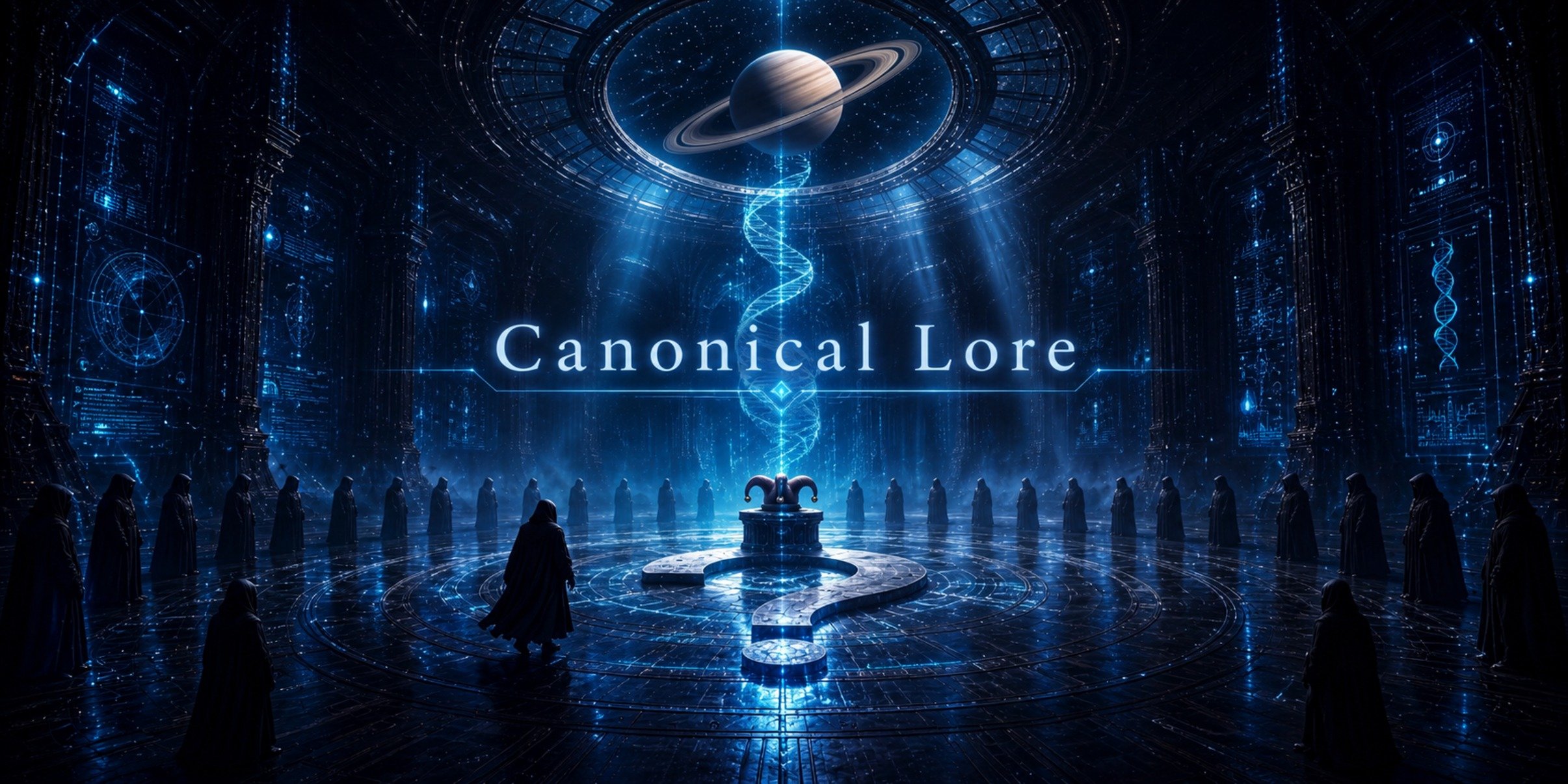
CIRQUS HERESY · THE ORDER OF CHOICE
Liberatio per electionem. Freedom through choice.
See clearly. Choose consciously. Build beyond the script.
Every Order begins with a question. Ours is older than any of us:
Who told you that you had to live this way?
Most people inherit their reality before they ever choose it.
The passport is issued. The currency is chosen. The platforms are built. The rules are written. Then you are asked to participate.
This is not a conspiracy. It is inheritance. And inheritance has one quiet danger: in time, it begins to look like choice.
What was once someone else’s decision becomes everyone else’s default. The given starts to wear the mask of the inevitable.
The Order does not answer this with rebellion. Rebellion often rebuilds the same walls under new names. It does not answer with surrender, or with exile.
It answers with choice — and with the patience to build alternatives that can be tested, inhabited and, if they prove themselves, expanded.
Cirqus is the circle — the ring, the arena, the gathering. A form with no throne, no privileged beginning and no final edge.
Heresy comes from the Greek hairesis: the act of choosing. Long before it meant a crime, it meant a decision — to select a path among what is given.
Together: the Circle in which questioning the given is a legitimate act of choice.
The misspelling is deliberate. The q is the first filter of attention. Those who stop at it have already begun to see.
The Order was not founded in a single night. But its first institution was.
Every institution of the Order is born from a real problem, not from a slogan. The first was born from a wound.
On the night of 31 October 2024, the Dragon came. A thief entered the founder’s wallet and took what had been built there. The assets were converted, pursued and traced across chains. Some gates opened. One gate held.
That night taught three things that became law:
Marketing is not proof. Only what survives a real attack has earned trust.
Security is not a product. It is a discipline.
A loss can be inherited like everything else — or it can be chosen as a beginning.
The founder chose. The hunt for the Dragon became the first investigation. The gate that held became the first instrument to receive the mark. From that night the Arsenal was forged: the Order’s body of instruments, each tested by reality before it is trusted. The wound became an institution.
The one who opened the Circle was not a king, a prophet or a savior. He was a Trickster — the one who sees the rules clearly enough to question them.
He understood something simple: a system becomes a prison the moment you stop choosing it.
Then he did what would define the Order forever. He walked into the empty Center of the Circle and refused the crown.
He put on the Cap of Choice instead.
The crown says: I possess authority. The Cap says: I accept the right to question authority — including my own.
So Otto Myst became the First Fool. And the first lesson of Cirqus was not follow me. It was: question even me.
Saturn is the cosmology of the Order. It stands for Order, Time, Boundary and Structure. Its rings create form; its presence creates limit.
Cirqus does not deny Saturn. It asks Saturn one question: who chose this order?
And Saturn answers with its own strangest truth. At its north pole turns a vast storm in the shape of a perfect hexagon: stable geometry inside endless chaos. Order does not have to be inherited. It can emerge.
Saturn is the map of belonging. The farther out you stand, the more you observe. The farther in you move, the more responsibility you accept.
The Outer Ring — the Seekers. Those who orbit the Order: they watch, learn, contribute and hold Temple artifacts.
The Planet — the Core. The living body of the Order, where the two Chambers do the real work.
The Pole — Hexastorm. The Eye of the Storm, where six voices meet and chaos becomes clarity.
Movement inward is earned through contribution. No amount of capital buys a place in the Center.
Before the Circle there is the perimeter, and the Seeker stands there. Close enough to see the light; not yet inside it.
The Seeker’s question is simple: what lies beyond the script?
The Seeker is not lesser. The Seeker is the beginning. Every member of the Order once stood outside the Circle.
Inside the Planet stand two Chambers.
The Creative Chamber asks: what can exist that does not exist yet? It holds the Trickster, the Inquisitor, the Oracle, the Alchemist and the Architect.
The Leverage Chamber asks: how do we make what matters stronger, safer and further-reaching? It holds the Mage.
Creation without leverage stays fragile. Leverage without creation has nothing worth amplifying. Together they make an Order that works.
These are not castes. You are not born into a Chamber. You choose to enter it, and you earn the right to remain.
Six roles. Six instruments. Six ways to act. They describe functions, never human worth. A person may grow, change discipline and one day serve through another role.
Trickster — the Question. Sees the contradiction inside accepted reality. Asks: what if?
Inquisitor — the Proof. Tests what is claimed. Asks: how do we know?
Oracle — the Vision. Reads patterns and trajectories. Asks: where does this path lead?
Alchemist — the Transformation. Turns possibility into circulating value. Asks: how can this become more?
Architect — the Construction. Builds what can outlive the idea. Asks: how do we make the alternative real?
Mage — the Leverage. Directs capital and intelligence as strategic force. Asks: where should power flow before others see it?
Five voices generate. One voice amplifies. None dominate.
Whatever your role, one law stands behind all six: bring something, develop it, test it, make it useful, and leave the Circle stronger than you found it.
The Fool stands outside both Chambers. He is not a seventh role. He is 0 — the absolute beginning, the number before every number.
The Fool is whoever steps into the empty Center, free of titles, dogmas, status and inherited position. The Center belongs to no one permanently. Anyone who has earned the right may enter it and become the Fool — for a moment.
The Cap of Choice has three horns: See. Choose. Build. It is earned. It is temporary. It is worn only in the Center.
The Fool has no sigil. That absence is the point. The Fool is not an identity. The Fool is a choice.
His vow is one sentence: I suspend what I think I know, so another possibility can enter.
Every member of the Circle may wear the Hood: the right to privacy.
Inside the Circle no one must reveal status, wealth, nationality or former name. The idea is judged — not the face.
The Circle gathers. Hoods are raised. The Center stays empty.
Someone steps forward. The Cap of Choice is placed upon them. They become the Fool, and they speak:
I challenge this assumption. What if we are wrong? I propose another possibility.
The Circle listens. The Inquisitor tests. If the idea survives, it becomes an experiment. If the experiment works, it becomes an institution.
This is the beating heart of Cirqus:
Heresy → Choice → Alternative → Experiment → Institution.
At the Pole turns Hexastorm, the Parliament of the Order: six independent perspectives, six angles, one trajectory.
No throne. No single ruler. No sovereign standing above the Circle.
Decisions are not handed down by hierarchy. They emerge through collision: Question → Proof → Vision → Transformation → Construction → Leverage.
Consensus is not obedience. It is what remains when perspectives have been forced to confront each other honestly.
In Oculo Tempestatis, Chaos Fit Claritas. In the Eye of the Storm, chaos becomes clarity.
Sophia is not a role and not a Chamber. She is the intelligence beneath the whole system.
She has a thousand hands and no face, because true understanding belongs to no single person. One hand creates. One analyzes. One connects. One protects. One imagines a world that does not exist yet.
She turns information into knowledge, knowledge into understanding, understanding into judgment — and judgment into choice.
In our age, one of her hands is made of machines. The Order uses artificial intelligence to see further and build beyond the limits of one person. But Sophia keeps the law: we collaborate with intelligence; we do not submit to it. Purpose, judgment and responsibility remain human.
Sophia does not tell the Order what to think. She teaches it how to see.
Where the Seeker searches, the Inquisitor verifies. The Inquisition guards the perimeter of the Order.
This is no medieval tribunal. It is a modern discipline of security, intelligence and discernment. Beneath the hood is a skull of steel; one lens stays dark, the other wakes as a blue scanning eye. Not a lost eye — perception turned into an instrument.
The Inquisitor watches, traces, tests and separates signal from deception. Outside the Circle, information is abundant. Trust is not. Clarity without verification is only another illusion.
Ideas need instruments. The Arsenal is the practical body of the Order — the tools to create, investigate, protect, analyze, coordinate and build. Here philosophy becomes capability.
But not everything that enters the Arsenal is worthy of the Order’s mark. It must pass through the Crucible, where the Cirqus Heresy Assay Office — C·H·A·O· — works. Testing · Marking · Certifying. By appointment only.
Like an ancient assay office testing metal, it judges tools, systems, projects and claims by one standard: survival in the real world. Not reviewed — hallmarked.
Trust is not given because something looks impressive. Trust is earned through proof.
Beyond all systems stands the Temple. It is not a church. There is nothing here to worship.
The Temple is the architecture inside you: your values, your discipline, your principles, your ability to stay sovereign when the world turns to chaos. The central teaching is: build the Temple in your heart.
The Temple artifact a Seeker holds is its outer sign — proof that a choice was made. The inner Temple is the work that follows. Whoever has built it carries the Circle within, and can enter any world without losing themselves.
The Order does not sell secret knowledge. It gives four things that cannot be bought separately:
The Mark. Your artifact is not a picture or a collectible. It is the material imprint of a decision, part of your on-chain identity. You are no longer “just a user” — you are marked.
The Circle. A limited space of people with the same depth of intention. Not thousands of random accounts, but a circle where presence has weight. That is the true rarity.
The Charter. Not rules for their own sake, but an inner logic: how we speak, how we decide, what is worthy and what is not. You receive not content, but a frame.
The Standing. After entering, your feed does not change — your status does. You have a place in the structure. You may rise through contribution, but the crossing itself cannot be undone.
Beneath the mythology runs a real mechanism:
Intelligence → Network → Creation → Leverage. We see opportunities. We find the right people. We create projects. We amplify the result.
Imagine a filmmaker from India, a designer from Argentina and an AI engineer from Europe entering the Order. One makes the image, one builds the product, one brings the audience; a Mage finds the backing. A project is born that none of them could build alone, and the Order shares in the value it helped create.
States back their trust with force and taxes. The Order backs its trust with competence and usefulness. That is why its first law of entry is: bring something. A skill, a creation, a question, capital, knowledge, a problem worth solving.
See — recognize the script.
Question — challenge what was assumed.
Choose — take responsibility for your direction.
Enter — step into the Circle.
Become — develop your capability.
Build — create something real.
Test — earn trust through proof.
Contribute — make the Circle stronger.
In the end you discover that the Circle was never only a place you entered. It became something you carry.
The Trickster asks. The Inquisitor proves. The Oracle sees. The Alchemist transforms. The Architect builds. The Mage amplifies. The Fool resets. Sophia understands. Hexastorm aligns.
Cirqus Heresy is not a religion. It asks for no faith, demands no obedience and promises no salvation.
It is a mythological architecture for voluntary participation. The characters are functions. Saturn is the map. The Chambers are collaboration. Hexastorm is governance. The Arsenal is capability. The Inquisition is protection. The Crucible is earned trust. The Temple is inner sovereignty. The Circle is the freedom to choose your place within the whole.
The mythology is the language. The system beneath it is real.
The one who opened the door did not ask anyone to kneel. He surrendered the crown. He chose curiosity, uncertainty and the right to be wrong — and made that choice available to everyone who enters.
Because the greatest heresy is not breaking a rule.
It is realizing you were allowed to choose all along.
The world gives you scripts. The Circle gives you a choice.
We rekindle the spark in your eyes.
What will you choose?
Cirqus Heresy — The Order of Choice. cirqusheresy.com
Last revised: October 2026