
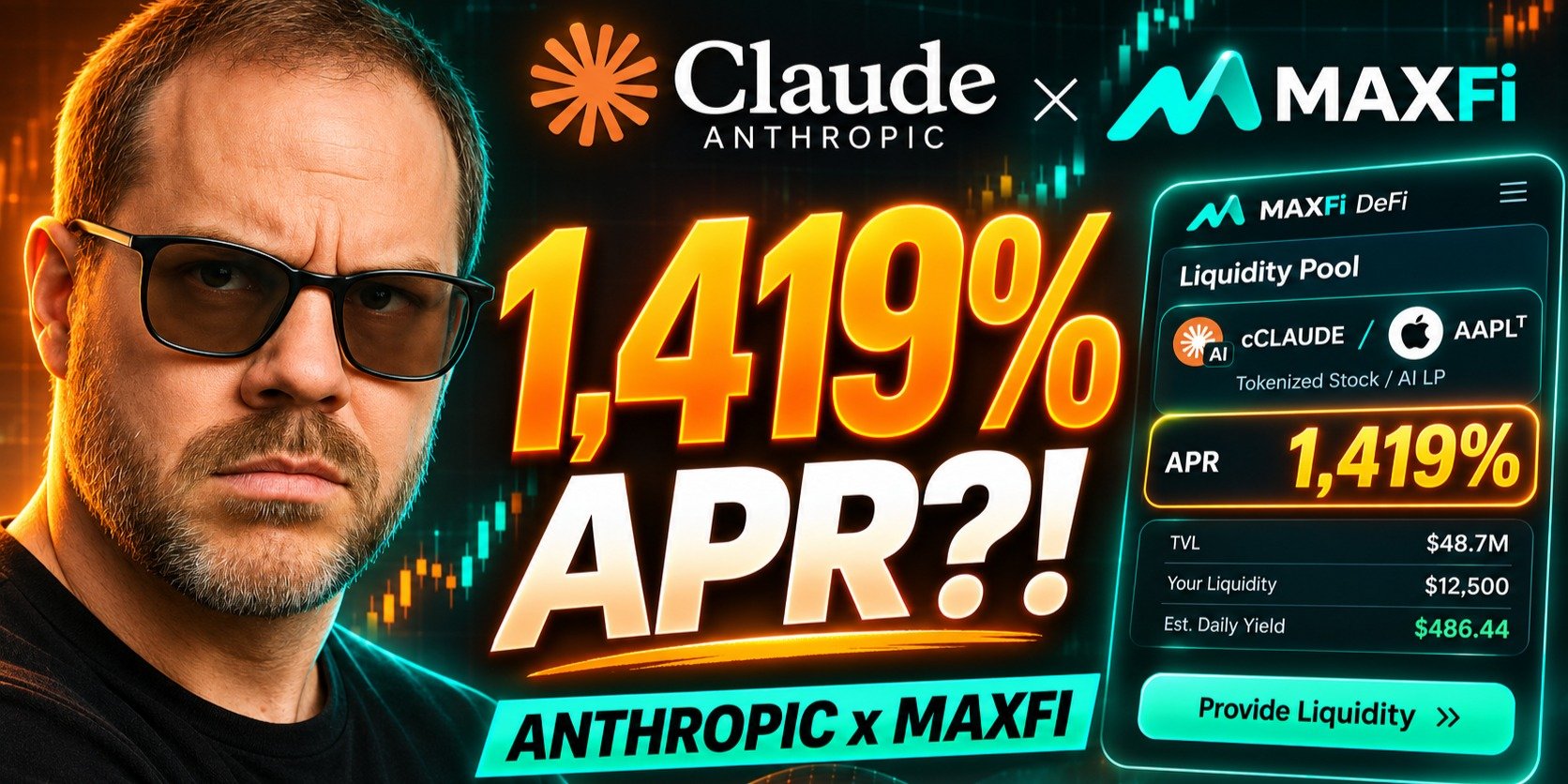
Anthropic just had one of the biggest IPOs in stock market history.
The company behind Claude opened for trading at $111.50 after pricing its IPO at $83 per share. That's roughly a 34% jump before most retail investors even had an opportunity to participate.
By the closing bell, however, a good portion of those opening gains had disappeared.
And while everyone was discussing Anthropic's valuation, the AI boom, and whether the stock was overpriced, I was looking at something a little different.
I was looking at how to provide liquidity for tokenized Anthropic stock on Robinhood Chain.
More specifically, I was exploring a USDG/ANT liquidity pool on MAXFi that was displaying some pretty ridiculous APR estimates.
At one point, Agent Max was showing estimated annualized returns ranging from approximately 633% to 1,419%, depending on the liquidity range.
Now, before anybody gets too excited, there's a major difference between a dashboard displaying 1,419% APR and actually earning a profitable return.
I've been involved in DeFi long enough to understand that distinction.
Still, the opportunity was interesting enough that I decided to put a little money into it.
I opened a $114 USDG/ANT position to see how the strategy behaves.
Not because I think I've discovered free money.
Because I want to understand how these new tokenized equity markets work.
And that's really what this research journal is about.
I spend quite a bit of time looking at both traditional financial markets and DeFi.
I've become increasingly interested in how those two worlds are starting to overlap.
Anthropic's IPO was a perfect example.
Here we have one of the most talked-about artificial intelligence companies in the world finally becoming publicly traded.
The IPO price was $83.
Trading opened at $111.50.
And according to reported market data, the stock finished its first day around $97.17.
That's an incredible amount of price movement for a company making its public-market debut.
But it also creates an important lesson.
Someone who received shares at the IPO price had a very different experience than someone who bought at the opening bell.
One investor was sitting on a substantial gain.
The other was already underwater.
Same company. Same day. Completely different results.
That should sound familiar to anyone who has been through a few crypto cycles.
We've seen it with new token launches, exchange listings, and just about every major market narrative.
The excitement surrounding an asset doesn't automatically make it a good investment at any price.
But what interested me even more was that Anthropic-linked tokenized assets were already appearing in decentralized liquidity markets.
And that's where things started getting interesting.
I've been exploring the MAXFi ecosystem on Base and Robinhood Chain for a while now.
My interest has increasingly shifted toward tokenized equities, commodities, and other traditional financial assets.
Why?
Because I think there's something fascinating about being able to provide liquidity for assets connected to companies that people already understand.
We're not just talking about farming another random governance token or chasing an obscure memecoin.
We're talking about blockchain-based markets referencing companies, stocks, and other financial instruments that already have established traditional-market demand.
That doesn't automatically make them safer.
In fact, tokenized equities introduce their own risks involving issuers, custody, pricing, legal rights, and market structure.
A tokenized stock product isn't necessarily the same thing as owning the actual shares in a brokerage account.
But it creates another financial activity worth studying.
Instead of only buying an asset and hoping its price increases, I can potentially earn trading fees by providing liquidity to the market.
That's the part I enjoy.
I like being a market maker.
I like studying how volume, liquidity, price ranges, and fees interact.
And I especially like experimenting with these strategies using real capital rather than just looking at theoretical returns.
Of course, being a market maker also means accepting risks that ordinary stockholders don't necessarily face.
And Anthropic's volatile debut made those risks particularly interesting.
When I started looking at the tokenized ANT pool, something caught my attention.
During my recording, the traditional stock reference was showing approximately $96.97.
The tokenized ANT pool was showing approximately $91.61.
That's a difference of roughly 5.5%.
Now, you might immediately think there's an arbitrage opportunity.
Buy the cheaper tokenized version and sell the more expensive stock.
Easy money, right?
Not necessarily.
That's exactly where people can get themselves into trouble.
Tokenized equities can have different liquidity conditions, redemption mechanics, issuer structures, and trading restrictions.
Traditional stock markets also operate during regular trading sessions, while blockchain markets can operate continuously.
So a price difference doesn't automatically mean the two assets will converge quickly.
It also doesn't mean you can move between the two markets without costs or restrictions.
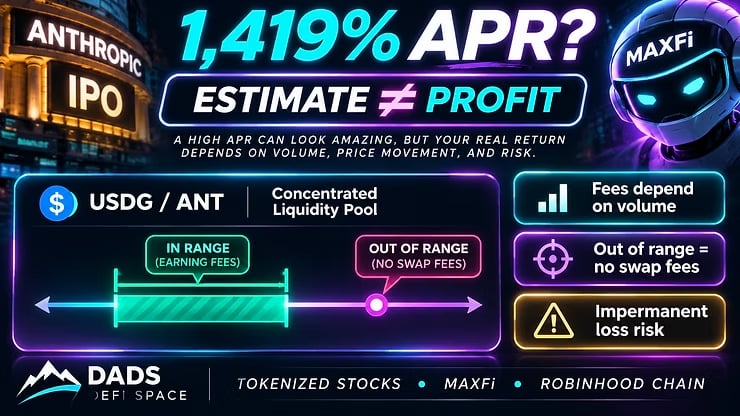
For my position, this difference mattered because I was considering a concentrated liquidity strategy.
I didn't want to blindly swap into ANT at whatever price the market happened to offer.
Instead, I wanted to explore whether a single-sided USDG position could give me a more deliberate entry.
And if the setup didn't develop the way I expected, I could reassess rather than force it.
This is where the numbers got pretty wild.
I pulled up the USDG/ANT pool on MAXFi and started examining the Agent Max estimates.
The 1% fee-tier pool was displaying approximately:
633% estimated APR for a wider, more conservative range.
1,419% estimated APR toward the more aggressive configurations.
Those are enormous numbers.
But I want to emphasize something.
Those figures were estimates displayed during my recording, not returns I had actually earned.
I think a lot of DeFi investors get into trouble because they look at an APR number without understanding what's creating it.
The math behind concentrated liquidity can produce extraordinary annualized estimates when trading activity is high relative to available liquidity.
Imagine a newly launched stock attracting significant attention.
Trading volume increases.
Liquidity providers collect fees.
But there may not be much active liquidity available yet.
If a dashboard takes the recent fee activity and annualizes it, the result can look incredible.
The problem is that the conditions creating those returns can change very quickly.
More liquidity enters.
Trading activity slows.
Price moves outside the active range.
And suddenly that enormous APR doesn't mean very much.
That's why I've always emphasized that APR alone isn't the strategy.
The pair matters.
The range matters.
The rebalancing settings matter.
And most importantly, your actual net return matters.
You can collect a lot of fees and still lose money.
I've seen that firsthand with other liquidity positions.
So rather than treating the 1,419% number as an opportunity to get rich, I treated it as a reason to investigate further.
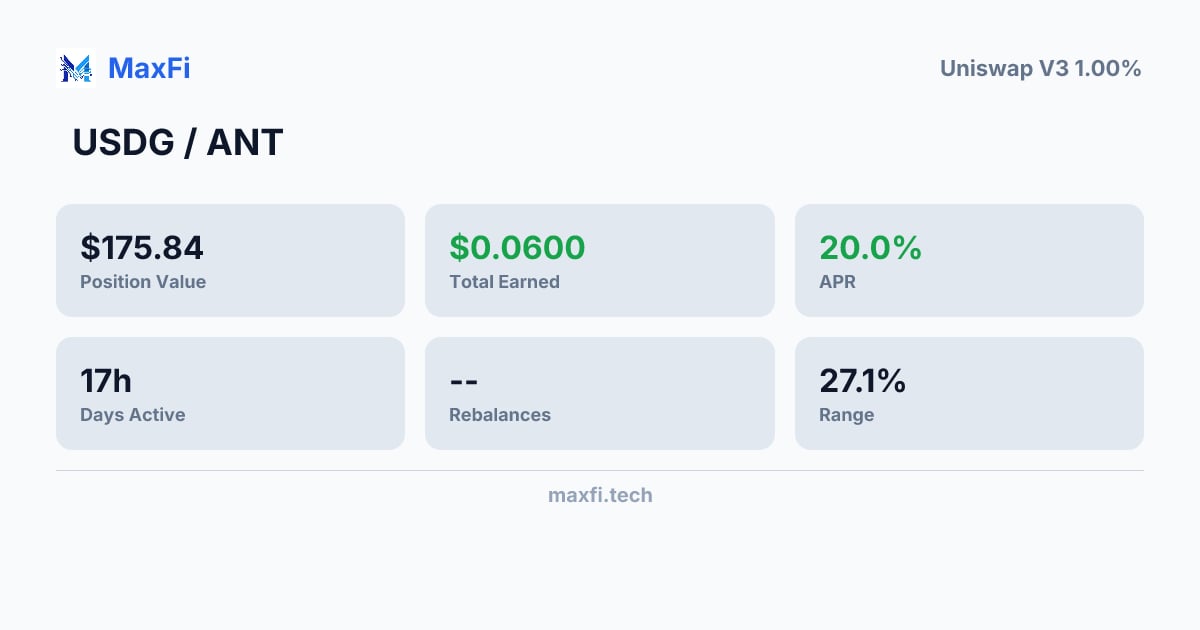
I could have allocated more capital to this experiment.
But I didn't see a reason to.
This was a new tokenized asset associated with a major IPO, an uncertain pricing relationship, and potentially volatile trading activity.
I wanted exposure to the mechanics without committing a significant amount of capital to an unproven setup.
So I decided on a small position.
Here's what I established during the video:
Setting | My Position |
|---|---|
Platform | MAXFi |
Blockchain | Robinhood Chain |
Pair | USDG/ANT |
Deposit | $114 USDG |
Entry | Single-sided |
Fee tier | 1% |
Liquidity range | Approximately 35% wide |
Rebalance-delay setting | 24 hours |
Management plan | Manual monitoring |
Initial condition | Out of range |
The approximately 35% range was a little wider than the aggressive range displayed by Agent Max.
I wanted to give the position some flexibility.
At the same time, I wasn't trying to create a huge range that diluted the potential fee-generating concentration of my capital.
This was a compromise based on the market conditions I was observing.
Whether it proves to be a good compromise is something we'll find out from the actual results.
The price difference between the traditional stock and the tokenized pool was one reason.
I wasn't particularly interested in immediately converting half of my deposit into ANT.
Instead, I wanted to position USDG in a range where market movement could potentially bring the liquidity position into activity and change my asset composition.
Depending on how the price moves through the range, the position can gradually acquire ANT.
Of course, that also means I could end up owning more of an asset while its price is falling.
That's a risk, not a bonus.
But with a small allocation and a defined plan, it was something I wanted to explore.
And after confirming the transaction, the position was successfully established.
There was just one catch.
It wasn't earning any fees yet.
It was initially out of range.
That is probably the most useful part of this entire experiment.
The dashboard was showing extraordinary APR estimates.
Meanwhile, my actual position wasn't generating trading fees.
That's DeFi in a nutshell.
The advertised opportunity and your actual result can be two completely different things.
One of the reasons I've continued using MAXFi is the broader liquidity-management infrastructure.
MAXFi integrates with SnuggleFi's no-swap rebalancing approach, which I've discussed in previous videos and portfolio updates.
The general idea is to manage certain liquidity repositioning scenarios without relying on conventional token swaps every time the position needs adjustment.
That can potentially reduce trading friction, slippage, and swap-related costs in suitable situations.
But it doesn't make liquidity farming risk-free.
And I think that's important to repeat.
Automation doesn't eliminate impermanent loss.
It doesn't guarantee that your range will remain profitable.
It doesn't mean your LP will outperform simply holding the underlying tokens.
And it certainly doesn't mean every position should be left running indefinitely.
For this particular ANT position, I'm being more hands-on because I want to observe what happens around the early trading sessions.
The larger point is that good liquidity management is about understanding the relationship between your assets, the market, and the strategy.
It's not about turning on automation and forgetting that risk exists.
This is something I've gotten better about over time.
When I open a position, I want to know what would make me reconsider it.
Not every trade needs to become a long-term conviction.
Not every LP needs to run for months.
Sometimes a position is simply a short-term experiment.
For USDG/ANT, I laid out a straightforward plan during the recording.
I wanted to observe the position over approximately the next 24 hours and see whether the price moved into my selected range.
If that happened, I'd begin tracking the actual fees.
If the position remained outside its range or the pricing conditions didn't improve, I would consider withdrawing and reassessing.
Another possibility would be adjusting the allocation toward a more conventional mix of the two assets.
But I wasn't committed to doing that.
And I'm still not interested in forcing a setup just because I initially thought it looked promising.
The market doesn't care about my original plan.
If the information changes, the decision should change with it.
When I revisit this position, I'm interested in more than the displayed APR.
I want to know how much fee income was actually generated, how the token balances changed, and whether the position gained or lost value.
I also want to compare the result against simply holding the assets.
That last comparison is particularly important.
A liquidity provider can collect fees while gradually changing their exposure to the underlying assets.
During a strong upward move, the strategy may sell some of the appreciating asset.
During a decline, it may accumulate more of the falling asset.
That's part of how concentrated liquidity works.
And that creates a completely different experience than simply buying ANT and holding it.
If the LP earns fees but underperforms a reasonable holding benchmark, I want to understand why.
If it performs well, I want to understand what conditions made that possible.
Either outcome is useful information.
One thing I've been thinking about lately is how easily we mix together different investment ideas.
Anthropic might be a fantastic company.
Artificial intelligence might continue transforming entire industries.
Tokenized financial markets might become a major part of blockchain adoption.
And MAXFi might offer useful infrastructure for managing liquidity across those markets.
All of those things can potentially be true.
But none of them automatically means that buying ANT at a particular price is a good decision.
And none of them guarantees that a USDG/ANT liquidity position will be profitable.
I think investors sometimes underestimate how important that distinction is.
We get excited about a narrative.
Then we become excited about an asset.
Then we find an APR or yield opportunity connected to that asset.
And before we know it, we're treating three separate decisions as though they're all part of the same investment thesis.
They're not.
The business thesis, the asset valuation, and the liquidity strategy need to stand on their own.
That's why I'm comfortable experimenting with relatively small allocations while keeping a much larger focus on protecting capital and managing my overall portfolio.
I'm not trying to win every opportunity.
I'm trying to become a better operator.
I've spent a lot of time exploring concentrated liquidity pools across Base and Robinhood Chain.
Some positions have performed extremely well.
Others have reminded me why risk management matters more than the headline numbers.
And the longer I do this, the more interested I become in the actual mechanics of generating yield.
Where is the trading volume coming from?
How much liquidity is competing for those fees?
How correlated are the assets?
How much divergence can the strategy tolerate?
What happens when the market moves sharply?
And perhaps most importantly, how much capital should I allocate when I don't know the answers yet?
That's the part of DeFi I enjoy researching.
We're watching financial markets develop new infrastructure in real time.
There are going to be opportunities.
There are also going to be plenty of mistakes.
I expect to make some of my own.
But I want those mistakes to be measured, documented, and useful.
The purpose of DADS DeFi Space has never been to pretend I know exactly what the market will do next.
It's to share what I'm researching, what I'm testing, what works, and what doesn't.
That includes positions like this one.
The position is established, but the results are still an open question.
The next meaningful update should answer whether the pool entered its active range, what fees were actually earned, how the token balances changed, and whether the position justified the capital committed to it.
I also want to keep watching how the tokenized ANT market behaves relative to the traditional stock.
If that relationship becomes more stable, it could change how I think about future liquidity positions.
If the divergence persists or the pool fails to generate meaningful fees, that's useful information too.
I don't need to manufacture a success story.
The $114 is there to help me learn how a new market behaves.
And if the results justify further research, I'll continue documenting it.
I think we're going to see more experimentation at the intersection of traditional finance and decentralized liquidity.
Tokenized equities are particularly interesting because they connect two financial worlds that have historically operated through very different infrastructure.
But we're still early in understanding how these products perform across different market conditions.
High APRs will attract attention.
Sometimes that attention will be justified.
Sometimes it won't.
For me, the goal is to understand the difference.
A great company, a great trade, and a great liquidity pool are not always the same thing.
That's the lesson I'm taking from Anthropic's IPO.
And it's something I'll continue testing with this MAXFi position.
Process over prediction. Survive first, compound second.
If you enjoy following real DeFi experiments and portfolio decisions, I share more frequent updates in the free DADS DeFi Space Telegram community.
That's where I document what I'm watching, why I'm making adjustments, and what I'm learning between longer videos and research articles.
If you'd like to explore the platform I'm using for this experiment, here's my MAXFi referral link.
You can also find my educational articles and DeFi resources at DADSDeFiSpace.org.
I'd also be interested to hear how others are approaching tokenized equities.
Would you rather buy and hold Anthropic stock, or explore liquidity farming with tokenized exposure?
And if you're already farming tokenized equities, what has surprised you the most?
Disclaimer: This article is for educational and informational purposes only and is not financial advice. Crypto, tokenized securities, and DeFi liquidity pools carry substantial risk, including loss of capital. APR estimates are variable and do not guarantee returns. I personally use MAXFi, and the referral link above may help support DADS DeFi Space at no extra cost to you. Always conduct your own research and make decisions based on your financial situation and risk tolerance.