
The Operator Journal | DADS DeFi Space | November 27, 2026
By Kevin — DADS DeFi Space
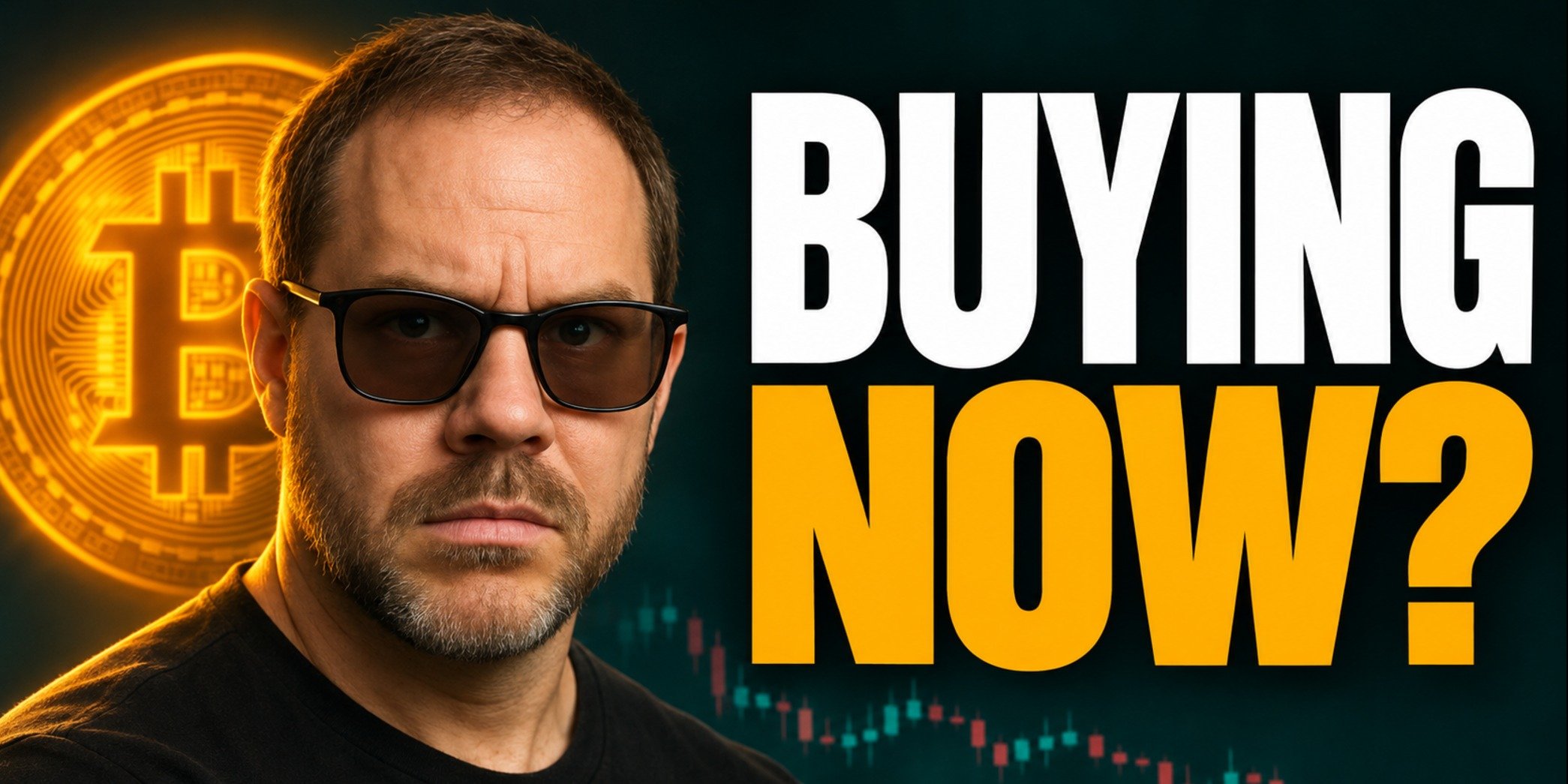
I've started buying crypto again.
And before anyone asks, no, I don't think we've necessarily found the bottom.
Actually, I think there's a reasonable chance we see more downside before this market finds its footing.
Bitcoin is still struggling. Altcoins have been beaten down. Sentiment has taken a hit, and there are plenty of reasons to remain cautious.
Yet here I am, slowly accumulating.
Does that sound contradictory?
Maybe a little.
But after spending years investing, trading, farming liquidity pools, and making my fair share of mistakes, I've learned something important:
You don't have to predict the bottom to begin building a position. You do need a plan for what happens if you're wrong.
That's what I've been thinking about lately.
And this week's Operator Journal is about more than the assets I'm buying. It's about how I'm approaching risk, what I'm changing in my portfolios, and why I'm trying to make investing fit into my life instead of allowing it to consume everything around me.
The other morning, I was scrolling through X when someone shared a piece of piano music.
Nothing particularly unusual about that.
But I stopped and listened.
Within a short period, I noticed myself relaxing. My heart rate seemed to drop, and for a moment I wasn't thinking about Bitcoin, market structure, DeFi positions, or the next project I needed to finish.
I was just listening.
And then I started thinking about my son.
He used to play the piano around the house quite a bit. He practiced, worked on different pieces, and filled the house with music.
He hasn't been playing nearly as much lately.
If you're reading this, son, keep playing. I miss hearing it.
Anyway, that little moment reminded me of something I occasionally struggle with.
I love researching cryptocurrency.
I love teaching people about DeFi.
I genuinely enjoy building DADS DeFi Space, recording videos, researching protocols, and experimenting with new opportunities.
But sometimes I have trouble turning it all off.
There is always another chart to analyze, another position to review, another article to write, or another project that needs attention.
And if I'm not careful, that work follows me home.
I don't want every red or green candle affecting how I spend time with my children.
I want my investments to improve my family's future, not steal my attention from the family I already have.
That thought has been influencing how I'm managing my portfolio.
Because if your positions are so large that you can't sleep, or so complicated that you can't put your phone down, you may have created a bigger problem than the market itself.
One thing I want to make clear is that my recent purchases don't represent some dramatic change in my market outlook.
I'm not calling the bottom.
I'm not convinced the broader downtrend has ended.
And I'm certainly not suggesting that everyone should rush out and buy altcoins because they're cheaper than they were a few months ago.
I'm approaching this from a different perspective.
At current prices, am I comfortable slowly increasing exposure to assets I've already researched and want to own over a longer period?
That's a much better question for me.
There are tokens I want to accumulate.
There are positions I'm comfortable holding.
There are assets I'm considering reducing.
And there are plenty of projects on my watchlist that I'm not ready to buy.
A falling price doesn't automatically create an opportunity.
Sometimes an asset is cheaper because the entire market is struggling.
Other times, the underlying investment thesis is deteriorating.
Those are two very different situations.
I've made enough mistakes over the years to understand that distinction.
Just because I already own something doesn't mean I should continue buying it.
Conviction should come from research, not from wanting to recover a loss.
One of my biggest weaknesses as an investor has always been patience.
I can spend hours researching something, become convinced there's an opportunity, and immediately want to build the position.
Crypto has a wonderful way of punishing that behavior.
So I've been trying to approach accumulation more deliberately.
For example, imagine I wanted to allocate $500 toward a smaller Robinhood Chain token.
Instead of committing the entire $500 immediately, I might begin with $100.
That leaves another $400 available.
If the price moves lower and my investment thesis remains intact, I can consider adding.
Maybe I add another $100 after a meaningful decline.
Maybe I wait for another technical level.
Maybe the asset starts recovering and I never deploy the full amount.
That's okay.
The goal isn't to spend the entire allocation. The goal is to make good decisions with the capital available.
Of course, spreading out purchases doesn't guarantee a better entry.
If the price immediately rallies, a larger initial purchase would have performed better.
But if the market continues falling, smaller purchases give me flexibility.
More importantly, they keep me from turning one emotional afternoon into a much larger position than I originally intended.
Here's the question I've been asking myself before adding:
If this asset falls another 20–30%, am I still comfortable with the amount of money I've committed?
If the answer is no, I'm probably taking too much risk.
And if that money is needed for family expenses, bills, or other responsibilities, it shouldn't be sitting in a speculative crypto position in the first place.
I recently spent some time reviewing my portfolio through CoinStats.
And this brings up another important lesson about managing cryptocurrency across different networks and protocols.
Your portfolio tracker doesn't always tell the complete story.
For example, I have Bitcoin exposure through lending positions that isn't fully reflected in my CoinStats allocation.
I also have a meaningful Solana position on Kamino that doesn't show up properly in the breakdown.
When I look at the dashboard, I have to mentally account for those assets.
That's not ideal.
And it's something I want to improve as I continue rebuilding my portfolio-tracking systems.
Based on my review, roughly 55–60% of the crypto portfolio exposure I was discussing was allocated toward Bitcoin and Ethereum.
That's a significant portion.
Yet I still find myself questioning whether I should have a little more exposure to those core assets.
I also know I should have taken more profits during the previous market rally.
We took some.
Just not as much as I probably should have.
That's part of investing.
You make decisions with the information available, review the results, and hopefully improve before the next opportunity comes around.
I'm not interested in pretending every decision was perfect.
I'm much more interested in learning from the ones that weren't.
It's what I already own.
Before increasing exposure to a token, I need to understand how that purchase affects the entire portfolio.
I can love a project and still have too much invested in it.
I can discover an interesting new protocol and decide I haven't done enough research to justify owning it.
And I can watch an asset rally without participating.
You don't owe your watchlist a purchase.
That's a lesson worth remembering.
One of the biggest changes in my recent portfolio management has been thinking more carefully about the purpose of each position.
I've spent considerable time farming liquidity pools across Base, Robinhood Chain, and other ecosystems.
I still believe LPs can be useful.
But I'm becoming increasingly focused on the difference between accumulating tokens and generating trading fees.
When I buy an asset directly, I receive straightforward directional exposure.
If I buy ETH and ETH appreciates, my position participates in that move.
With a liquidity pool, things become more complicated.
The amounts of each token I hold can change as relative prices move.
I might collect trading fees while gradually increasing exposure to one asset and decreasing exposure to another.
That can be useful.
But it can also produce a result that underperforms simply holding the original assets.
And that's why I'm spending more time comparing the actual outcomes.
One of the positions I've been monitoring on MAXFi is WETH paired with Coinbase-wrapped Bitcoin.
In the portfolio snapshot discussed in my video, that position had been operating for approximately 64 days with seven rebalances and a roughly 55-hour rebalance delay.
It had collected about $12.79 in fees denominated in Bitcoin and Ethereum.
Those numbers weren't especially dramatic.
But that's not necessarily the point.
My objective with that position is to gradually accumulate exposure to assets I already want to own.
I'm considering whether adjusting the range could allow for greater participation in potential price appreciation.
But making the range wider also changes the strategy's fee-generation characteristics.
That's the trade-off.
And it deserves more attention than simply looking at whichever pool has the highest APR.
Another position I've been watching closely involves WETH and Venice AI's VVV token.
The snapshot I discussed showed a roughly 22% range, a seven-hour rebalance setting, and a displayed annualized earning rate near 175%.
That's an eye-catching number.
But it isn't a guaranteed annual return, and it certainly doesn't tell me whether the position is outperforming a simple hold strategy.
VVV can experience dramatic moves in both directions.
The risk is very real.
What interests me is whether the LP structure is helping me accumulate the token and ETH over time.
That means monitoring the token balances, fees, range behavior, and total position value.
Not just the advertised APR.
I'm also applying this thinking to ETH/TAO positions.
The broader lesson is pretty simple:
APR is not the strategy. The pair, the range, the rebalance settings, and the assets you ultimately accumulate are the strategy.
And even then, I have to compare the outcome against simply buying and holding.
I've been getting questions about which assets I'm actually buying, so here's a look inside my thinking.
This isn't a recommendation list.
It's a snapshot of what I'm personally researching, holding, accumulating, or monitoring.
These remain central to my longer-term crypto exposure.
I generally prefer having larger allocations to established assets before increasing exposure to more speculative opportunities.
That doesn't eliminate downside risk.
But it helps me think about the portfolio in terms of core holdings versus experiments.
TAO continues to be one of the assets I'm particularly interested in accumulating.
I'm also exploring exposure to individual Bittensor subnets.
That requires a different level of research because subnet exposure isn't necessarily identical to holding TAO directly.
I'm interested in how these different pieces of the ecosystem develop.
VVV is another asset I'm following closely, especially through my Base liquidity positions.
Both offer interesting technology narratives, but their price volatility and ecosystem risks require attention.
This has become one of my favorite areas to research.
I'm following and holding smaller positions across parts of the Robinhood Chain ecosystem, including assets such as HOOKR, Bundle Cat, ZZ, and BONER.
Some of these positions are speculative.
Others are connected to ecosystems, liquidity infrastructure, or creator communities I'm interested in learning more about.
I also have exposure to projects such as UP and PONS, although I'm not aggressively accumulating every token I own.
That's an important distinction.
There are assets I want more of.
There are assets I'm simply monitoring.
And there are projects where I want to see more evidence before committing additional capital.
I'm also accumulating tokenized equity exposure.
Some of the assets I've been discussing include QQQ, Nvidia, Palantir, Apple, and Google.
I have exposure through both Robinhood Chain and Base-related markets.
What interests me is the intersection between traditional investments and onchain financial infrastructure.
The ability to interact with equity-linked assets through DeFi opens interesting possibilities for liquidity, lending, and portfolio construction.
But tokenized equities also introduce additional considerations involving issuers, backing, liquidity, pricing, and counterparty arrangements.
They're not automatically identical to holding traditional brokerage shares.
That's something investors need to understand.
There are smaller allocations and ongoing experiments scattered throughout the portfolio.
These include NAMI, an OGNAMI seed-round allocation, Agent Max seed exposure, some Zora creator tokens, and other ecosystem holdings.
I've also received the Midnight airdrop and continue watching assets such as ONDO and VIRTUAL without necessarily adding to them.
Not every position deserves the same attention.
And not every asset deserves fresh capital.
Part of improving as an investor is learning when to stop adding.
This is probably the most important part of the entire journal.
Because it's easy to create an accumulation plan.
It's much harder to decide when that plan no longer makes sense.
Here are three situations that would cause me to reconsider.
If I'm buying a token because I believe in a particular technology, business model, or ecosystem, I need to reconsider that decision when the evidence changes.
Maybe the protocol suffers a security incident.
Maybe user activity deteriorates.
Maybe the token isn't capturing the economic value I originally expected.
Or perhaps the team changes direction in a way that undermines my investment thesis.
A cheaper price doesn't automatically fix those problems.
Sometimes the right decision is to admit that the original reasoning no longer holds up.
Even if I remain bullish on a project, there's a point where I can own enough.
I don't need every position to grow indefinitely.
Concentration risk matters.
And with smaller tokens, thin liquidity can make exiting a large position difficult.
Sometimes protecting the rest of the portfolio is more important than maximizing exposure to one investment idea.
This one is straightforward.
My family comes first.
If unexpected expenses arise, my responsibilities change, or I need additional liquidity, that takes priority over buying cryptocurrency.
There will always be another setup.
Another token.
Another opportunity.
I don't have to participate in every one.
And there's a fourth warning sign that deserves mentioning.
If I catch myself buying because I'm desperate to recover previous losses, it's time to reconsider my motivation.
That's not patient accumulation.
That's emotion taking control of the portfolio.
I've learned enough expensive lessons to recognize the difference.
Although I'm beginning to accumulate again, I'm not ignoring the broader market.
In my recent chart review, I was watching Bitcoin around the $63,000–$64,000 area after a move toward approximately $62,000.
These were levels from that chart review, not live price quotes.
The 200-week moving average was one of my major reference points.
I was also watching the higher weekly moving averages and whether Bitcoin could recover important areas of resistance.
Momentum indicators, including RSI and Stochastic RSI, had reached depressed readings.
That can create conditions for a relief rally.
But an oversold market can remain weak.
And a bounce doesn't automatically mean the broader trend has reversed.
I was also considering the possibility of another move toward the $58,000 area if support failed.
Could Bitcoin go even lower?
Absolutely.
Could we see a stronger recovery before then?
Also possible.
That's why I don't want my entire portfolio strategy depending on one forecast.
The questions I'm currently using to evaluate this market are:
Can Bitcoin reclaim and hold important weekly trend levels?
Are rallies beginning to establish stronger market structure, or are they still producing lower highs?
Is weakness spreading across altcoins, or are some sectors beginning to show relative strength?
Are the assets I'm accumulating maintaining meaningful network activity and utility?
Would I be comfortable with my current exposure if the market experienced another major decline?
I'm not looking for perfect certainty.
I'm looking for enough evidence to make decisions I can live with.
One of the reasons I started writing these Operator Journals was to document the process behind the decisions.
Not just the results.
DADS DeFi Space has grown into much more than me occasionally recording a cryptocurrency video.
I'm building educational resources, researching protocols, maintaining several DeFi portfolios, working on courses, exploring AI tools, and documenting experiments across different ecosystems.
And the more I build, the more I realize how important having a repeatable process becomes.
I'm working toward improving my portfolio-tracking systems so I can better understand asset allocations across wallets, lending markets, and liquidity pools.
I want to make it easier to compare LP performance against holding the underlying tokens.
I also want to continue developing lessons that explain these strategies without making everything sound unnecessarily complicated.
Because people shouldn't need a finance degree to understand what happens when they deposit two tokens into a liquidity pool.
But they do need to understand the risks.
That's the bigger purpose of DADS DeFi Space.
I'm not building a platform to tell people exactly what to buy.
I'm building a place where we can research, test, learn, make mistakes, and hopefully become better investors over time.
Here's where I've landed.
I'm comfortable beginning to accumulate selected assets.
I'm also comfortable admitting that we could experience more downside.
Those two positions aren't mutually exclusive.
I don't need to make one enormous prediction about where Bitcoin will trade next month.
I need to understand my own exposure, maintain enough flexibility to adjust, and avoid creating positions I can't emotionally or financially manage.
I need to take profits when opportunities arise.
I need to review investments when the underlying evidence changes.
And I need to remember that protecting capital is part of building wealth.
But most importantly, I need to remember why I'm doing all this in the first place.
I want to build something meaningful.
I want to become a better investor.
I want to help other people understand this complicated and sometimes ridiculous DeFi ecosystem.
And I want to be able to close the laptop, put down my phone, and spend an evening with my family without worrying about every market movement.
That little piano moment earlier in the week reminded me of something the charts never will.
A successful portfolio should give you more freedom to enjoy your life, not make you feel chained to the market.
I'm still working on that.
And I suspect a few of you are, too.
I'd love to know how everyone else is approaching this part of the market.
Are you slowly accumulating Bitcoin and altcoins?
Are you waiting for more confirmation that a bottom is forming?
Or are you focused on managing the positions you already own?
I'm particularly interested in hearing how other DeFi investors are balancing spot accumulation with liquidity pools.
If you want to follow my thinking between longer articles and videos, that's what our free Telegram community is for.
📢 Join the DADS DeFi Space Telegram Community
You can also follow the educational articles, research, and ongoing projects I'm building at DADSDeFiSpace.org.
And if you'd rather watch the original video that inspired this journal:
🎥 I'm Buying Crypto Again—But I'm Not Calling the Bottom
Thanks for following along with the journey.
Process over prediction. Survive first, compound second.
And seriously, go touch some grass.
Peace. ✌
— Kevin | DADS DeFi Space
This article is for educational and informational purposes only and is not financial advice. I personally hold or have exposure to several assets, projects, and protocols discussed. Cryptocurrency, DeFi, liquidity pools, lending, tokenized assets, and early-stage tokens involve significant risk, including the possibility of losing your entire investment. Portfolio figures and market levels reflect historical observations rather than live prices or guaranteed results. Always conduct your own research and consider your financial circumstances and risk tolerance. Some resource links may be affiliate or referral links that support DADS DeFi Space at no additional cost to you.