
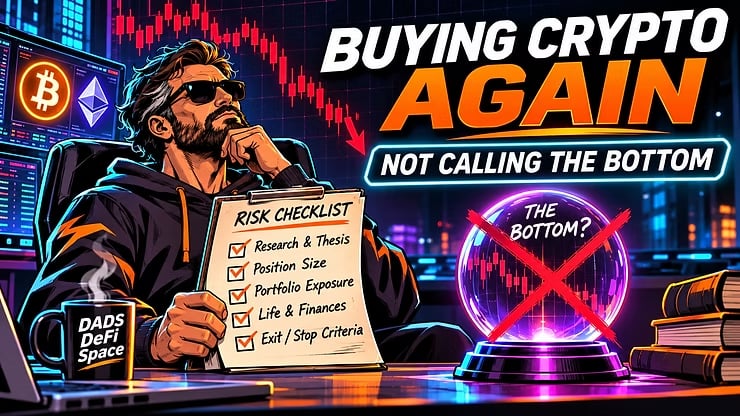
I've started buying crypto again.
And before anyone gets too excited, I'm not calling the bottom.
In fact, I still think there's a reasonable chance that Bitcoin and the broader crypto market could move lower before we see a meaningful recovery.
So why am I buying?
Because after spending years investing, trading, and farming liquidity pools, I've learned something important:
You don't have to predict the bottom to begin building a position. But you absolutely need a plan for what happens if you're wrong.
That's what I've been thinking about lately, and I want to share how I'm approaching it.
Not just what I'm buying, but why, how I'm managing exposure, and what would make me stop accumulating altogether.
Something happened recently that reminded me why I invest in the first place.
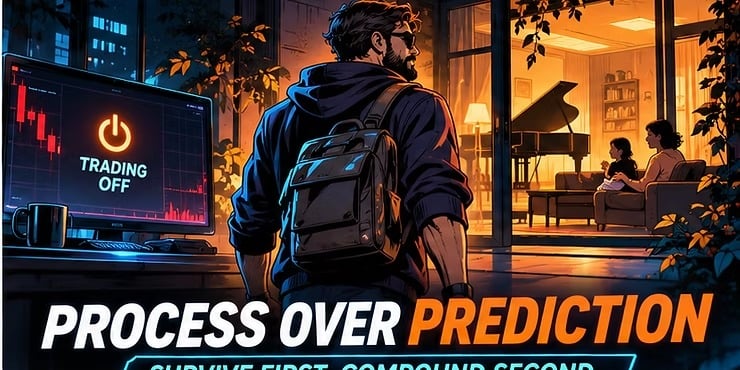
I was scrolling through X one morning when I came across someone sharing a beautiful piece of piano music.
I stopped and listened.
It reminded me of my son.
He used to spend quite a bit of time practicing piano at home, and this was one of the pieces he played.
I even mentioned it in my latest video. If he's watching, I hope he keeps playing.
It's funny how a simple piece of music can interrupt your morning and make you think about what's important.
I love researching crypto. I genuinely enjoy building DADS DeFi Space, managing liquidity pools, studying markets, and exploring emerging technology.
But I don't want every red and green candle following me home.
And I'll admit, I'm not always very good at putting the work down.
I've spent plenty of evenings staring at charts when I probably should have closed the laptop.
That's something I'm trying to improve.
Because what's the point of building wealth if the process consumes all your time and attention?
Anyway, let's talk about these markets.
I think people sometimes confuse buying an asset with making a bullish market prediction.
Those are two different things.
I can believe in Bitcoin over the long term and still expect a correction.
I can like Ethereum at current valuations without expecting it to rally tomorrow.
I can research an altcoin for months, finally establish a small position, and still believe there's a chance I'll get a better entry later.
That's the situation I'm in right now.
I'm watching technical indicators, moving averages, market structure, and how different sectors are holding up.
During my video, Bitcoin was showing significant weakness around its long-term moving averages.
The 200-week moving average was particularly important to my analysis.
Those specific chart levels change over time, so I'm not going to turn this article into a permanent price prediction.
But the larger point remains relevant:
I don't need to become bullish on the entire market to selectively accumulate assets I've already researched.
And I certainly don't need to buy everything on my watchlist.
CHECK US OUT ON ZORA and the $DADSDEFISPACE COIN
DADS DEFI SPACE - DAD ENERGY. ONCHAIN.
DADS DEFI SPACE is a Base creator token on Zora. Meet the builder, explore the plan, join the community, or buy on Zora and Uniswap.
I've made plenty of mistakes in crypto.
One of them has been impatience.
I'll research an asset, develop conviction, see a price I like, and suddenly feel that I need to establish my entire position.
Sometimes that's worked.
Other times, I've watched the asset fall considerably further.
So I'm trying to become more deliberate about how I deploy capital.
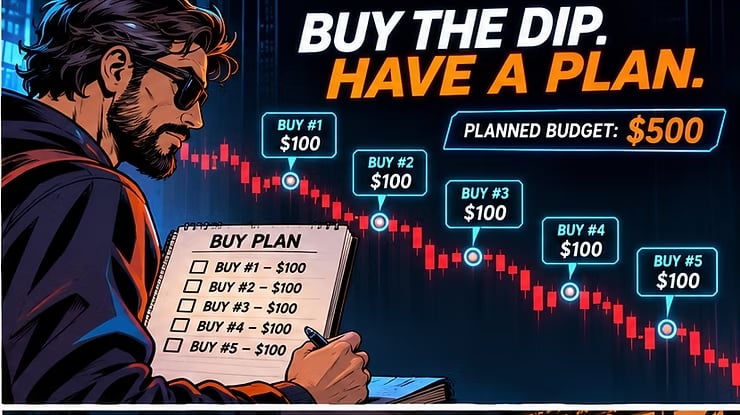
Let's say I decide that I want to allocate $500 to a cryptocurrency.
I don't necessarily need to invest all $500 immediately.
Maybe I start with $100.
If the price falls another 10%, and the investment thesis is still intact, I might consider another purchase.
If it falls further, I can reassess again.
The remaining capital gives me options.
Now, this doesn't guarantee a better average entry.
If the asset immediately doubles, buying the whole position at once would have been more profitable.
But that's not the only outcome I'm trying to optimize.
I'm trying to avoid turning one emotional decision into a position that's larger than I intended.
And here's something I've been asking myself before making another purchase:
If this asset falls another 20–30%, am I still comfortable with the amount of money I have committed?
If the answer is no, maybe I need to rethink the position size.
I shouldn't be using money needed for the mortgage, family expenses, or other financial priorities.
That might sound obvious, but markets have a way of making people forget the obvious.
Especially when everyone on social media is convinced they're buying a generational opportunity.
Another thing I've been working on is getting a clearer picture of everything I actually own.
I use CoinStats to track much of my portfolio, but it doesn't always capture everything.
Some assets are deployed into lending protocols.
Others are held across different blockchains.
Some are in concentrated liquidity pools where the underlying token balances constantly change.
For example, I have Solana exposure through Kamino that wasn't properly reflected in the portfolio allocation shown during my recording.
I also have Bitcoin exposure in lending positions.
So when I looked at the portfolio, I estimated that approximately 55–60% of my crypto exposure was in Bitcoin and Ethereum.
That's a snapshot estimate from the video rather than a fully reconciled accounting.
But the important lesson is that your portfolio tracker isn't necessarily telling you the whole story.
Before adding another altcoin, I want to understand my exposure across all my accounts.
How much BTC do I really own?
How much ETH?
How much capital is deployed into lending?
How much is tied up in LPs?
And how much exposure do I have to smaller, more speculative tokens?
It's easy to convince yourself you're diversified when your assets are spread across ten protocols.
But spreading exposure across platforms doesn't automatically eliminate concentration risk.
Sometimes you're just exposing the same underlying assets to additional smart-contract and counterparty risks.
That's something worth remembering.
Anyone who's followed DADS DeFi Space for a while knows that I enjoy yield farming.
I've spent a considerable amount of time experimenting with concentrated liquidity, correlated pairs, automated rebalancing, and token accumulation strategies.
And I still believe liquidity pools can be useful.
But lately, I've been choosing to purchase certain assets directly rather than opening more LP positions.
Why?
Because I'm asking myself what I actually want each position to accomplish.
If I purchase ETH directly, I own that amount of ETH.
The value changes with the market, but simply holding it doesn't automatically change the number of tokens.
If ETH appreciates significantly, I retain that direct exposure.
With a two-asset concentrated liquidity pool, the position behaves differently.
As the relative prices move, the composition of my assets can change.
I may earn trading fees, but I also experience the effects of divergence loss and range management.
That matters when my objective is accumulating a particular token.
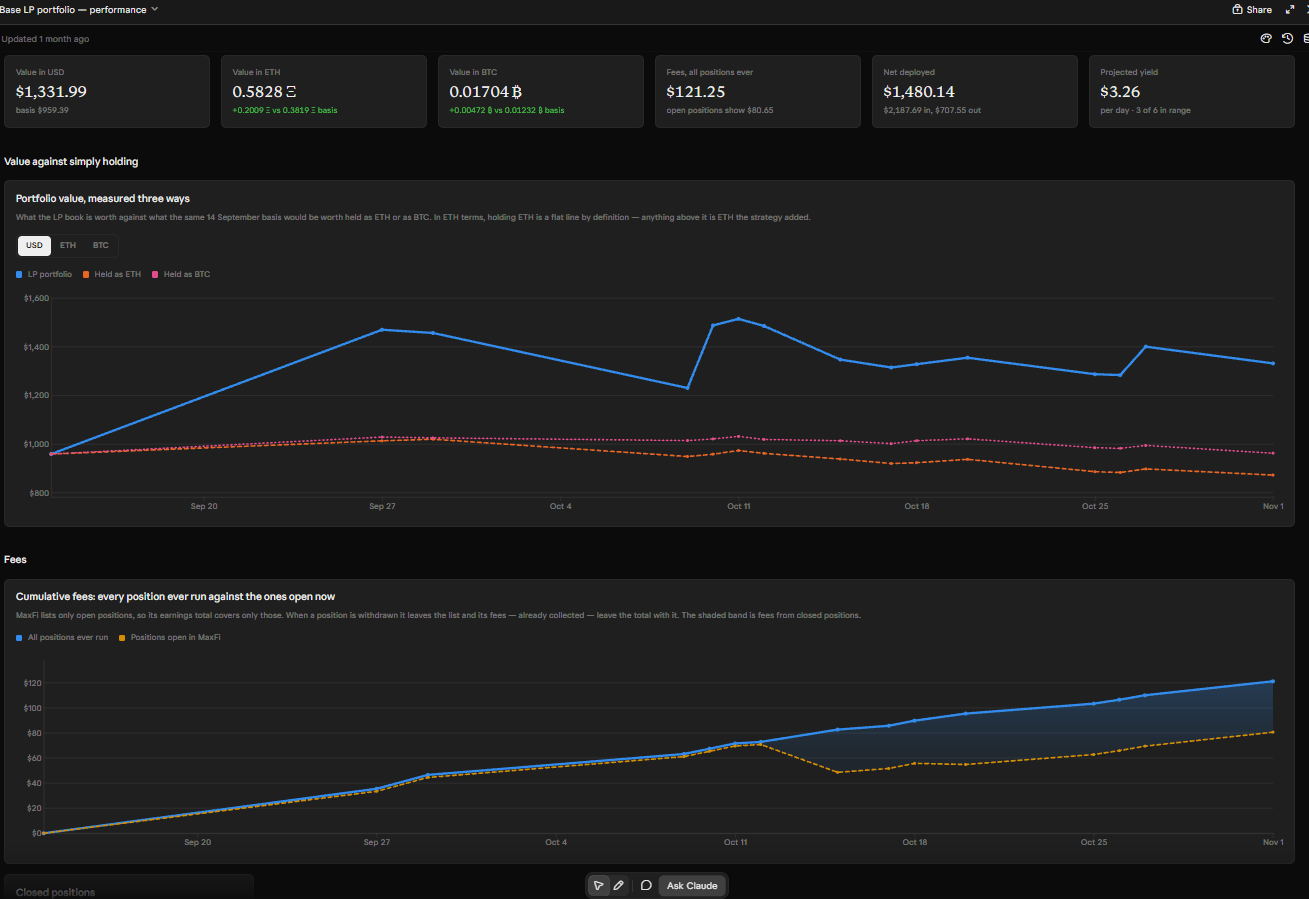
During the video, I reviewed a WETH/cbBTC position that had been running for approximately 64 days.
It had undergone seven rebalances, and the dashboard showed around $12.79 in collected fees at the time.
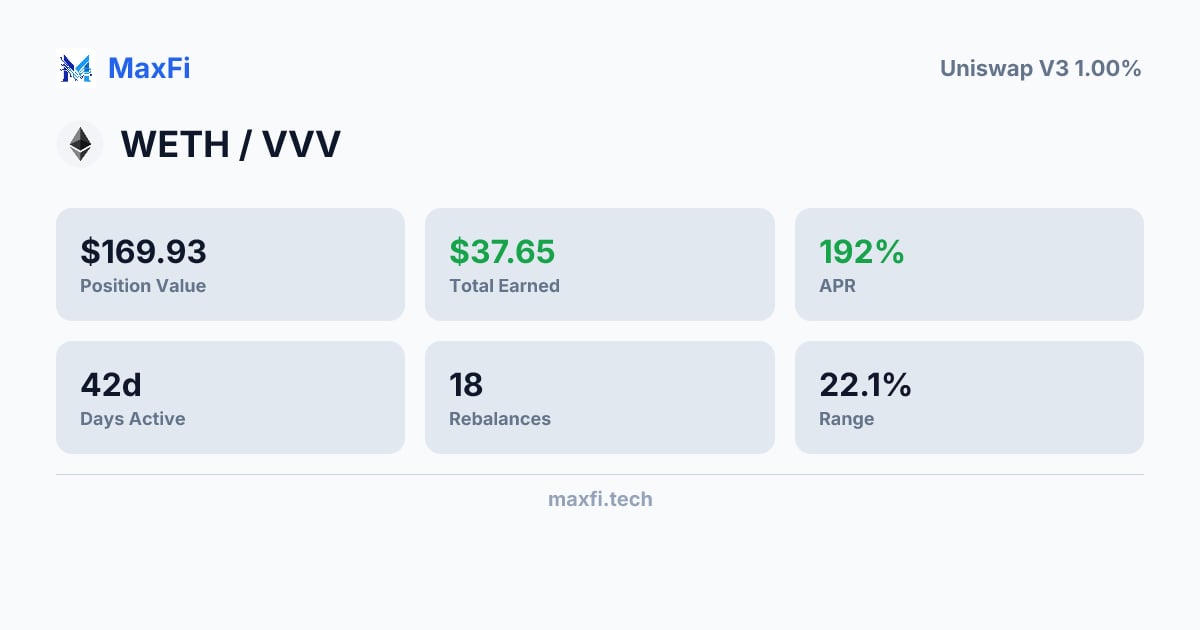
I also discussed my WETH/VVV position, which displayed a very high annualized APR during the recording.
But those displayed numbers aren't the most important part of the story.
What interests me is the total result.
Did the LP increase my token holdings?
Did the fees offset the losses or opportunity costs?
How did the position compare with simply holding the assets?
And was the additional management worth it?
The highest APR isn't necessarily the best investment.
Sometimes earning fees makes sense.
Other times, I'd rather own the asset directly and not worry about managing a range.
I'm increasingly comfortable using both strategies for different purposes.
My approach still starts with larger-cap crypto assets.
Bitcoin and Ethereum remain central to my holdings, with meaningful Solana exposure as well.
Beyond those, I'm selectively accumulating several projects I've spent time researching.
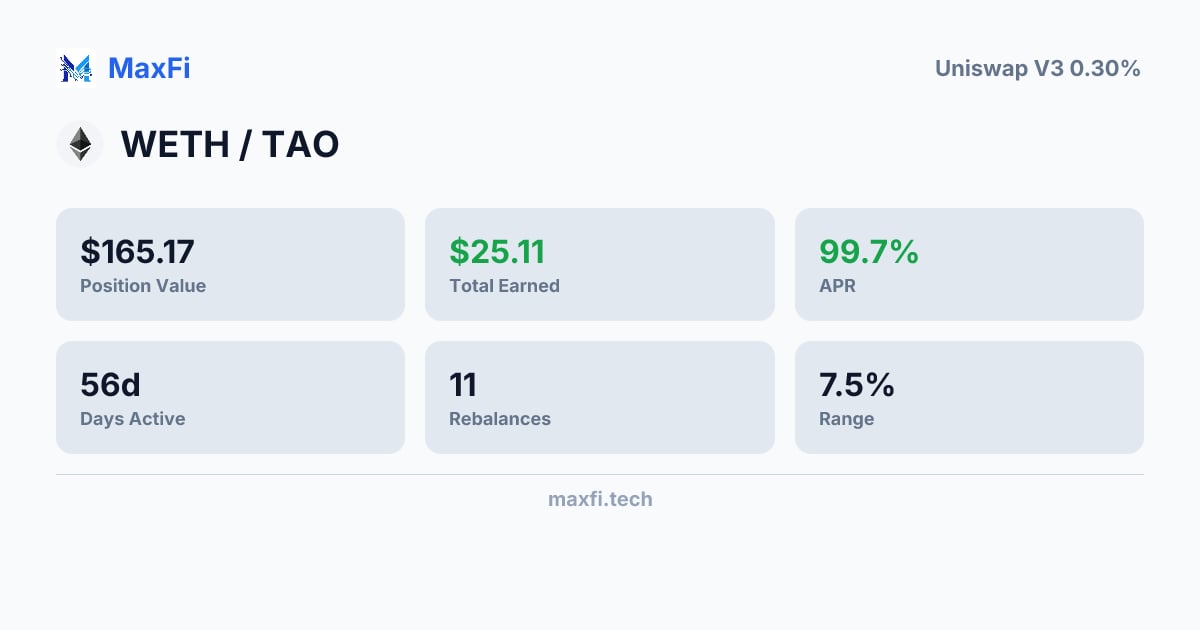
TRY MAXFI - with Snuggle.fi Zero-Swap Rebalacning Tech
TAO remains one of my stronger areas of interest.
I'm accumulating TAO itself and exploring selected Bittensor subnet exposure.
I think the ecosystem is worth continuing to research, but that doesn't mean every subnet is an attractive investment.
Subnet exposure introduces additional tokenomics, liquidity, performance, and execution risks.
This is an area where I want to keep learning rather than pretend I've figured everything out.
Venice's VVV token is another asset I've been watching and accumulating.
It's also one of the assets I've explored through liquidity pools.
VVV can move aggressively in both directions, and that volatility is an important part of the risk.
I like the project enough to continue researching it, but I'm not ignoring what could go wrong.
I've also been accumulating or holding several assets across Robinhood Chain.
Some of the projects discussed in the video include Bundlecat, HOOKR, BONER, and other community tokens.
These are considerably more speculative than Bitcoin or Ethereum.
I enjoy participating in emerging on-chain ecosystems, but I don't want anyone confusing that interest with a claim that these assets are appropriate for everyone.
Liquidity, token supply, developer execution, and community sustainability all matter.
A project can be interesting and still become a terrible investment.
Another area I'm spending more time on is tokenized stocks.
I've been building exposure to assets connected with QQQ, Nvidia, Palantir, and other equities through Robinhood Chain.
I've also explored Apple and Google exposure through Base.
This is one of the more interesting developments in DeFi to me because it connects traditional financial markets with on-chain strategies.
But there are additional risks.
Tokenized equity products aren't necessarily equivalent to directly owning shares through a brokerage.
Depending on the product, investors may face issuer, custody, redemption, oracle, liquidity, and regulatory risks.
I want to understand those mechanics before increasing exposure.
That research is part of what I'll continue documenting.
Here's where I think an accumulation strategy becomes much more useful.
It's easy to make a plan for buying.
The harder part is deciding what would make you stop.
For me, there are three main reasons.
If I purchase a token because I believe in the protocol's development, user adoption, or long-term utility, I need to keep evaluating those assumptions.
What if the team stops delivering?
What if user activity collapses?
What if a security problem develops?
What if the token doesn't capture the value I originally expected?
A cheaper price doesn't necessarily solve any of those problems.
Sometimes averaging down is just adding more money to a deteriorating investment.
I've learned that conviction needs to be supported by evidence.
Even if I still like a project, I might already own enough of it.
That's especially relevant when discussing smaller altcoins.
I don't need every high-conviction position to become an enormous percentage of my portfolio.
There is a point where additional exposure creates more risk than I'm comfortable taking.
Sometimes the right decision is to keep holding without adding.
This is probably the simplest reason, but it might be the most important.
Sometimes life takes priority.
Family expenses, financial obligations, or changes in income can make another crypto purchase inappropriate.
The market will still be here.
There will be more opportunities.
I don't need to stretch my finances just because an asset looks cheap.
And there's one more emotional warning I try to recognize.
If I'm buying because I feel like I need to recover a previous loss quickly, that's a sign I should reconsider what I'm doing.
I've made that mistake before.
A loss doesn't create a deadline to make the money back.
The next decision needs to make sense on its own.
As I continue accumulating, I'm trying to keep several questions in front of me.
Bitcoin market structure: Is BTC reclaiming important long-term moving averages, or is the broader trend continuing to deteriorate?
Altcoin performance: Are smaller assets showing genuine relative strength, or are brief rallies taking place inside a larger downtrend?
Portfolio allocation: Am I maintaining a sensible balance between major cryptocurrencies, speculative assets, and available capital?
Liquidity pools: Are my positions earning enough net fees to justify their range exposure, divergence loss, and management requirements?
Project fundamentals: Are the protocols I'm investing in developing real users, liquidity, and economic activity?
Personal capacity: Am I spending too much time managing strategies that don't meaningfully improve my portfolio?
I don't have perfect answers to all of those questions.
That's part of why I document this process.
My research notebook isn't supposed to make me look like I know everything.
It's supposed to help me make better decisions over time.
I want to return to that piano story for a moment.
Because I think it's connected to everything else I've been talking about.
I genuinely enjoy investing and researching crypto.
I like discovering projects, experimenting with new DeFi tools, and sharing what I'm learning through DADS DeFi Space.
But I also want to be present with my family.
I want to spend time with my children without wondering what happened to Bitcoin in the last fifteen minutes.
I want to be able to walk away from the screen.
A portfolio that demands constant attention can become exhausting.
And sometimes I need to remind myself that taking a break is part of managing risk, too.
That's another reason I'm trying to make my accumulation strategy simpler.
I don't need to buy every dip.
I don't need to farm every pool.
I don't need to participate in every new launch.
And I certainly don't need to be right about the bottom.
I need a process I can follow without allowing the market to take over everything else

.
Yes, I've started accumulating cryptocurrency again.
I could be early.
Prices could fall considerably further.
Some of the projects I'm researching may disappoint me.
And some positions may eventually need to be reduced or closed.
But uncertainty doesn't mean I have to stop making thoughtful decisions.
I'm spreading purchases out, reviewing my existing exposure, and trying to remain honest about what would change my mind.
The goal isn't to make the perfect purchase.
It's to make decisions that I can live with, even when the market doesn't cooperate.
And if I can do that while spending a little less time staring at charts and a little more time enjoying my family, that's progress.
Process over prediction. Survive first, compound second.
And occasionally, go touch some grass.
— Kevin
DADS DeFi Space
If you've enjoyed following my investing process, here are a few ways to explore what I'm researching, building, and learning.
Follow my ongoing market reflections, investing decisions, DeFi experiments, and lessons learned while navigating another crypto market cycle.
Follow DADS DeFi Space on Paragraph
Accumulating assets is only part of the process. Learning how to manage self-custody safely is just as important.
Tangem is one of the hardware wallet solutions I recommend exploring.
Explore My Tangem Referral Offer
The previously discussed offer was 30% off. Verify the current discount and terms at checkout.
DADS DeFi Space is also documenting the journey on-chain through original content, creator experiments, and the $DADSDEFISPACE creator coin.
It's another way to follow what we're building in Web3.
Explore DADS DeFi Space on Zora
I share more frequent portfolio observations, research, market commentary, and conversations between videos and articles.
Join the Free Telegram Community
Disclaimer: This article is for educational and informational purposes only and is not financial advice. I personally hold or use some of the assets, protocols, and products discussed. Crypto, DeFi, lending, liquidity pools, and tokenized assets involve substantial risk, including possible loss of capital. Market levels and portfolio observations reflect the original video recording, not live data. Some links, including Tangem, are affiliate or referral links that may support DADS DeFi Space at no additional cost to you. The $DADSDEFISPACE creator coin is speculative and carries risk. Always conduct your own research and make decisions appropriate for your circumstances.