
November 2026 | DADS DeFi Space
The last several weeks have been a pretty humbling experience for anyone actively managing a crypto portfolio.
I'm certainly no exception.
Bitcoin broke below $60,000, Ethereum experienced another significant decline, and many of the smaller-cap assets I've been farming took an absolute beating.
I've spent a considerable amount of time reviewing my MAXFi portfolios on both Base and Robinhood Chain, rebuilding my portfolio tracking systems, closing positions, and reflecting on some of the decisions I've made over the last several months.
Some were good decisions.
Others, not so much.
But that's exactly why I started documenting my investing journey through DADS DeFi Space. I don't want to be another person on the internet showing screenshots of incredible APRs without explaining what happened to the underlying capital.
So, in this edition of The Operator's Journal, I want to open up my research notebook and explain where I stand, what I've learned, and what I'm changing.
Since October 15, my records indicate that I've generated approximately $825 in trading fees across open and closed liquidity positions on Robinhood Chain.
That's a number I would have been pretty excited about under different market conditions.
However, many of the underlying assets in those liquidity pools experienced significant declines.
When I began comparing my fee-adjusted portfolio performance against simply holding Bitcoin and Ethereum, it became apparent that my strategy had substantially underperformed those benchmarks over the period reviewed.
Now, my calculations aren't perfect. I've been rebuilding my tracking system, and some historical deposits still need to be reconciled. I consider these preliminary estimates rather than a definitive accounting of my lifetime returns.
Nevertheless, the lesson is clear.
Generating trading fees and generating investment profits are two very different things.
I can earn fees every single day and still have a portfolio that's losing value.
That's the reality of concentrated liquidity.
And it's something I wish more people discussed when sharing their DeFi results.
Looking back at my Robinhood Chain portfolio, I think I made three significant mistakes.
I've been expecting lower crypto prices for much of this year. Ironically, when those lower prices started arriving, I became a little too aggressive with my capital deployment.
I started positioning for a recovery that hadn't been confirmed.
The market reminded me that something being cheaper doesn't necessarily mean it can't get significantly cheaper.
I enjoy researching smaller protocols, emerging ecosystems, and meme coins.
I'm naturally curious about new technology, especially when I see interesting utility or liquidity opportunities developing.
However, I allowed some of that curiosity to translate into more portfolio exposure than was probably appropriate.
Some positions generated tremendous fees. Unfortunately, others experienced underlying asset declines that those fees couldn't offset.
Conviction is important, but conviction doesn't eliminate risk.
There were positions I opened primarily because the trading fees looked attractive.
I should have spent more time asking myself whether I genuinely wanted to accumulate either asset in the pair.
That distinction becomes incredibly important when the market turns against you.
Would I be comfortable holding either asset if my entire liquidity position converted into it?
If the answer is no, I probably need to reconsider the position.
As of my November 23 portfolio review, I've consolidated my Robinhood Chain portfolio from 18 open positions down to 12.
Ten were in range when I reviewed the portfolio, with two outside their selected ranges.
The current open positions had generated approximately $179 in recorded fees. That figure does not include the historical earnings from positions I've already closed.
This is one of the reasons I've been developing an independent tracking system rather than relying exclusively on the platform dashboard.
Closing a position doesn't erase its contribution to my investing history.
I want to know what happened to every dollar of capital I deployed, regardless of whether the position is still open.
My Robinhood Chain portfolio is now divided into three primary categories.
Portfolio category | November 23 allocation |
|---|---|
Core BTC and ETH exposure | 13% |
Altcoins and emerging assets | 32% |
Tokenized stocks, metals and associated stablecoins | 55% |
These percentages reflect the portfolio classification in my tracker at the time of the review. Actual underlying token exposure changes as liquidity positions move through their ranges.
I've maintained selective exposure to assets such as BUN, UP and HOOKR, primarily because I have conviction in those projects beyond their immediate yield opportunities.
However, I've closed several smaller positions, redirected some capital into ETH and lending positions, and consolidated the remainder into a more focused portfolio.
I'm not eliminating speculation altogether.
I'm trying to prevent speculation from becoming the foundation of my portfolio.
My Base portfolio tells a somewhat different story.
Portfolio metric | November 23 snapshot |
|---|---|
Portfolio value | Approximately $1,253 |
Open positions | 8 |
In range | 6 |
Out of range | 2 |
One particularly interesting observation came during the market decline between November 11 and November 19.
My tracker showed the following approximate declines:
Asset or portfolio | Change during the period |
|---|---|
Base MAXFi portfolio | -10% |
Bitcoin and Ethereum | Approximately -14% to -15% |
Obviously, losing 10% isn't something to celebrate.
However, when evaluating a liquidity strategy, I think it's important to measure relative performance alongside absolute returns.
During that particular period, the Base portfolio showed better relative resilience.
It's also worth acknowledging that this portfolio benefited from some unusually strong fee-generation opportunities earlier in its history. That gave it a cushion that my Robinhood Chain portfolio didn't necessarily have to the same extent.
I'm still carrying losses in several positions, and some of my newest positions haven't been running long enough to draw meaningful conclusions.
I continue to maintain exposure to correlated pairs involving:
Bitcoin and Ethereum
TAO
Virtuals (VVV)
Solana
ZORA
These positions generally serve an accumulation purpose rather than simply chasing dollar-denominated yield.
I've also started introducing tokenized equities, including NVIDIA and Amazon, alongside stablecoins.
The intention is to diversify the sources of both portfolio exposure and fee generation.
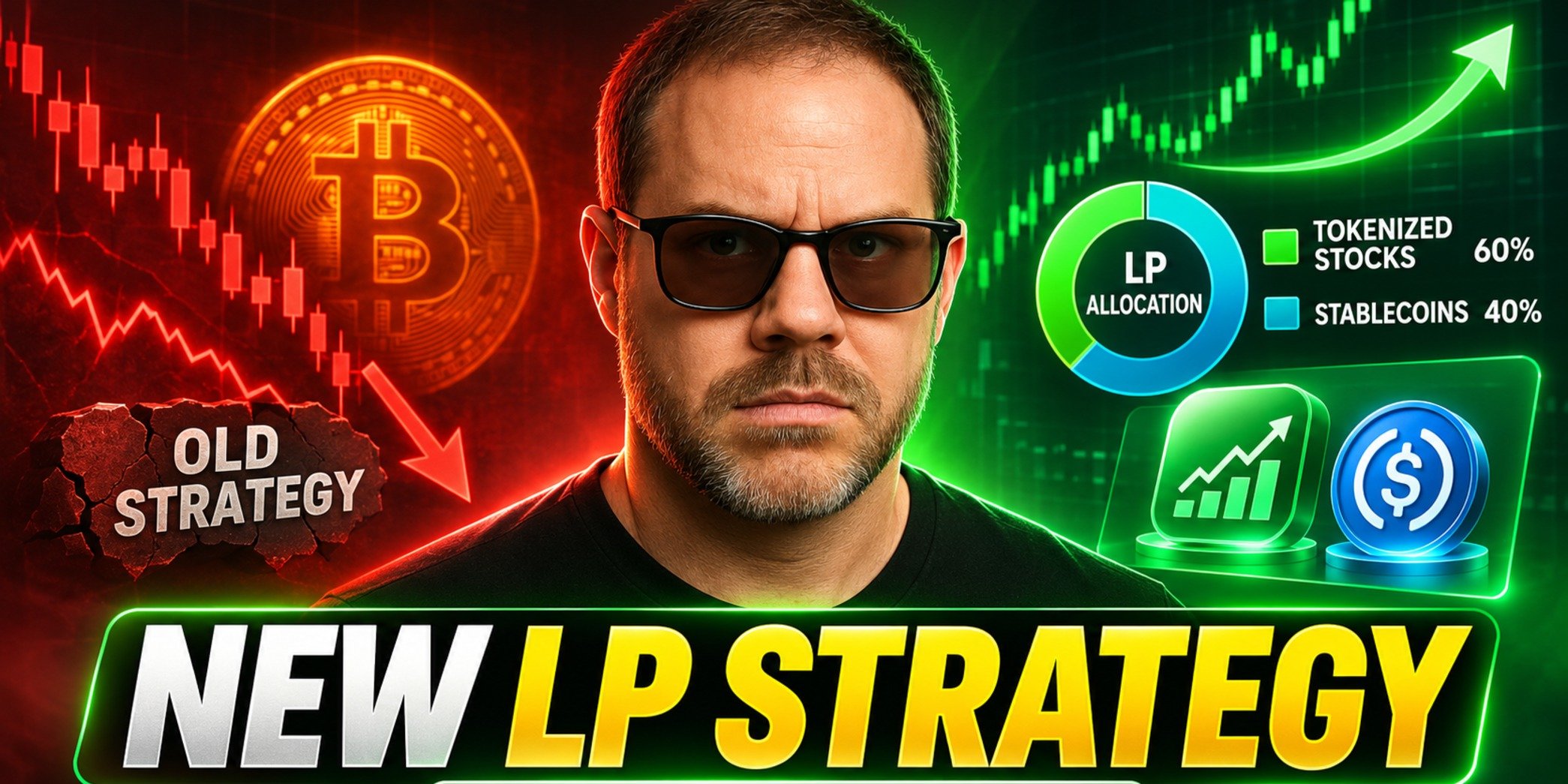
One of the biggest changes I'm making is moving toward a roughly balanced allocation between two different categories of liquidity positions.
This portion of the portfolio is designed around accumulating assets I have longer-term conviction in.
Bitcoin and Ethereum remain central to this strategy, alongside selective altcoins.
The objective is to use liquidity pools where appropriate to generate fees and accumulate additional assets over time.
However, I also recognize that simply holding an asset may be preferable when I want unrestricted directional exposure to a potential rally.
Not everything belongs in a liquidity pool.
The other portion of my portfolio is intended to provide exposure to a different set of underlying assets and trading opportunities.
I'm increasingly interested in liquidity pools involving:
NVIDIA
AMD
Palantir
Amazon
SPY
Other tokenized equities
These positions may generate trading fees that I can subsequently redirect into Bitcoin, Ethereum, stablecoins or other areas of my portfolio.
What interests me most is the ability to connect traditional financial assets with decentralized finance infrastructure.
That doesn't mean these positions are risk-free.
Tokenized equities carry additional considerations involving issuers, counterparties, pricing, liquidity and smart contracts. They can also decline alongside crypto during broader market stress.
My 50/50 framework isn't a proven solution or a rigid rule.
It's a portfolio structure I'm testing.
One of the most important lessons from this entire experience involves understanding what you're actually accumulating inside a concentrated liquidity position.
Imagine you're providing liquidity between Ethereum and a smaller cryptocurrency.
As that smaller cryptocurrency declines relative to Ethereum, the composition of your liquidity position changes.
Eventually, depending on the range and direction of the price movement, you could find yourself holding entirely the underperforming asset.
That might be acceptable if your original intention was to accumulate that particular cryptocurrency.
But what if you only entered the position because it displayed a 500% APR?
Now you're holding an asset you never really wanted to own.
That's a completely different situation.
I've experienced versions of this firsthand throughout the current downturn.
It's also why I've been spending more time researching price ranges, relative asset strength, single-sided deposits and rebalance delays.
The questions I increasingly ask before opening a position are:
Do I have conviction in both underlying assets?
What is generating the trading fees?
Where are we within the historical trading range?
What happens if the correlation breaks down?
Am I comfortable holding either asset?
Would simply holding one of these assets be more appropriate?
How much capital am I willing to expose to this strategy?
Notice that none of these questions begin with the advertised APR.
Yield matters, but it should be evaluated within the context of the entire strategy.
Despite the losses I've experienced, I'm not abandoning MAXFi or concentrated liquidity.
I still find the underlying technology, particularly SnuggleFi's zero-swap rebalancing approach, interesting.
Automation can help reduce some of the friction associated with manually managing liquidity positions and conventional swap-based rebalancing.
But automation isn't a substitute for good investment decisions.
A sophisticated liquidity management system cannot make an undesirable asset fundamentally more valuable.
It cannot prevent every drawdown.
And it cannot eliminate the consequences of poor capital allocation.
That's still my responsibility as an investor.
One recent improvement I particularly appreciated was the introduction of MAXFi's fee collection feature, allowing me to initiate fee collection across multiple positions more conveniently.
When you're managing numerous liquidity positions across multiple ecosystems, improvements like this can make a meaningful difference to your workflow.
I'm looking forward to continuing to document how the ecosystem develops.
🚀 If you're researching automated liquidity management, MAXFi is the platform I personally use for these portfolios.
Explore MAXFi:
https://www.maxfi.tech/deposit?ref=0x1b8021D5fb5fDcc7E1C084c042F7e765EC31a3E0
This is my referral link, and I may receive compensation if you use it. Please understand the strategy and its risks before depositing capital.
Another project I've been working on behind the scenes is improving the way I track my DeFi investments.
I want my portfolio tracker to answer questions that aren't always immediately obvious from individual protocol dashboards.
Metric | Why I'm tracking it |
|---|---|
Lifetime trading fees | Understand cumulative fee generation |
Capital deposited | Establish an accurate investment baseline |
Capital withdrawn | Account for capital removed from the portfolio |
Current position value | Measure remaining exposure |
Net portfolio P&L | Evaluate actual financial performance |
Performance vs. BTC and ETH | Evaluate relative performance |
Underlying token allocation | Understand what I'm actually accumulating |
Range status | Monitor active versus inactive liquidity |
Historical rebalance activity | Evaluate the behavior of my LP strategy |
I'm increasingly convinced that these types of tracking systems should be a fundamental part of actively managing a DeFi portfolio.
Especially when you regularly close positions, reinvest fees, move assets between protocols or add capital.
Without proper records, it's surprisingly easy to convince yourself you're doing better than you actually are.
Or, in some cases, underestimate your performance because you've already withdrawn earnings.
The objective is to get a more complete picture.
Not a prettier number.
I still believe we're moving closer to the next major bullish phase in crypto.
However, I could be early.
I've been early before.
And there's no reason to assume the market cannot move significantly lower from here.
My approach moving forward involves preparing for three possible scenarios.
If the market continues falling: I want available capital and stablecoin reserves so I can evaluate further accumulation opportunities without feeling forced to sell existing positions.
If the market trades sideways: I want appropriately selected liquidity positions to have the opportunity to generate trading fees from ongoing volatility.
If the market begins recovering: I want meaningful exposure to the assets I believe in, including spot holdings that aren't constrained by concentrated liquidity ranges.
I don't need to know which scenario will happen tomorrow.
I need to understand how my portfolio might behave in each of them.
That's a much more productive use of my time than trying to predict the exact bottom.
Over the next several weeks, I'll be monitoring:
Whether my revised allocations demonstrate better relative resilience.
The actual fees generated by tokenized-stock liquidity pools.
How my correlated crypto positions behave during potential market recoveries.
Whether selected fees should be reinvested or retained as stablecoins.
Lifetime portfolio performance after reconciling deposits and withdrawals.
Whether individual positions still justify their allocation.
I want to give this revised strategy at least a couple of weeks before making any meaningful judgments about its effectiveness.
A few good trading days don't prove a strategy works.
Just as a few bad days don't necessarily invalidate an entire investment thesis.
The quality of the process matters more than any individual outcome.
Beyond managing these portfolios, I'm continuing to build DADS DeFi Space into something more than just a YouTube channel.
The website, educational courses, research articles, portfolio tracking systems and community are all part of that bigger picture.
I want people following this journey to understand not just what I'm investing in, but how I'm thinking through these decisions.
The mistakes.
The research.
The changes in conviction.
The experiments that work.
And the experiments that don't.
That's what The Operator's Journal is about.
I'm not claiming to have perfected DeFi investing. I'm documenting the process of becoming better at it.
And hopefully, some of the lessons I learn along the way help other people avoid making the same mistakes.
I've recorded a full walkthrough of both my MAXFi portfolios, including the actual dashboards, individual liquidity positions, Bitcoin and Ethereum market analysis, my portfolio trackers and the strategy changes discussed in this journal.
MAXFi Portfolio Review: Real Results, Losses & My New Strategy
I'm curious what everyone else is doing during this market downturn.
Are you accumulating through spot purchases?
Are you continuing to farm liquidity pools?
Are you increasing your stablecoin exposure?
Or are you exploring tokenized equities and other real-world assets?
I share more frequent portfolio adjustments, market observations and research inside our free Telegram community.
📢 Join the DADS DeFi Space community:
https://t.me/DADSDefiSpace
Explore my free crypto and DeFi educational course:
https://www.dadsdefispace.org/challenges
🌐 Research, articles and educational resources:
https://www.dadsdefispace.org
Until next time, keep learning, stay curious, and respect the risk.
Process over prediction.
Survive first. Compound second.
Peace! ✌
— Kevin
Founder, DADS DeFi Space
Disclaimer: This journal is for educational and informational purposes only and is not financial advice. It documents my personal investments, opinions, research and portfolio experiments. Cryptocurrency, DeFi, tokenized assets and concentrated liquidity involve significant risks, including the potential loss of your entire investment. Portfolio figures are historical snapshots and preliminary personal calculations that have not been independently audited. Displayed yields are variable and do not guarantee future performance. I personally hold assets discussed in this article and use MAXFi. Some links are affiliate or referral links from which I may receive compensation.