
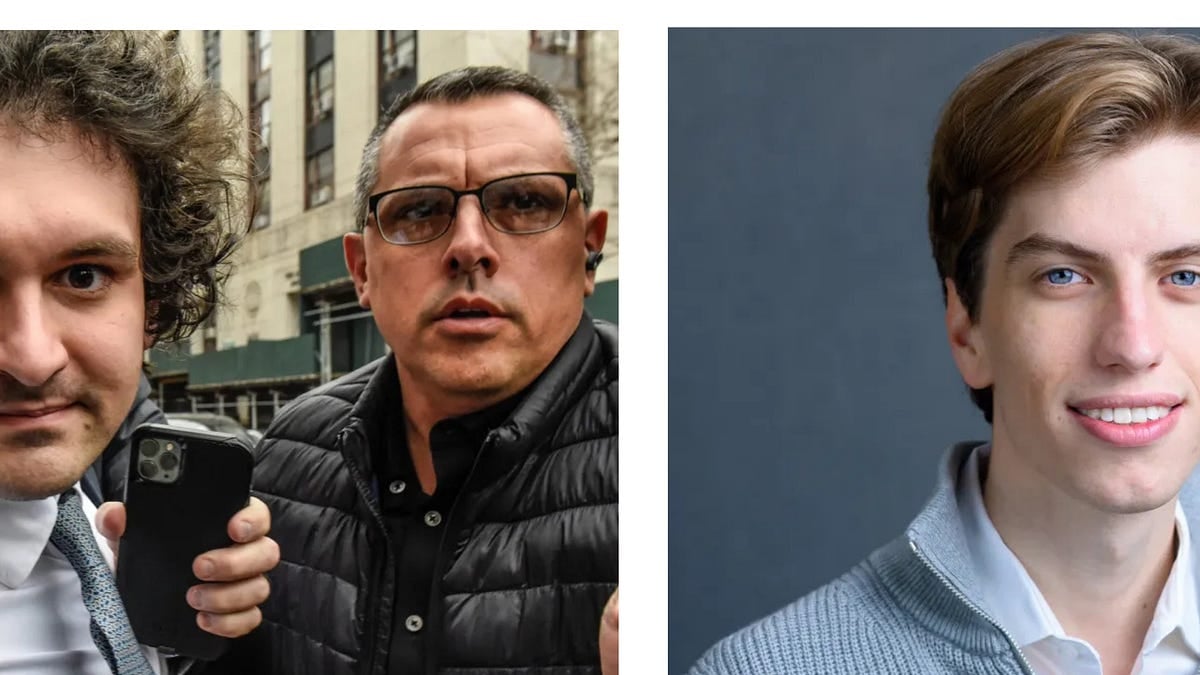
Welcome to Dark Markets, your weekly round-up of the crimes and shenanigans of Effective Altruists, Rationalists, Eugenicists, Singularitarians, and other Silicon Valley moonbats. I’m David Z. Morris, longtime fraud investigator and author of Stealing the Future, a book about the fraud endemic to utilitarian longtermism.
Subscribe
An infamous Effective Altruist thought experiment is “the coin flip to end the world.” Sam Bankman-Fried interpreted this as an injunction to take catastrophic risk if the average “expected value” of winning a long bet was even slightly positive.
That high-risk mindset also seems to have ruled at Situational Awareness, a huge, AI-focused hedge fund that exploded in blood and guts last week. It was run by a deeply involved Effective Altruist named Leo Aschenbrenner.
Aschenbrenner’s downfall very closely tracks that of Sam Bankman-Fried. Specifically in that they were both young, loved using very high leverage in volatile markets, believed trend-lines only go up, and apparently thought risk management is for cowards.
Aschenbrenner is different from SBF in that he seems genuinely smart and hard-working. He graduated from Columbia at 19, and started his fund two years ago after writing a bullish post on AI. Aschenbrenner started the Effective Altruism club at Columbia, seemingly in the late 2020s. He is now married to a high-ranking Anthropic staffer, and the best-performing portion of the remaining SA portfolio was apparently Anthropic equity. It is what allowed Aschenbrenner to say the fund remains up 80% for the year. That was also one of Bankman-Fried’s best bets.
But Aschenbrenner still got caught by the exact same ratchet that killed SBF.
Situational Awareness LP grew incredibly fast after 2024, to a peak of $45 billion in AUM, by using high leverage to bet on the continued rapid growth of AI. Aschenbrenner had kept making the same bet for years, at larger and larger size, to the point where his leverage may have been propelling the broader market.
Then July was choppy for AI stocks - incredibly, even $Nvidia was flat - and that was all it took to destroy Situational Awareness.
For the remainder of August, readers accumulating three referrals will be entered into a drawing for a (physical) copy of Hayek’s Bastards: Race, Gold, IQ, and the Capitalism of the Far Right, an invaluable dive into the hidden psychology of hard money and free markets. I’ll have a review soon.
Every time you click the “Share” or “Refer a Friend” buttons in a post, and every time you restack a post, Substack tracks your sharing. If that sharing results in a subscription, you get one of your three referral credits.
As an added bonus, you also still only need to refer two free subscribers to get a month of free premium access.
(Paying premium supporters at the end of the month will get one drawing entry by default, and two additional entries per referral reward.)
Subscribe
That he was taken out by even a slight pause in the upward trend is why the Expected Value/high-risk framework taught by EA is wrong. Aschenbrenner still seems to have been directionally correct - AI, like it or not, is growing, and that growth seems likely to continue.
But the linear, predictionist modelling that rules EA is rooted in, alongside the idea that its adherents are uniquely genetically gifted, lead believers to take on extreme risk and, inevitably, to blowups like Aschenbrenner’s.

·
Feb 3
To save himself from total liquidation, Aschenbrenner sold all of his public equities to Ken Griffin’s Citadel, and from a peak of $45B would seem to now manage a still-respectable $10 billion. In a letter to investors, Aschenbrenner seemed upbeat, focused on having survived to fight another day.
But this is very, very bad for investors in Aschenbrenner’s fund - way worse than Aschenbrenner’s letter made it sound. In many scenarios, for instance if you invested in SA in June of this year, you may have lost more than 100% of your investment thanks to tax obligations.
And it’s actually worse than that. Immediately after Aschenbrenner was washed out (and likely because that washout reduced risk in the overall market), AI and related stocks rallied. Just days later, Citadel is up 6% on the discounted purchase.
So arguably Aschenbrenner’s unluckiest investors lost something like 110% of the current mark-to-market value of their assets.
That means Leo Aschenbrenner was far, far worse for many investors than Sam Bankman-Fried was for FTX depositors.
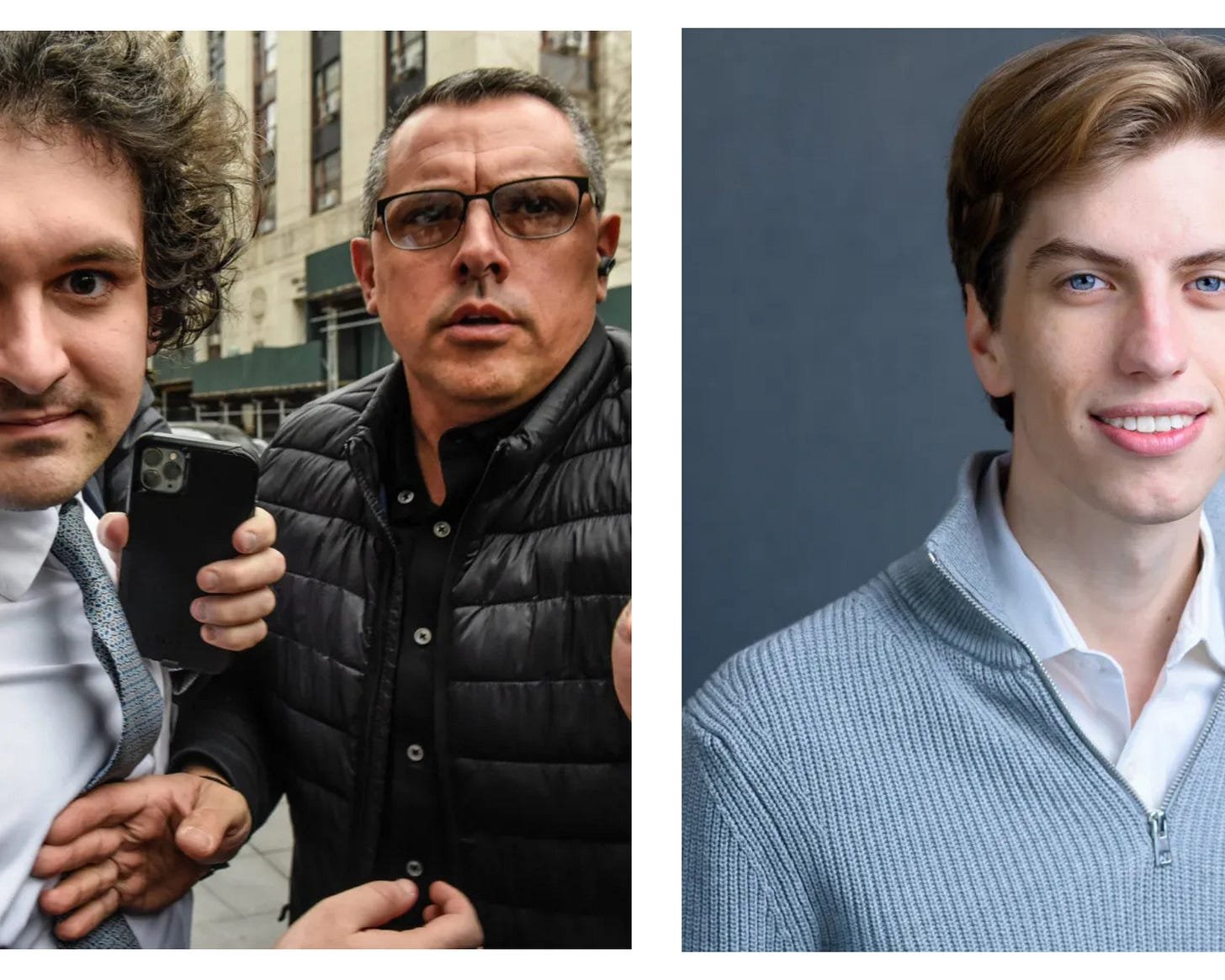
FTX depositor funds eventually largely came back (even if never to the actual value of the assets at time of loss - see below). But if a hedge fund blows up, there’s no recourse. Aschenbrenner faces no obvious personal liability, though there are rumors and complaints. You payed him to gamble with your money and that’s what he did.
Obviously SBF should have stuck to running a hedge fund, where he could have continued to be great at losing money for decades.

·
February 10, 2025
Aschenbrenner exemplifies the fact that Effective Altruism is less a philosophical movement than a network to facilitate corruption.
Before he nuked $45 billion of customer money by getting margin called on a highly-leveraged one-way bet on uninterrupted, immediate, and profitable technological progress, Aschenbrenner worked for the FTX Future Fund, an institution that was born, lived, and died in graft.
I’ve recently joined Austin Campbell at Zero Knowledge Group, where we’re hard at work building a source for hard-core analysis of finance and technology. Dark Markets will continue to be home for my work on the philosophical underpinnings of Silicon Valley’s ideological grift, and for early views of my major documentary and book projects.
But the free Zero In Newsletter will be the new gateway to my big-picture finance work. We have already made numerous critical calls - including predicting the troubles of both Strategy and the SpaceX IPO - with a bit more rigor and a bit less vitriol (but still plenty of vitriol).
(Hot tip: These are all based on long-form deep dives. For now, these are also free on the Zero Knowledge Blog.)
Are “Open Weights” the Path to a Freer AI Economy?
Whether you’re a finance professional or just interested in getting deeper into the mechanics of Wall Street, please subscribe here.
The Future Fund was the “longtermist” arm of the FTX philanthropic arm, and like all of EA’s implictly eugenicist utilitarian projects, it ultimately came to serve the interests of the self-declared geniuses who created and ran it. As I describe in Stealing the Future, Oxford professor Will MacAskill used his role at the Future Fund to direct money to charities he controlled directly.
There’s another interesting connection between Aschenbrenner and MacAskill. MacAskill took his name from ex-wife Amanda Askell, an alignment researcher at Anthropic. Aschenbrenner, the very weekend after his fund blew up, married Avital Balwit, currently Chief of Staff to Anthropic CEO Dario Amodei.
This raises many questions, particularly because the largest remaining asset in Situational Awareness LP portfolio is reportedly a large stake of illiquid Anthropic equity. Anthropic hasn’t gone public yet, which is why Aschenbrenner wasn’t able to lever it up the way everything else in his portfolio. The current understanding is that Aschenbrenner’s claim to still be up 80% for 2026 are based largely on that illiquid Anthropic stake. So it’s purely an accident that he’s not completely wiped out.
Aschenbrenner’s deep influence by EA can be seen in the gormless hyperbole on which his brief and meteoric ascent was based. Behold, the first paragraph of “Situational Awareness,” the 2024 essay that became the foundation for his fundraising.
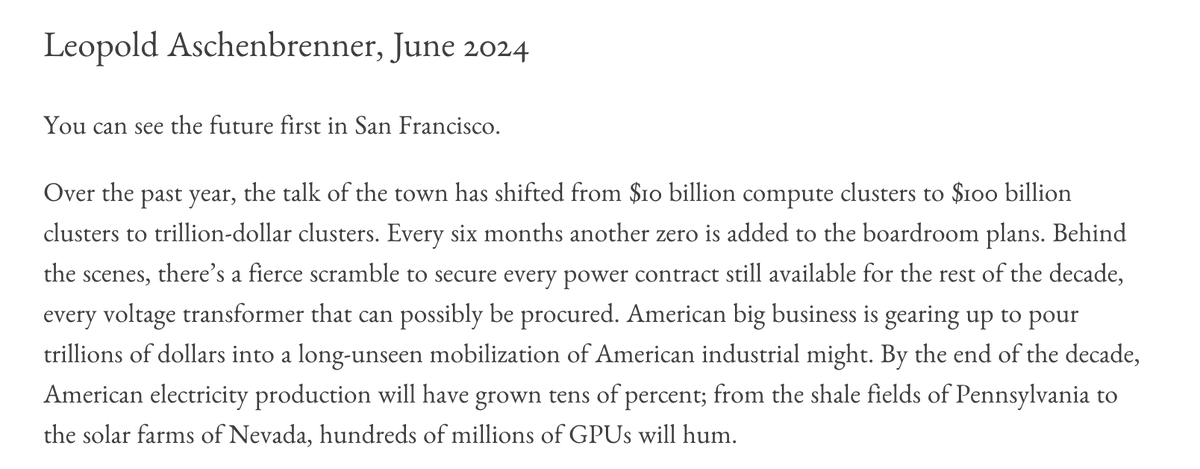
“From $10 billion compute clusters to $100 billion clusters … a fierce scramble to secure every power contract still available for the rest of the decade.”
It’s actually quite staggering. The premise of the essay is that Aschenbrenner was diagnosing some dramatic societal or technological shift, but his opening evidence is all financial. Just as I wrote about SBF’s enslavement to the numbers on his trading view, Aschenbrenner’s view of reality was shaped by financial indexes of it as much as any deeper understanding of society or technology.
This endemic blindness has already destroyed the Effective Altruism brand - a task Aschenbrenner has now put a bow on with his meltdown.
The same addiction to one-dimensional leveraged risk is also the key weakness shadowing AI investment more broadly. The blowups are far from over.
Dark Markets is a reader-supported publication. To receive new posts and support my work, consider becoming a free or paid subscriber.
Subscribe