

My previous career was as a teacher. After graduating from an education faculty, I taught geography, history, and civics at a school. I aspired to become a teacher during high school, influenced by the teachers who supported me when I felt like I was nobody. I wanted to become that kind of teacher myself, and since I naturally have a nurturing personality, it was a perfect fit. However, after six years as a teacher, I made a major career change and now lead the Incubation business at Fracton Ventures. While I call this a bold career shift, the truth is that both teaching and incubation involve guiding others toward their next optimal step. Despite the critical importance of this role, there's a problem: there are virtually no incubators. Through this article, I'll explain why incubators are such a vital approach, why they're needed in today's ecosystem, and how Fracton Ventures will succeed in the future.
* By Kazuya(vinyl), Incubation Lead at Fracton Ventures
[ Table of Contents ]
Introduction
Chapter 1: Why Fracton Ventures Remains an Incubator
About Fracton Ventures
What is an Incubator?
Hackathon → Incubation → Acceleration
Why can't hackathon organizers fully support winners?
What's the Difference Between Incubators and Accelerators?
Why are incubators more valuable than pre-seed investors?
The Uniqueness of Fracton Incubation's Approach
The Importance of the Founder Community
Chapter 2: Incubators from the Perspective of the Ethereum Ecosystem
The Ethereum Ecosystem
The Importance of Regional Presence
The Global Network via Ethreactor
Chapter 3: Distortions in the Asian (Japanese) Market and Solutions
The Asian Ecosystem
Current Status of Japan-Origin Projects
Solutions to the Distortions
Conclusion
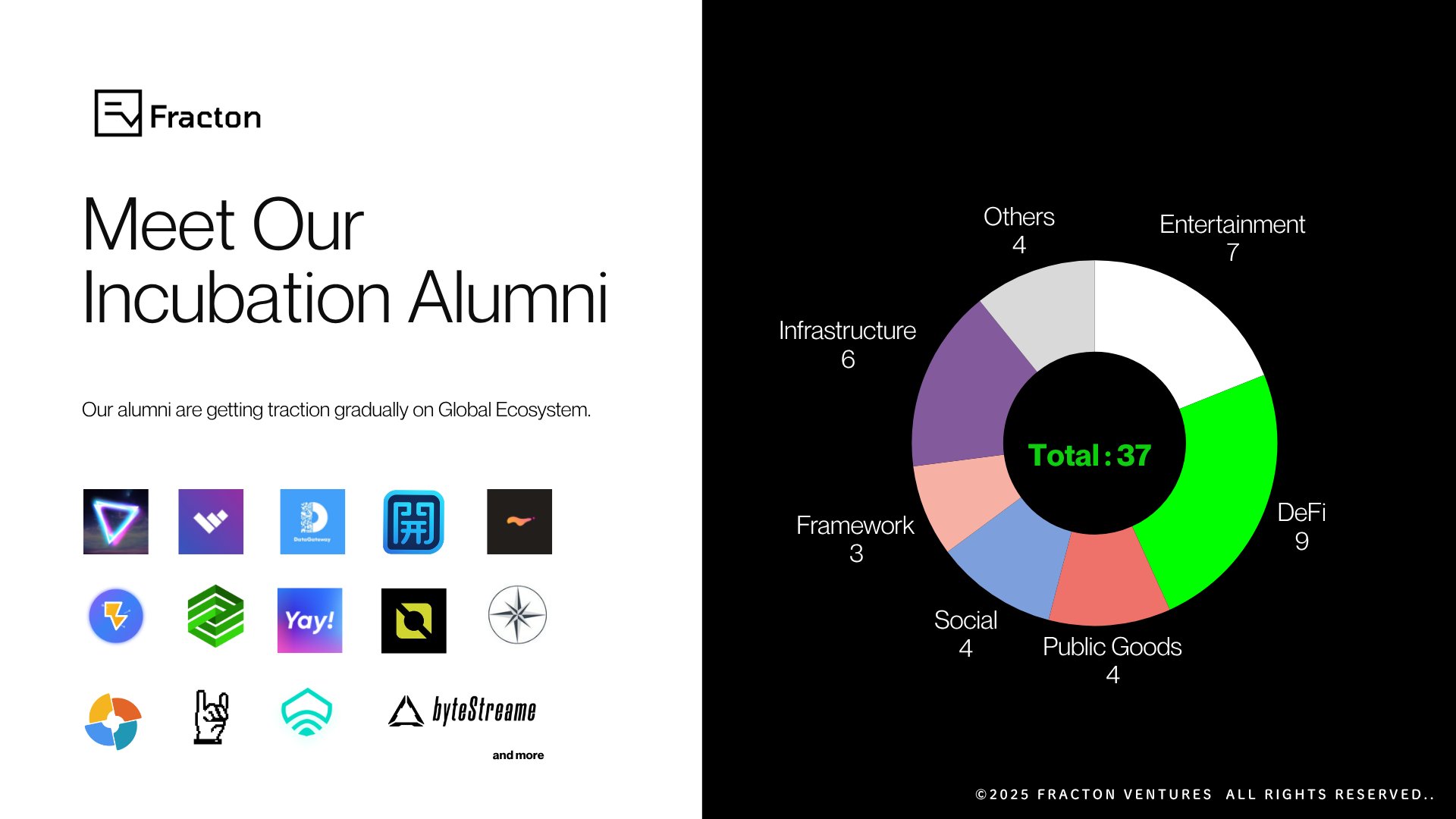
Since its founding in 2021, Fracton Ventures has consistently run an Incubation Program. We have incubated over 40 teams to date, with a new Cohort starting next month. Cohorts 1 and 2 were general incubation programs without specific themes. Starting with Cohort 3, we focused on the Ethereum Ecosystem, setting distinct themes for each Cohort.
While our initial mission was to guide Japan-born protocols globally, we now select teams globally without restricting to Japan-born projects. Since Cohort 4, the ratio of domestic to international teams has reversed, with domestic applications now under 30%.
In the vast world of Crypto/Web3, incubators are few and far between. Within the global ecosystem, prominent players like a16z Crypto, (CSX) Outlier Ventures, and OrangeDAO exist, but they hold VC funds and conduct incubation for investment purposes. Incubators like ours, which do not bundle investment, are rare. Furthermore, incubators' contributions are generally undervalued in the market. This is because many people misunderstand the incubator's role and fail to grasp the value they bring to the supported protocols/projects. Here, we explain the primary tasks and roles of an incubator. The main role of an incubator is to support protocols/projects from the very earliest stages, often at the seed or idea phase.
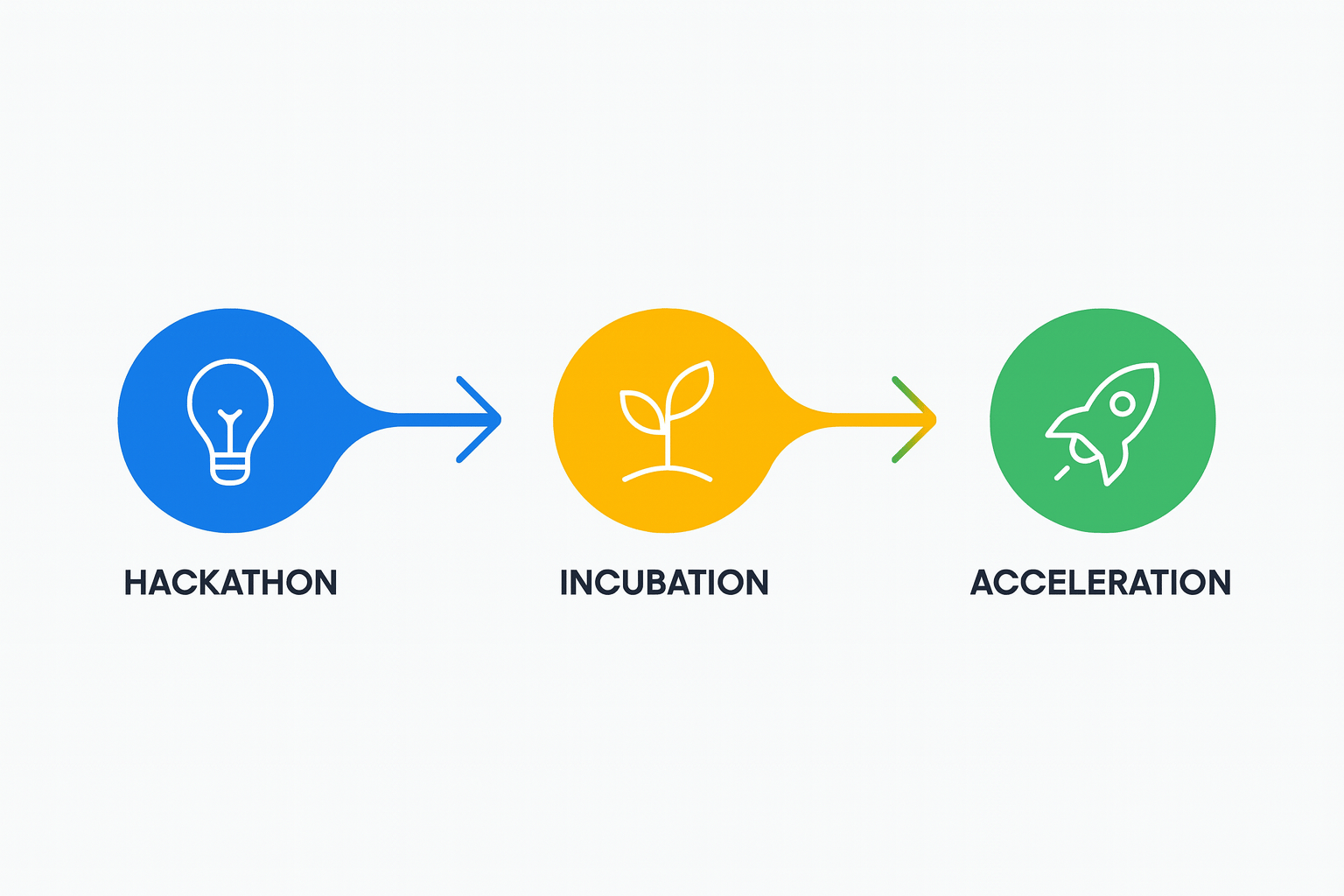
The support process for early-stage projects within the crypto ecosystem can be divided into three distinct phases: “Hackathon,” “Incubation,” and “Acceleration.” Since each phase requires different roles, protocols progressing through this process typically engage with three distinct types of organizations. Here, we'll explain the roles of the other two types besides the Incubator.
Hackathons are among the most recognized crypto events, held frequently worldwide. They serve as crucial venues for entrepreneurs (Builders) to validate initial ideas, form teams, and secure early prize money (grants). However, Hackathons are fundamentally just opportunities funded by sponsors. Hackathon providers typically have no ongoing involvement with the future activities of the winners.
Acceleration is, as the name suggests, the phase where the Protocol/Project is accelerated towards PMF (Product-Market Fit), and the Accelerator fulfills this role. Protocols/Projects that have typically completed fundraising in rounds like Pre-Seed or Angel join an Accelerator. It primarily provides the support needed for growth, such as fundraising assistance, finding partners for PMF, and acquiring users.
To clarify the Incubator's position, we focus on the following two points:
Why can't Hackathon organizers fully support winners?
What is the difference between an Incubator and an Accelerator?
The role of a hackathon organizer is to gather sponsors and host the hackathon. Sponsors fund the hackathon to generate new protocols/projects that will use their protocol, SDK, or API. Therefore, the ultimate goal for the hackathon organizer is to connect the hackathon winners with the most suitable sponsors. Once connected, sponsors guide the hackathon winners (award recipients) to commit to their ecosystem. While this is the ideal path, recent hackathons often see this route failing to function effectively, with issues like sponsors dropping the ball or failing to provide proper support frequently observed. Rebuilding this path is one of the key roles of an Incubator.
Incubators support entrepreneurs who are still unknown, while Accelerators support entrepreneurs who have already received validation, such as from VCs. Incubators support at the earliest stage, which carries risk, but in return, they help by discussing ideas and supporting pivots. Essentially, the difference lies in the core evaluation criteria: Incubators primarily evaluate the Builder, while Accelerators primarily evaluate the Product.
When you hear about supporting early-stage projects, you might think (pre)seed investors do the same, but their focus differs. Incubators engage directly with the entrepreneurs (the builders), while investors typically engage with their LPs. An investor's job is to grow the money entrusted by their LPs, and they support protocols/projects to achieve that growth. In other words, their ultimate goal is to grow capital, and supporting entrepreneurs is a “means” to that end. Incubators, however, consistently focus on the entrepreneurs themselves. An incubator's ultimate goal is to help entrepreneurs succeed, aligning directly with the entrepreneur's own goal. This means incubators aren't constrained by capital concerns and can flexibly provide greater value. The most unique aspect of this is their tolerance for pivoting. They may pivot ideas deemed unfit for the market or even hit the brakes on products already in development. Incubators are invaluable entities that can view entrepreneurs from a step back.
※Of course, many VC firms are also entrepreneur-first, taking risks similar to incubators while supporting founders.
Having explained general incubators thus far, let's now detail the Fracton Incubation approach implemented by Fracton Ventures. As mentioned earlier, we do not hold investment capital and operate as an independent incubator. Therefore, while we cannot invest in the entrepreneurs (teams) selected for our program, we can build relationships that don't rely on money. Instead, we receive 1% of the total future token supply from the selected team as compensation for program participation. This 1% comes from either the advisor allocation or the team allocation and carries the strictest lock-up and vesting conditions. We believe these conditions should be as long as possible to ensure we walk alongside them as stakeholders.
The program offered at the time of selection lasts three months, but this program is merely the first step. It's been four years since we first ran the program, and we still frequently consult with and support graduates from Cohort 1. Now, let's introduce our approach within the program.
Mentoring Provision
Refine ideas through regular mentoring sessions with the Fracton team
Opportunities to receive mentoring from invited external mentors
Lectures and Workshops
Structured lectures
AMA-style communication opportunities with industry pioneers
Network Provision
Founders Community
Partners, Advisors
Fundraising Support
While Fracton members regularly mentor selected teams, we also provide opportunities to receive direct feedback from partners and pioneers. Since gathering diverse feedback is crucial in the early stages, we introduce optimal partners. The partners we connect you with are either former entrepreneurs themselves or have a strong entrepreneur-first mindset, so they share real-world experiences, including the hard things they've faced. We are truly grateful to the mentors who always support us.
As mentioned earlier, we provide ongoing support after the program ends. Another core value is inviting you to join the “Founder Community.” While the program allows you to build horizontal relationships with peers selected in the same cohort, joining the Founder Community enables you to build vertical relationships too. You can observe the backs of seniors who are slightly ahead in their phase up close and gain valuable insights. You can also exchange the same founder's worries and alpha information that can only be shared in closed settings. By providing a place to consult on things that can't be discussed openly, like information on suspicious operators or exchange listing fees, we also support founders' mental well-being. Beyond exchanging alpha information, it's also possible to mutually connect each other's high-quality networks, building an ecosystem. We refer to this ecosystem as the “Fracton Community,” and indeed, the majority of builders in Japan's crypto scene are involved in it.
Furthermore, Fracton occasionally provides exclusive V opportunities to this Community. For example, last summer we hosted a VIP lunch with Monad's founders, which became the catalyst for LootGo joining the Monad ecosystem. (Of course, LootGo's presence in the Monad ecosystem is entirely due to their own efforts; we merely provided the initial opportunity.)
Thankfully, we've seen an increase in requests from many protocols/projects visiting Japan asking us to introduce them to talented Japanese founders. This is especially true in the L1/L2 space, where strategies to secure top founders have become increasingly prominent. Fracton is proud to play a bridging role for this ecosystem in Japan.
Many are aware of the recent major organizational changes at the Ethereum Foundation. These changes represent significant transformation not only superficially but also internally. It has shifted from a structure focused solely on protocol research to establishing teams dedicated to supporting protocols and founders within the ecosystem, prioritizing engagement with the ecosystem itself. Teams that were standard features in other L1/L2 ecosystems have only now been established here. Because Ethereum is accessible to anyone and universally applicable, it faces challenges in achieving sharp growth in specific domains or fostering killer use cases. This is evident in Solana capturing some DeFi use cases (including meme coins) and Avalanche gaining significant support from financial institutions. While the Founder Success Team's launch may make the ecosystem more friendly than before, the Ethereum Foundation fundamentally has no need for such top-down decision-making.
Therefore, the essential approach for the ecosystem—both past and future—is bottom-up use case creation originating from the Regional level. If Ethereum's ultimate destination is to become a digital public good used by billions of people, it must adapt more to end-users (Regional). Frankly, from this perspective alone, it remains immature, with significant potential still untapped. This is precisely why we selected “ConsumerDeFi” and “Culture&Fun” as themes for both the previous and current Fracton Incubation programs.
So, how do we generate and support Protocols/Projects from the Regional level?
Current global approaches, like ETHGlobal's worldwide hackathons or Protocol-hosted Incubation/Acceleration programs, have limitations. The sheer volume becomes overwhelming, leaving many projects hanging in limbo. Our Regional Incubator can support these hidden gems. Furthermore, in the phase just before Incubation, community-driven approaches like the ETHTokyo hackathon are being implemented worldwide. And now, what the ecosystem truly needs is Incubation carried out at the Regional level.
※Readers of this article will understand, but “ETHGlobal Tokyo” is a hackathon hosted by the company ETHGlobal, while “ETHTokyo” is a hackathon hosted by the regional community.
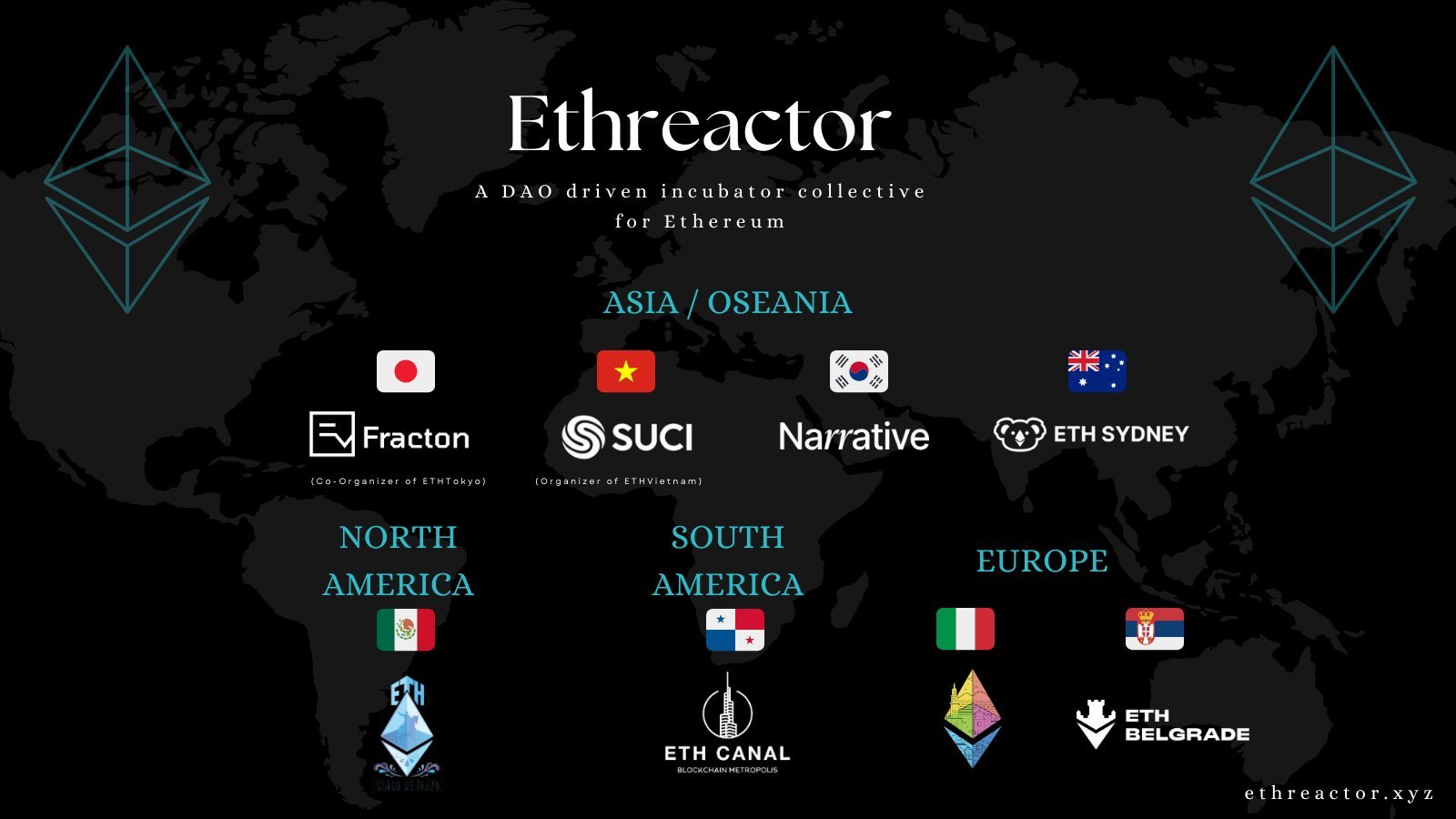
To address the challenges above, Fracton Ventures announced the launch of Ethreactor. As the first step, we will transform Fracton's incubation expertise and knowledge into shared wisdom within Ethreactor, establishing a framework to enable regional incubation worldwide. Overseas teams currently applying to Fracton Incubation are starved for incubators. This is particularly evident in India and Nigeria. Their immense passion comes through in just a 30-minute interview. It is an immense honor for Fracton to support them, and it also underscores the critical need for Regional Incubators. The next step after establishing Regional Incubators is building a global network through their interconnection. Ethereactor will function as a framework to support Protocols/Projects born bottom-up from these regions globally and borderlessly.
In the global market, “Asian entrepreneurs and Protocols” are undervalued. It's true that the current crypto hubs are NYC or San Francisco, and much innovation originates there. However, it's also true that outstanding Protocols are emerging from Asia, with the key challenge being an incomplete ecosystem. Take India, for example. If Polygon (Matic) represents the first generation, then second-generation protocols like Push Protocol and Biconomy were created by Indian entrepreneurs. Currently, an ecosystem is circulating to foster the emergence of a third generation. Specifically, the elements necessary for this ecosystem circulation are the presence of pioneers, players like crypto VCs, angel investments from previous generations, and a support system for entrepreneurs. Unfortunately, Japan is still in the phase where second-generation projects (Napier Finance, Yay!, Sunrise, Hana Network, Phi, etc.) are emerging, meaning the Japanese ecosystem itself is still in its incubation phase.
Recently, especially within Japan, it's deeply regrettable that teams led by Japanese founders are often labeled as “scams.” It's easy to criticize without knowing the efforts and track record of entrepreneurs and builders, focusing solely on token prices. Japan's Web3 market (not Crypto) has become such a rotten ecosystem, where end-users are only interested in getting airdrops (money) and nothing else. While this is not necessarily a wrong stance for investors (speculators), there should be more respect for entrepreneurs and builders. We aspire to be an Incubator that helps not only Japanese founders, but founders in general, grow into respected entities. Innovation is driven not by the Incubator, but by the entrepreneur.
I believe “education” is key to improving this distorted market. Broadly defined, education can be considered part of Incubation. As mentioned earlier, “Japan's ecosystem itself is in the incubation phase,” and the same holds true for the Asian market. To resolve this distortion, proper education for end-users and future aspiring entrepreneurs is crucial, and we must break free from the culture of nitpicking and sabotaging each other. We've had enough of superficial, trend-chasing projects. It's time to recognize the essence and true value of Protocols/Projects. Make Ethereum Great Again.
While writing this article, I reflected on and evaluated Fracton Ventures myself. Fracton Ventures is unique and yet the strongest. I've been asked countless times about our business model (how we make money), but we will prove that continuously acquiring 1% of tokens is the optimal solution for a Crypto Incubator's business model. I hope to meet players who will properly evaluate not only the projects Fracton supports, but Fracton itself.
[Official Links]